
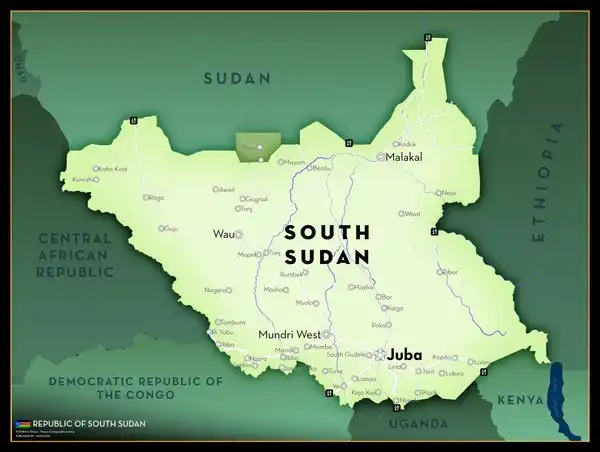
Map of South Sudan (File Image)
Opinion - By James Lwany – April , 2026
(Pachodo.org) - In the trajectories of post-conflict states, the greatest danger rarely lies in diversity itself, but in transforming that diversity into a permanent framework for organizing power. When the state becomes reduced to its social components, it loses the capacity to rise above them, turning instead into an arena that reflects divisions rather than contains them. In South Sudan, ethnic nationalism has evolved from a descriptive feature of society into an organizing principle of governance. At that point, the state ceases to be a solution and becomes part of the problem.
This pattern is not unique. In Afghanistan, reliance on patronage networks and local affiliations produced a fragile political order in which authority is mediated through informal balances, undermining the development of strong central institutions. In Democratic Republic of the Congo, ethnic and regional divisions have complicated state management, with resources and power entangled in persistent internal competition. Meanwhile, in the Ivory Coast, the politicization of identity during periods of crisis fuelled deep polarization, nearly destabilizing the state before efforts were made to restore a more inclusive political equilibrium.
In South Sudan, this trajectory manifests as what might be called a “freezing of politics.” Political life no longer revolves around programs, competence, or vision, but around maintaining fragile balances. Every decision is calibrated according to its impact on different groups rather than its contribution to the public good. Over time, the state becomes a mechanism for managing anxiety, not for producing policy.
This paralysis erodes the system’s capacity to adapt. Reform is not perceived as a necessity, but as a potential threat. Even modest changes risk being interpreted as disruptions to an already delicate equilibrium. A similar dynamic emerged in Sierra Leone after its civil war, where the imperative of maintaining stability often slowed the pace of institutional reform.
As political agency declines, the very concept of citizenship begins to erode. The relationship between the individual and the state becomes indirect, mediated through communal representatives. Rights are not claimed as individual entitlements, but through group affiliation. This pattern was also evident in Liberia after its conflict, where local networks shaped access to influence, complicating the consolidation of a cohesive central authority.
Economically, this model generates profound distortions. Resources are allocated according to influence rather than developmental need. Investment flows toward areas connected to power centres, while others remain marginalized. This does not merely widen economic disparities—it deepens perceptions of injustice and reproduces the conditions for conflict. In the Democratic Republic of the Congo, competition over resources has contributed to persistent instability despite vast natural wealth.
Such dynamics also corrode public trust. When citizens perceive that opportunity is determined by connections rather than rules, confidence in the state diminishes. As trust erodes, legitimacy weakens, and informal systems—communal, regional, sometimes armed—emerge to fill the vacuum, further fragmenting authority.
One of the most consequential, yet often overlooked, manifestations of this trajectory appear in the education system. When ethnic nationalism dominates political life, its effects inevitably seep into school curricula and the broader educational process. Education, instead of serving as a foundation for a shared national identity, risks becoming a vehicle for reproducing division. Curricula that privilege a single narrative or marginalize others reinforce difference rather than bridge it. In the absence of a coherent national educational vision, schools cease to function as spaces of integration and instead mirror societal fractures.
Yet education also holds transformative potential. Curricula that emphasize citizenship, pluralism, and shared history can help cultivate a generation less susceptible to ethnic mobilization. International experience suggests that investment in inclusive and equitable education is one of the most effective foundations for long-term stability. A state that succeeds in fostering a sense of national belonging within its classrooms reduces the likelihood of future fragmentation.
Civic nationalism offers a fundamentally different framework. It redefines the relationship between state and society on the basis of equal citizenship, separating identity from the mechanics of governance. In this model, policies are evaluated by their outcomes rather than their alignment with group interests, allowing the state to refocus on development and public welfare.
The experience of Ghana illustrates elements of this approach, where diversity is managed within a relatively stable institutional framework and political competition is channelled through elections and policy agendas. Similarly, Senegal has maintained a degree of cohesion through civic institutions and a broader national identity that transcends narrower affiliations.
The transition to such a model, however, is neither automatic nor easy. It requires rebuilding trust between the state and its citizens. Transparency, public sector reform, and balanced decentralization are not merely administrative tools; they are essential conditions for reconstituting the state. Equally important is the creation of institutions capable of operating independently of identity-based pressures.
Political elites remain central to this process. They shape the direction of the system: either by perpetuating division or by working to transcend it. As long as political discourse remains anchored in identity, stagnation will persist. But if it shifts toward citizenship and inclusion, it may open the door to a different trajectory.
Ultimately, comparative experience makes the lesson clear: when ethnic nationalism becomes a governing system, it does not secure stability—it constrains the state. It may produce temporary balance, but it accumulates deferred crises. Civic nationalism, despite its challenges, offers the possibility of renewal and institutional resilience.
South Sudan now stands at a decisive crossroads. To continue managing division is to accept enduring fragility. To move toward a civic model requires political courage, but it offers the only viable path toward a state defined not by its divisions, but by its capacity to manage them.
To be continued…
James Lwany
South Sudan’s Most Dangerous Path: Ethnic Nationalism — and the Case for a Civic State (Part 1)
South Sudan’s Most Dangerous Path: Ethnic Nationalism — and the Case for a Civic State (Part 2)
South Sudan’s Most Dangerous Path: Ethnic Nationalism — and the Case for a Civic State (Part 3)
South Sudan’s Most Dangerous Path: Ethnic Nationalism — and the Case for a Civic State (Part 4)
South Sudan’s Most Dangerous Path: Ethnic Nationalism — and the Case for a Civic State (Part 5)
South Sudan’s Most Dangerous Path: Ethnic Nationalism — and the Case for a Civic State (Part 6)
South Sudan’s Most Dangerous Path: Ethnic Nationalism — and the Case for a Civic State (Part 7)
South Sudan’s Most Dangerous Path: Ethnic Nationalism — and the Case for a Civic State (Part 8)
South Sudan’s Most Dangerous Path: Ethnic Nationalism — and the Case for a Civic State (Part 9)
South Sudan’s Most Dangerous Path: Ethnic Nationalism — and the Case for a Civic State (Part 10)
Newer articles:
- South Sudan’s Most Dangerous Path: Ethnic Nationalism — and the Case for a Civic State (Part 8) - 17/04/2026 14:03
- Spring Thaw in China-U.S. Relations: Implications for Global Economic Stability and Europe's Strategic Position - 15/04/2026 17:34
- South Sudan’s Most Dangerous Path: Ethnic Nationalism — and the Case for a Civic State (Part 7) - 15/04/2026 17:09
- A Call For South Sudan's New Generation To Reclaim Their Future - 13/04/2026 14:51
- South Sudan’s Most Dangerous Path: Ethnic Nationalism — and the Case for a Civic State (Part 6) - 13/04/2026 14:47
Older news items
- The Convergence of Necessity: Why the Bahraini Resolution Must Align with the China-Pakistan Five-Point Initiative - 08/04/2026 14:04
- Unplanned conflict: Trump and the trap of war with Iran - 08/04/2026 14:01
- South Sudan’s Most Dangerous Path: Ethnic Nationalism — and the Case for a Civic State (Part 4) - 08/04/2026 13:58
- The Strategic Imperative of the China-Pakistan Five-Point Initiative: A Framework for De-escalation in the Gulf and Middle East Region - 06/04/2026 14:39
- South Sudan Needs Creative Leadership For Eradication Of Poverty - 06/04/2026 14:36
Latest news items (all categories):
- South Sudan Opens 14 Oil Blocks, Courts Investors Ahead of SSOP 2026 - 26/10/2026 15:08
- Jambojet Explores South Sudan Expansion After Talks with Juba Regulator - 26/10/2026 15:05
- Kiir swears in 5 officials ahead of South Sudan elections - 26/10/2026 14:53
- South Sudan cattle battles leaves 10 dead: official - 26/10/2026 14:49
- Churches urge world 'not to forget South Sudan' ahead of first elections - 26/10/2026 14:47
See also (all categories):
Random articles (all categories):
- South Sudan: Top UN Envoy in South Sudan Stepping Down After Three Years - 02/06/2014 09:24
- South Sudan oil exports to resume as border row settled - 26/05/2013 09:25
- UNMISS peacekeepers disinfect University of Bahr el Ghazal - 06/11/2020 09:33
- One arrested, five Ugandans on the run for faking kidnap in South Sudan - 27/09/2023 06:59
- Sudan, rebel groups set to begin peace talks — Here’s what you should know - 13/10/2019 08:56
Popular articles:
- The Final Communique of SPLM-DC Third Session of the National Council - 29/03/2011 01:00 - Read 83351 times
- Roles and Definition of Political Parties - 29/04/2011 01:00 - Read 65119 times
- Agriculture in Southern Sudan: Challenges and Investment Opportunities - 06/10/2010 01:45 - Read 57842 times
- Fashoda Youth Forum Rehabilitation of Drainage Culverts in Malakal town Report - 07/08/2008 16:22 - Read 36108 times
- Creation and establishment of the Local Government Councils ( Counties ) (2) - 28/09/2011 01:00 - Read 34009 times
