
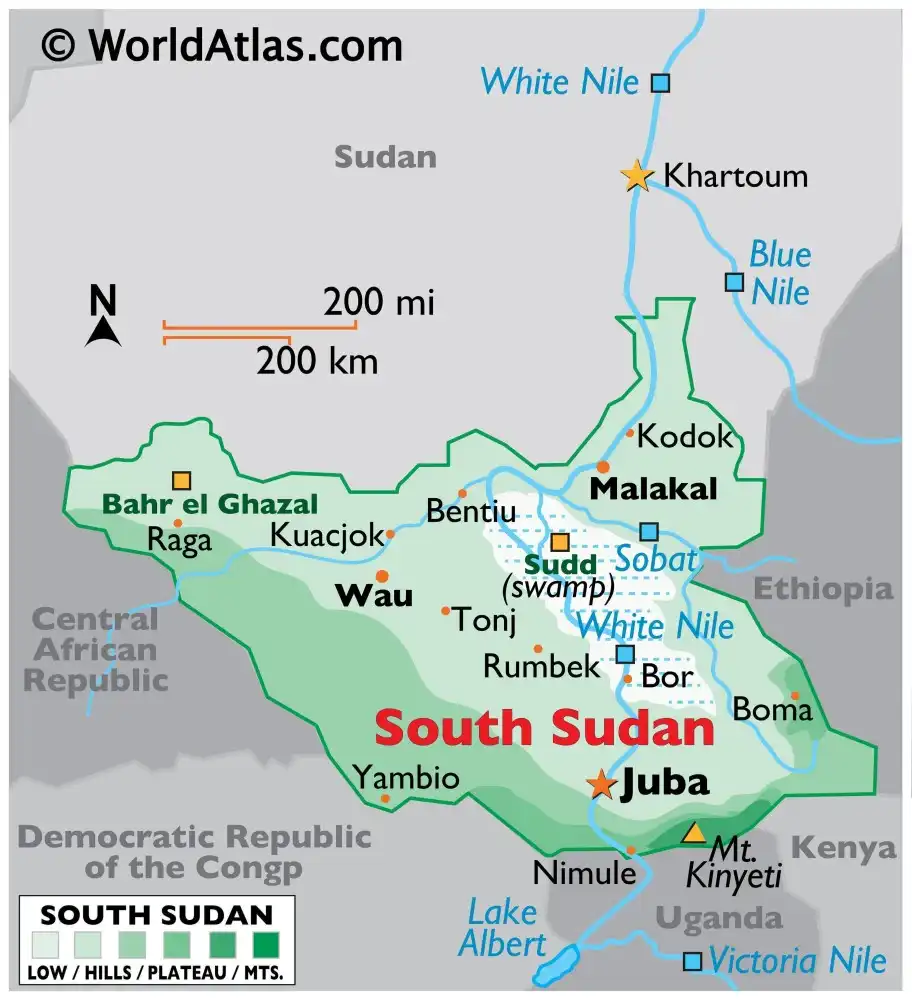
South Sudan Map (File Image)
Opinion by James Lwany - April , 2026
(Pachodo.org) - In post-conflict societies, the search for stability often becomes urgent, even desperate. But is all stability a genuine achievement? Or are some forms of calm merely a temporary stillness that conceals the forces of future rupture? This is not a theoretical concern. It lies at the core of South Sudan’s current dilemma. The challenge is not simply the absence of stability, but the nature of the stability being constructed: is it grounded in durable rules, or in fragile balances that can unravel at any moment?
In South Sudan, this confusion is particularly evident when ethnic nationalism is presented as a mechanism for maintaining equilibrium. It is often treated as a practical tool to avoid conflict, yet in reality it defers and reshapes it. Rather than addressing the root causes of division, it reorganizes them within the structure of governance itself. This raises a fundamental question: can a system built on managing division ever evolve into one that transcends it?
Comparative experience suggests that the answer is often no. In Yemen, tribal and political balances sustained a semblance of order for years, only to collapse when conditions shifted, because the foundation was not institutional. In Sudan before secession, the exclusionary management of diversity deepened fractures rather than resolving them. In Western Europe, Spain offers a more nuanced case, where the state has sought to reconcile regional identities with national unity—though not without recurring tensions. Meanwhile, Belgium demonstrates both the potential and the limits of power-sharing arrangements, which can mitigate conflict but also risk political paralysis when balance becomes an end in itself.
In North and Central Africa, similar patterns emerge. In Chad, the entanglement of identity and power has perpetuated cycles of instability. In the Central African Republic, weak institutions have allowed parallel authorities to flourish outside the state’s formal structures. Across these cases, the lesson is consistent: when identity becomes an organizing principle of governance, the state itself becomes hostage to it.
In South Sudan, this dynamic manifests in short-term policymaking. Agreements are signed but only partially implemented. Institutions are established but lack genuine independence. The result is a form of provisional stability—closer to an unspoken truce than to a functioning system. This raises an unavoidable question: can agreements endure without institutions? The answer, borne out by experience, is no. Agreements without institutions are promises without guarantees.
From a sociological perspective, Émile Durkheim argued in The Division of Labour in Society (p. 129) that modern cohesion depends on interdependence, not uniformity. When interdependence erodes, fragmentation follows. Similarly, Thomas Hobbes warned in Leviathan (p. 89) that without a central authority, society risks descending into a condition of perpetual conflict. These are not abstract insights; they describe the lived consequences of institutional weakness.
Economically, the implications are equally stark. As Amartya Sen observed in Development as Freedom (p. 36), equitable access to opportunity is essential to development. But what happens when opportunity is distributed along ethnic lines? The answer is predictable: perceptions of injustice deepen, incentives weaken, and growth falters.
This is particularly evident in the realm of higher education and scientific research—sectors that should serve as engines of national development. When universities and research institutions are governed by patronage rather than merit, they lose their transformative capacity. The inequitable distribution of foreign scholarships is a telling example. When such opportunities are allocated based on loyalty or ethnic affiliation rather than academic excellence, the consequences are far-reaching. The state not only forfeits potential talent; it also entrenches a sense of exclusion among large segments of society.
Can a cohesive national elite emerge under such conditions? The answer is, at best, doubtful. An elite formed through privilege rather than competence is inherently limited in its capacity to lead. Moreover, these practices reproduce inequality across generations. As Pierre Bourdieu argued in Reproduction in Education, Society and Culture (p. 72), educational systems can serve to replicate existing social hierarchies rather than dismantle them.
In this context, education becomes more than a sector—it becomes a battleground. It can either function as a vehicle for building a civic state or as a mechanism for reinforcing division. Can a country build its future if its educational system reproduces its past? The answer, again, is sobering.
From the standpoint of international relations, Henry Kissinger noted in Diplomacy (p. 23) that a state’s stability depends as much on internal legitimacy as on external positioning. A state fractured from within is inherently vulnerable to outside influence. This raises another pressing question: can a divided state preserve its sovereignty? The evidence suggests otherwise. Internal weakness invites external intervention.
The cultural dimension is equally decisive. Culture is not merely reflective; it is constitutive. When cultural narratives reinforce narrow identities, they deepen division. When they promote shared values, they help construct national cohesion. Here, the role of education, media, and the arts becomes critical in shaping collective consciousness.
Civic nationalism offers a different framework—not by erasing identity, but by regulating it within a legal and institutional order. Stability, in this model, is not the product of fragile bargains but of predictable rules. The experience of Indonesia, particularly in Aceh, illustrates how gradual reform, coupled with political will, can transform conflict into stability.
But is such a transition possible in South Sudan? Yes—but not easily. It requires political commitment, institutional strength, and a supportive civic culture. It demands a redefinition of the relationship between state and citizen, grounded in rights rather than affiliation.
Ultimately, the central question remains: what kind of stability does South Sudan seek? If the aim is merely to avoid conflict, ethnic nationalism may appear expedient. But if the goal is to build a durable state, civic nationalism is not optional—it is essential.
The answer, then, is not simply a political choice. It is a historical decision. States are not defined only by what they avoid, but by what they choose to become.
To be continued
South Sudan’s Most Dangerous Path: Ethnic Nationalism — and the Case for a Civic State (Part 1)
South Sudan’s Most Dangerous Path: Ethnic Nationalism — and the Case for a Civic State (Part 2)
South Sudan’s Most Dangerous Path: Ethnic Nationalism — and the Case for a Civic State (Part 3)
South Sudan’s Most Dangerous Path: Ethnic Nationalism — and the Case for a Civic State (Part 4)
South Sudan’s Most Dangerous Path: Ethnic Nationalism — and the Case for a Civic State (Part 5)
South Sudan’s Most Dangerous Path: Ethnic Nationalism — and the Case for a Civic State (Part 6)
South Sudan’s Most Dangerous Path: Ethnic Nationalism — and the Case for a Civic State (Part 7)
South Sudan’s Most Dangerous Path: Ethnic Nationalism — and the Case for a Civic State (Part 8)
South Sudan’s Most Dangerous Path: Ethnic Nationalism — and the Case for a Civic State (Part 9)
South Sudan’s Most Dangerous Path: Ethnic Nationalism — and the Case for a Civic State (Part 10)
Newer articles:
- End The Transition, No To Extension - 22/04/2026 14:30
- When stories travel: How screens connect China and Africa - 20/04/2026 15:01
- Intelligence Is Prerequisite For Affective Leadership - 20/04/2026 14:56
- South Sudan’s Most Dangerous Path: Ethnic Nationalism — and the Case for a Civic State (Part 9) - 20/04/2026 14:50
- Rebuttal to the So-called SPLM Cadres Forum: In Defense of SPLM-Secretary General, Cde. Dr. Akol Paul Kordit and the Rule of Law - 17/04/2026 14:06
Older news items
- Spring Thaw in China-U.S. Relations: Implications for Global Economic Stability and Europe's Strategic Position - 15/04/2026 17:34
- South Sudan’s Most Dangerous Path: Ethnic Nationalism — and the Case for a Civic State (Part 7) - 15/04/2026 17:09
- A Call For South Sudan's New Generation To Reclaim Their Future - 13/04/2026 14:51
- South Sudan’s Most Dangerous Path: Ethnic Nationalism — and the Case for a Civic State (Part 6) - 13/04/2026 14:47
- South Sudan’s Most Dangerous Path: Ethnic Nationalism — and the Case for a Civic State (Part 5) - 10/04/2026 19:08
Latest news items (all categories):
- Op-Ed - Breaking the Double-Standard Lens on China's Population Shifts - 23/10/2026 14:23
- South Sudan ceasefire monitors warn of rising violence ahead of December elections - 23/10/2026 13:39
- UNMISS SRSG visits Malakal, emphasizes that peace begins with collective action - 23/10/2026 13:36
- How Technology is Accelerating South Sudan’s Next Oil Discovery - 23/10/2026 13:34
- South Sudan’s Patriot make case in their opener against Urunani - 23/10/2026 13:12
See also (all categories):
Random articles (all categories):
- UNICEF - Consultant pour Sao Tome e Principe - Etude sur l'impact des Interventions C4D - 15/07/2016 15:35
- South Sudan: Army shoots down UN helicopter - GlobalPost - 22/12/2012 10:00
- South Sudan: In South Sudan, Few Take Their Money to the Bank - 30/08/2014 09:59
- Expensive wedding, while millions face severe hunger in South Sudan - 16/09/2022 01:00
- Nearly 170 people killed in attack in South Sudan’s Ruweng, officials say - 02/03/2026 14:23
Popular articles:
- The Final Communique of SPLM-DC Third Session of the National Council - 29/03/2011 01:00 - Read 83346 times
- Roles and Definition of Political Parties - 29/04/2011 01:00 - Read 65112 times
- Agriculture in Southern Sudan: Challenges and Investment Opportunities - 06/10/2010 01:45 - Read 57835 times
- Fashoda Youth Forum Rehabilitation of Drainage Culverts in Malakal town Report - 07/08/2008 16:22 - Read 36104 times
- Creation and establishment of the Local Government Councils ( Counties ) (2) - 28/09/2011 01:00 - Read 33999 times
