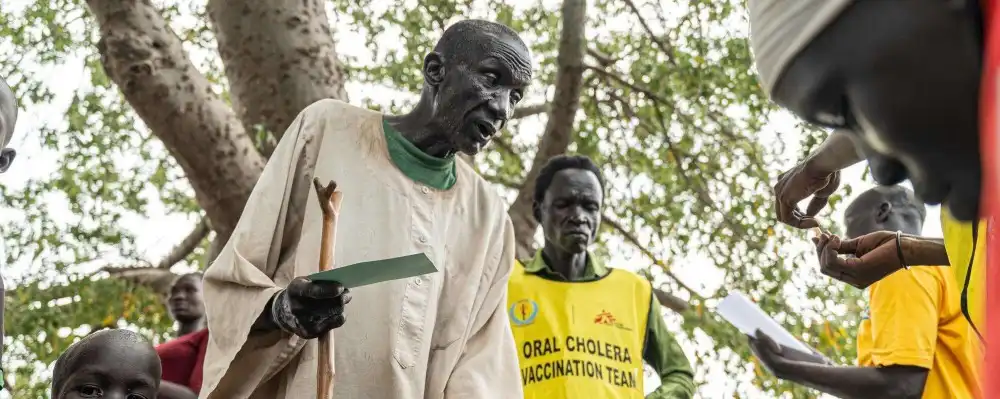
Bol Kai, 87, waits in line for the oral cholera vaccine at an MSF vaccination post in Bentiu, Unity State (South Sudan 2026 © Isaac Buay/MSF)
Funding cuts and the withdrawal of aid organizations have left around 150,000 internally displaced people living in South Sudan’s Bentiu and Malakal camps without water, sanitation, and primary health services — increasingly exposing them to the risk of cholera and other waterborne diseases, warns Doctors Without Borders/Médecins Sans Frontières (MSF).
Displaced communities in Upper Nile and Unity states depend heavily on external aid. As resources dwindle, the few organizations still operating there are further scaling back already limited services. As a result, water supply, waste collection, latrine maintenance, and primary health care services are at risk of total collapse in the coming months. MSF calls on donors and humanitarian organizations to act immediately to reverse funding shortfalls; maintain critical water, sanitation, hygiene, and health services; and prevent a renewed public health emergency.
“In Malakal, the clock is already running,” said Foued Gamoudi, MSF deputy head of operations in South Sudan. “The transfer of camps to government authorities does not remove the humanitarian needs of the people living there. As long as people remain in Bentiu and Malakal displacement sites, minimum WASH [water, sanitation, and hygiene], health, food, and nutrition services must be maintained.”
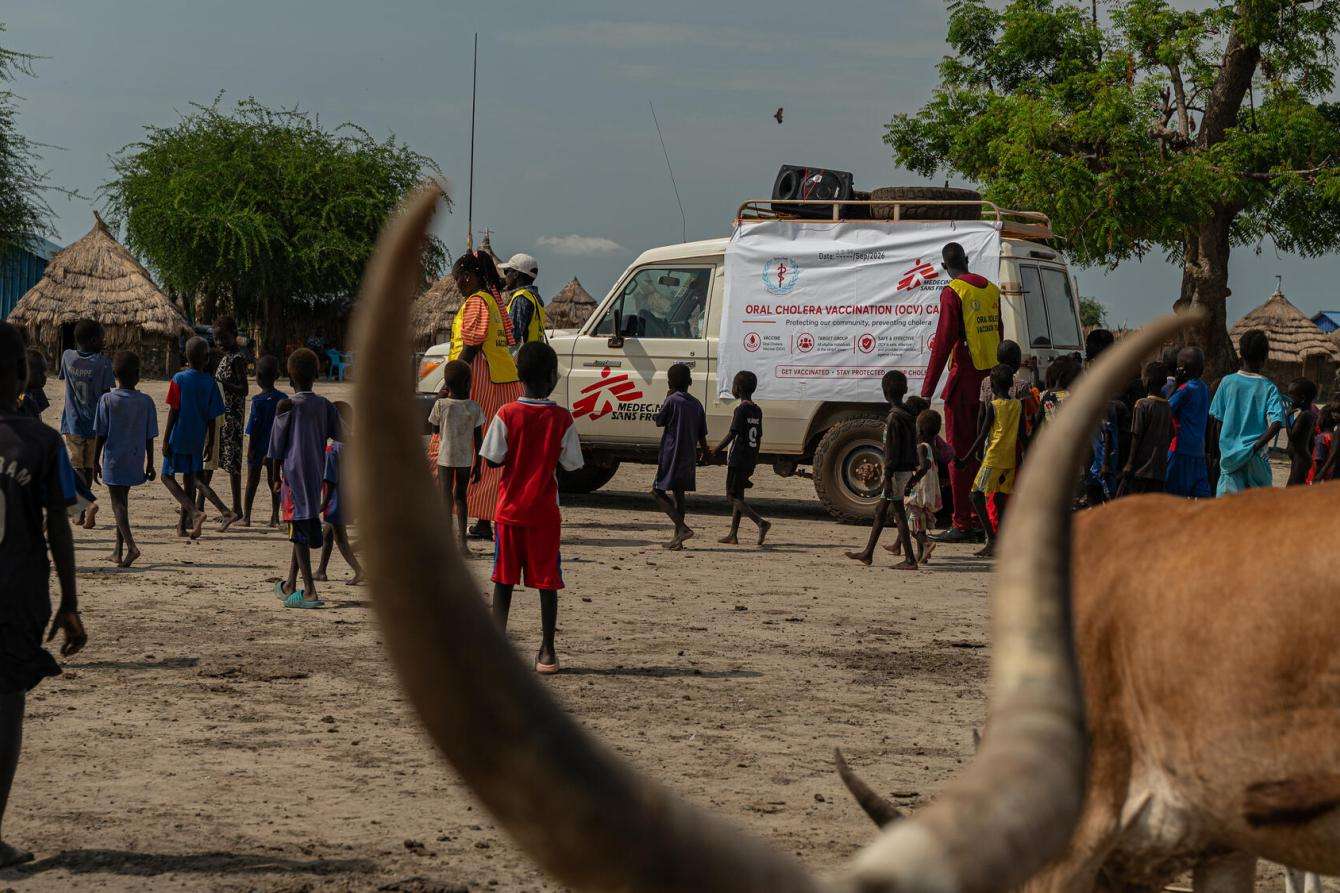
An MSF health promotion team uses a megaphone to raise awareness and mobilize communities for an oral cholera vaccination campaign in Bentiu. | South Sudan 2026 © Isaac Buay/MSF
Displaced people are stuck in dire conditions
Bentiu and Malakal camps were established in 2013, when thousands of people fleeing violence sought protection at UN peacekeeping bases. Both camps were formerly known as Protection of Civilians sites. Bentiu was redesignated as a conventional internal displacement camp in 2021 and placed under government authority, while Malakal was formally handed over in February 2026.
We have already suffered from conflict, flooding, and cholera, and many of us still cannot return home. I decided to get vaccinated to protect myself and my family ... we do not want to lose more lives to cholera.
Nysunday Dobuol, displaced woman living in Bentiu camp
Despite these changes in status, both sites continue to host large numbers of people living in protracted displacement. Many residents remain unwilling or unable to return home safely. In a survey conducted in February 2026 by the International Organization for Migration (IOM), 55 percent of households in Bentiu said that their intended destination was currently unsafe.
Bentiu camp, home to about 111,000 people, is located in a flood-prone area, where an MSF assessment found that around 60 people share each functioning latrine, and only 109 handwashing stations serve the entire camp. Open defecation is also widespread across the camp.
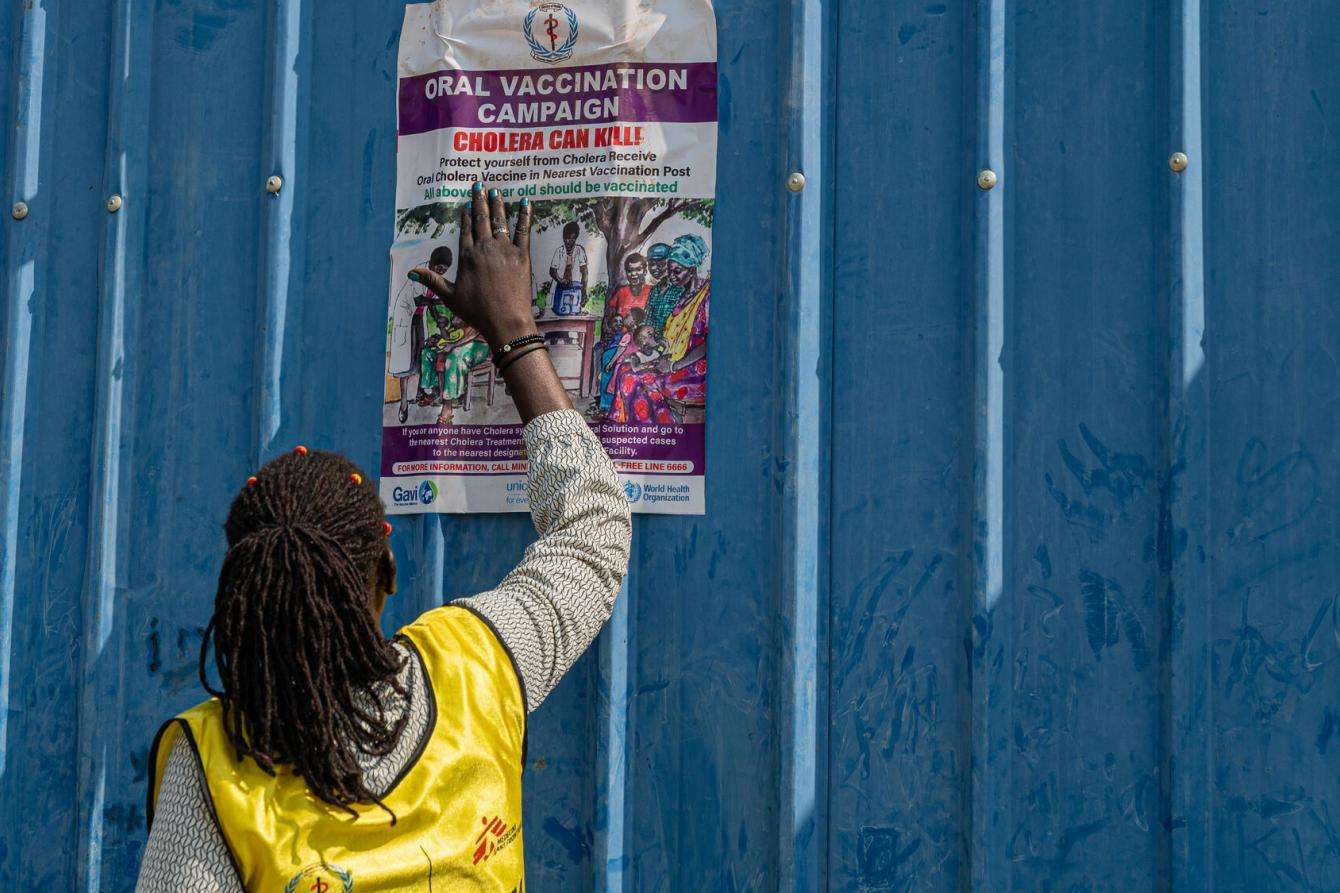
A member of MSF's health promotion team puts up a poster to raise awareness about an oral cholera vaccination campaign in Bentiu. | South Sudan 2026 © Isaac Buay/MSF
Water and sanitation needs raise cholera risk
Since 2024, South Sudan has recorded nearly 110,000 cholera cases and 1,970 deaths nationwide. During the peak of the outbreak in 2024–2025, Rubkona County in Unity State — where Bentiu is located — accounted for roughly a quarter of the cholera cases reported nationally during that period.
Although cholera cases in MSF-supported areas have remained low since mid-2025, the conditions that contributed to the outbreak persist. From January to September, more than 14,000 cholera cases were recorded across South Sudan, with Rubkona County alone accounting for nearly one-third of all patients.
“We have already suffered from conflict, flooding, and cholera, and many of us still cannot return home,” said Nysunday Dobuol, a displaced woman living in Bentiu camp. “I decided to get vaccinated to protect myself and my family, and now I encourage others to do the same because we do not want to lose more lives to cholera."
From left: A dilapidated public bathroom in Bentiu; the garbage dump in Malakal, which can go uncollected for weeks or even months; and dirty water and waste flow through an open drainage channel in Malakal. South Sudan 2026 © Isaac Buay/MSF
IOM is the only organization currently providing water, sanitation and hygiene services and primary health care in Bentiu camp, but faces critical funding gaps following major cuts since 2024. Although its funding for water, sanitation, and hygiene services has been extended by three months (until March 2027), the continuation of these essential services beyond that date remains uncertain without additional support. Primary health care will remain a major gap in January 2027.
In Malakal, Upper Nile State, where IOM is also now the only water and sanitation provider, the organization has prioritized water supply and desludging over latrine construction and garbage collection. Without new funding, the water supply for 40,000 people and desludging of around 900 latrines could come to a halt.
Sometimes garbage remains uncollected for weeks, even months. Latrines are not always emptied, and waste flows into the drainage channels.
Rebecca Abang, MSF counselor
Health services are also contracting in Malakal. The International Medical Corps, which supported nearly 100 deliveries a month, has ended its services including outpatient consultations, laboratory services, mental health care, and routine immunization. In theory, health services have been handed over to local health authorities, but they are also short of supplies and staff, with limited capacity to fill the gaps.
“Sometimes garbage remains uncollected for weeks, even months,” said Rebecca Abang, MSF counselor. “Latrines are not always emptied, and waste flows into the drainage channels.”
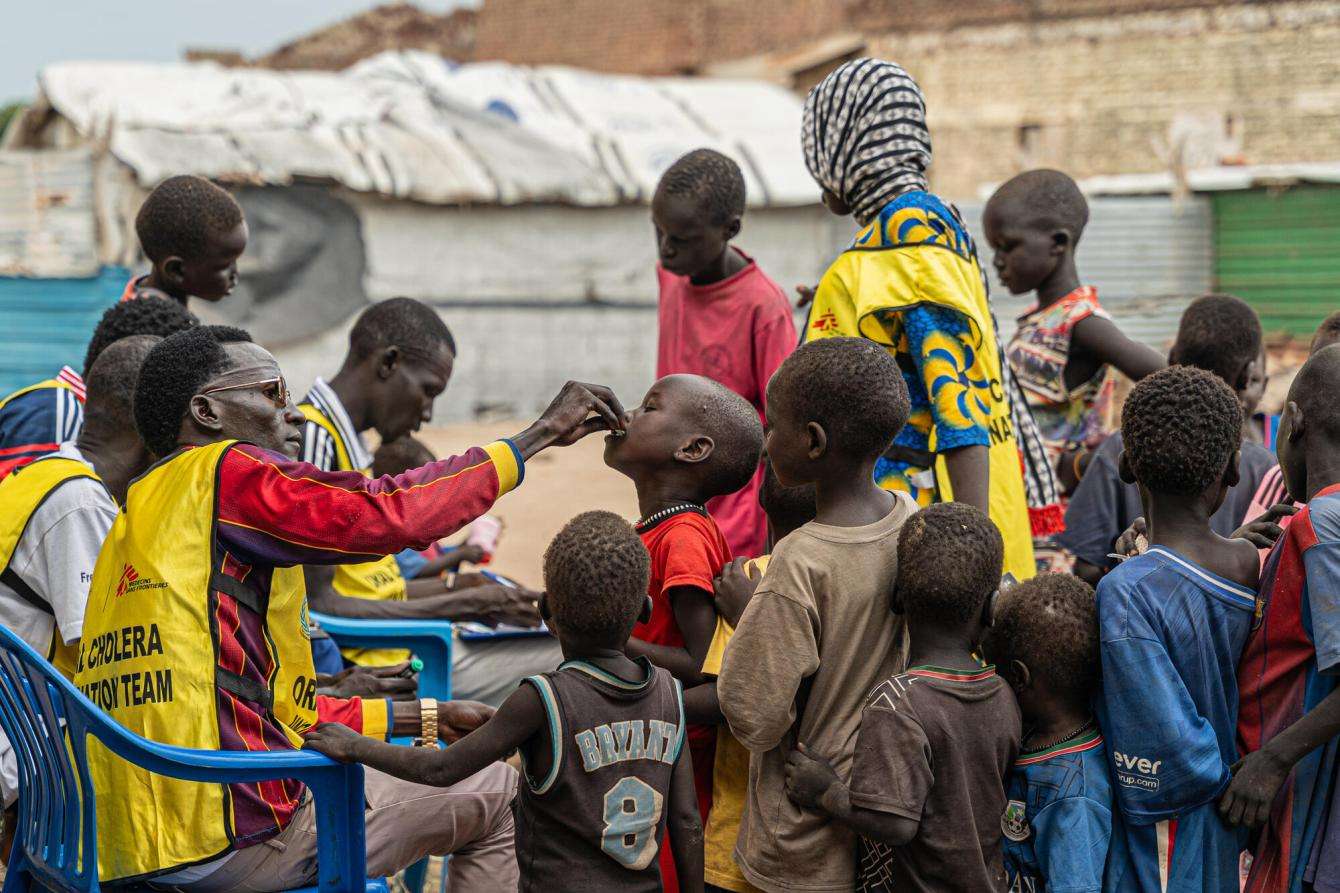
Community members queue to receive the oral cholera vaccine at an MSF vaccination post in Bentiu, Unity State, South Sudan.
Vaccination is important, but it’s not enough
Working with the Ministry of Health in Bentiu, MSF vaccinated 102,251 people during a second round of oral cholera vaccination in September 2026, reaching nearly 75 percent of the target population.
“Vaccination is an important step, but it cannot work alone,” said Patrick Mayen Biel, MSF outreach manager in Bentiu. “Without sustained access to safe drinking water, functioning latrines, and adequate sanitation, people will remain at risk of future outbreaks.”
Without sustained access to safe drinking water, functioning latrines, and adequate sanitation, people will remain at risk of future outbreaks.
Patrick Mayen Biel, MSF outreach manager in Bentiu
The service reductions in Malakal and Bentiu reflect a broader, worrying trend of reduced humanitarian aid in South Sudan over the years. Major donors — including the US and European countries — have scaled back support, even as renewed violence has driven needs up since last year. In this context, the health risks in crowded displacement camps like Malakal and Bentiu remain particularly high.
“This is an urgent call to donors to provide immediate funding to protect people’s dignity, avert a public health emergency, and prevent loss of life,” said Gamoudi. “Support must sustain safe water supplies, functioning latrines and desludging, adequate hand-washing facilities, and primary health care.”
Impact of funding cuts on vaccination in South Sudan
Steep funding cuts have curtailed vaccination activities in South Sudan. This year, we have seen national stockouts of basic vaccines, including the tuberculosis (BCG), oral polio (OPV), tetanus-diphtheria (Td), rotavirus, and malaria vaccines. Recurrent stockouts can last for weeks or months and have a direct impact on our work. During national stockouts, for example, many of our facilities find themselves without supplies of BCG and OPV to vaccinate newborns.
While the US recently provided funding through UNICEF to procure a six-month supply of BCG, OPV, and Td vaccines, this only provides a temporary solution. Further stockouts may occur if sustainable procurement financing is not secured.
Nationally, MSF continues to provide routine vaccinations while also vaccinating people during outbreaks. In 2025, we provided 162,898 routine vaccinations in South Sudan and 343,774 cholera vaccinations in response to a major outbreak.
Older news items
- South Sudan wants to hold elections in December: 3 major obstacles and some ways around them - 06/11/2026 16:27
- UN peacekeeping chief says Abyei mission delivering 'tangible results' in disputed Sudan, South Sudan border region - 06/11/2026 16:22
- South Sudan Civil Society Pushes For Peace And Development - 02/11/2026 20:21
- South Sudan’s first dedicated Media and Information Literacy Centre is creating opportunities for young people to navigate the digital space responsibly - 02/11/2026 20:17
- ‘We carried books into the bush’ – conflict-affected people of Lui plead for peace - 02/11/2026 20:06
Latest news items (all categories):
- UNICEF Vacancy Announcement: Planning, Monitoring & Evaluation Specialist, NO-3, Fixed Term Position, #119488, Juba, South Sudan - 06/11/2026 16:58
- Aid funding cuts raise health risks for displaced people in South Sudan - 06/11/2026 16:54
- South Sudan wants to hold elections in December: 3 major obstacles and some ways around them - 06/11/2026 16:27
- UN peacekeeping chief says Abyei mission delivering 'tangible results' in disputed Sudan, South Sudan border region - 06/11/2026 16:22
- "أمل نساء دارفور".. مبادرة لتمكين اللاجئات اقتصاديا وإعالة أسرهن - 06/11/2026 16:09
See also (all categories):
Random articles (all categories):
- Letter of Appreciation to Cde Dr. Chol Thon Abel, MD of Nilepet for his tremendous commitment towards Nation building in our country - 05/02/2022 11:40
- MSF: Malaria, malnutrition rise among South Sudanese returnees in Renk requires stronger medical response - 04/10/2023 06:24
- UNITING THE DIASPORA FOR PEACE IN SOUTH SUDAN: BUILDING TRUST AND DOING GOOD - 02/08/2015 15:48
- SPLM in Unity State, welcome belated support from Juba - Sudan Tribune - 24/05/2012 07:24
- Collo Global Action CONDEMNS THE REBELS FOR KILLING SHILLUK PEOPLE IN MALAKAL - 03/03/2014 13:22
Popular articles:
- Who is the darkest person in the world, according to Guinness World Record? - 25/10/2022 02:34 - Read 151525 times
- School exam results in South Sudan show decline - 01/04/2012 17:58 - Read 28511 times
- Top 10 weakest currency exchange rates in Africa in 2023 - 19/07/2023 00:24 - Read 25612 times
- No oil in troubled waters - 25/03/2014 15:02 - Read 24805 times
- NDSU student from South Sudan receives scholarship - In-Forum - 29/09/2012 01:44 - Read 22785 times