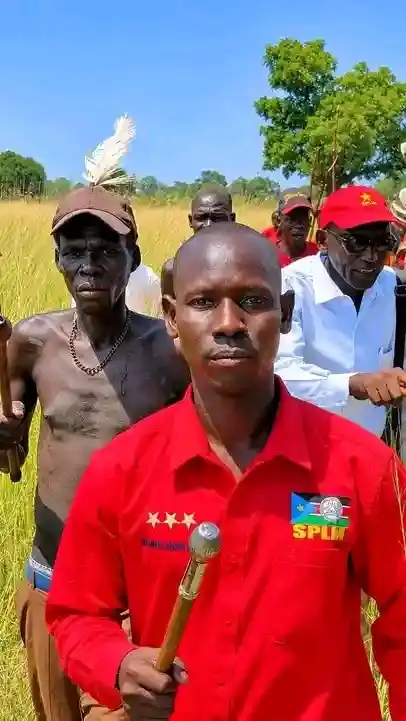
(Photo Credit: Supplied)
By *Amaju Ubur Yalamoi Ayani
(Pachodo.org) - As South Sudan approaches its first general election—rescheduled by the National Elections Commission for February 11, 2027—a systematic political shift is already underway inside the Sudan People’s Liberation Movement (SPLM). Across the country, internal party primaries for both state assemblies and the National Legislative Assembly have sent a clear signal from the grassroots: voters are ready to turn the page.
From Jonglei to Central Equatoria, young SPLM cadres have unseated a good number of long-serving political veterans to claim the party’s parliamentary tickets. Yet winning those primaries is merely opening the door, for walking through it into genuine governance is another matter entirely. Entrenched patronage networks for example, will not cede ground without a fight. If elected in February 2027, this incoming cohort of young parliamentarians will carry both a rare popular mandate and the heavy burden of delivering where the old guard fell short.
Beyond wartime credentials: Delivering basic services
For more than a decade, political authority in South Sudan rested largely on liberation-era seniority. Wartime credentials served as the primary currency of power, creating a political culture in which historical sacrifice frequently insulated incumbents from accountability. For years, citizens were expected to swallow broken promises in deference to the past, even as basic institutions withered and public trust wore thin.
The ongoing SPLM primaries have shown that this old formula is running out of road. By rejecting established heavyweights in favour of younger aspirants across multiple states, grassroots voters have made it clear that historical prestige can no longer bypass over institutional stagnation. A generation born during or after the liberation struggle views legitimacy not as an heirloom inherited from the past, but as a covenant renewed through tangible results.
Young cadres entering state and national legislatures owe their rise to community mobilization rather than political favours dispensed in the Capital Juba. Unlike older politicians cushioned from daily economic shocks by state privileges, younger lawmakers feel the pinch alongside ordinary citizens—from soaring food prices to understaffed clinics. To prove they are worth their salt, their immediate legislative priority must be basic service delivery: steering national and state budgets toward functional primary healthcare facilities in remote payams, rehabilitating feeder roads that link farmers to markets, and rescuing a public education system hanging by a thread.
Breaking the demographic and economic bottleneck
South Sudan’s long-term stability hinges on its ability to absorb a rapidly expanding youth population into a productive economy. With young people forming the overwhelming majority of the population, chronic unemployment is far more than a macroeconomic headache. It is dry tinder for local insecurity, cattle raiding, and political disillusionment. Young SPLM legislators cannot afford to treat youth empowerment as lip service or settle for token ministerial appointments.
Once in offices, these lawmakers must spearhead policies that wean the country off its crippling dependence on volatile oil revenues. At both the national and state levels, that means legislating real investments in vocational and technical training across all ten states and three administrative areas to equip young people for trades, commercial agriculture, and local enterprise. Building an economy that works for the majority requires trimming bloated administrative overhead and putting money where it actually generates livelihoods.
Equally urgent is dismantling the gatekeeping that locks young entrepreneurs out of capital. Young parliamentarians should champion transparent, merit-based micro-credit facilities and agricultural grants free from political patronage, alongside civil service reforms that ensure teachers, health workers, and junior administrators are paid on time. When young citizens see a clear path to earning an honest living, the appeal of armed mobilization and zero-sum politics loses its grip.
Putting teeth back into legislative oversight
Past transitional parliaments have too often operated as rubber stamps for the executive, hamstrung by fragmented loyalties, repeated extensions, and lax oversight of public finances. Because many previous lawmakers owed their seats to political appointment rather than competitive elections, few were willing to rock the boat by challenging ministerial misconduct or questioning opaque budget allocations.
Entering the legislature with fresh grassroots legitimacy, young parliamentarians have a golden opportunity to restore the chamber’s constitutional role as a genuine check on executive power. Using parliamentary committees to scrutinize national budgets with a fine-tooth comb, demand audited financial statements, and summon ministries to account will be essential to curbing corruption. Accountability ceases to be an empty slogan when lawmakers insist on tracking whether funds allocated for a state hospital or rural road actually reach the ground.
Modernizing how representatives engage the public is just as vital to keeping the executive on its toes. By pairing regular constituency town halls with digital communication, younger lawmakers can pull back the curtain on legislative proceedings in Juba and state capitals. When citizens can clearly see how public money is spent and how their representatives vote, parliament shifts from a distant elite club into an institution answerable to the people.
Moving beyond ethnic politics
During the primary exercises, SPLM Secretary-General Dr. Akol Paul Kordit stressed that overcoming ethnic loyalties is central to transforming the party and uniting the nation. For decades, political elites have too often played the ethnic card to secure power, deepening communal fault lines and reducing national politics to a tug-of-war over tribal representation rather than shared prosperity.
Many of the young cadres emerging from these primaries belong to a generation educated in universities and towns alongside peers from every corner of the country. Having forged friendships, business ventures, and civic networks across regional divides, they are well placed to champion an issue-based political culture. Their everyday struggles—jobs, security, infrastructure, and education—know no county or state boundaries.
In state assemblies especially, young legislators will sit closest to the localized sparks of conflict, including cattle raiding, boundary disputes, and competition over water and grazing land. Cooling these flashpoints requires moving away from defensive ethnic solidarity toward community-driven legislation. By backing local peace committees, upholding both customary and statutory accountability, and investing in shared infrastructure that binds neighbouring communities together, young lawmakers can help build peace from the ground up.
From party tickets to real delivery
The primary victories of young SPLM cadres reflect a maturing electorate hungry for responsive leadership. Still, winning a party flag is only the opening chapter, and the real test begins after the ballots are cast. Once sworn into national and state assemblies, young parliamentarians will face immense institutional pressure to fall in line with the very culture of patronage and silence that their voters rejected.
Resisting that pull will take unity of purpose among the incoming cohort. Rather than acting as lone voices easily co-opted by seasoned power brokers, young legislators across party and regional lines will need to build issue-based caucuses capable of setting legislative agendas and defending constitutional norms. True political renewal happens not when fresh faces warm old benches, but when they change how power is exercised.
Come February 2027, these emerging leaders will not be judged by the veterans they unseated in the primaries, nor by the party slogans they invoke on the campaign trail. Their legacy will rest on whether they deliver where it counts—exercising fearless oversight, passing people-cantered laws, and proving that generational change can finally move South Sudan forward.
About the writer

*Amaju Ubur Yalamoi Ayani (also known as Amaju Joseph Ubur Ayani), is a South Sudanese teacher, political analyst, and an SPLM flag bearer contesting for Lafon Constituency No.6 in Eastern Equatoria State Legislative Assembly. He can be reached via
Older news items
- Research ● Bogoljub J. Karić: Never again media darkness: Time for a new European Charter on the Economic and Professional Rights of Journalists - 23/11/2026 14:59
- Research - Europe between a new world war and geopolitical defeat: strategic energy miscalculations, geopolitical ambitions and American pragmatism - 21/11/2026 00:54
- APEC is finding ways to make cross-border services easier - 21/11/2026 00:45
- Xi Jinping’s push for tech independence: How China is trying to close the gap - 21/11/2026 00:44
- How does regional integrated development become a key driver for rapid growth? - 21/11/2026 00:36
Latest news items (all categories):
- Beyond the SPLM Primaries: What Young Lawmakers Must Deliver in 2027 - 23/11/2026 15:04
- Research ● Bogoljub J. Karić: Never again media darkness: Time for a new European Charter on the Economic and Professional Rights of Journalists - 23/11/2026 14:59
- 24 civilians, including children and women, killed in South Sudan - 23/11/2026 14:53
- MSF suspends all activities in Yei River county following abduction - 23/11/2026 14:48
- African leaders seek lasting peace - 23/11/2026 14:46
See also (all categories):
Random articles (all categories):
- Investment Conference Sparks Interest in South Sudan - 10/12/2013 12:25
- Job: FAO - NATIONAL COMMUNICATION OFFICER - Juba - 27/04/2013 12:32
- A rebuttal on Daniel Wuor Thon's article - 29/05/2010 01:00
- How African states voted on UN debate on Ukraine - 03/03/2022 00:21
- Sudan inflation hits 45.3 pct in June - 07/07/2014 12:00
Popular articles:
- The Final Communique of SPLM-DC Third Session of the National Council - 29/03/2011 01:00 - Read 83500 times
- Roles and Definition of Political Parties - 29/04/2011 01:00 - Read 65338 times
- Agriculture in Southern Sudan: Challenges and Investment Opportunities - 06/10/2010 01:45 - Read 58098 times
- Fashoda Youth Forum Rehabilitation of Drainage Culverts in Malakal town Report - 07/08/2008 16:22 - Read 36258 times
- Creation and establishment of the Local Government Councils ( Counties ) (2) - 28/09/2011 01:00 - Read 34271 times