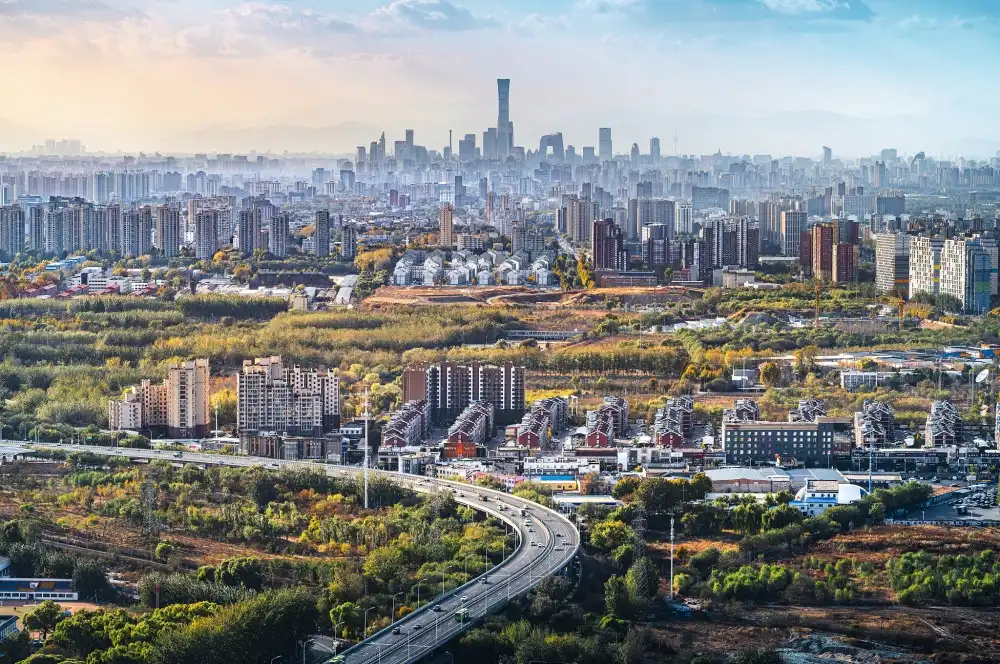
Image of a Chinese city [Photo: VCG]
About the author:
Xie Cheng is an editor with CGTN. He is also one of the editors of Stories of Xi Jinping.
(Pachodo.org) - While producing an episode on how China addresses its vast regional disparities, I faced a daunting question: how do you explain such a massive national strategy to a global audience? To bring the concept of "coordinated growth" down to earth, a few prime examples immediately came to mind: the Yangtze River Delta in the east, the Greater Bay Area in the south, and the Beijing-Tianjin-Hebei region in the north. I decided to start with the last one, because it is the landscape I know best. More specifically, I looked to a new area built in my home province of Hebei: the Xiong'an New Area—a massive, futuristic area being built from scratch. Driven by the thrill of seeing my forefathers' roots transform into a blueprint for China's future, I knew this was exactly where our story had to begin.
The rapid development of Xiong'an New Area
According to the report delivered at the 19th CPC National Congress in October 2017, China would relieve Beijing of functions nonessential to its role as the capital and use this effort to drive the coordinated development of the Beijing-Tianjin-Hebei region.
Since the establishment of the Xiong'an New Area in 2017, Xi Jinping has made four inspection tours to the area in less than a decade, charting its course at every key juncture.
One of President Xi's top priorities for the area is its interconnectivity, which requires high-quality transportation infrastructure. During his second visit to Xiong'an in January 2019, he was briefed on the construction of the Beijing-Xiong'an Intercity Railway and spoke via video link with construction workers on site.
"Transport must come first for urban construction and economic development, so transport infrastructure is our top priority. The Beijing-Xiong'an Intercity Railway is the first project undertaken. Its significance is self-evident. As trailblazers for this millennium strategy, you have made indelible contributions," said Xi.
In May 2023, Xi paid his third visit. At the Xiong'an Railway Station, he called for efforts to ensure visitors feel the new atmosphere of the modernized New Area upon arrival. At Nanwenying Community, he pressed for modernization of urban governance with the vision, nuance and patience of embroidery masters. At the the construction sites of Xiong'an Intercity Station and the international trade center, he stressed efforts to build a future city without big city malaises.
When I began looking into the Xiong'an New Area, the first story I came up with was the one about President Xi Jinping’s very latest inspection tour to the area which took place just a few months ago. I happened to work as one of the desk editors in my team, which made me quite familiar with the story.
As one of the most prestigious schools in the capital, Beijing No. 4 High School's new campus in Xiong'an is physical proof of the policy working—allowing high-quality educational resources to be shared between Beijing and Hebei.
On March 23, 2026, the school's students and faculty members welcomed President Xi. For them, just as seventh-grade student Zhou Mingshuo remembered, that day was not a typical day.
"We were just studying the 'Ode to the Yellow River', and our teacher was making explanations, when Grandpa Xi came in. I was very excited, happy and nervous, as this was my first time seeing him in person," recalled Zhou, who was having a Chinese class with her classmates when President Xi stepped into their classroom.
Before he left, President Xi encouraged the students to strive for progress, grow together with the Xiong'an New Area: "Keep up the good work, grow up healthy and strong, and become an excellent generation.".
Today, in the 215-square-kilometer space that is the Xiong'an New Area, three parallel "cities" are emerging simultaneously: a physical city above ground, a massive infrastructure network of utility tunnels underground, and a digital twin city operating in the cloud. The buildings stand row upon row, while the road and utility networks have taken shape. Underground in the integrated utility tunnels, internet-of-things facilities such as temperature and humidity sensors keep constant watch. On the giant screen of the Xiong'an Urban Computing Center, real-time data converge to indicate the status of the city's operations.
Economic engine driving China
While Xiong'an represents building a new economic engine from scratch, my other prime example—the Yangtze River Delta—represents upgrading an existing one. As the commercial powerhouse surrounding Shanghai and its neighboring provinces, it is a key economic engine already driving the country.
Occupying a modest 4% of China’s land area, the region at the mouth of China’s longest river is home to about 17 percent of the country’s total population and contributes about 25 percent of its total GDP. It is one of the most economically dynamic, open and innovative areas in China.
In 2018, during the first China International Import Expo in Shanghai, President Xi’s speech envisioned a new chapter for the region.
"We will support integrated development of the Yangtze River Delta region. We will make it a national strategy and implement our new development philosophy in real earnest. We will build a modern economic system, and adopt higher standards for reform and opening-up. The region will develop in tandem with the Belt and Road Initiative, the Beijing-Tianjin-Hebei coordinated development area, the Yangtze River Economic Belt and the Guangdong-Hong Kong-Macao Greater Bay Area, and will help improve the overall layout of China’s reform and opening-up," said Xi.
Over the following years, as major blueprints were rolled out, President Xi made repeated visits across the Yangtze River Delta to push the region's integration forward.
One of the examples was his inspection at Baowu Steel's plant in Anhui Province in August 2020. Historically, inland Anhui was far less developed than its wealthy coastal neighbors like Shanghai. Integrating it into the delta's supply chain is the very essence of coordinated growth. There, he encouraged the enterprise to seize the momentum of this integration.
"You have earned many achievements, now make full use of your advantages, go with the trend of industrial modernization. During the current industrial reform and development, seize the opportunities and go with the flow, make contributions to the integrated development of the Yangtze River Delta."
The next day at a high-level symposium, he laid out the objectives for the region to "take the lead in working out a new development pattern", "rise to assume the role of trail-blazer for China's technological and industrial innovations" and "achieve faster progress in developing the region into a new high ground of reform and opening up."
Another sign demonstrating the integrated development of the region came in September 2022, when Shanghai Municipality and the provinces of Jiangsu, Zhejiang and Anhui signed an agreement to standardize and streamline administrative procedures for market access registration across the region.
This means that in the field of market access, the Yangtze River Delta region will take the lead in forming unified registration standards, service specifications and information sharing, marking a substantive step forward in building a unified large market.
Later at a 2023 symposium on promoting the integrated development of the Yangtze River Delta, President Xi stressed the need to strengthen cross-regional collaboration in sci-tech and industrial innovation, the governance of the ecological environment and the pursuit of safe development.
By 2025, the Yangtze River Delta's economic output crossed 34 trillion yuan—roughly five trillion US dollars. Companies from this region make up nearly half of all listings on China's Science and Technology Innovation Board. And through early 2026, the delta accounted for over a third of China's entire foreign trade.
Working on this podcast, I found that all those regional plans come down to one fundamental reality: China is massive, and its growth has never been evenly spread.
Different areas start from completely different baselines—some have world-class deepwater ports, others are agricultural breadbaskets, and some sit on vast energy reserves. That’s why regional coordination has become such a cornerstone of national strategy.
President Xi has personally steered this balance—laying out the blueprints for mega-regions like the Beijing-Tianjin-Hebei cluster, the Yangtze River Delta, and the Greater Bay Area to make sure they complement each other instead of competing.
To explore more about China’s integrated regional development and its role in boosting the country’s growth, tune in to the podcast “Stories of Xi Jinping”. It adds a layer of texture that writing alone can’t provide.
Newer articles:
- Research - Europe between a new world war and geopolitical defeat: strategic energy miscalculations, geopolitical ambitions and American pragmatism - 21/11/2026 00:54
- APEC is finding ways to make cross-border services easier - 21/11/2026 00:45
- Xi Jinping’s push for tech independence: How China is trying to close the gap - 21/11/2026 00:44
Older news items
- The power of Africa - 17/11/2026 20:38
- China’s next stage of modernization is beyond infrastructure - 17/11/2026 19:50
- Who will feed China: How technology and land policy are reshaping Chinese agriculture - 17/11/2026 19:23
- Warmth measured in small things - 17/11/2026 19:19
- Why global companies are debuting products at China International Import Expo - 14/11/2026 21:12
Latest news items (all categories):
- Research - Europe between a new world war and geopolitical defeat: strategic energy miscalculations, geopolitical ambitions and American pragmatism - 21/11/2026 00:54
- APEC is finding ways to make cross-border services easier - 21/11/2026 00:45
- Xi Jinping’s push for tech independence: How China is trying to close the gap - 21/11/2026 00:44
- How does regional integrated development become a key driver for rapid growth? - 21/11/2026 00:36
- South Sudan rejects claims US-deported migrants face hunger, poor conditions - 21/11/2026 00:12
See also (all categories):
Random articles (all categories):
- South Sudan: Bodies in wells, houses burned - NBC40.net - 13/05/2014 17:41
- South Sudan says Sudan seized oil - 23/01/2012 11:09
- Kiir, back from China, says Heglig belongs to South Sudan - Chicago Tribune - 27/04/2012 21:13
- South Sudan resumes pumping 20,000 bpd from oil field suspended since 2013 - Sudan - 26/08/2018 14:14
- South Sudan says UN's Lanzer Expelled for Comment on Economy - 02/06/2015 15:30
Popular articles:
- The Final Communique of SPLM-DC Third Session of the National Council - 29/03/2011 01:00 - Read 83484 times
- Roles and Definition of Political Parties - 29/04/2011 01:00 - Read 65326 times
- Agriculture in Southern Sudan: Challenges and Investment Opportunities - 06/10/2010 01:45 - Read 58076 times
- Fashoda Youth Forum Rehabilitation of Drainage Culverts in Malakal town Report - 07/08/2008 16:22 - Read 36246 times
- Creation and establishment of the Local Government Councils ( Counties ) (2) - 28/09/2011 01:00 - Read 34245 times