
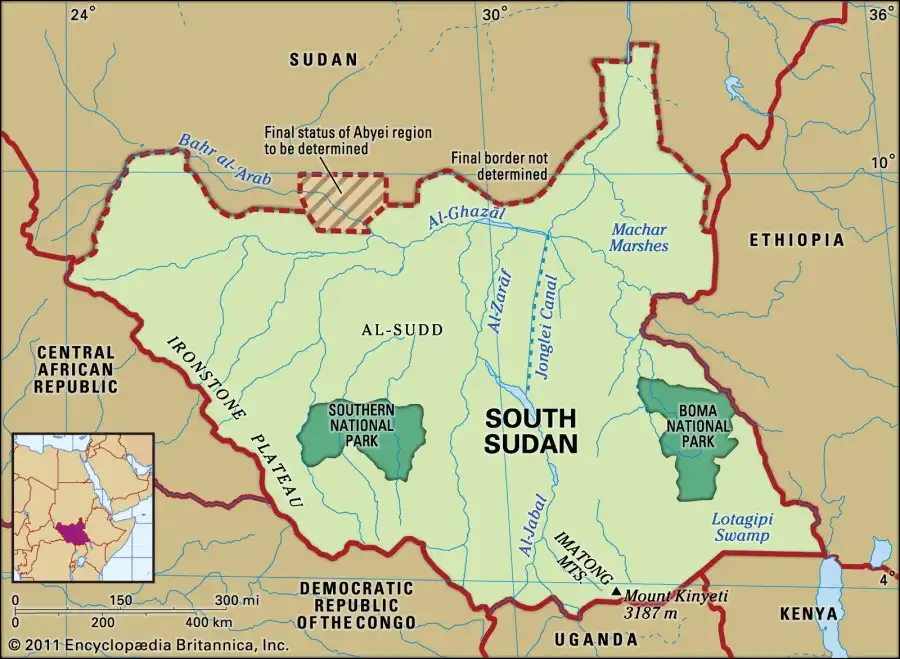
South Sudan Map (Source: Encyclopædia Britannica)
Opinion: By James Lwany - April 2, 2026
(Pachodo.org) - The gravest danger facing South Sudan lies not in its ethnic diversity, but in the manner in which that diversity has been politicized and weaponized as an instrument of power monopolization and informal governance. When identity becomes the primary currency for allocating influence and resources, the state forfeits its fundamental role as a unifying framework and is gradually reduced to an arena of zero-sum competition, rather than a system capable of stability.
In this context, ethnic nationalism is not merely a rhetorical device deployed in moments of crisis. It has evolved into a parallel architecture of governance—one that reshapes the priorities of the state itself. The preservation of loyalty networks begins to outweigh the pursuit of the public good. Public offices, economic privileges, and positions of influence are no longer allocated on the basis of merit or competence, but rather distributed to sustain delicate ethnic balances that entrench elites in power.
These dynamic produces what might best be described as a “state within the state.” While formal institutions continue to function at a superficial level, informal structures emerge to perform the real work of governance—from providing security to mediating disputes—based not on law, but on affiliation. Over time, these parallel systems grow more powerful, steadily eroding the authority of the state until it can no longer enforce its rules beyond narrow confines.
More troubling still, this model empties politics of substance. Instead of serving as a forum for competing ideas and policy visions, politics becomes a contest over control of distributive levers. Elections, when held, rarely produce genuine transformation; they merely recycle existing power structures with cosmetic adjustments. In the absence of trust in the political process, communities increasingly turn to alternative mechanisms to safeguard their interests, further entrenching instability.
Economically, the consequences are equally corrosive. When the economy is governed by the logic of patronage, efficiency declines, resources are squandered, and investors retreat in the face of uncertainty. In the absence of transparency, national wealth is repurposed as a tool for consolidating political power rather than a driver of development. The result is a fragile economy—one sustained more by distribution than production—deepening inequalities across regions and communities.
The risks, however, do not end at the domestic level. A state governed along ethnic lines becomes inherently vulnerable to external pressures. Internal divisions create openings for regional interventions—direct or indirect—that reshape internal balances in line with outside interests. The challenge thus becomes twofold: a state weakened from within, and exposed from without.
Against this trajectory, civic nationalism emerges not as an abstract ideal, but as a strategic necessity. It offers the only viable framework for redefining the relationship between state and citizen on the basis of equality. Under this model, identities are not erased, but they are decoupled from the mechanisms of governance, ensuring that they do not become sources of privilege or exclusion.
Yet the transition to such a model demands far more than declaratory politics. It requires the dismantling of the informal structures that effectively run the state. This is no simple undertaking. These networks are deeply entrenched, bound up with powerful interests. But without confronting them, the reconstruction of functional, rule-based institutions will remain out of reach.
The first step in this transformation must be radical transparency. Shedding light on how decisions are made and resources are allocated weakens the logic of monopolization and reintroduces accountability. The establishment of independent oversight bodies is equally critical—not only to curb abuses of power, but to restore public confidence in the state.
Equally important is the delivery of tangible outcomes in citizens’ daily lives. Public services—from healthcare to education—must be provided equitably and without discrimination. This is not merely a technical matter; it is a political signal that the state is beginning to reclaim its neutrality.
Reforming the political system is also essential. Mechanisms of representation must be rethought to encourage cross-cutting alliances rather than reinforce division. Carefully designed electoral systems can incentivize leaders to broaden their constituencies, moving beyond narrow identity-based mobilization.
Ultimately, the issue at stake is not a clash between competing identities, but a contest between two models of governance. One is built on the management—and exploitation—of division; the other seeks to mitigate it through inclusive institutions. Experience has shown that while the former may endure for a time, it cannot deliver sustainable stability. It postpones crises, only to deepen them.
South Sudan now stands at a stark crossroads: continue along a path that reproduces fragility, or embark on a gradual transition toward a civic state capable of managing its diversity. The latter will not be easy. But it remains the only path capable of breaking the cycle that has kept the country trapped in recurring conflict.
To be continued.
James Lwany
South Sudan’s Most Dangerous Path: Ethnic Nationalism — and the Case for a Civic State (Part 1)
South Sudan’s Most Dangerous Path: Ethnic Nationalism — and the Case for a Civic State (Part 2)
South Sudan’s Most Dangerous Path: Ethnic Nationalism — and the Case for a Civic State (Part 3)
South Sudan’s Most Dangerous Path: Ethnic Nationalism — and the Case for a Civic State (Part 4)
South Sudan’s Most Dangerous Path: Ethnic Nationalism — and the Case for a Civic State (Part 5)
South Sudan’s Most Dangerous Path: Ethnic Nationalism — and the Case for a Civic State (Part 6)
South Sudan’s Most Dangerous Path: Ethnic Nationalism — and the Case for a Civic State (Part 7)
South Sudan’s Most Dangerous Path: Ethnic Nationalism — and the Case for a Civic State (Part 8)
South Sudan’s Most Dangerous Path: Ethnic Nationalism — and the Case for a Civic State (Part 9)
South Sudan’s Most Dangerous Path: Ethnic Nationalism — and the Case for a Civic State (Part 10)
Newer articles:
- The Strategic Imperative of the China-Pakistan Five-Point Initiative: A Framework for De-escalation in the Gulf and Middle East Region - 06/04/2026 14:39
- South Sudan Needs Creative Leadership For Eradication Of Poverty - 06/04/2026 14:36
- God’s Redemptive Plan Unfolds In The Glory Of Easter - 06/04/2026 14:31
- South Sudan’s Most Dangerous Path: Ethnic Nationalism — and the Case for a Civic State (Part 3) - 06/04/2026 14:24
- When Information Is No Longer Enough: Intelligence and the Degradation of Strategic Truth - 06/04/2026 14:18
Older news items
- Structural factors are responsible for persistent poverty in South Sudan, not laziness - 01/04/2026 18:56
- South Sudan’s Most Dangerous Path: Ethnic Nationalism — and the Case for a Civic State (Part 1) - 01/04/2026 18:50
- Either Oppositions Unite, Or Are All Defeated One By One by The Regime - 01/04/2026 18:34
- South Sudan's Monkey Politics Of Folly - 23/03/2026 18:22
- Is God Your Lord Or Your Witch-Doctor? The Myth Of Divine Manipulation - 20/03/2026 16:56
Latest news items (all categories):
- South Sudan Opens 14 Oil Blocks, Courts Investors Ahead of SSOP 2026 - 26/10/2026 15:08
- Jambojet Explores South Sudan Expansion After Talks with Juba Regulator - 26/10/2026 15:05
- Kiir swears in 5 officials ahead of South Sudan elections - 26/10/2026 14:53
- South Sudan cattle battles leaves 10 dead: official - 26/10/2026 14:49
- Churches urge world 'not to forget South Sudan' ahead of first elections - 26/10/2026 14:47
See also (all categories):
Random articles (all categories):
- Afcon 2025: Which Premier League teams will lose most players to Afcon? - 15/12/2025 13:36
- South Sudan floods wreak havoc on vulnerable communities - 19/10/2021 03:29
- UN, UK, Norway congratulate Sudan on lifting of sanctions - 08/10/2017 01:22
- South Sudan's central bank orders banks to suspend transactions in Kenyan currency - 01/07/2019 09:54
- South Sudan: Release Detained Airport Officials - 29/07/2019 22:00
Popular articles:
- The Final Communique of SPLM-DC Third Session of the National Council - 29/03/2011 01:00 - Read 83351 times
- Roles and Definition of Political Parties - 29/04/2011 01:00 - Read 65119 times
- Agriculture in Southern Sudan: Challenges and Investment Opportunities - 06/10/2010 01:45 - Read 57842 times
- Fashoda Youth Forum Rehabilitation of Drainage Culverts in Malakal town Report - 07/08/2008 16:22 - Read 36108 times
- Creation and establishment of the Local Government Councils ( Counties ) (2) - 28/09/2011 01:00 - Read 34009 times
