
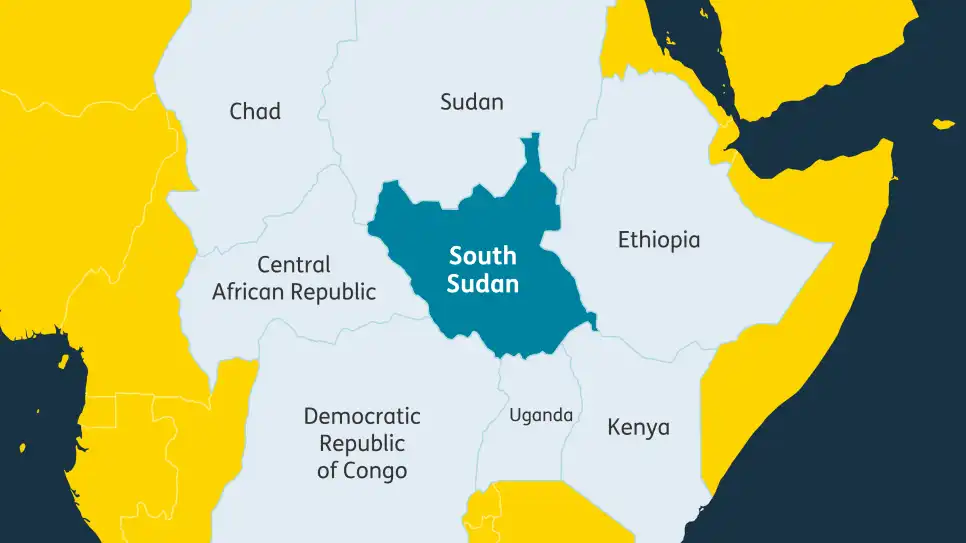
Map of South Sudan (File Image)
Opinion: By James Lwany – April 2, 2026
(Pachodo.org) - The existential threat facing South Sudan is not simply the outbreak of violence, but the gradual shift of political loyalty from the state to the group. This transformation, fuelled by weak institutions and eroding public trust, does more than reshape the relationship between citizen and authority—it redefines the very meaning of the state. When security becomes an ethnic privilege rather than a public good, the modern state begins to recede, replaced by alternative arrangements that are inherently less stable and more prone to rupture.
This pattern is not unique to South Sudan. In Somalia, the collapse of state institutions gave rise to clan-based systems that supplanted national authority. In Iraq after 2003, sectarian affiliation became the gateway to protection and opportunity. In both cases, violence was not the starting point, but the consequence of a deeper shift in the structure of political loyalty.
In such contexts, ethnic identity ceases to be merely a component of personal belonging. It becomes an unspoken prerequisite for participation in public life. Citizens are judged less by their competence than by their affiliation. Over time, this dynamic produces a political environment that rewards insularity and penalizes openness. Those who seek to build bridges are viewed with suspicion; those who deepen divisions are rewarded with loyalty.
The result is what might be termed an “economy of limited trust.” Trust does not disappear—it contracts. It is confined within the boundaries of the group, while relations between groups are governed by caution, competition, or outright hostility. The long-term consequence is the gradual erosion of national cohesion. Society fragments into adjacent units rather than forming a cohesive whole. In such an environment, even minor incidents can trigger wider unrest, because the foundations of trust have already collapsed.
The experience of Lebanon illustrates how such a system can endure for decades, sustained by delicate balances yet perpetually vulnerable to disruption. In Bosnia and Herzegovina, the institutionalization of division produced formal stability but entrenched long-term fragmentation.
Political elites play a decisive role in sustaining this reality. They do not merely exploit divisions; they actively reproduce them through systematic practice. Through rhetoric, appointments, and resource allocation, they reinforce the notion that identity is the only reliable guarantee of security and access. Over time, this belief hardens into conventional wisdom, difficult to challenge even when underlying conditions change.
Yet this strategy carries an inherent contradiction. It weakens the very state upon which these elites depend. As institutions deteriorate, reliance on informal loyalties deepens; as that reliance grows, authority becomes increasingly fragile. This vicious cycle was evident in Libya after 2011, where the erosion of central authority led to competing centres of power, complicating any effort at reconstruction.
Breaking this cycle requires a fundamental redefinition of security. Security must cease to be an ethnic entitlement and be restored as a universal right guaranteed by the state. This demands deep reform of the security sector—professionalization, accountability, and adherence to law rather than loyalty.
Equally critical is the creation of shared spaces that reconnect interests across communities. Economic cooperation can play a decisive role here. Evidence shows that projects built on cross-regional collaboration help rebuild trust over time. In Rwanda, for instance, development policies aimed at inclusivity have contributed to reducing reliance on narrow identities, despite ongoing political challenges.
Civic nationalism, in this framework, is not an abstract ideal but a practical mechanism for redirecting loyalty. It reconnects citizens to the state through rights and institutions, rather than protection and identity. This shift does not erase identities; it reorders them, ensuring they do not determine opportunity or status.
Achieving this transformation, however, requires genuine political will. Elites who benefit from the current system are unlikely to relinquish it voluntarily. Incentives must therefore be recalibrated so that inclusive behaviour is rewarded, and exclusionary rhetoric carries a cost—through both domestic pressure and international engagement.
Ultimately, the question is not whether ethnic nationalism will persist, but how it will be managed. It can remain a vehicle for conflict, or it can be contained within a broader civic framework. Comparative experience shows that the decisive factor is not diversity itself, but how it is politically organized.
South Sudan does not need to erase its identities. It needs to reorganize them within a fair political order. That is the challenge—and, at the same time, the country’s most viable path forward.
To be continued…
James Lwany
South Sudan’s Most Dangerous Path: Ethnic Nationalism — and the Case for a Civic State (Part 1)
South Sudan’s Most Dangerous Path: Ethnic Nationalism — and the Case for a Civic State (Part 2)
South Sudan’s Most Dangerous Path: Ethnic Nationalism — and the Case for a Civic State (Part 3)
South Sudan’s Most Dangerous Path: Ethnic Nationalism — and the Case for a Civic State (Part 4)
South Sudan’s Most Dangerous Path: Ethnic Nationalism — and the Case for a Civic State (Part 5)
South Sudan’s Most Dangerous Path: Ethnic Nationalism — and the Case for a Civic State (Part 6)
South Sudan’s Most Dangerous Path: Ethnic Nationalism — and the Case for a Civic State (Part 7)
South Sudan’s Most Dangerous Path: Ethnic Nationalism — and the Case for a Civic State (Part 8)
South Sudan’s Most Dangerous Path: Ethnic Nationalism — and the Case for a Civic State (Part 9)
South Sudan’s Most Dangerous Path: Ethnic Nationalism — and the Case for a Civic State (Part 10)
Newer articles:
- Unplanned conflict: Trump and the trap of war with Iran - 08/04/2026 14:01
- South Sudan’s Most Dangerous Path: Ethnic Nationalism — and the Case for a Civic State (Part 4) - 08/04/2026 13:58
- The Strategic Imperative of the China-Pakistan Five-Point Initiative: A Framework for De-escalation in the Gulf and Middle East Region - 06/04/2026 14:39
- South Sudan Needs Creative Leadership For Eradication Of Poverty - 06/04/2026 14:36
- God’s Redemptive Plan Unfolds In The Glory Of Easter - 06/04/2026 14:31
Older news items
- When Information Is No Longer Enough: Intelligence and the Degradation of Strategic Truth - 06/04/2026 14:18
- South Sudan’s Most Dangerous Path: Ethnic Nationalism — and the Case for a Civic State (Part 2) - 03/04/2026 16:19
- Structural factors are responsible for persistent poverty in South Sudan, not laziness - 01/04/2026 18:56
- South Sudan’s Most Dangerous Path: Ethnic Nationalism — and the Case for a Civic State (Part 1) - 01/04/2026 18:50
- Either Oppositions Unite, Or Are All Defeated One By One by The Regime - 01/04/2026 18:34
Latest news items (all categories):
- Independent human rights investigators: Human cost of violence in South Sudan ‘continues to grow’ - 11/09/2026 10:43
- Displaced women build resilience through new livelihoods in Tambura - 11/09/2026 10:38
- Officially: Egypt lose their star for Angola and South Sudan clashes - 11/09/2026 10:36
- VP Nyandeng’s Critique And The Splintered Politics Of South Sudan - 09/09/2026 13:34
- UN rights Commission begins four-day South Sudan mission amid renewed conflict - 09/09/2026 13:25
See also (all categories):
Random articles (all categories):
- Ahead of Africa trip, pope dismisses security fears and condemns exploitation - 20/01/2023 04:00
- South Sudan religious leader urges President Kiir to step down - 22/02/2018 22:12
- Sudan military offers to talk after 60 die in protest crackdown - 05/06/2019 10:39
- Illegal entry by South Sudan nationals into Uganda worries authorities in Amuru - 25/03/2020 10:17
- SPLM-IO Declares South Sudan Government Collapsed, Illegitimate - 16/09/2025 18:36
Popular articles:
- The Final Communique of SPLM-DC Third Session of the National Council - 29/03/2011 01:00 - Read 83164 times
- Roles and Definition of Political Parties - 29/04/2011 01:00 - Read 64900 times
- Agriculture in Southern Sudan: Challenges and Investment Opportunities - 06/10/2010 01:45 - Read 57546 times
- Fashoda Youth Forum Rehabilitation of Drainage Culverts in Malakal town Report - 07/08/2008 16:22 - Read 35936 times
- Creation and establishment of the Local Government Councils ( Counties ) (2) - 28/09/2011 01:00 - Read 33779 times
