
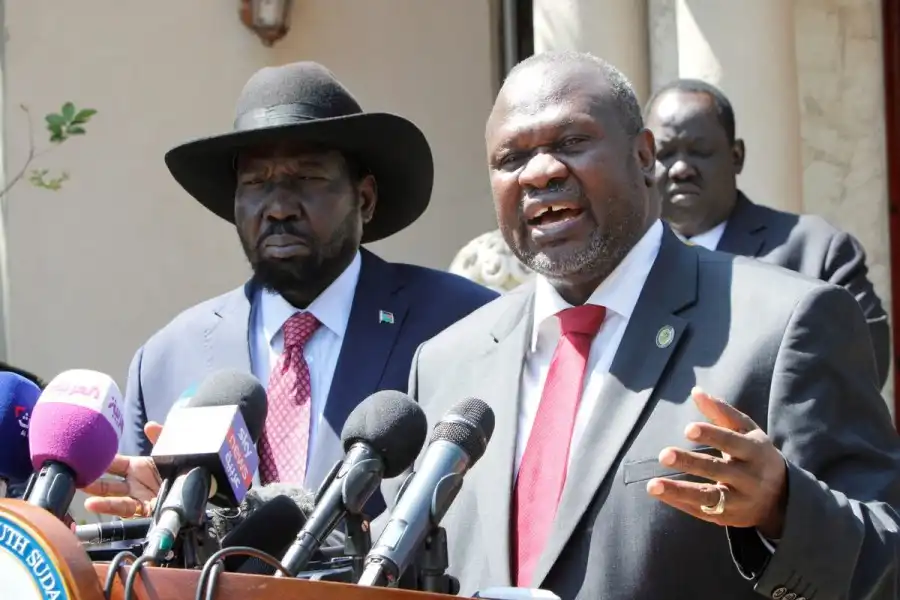
Riek Machar, speaks during a news statement with South Sudan's President Salva Kiir Mayardit (L) (Photo Credit: REUTERS/ Jok Solomun / File Photo)
By Jwothab Othow
July 10, 2026
(Pachodo.org) - Congratulations to the people of the Republic of South Sudan on 15 years of independence from Sudan in 2011. Regrettably, for the past 15 years, SPLM leaders have failed the people of South Sudan, bringing only suffering, death, and displacement to the true custodians of this nation. This month marks the 15th anniversary of our nation’s Independence Day, July 9, 2011 - July 9, 2026. The SPLM leaders have inflicted unimaginable suffering, leading to the deaths of over 500,000 South Sudanese citizens in a senseless war. More than 4 million have been displaced from their ancestral lands due to SPLM leaders driven by greed for power and wealth. I firmly believe that no nation can be built on political deceit; effective nation-building requires a well-coordinated vision and plan.
Is the ongoing violence in South Sudan truly a consequence of ignorance, a backward culture, and poverty? I respectfully disagree with certain South Sudanese political elites who claim the country's problems originate from sources other than their own internal power struggles. In reality, South Sudanese political elites are the primary drivers of the South Sudan crisis due to their internal power struggles. Consider the historical disagreements: the SPLM versus Anya-Nya II in 1983, the SSIM and SPLM in 1991, and again in 2013, which centered on securing the SPLM ticket for the 2015 election. These instances clearly highlight power struggles, rather than ignorance, backwardness, or poverty, as the main catalysts. The disputes were fundamentally about power, leadership of the movement, and its core objectives. Unscrupulous political elites try to convince the impoverished citizens of South Sudan that ignorance, poverty, and a backward culture are the root causes. However, these are not the dominant issues. The fundamental problem lies in the power struggles among political elites who remain indifferent to the well-being of South Sudan and its people.
Inclusive governance and representation are crucial for a nation like South Sudan, ensuring that all ethnic groups are involved in decision-making. This participation helps prevent tribalism and promotes equality. National governments must focus on security, fair development, and equal access to education, healthcare, and economic opportunities. Regrettably, South Sudan’s political elite are primarily motivated by personal desires for power and wealth. It's commonly thought that the ongoing conflict is a result of severe power struggles among the nation's political and military leaders. The central challenge is finding a way to resolve this systematic power struggle to end South Sudan’s protracted war. When South Sudanese politicians cannot attain political power through legitimate channels, they exploit ethnic divisions. This has contributed to South Sudan being considered a failed state since its independence in 2011. This pattern was demonstrated in the 1983 leadership dispute between Anya-Nya II and the SPLM/ SPLA, which led to the deaths of Akuot Atem and Gai Tut, reportedly at the hands of the SPLA, then led by the late Dr. John Garang. Deep-seated mistrust among South Sudanese leaders, along with the actions of those who disrupt peace efforts and benefit from conflict, further hinder the achievement of lasting peace. As a result, South Sudan’s conflict is exceptionally complex, involving political rivalries, ethnic tensions, and regional interests, all of which make peace and stability a significant challenge.
The SPLM leadership has evolved into a bourgeois and corrupt elite, failing to provide South Sudan’s citizens with essential services and development. They have transitioned from liberation fighters to a predatory class, utilizing violent kleptocracy to plunder the nation’s resources from 2005 to the present. After gaining independence in 2011, SPLM elites and military commanders began exploiting their political and military influence for personal enrichment, disregarding the populace and national development. Many SPLM leaders amassed wealth, forsaking their liberation ideals for predatory practices that prioritized personal gain and rapid accumulation of riches over the needs of the citizens. They now vie for power and wealth by exploiting ethnic divisions and establishing patronage networks that control public funds, using money to ensure loyalty rather than investing in national development and infrastructure. This insatiable greed among many South Sudanese political elites became apparent during the interim period in 2005 and has continued post-independence in 2011.
President Kiir, reportedly alongside certain Dinka elites like the Jieng Council of Elders, seems to be fostering Dinka nationalism and a unique political identity. Their goal appears to be achieving dominance in political, social, and economic spheres, even at the expense of other South Sudanese. One can envision the late Dr. John Garang lamenting South Sudan becoming a pawn for regional interests. The Dinka pursuit of expansion and appropriation of others’ land is evident. It is regrettable that President Kiir and some radical Dinka figures, including the Jieng Council of Elders, appear set to destabilize South Sudan in their self-serving quest for power, wealth, and complete control over the nation’s political, social, and economic landscape. It is unsurprising, then, that President Kiir has surrounded himself with opportunistic political figures who revere him to secure their government positions. The most concerning aspect is that President Kiir’s administration and his inner circle have fractured South Sudanese along ethnic lines to preserve their enduring power, and they are resolved to ruin the country at any price. The President’s strategy involves distributing resources to elites to ensure their allegiance. He has governed primarily through presidential decrees and the military intelligence apparatus, exploiting the extensive executive powers vested in him by the transitional constitution. This method has allowed him to rule South Sudan almost as a hereditary domain. Kiir’s authoritarian tendencies, consistent use of decrees, and the appointment of military personnel to crucial roles have eroded institutional processes, effectively transforming the nation into an autocratic state.
President Kiir frequently issues decrees to enact significant changes in high-level appointments, affecting roles such as Vice President and military leadership. This approach prioritizes consolidating power among rival factions and managing loyalties over establishing a meritocracy that could serve the nation. Initially, SPLM leaders empowered Kiir with these broad authorities, assuming they would retain influence alongside him indefinitely. However, Kiir has since utilized these same powers to dismiss many of those very leaders. His decrees often circumvent parliamentary review, undermining the transitional constitution and steering the country towards autocratic rule. These decisions are typically made with a small circle of advisors, lacking transparency and public accountability. Moreover, Kiir’s reliance on military intelligence, often informed by rumors from loyalists, heightens concerns about a resurgence of civil conflict.
Another viewpoint suggests Kiir strategically employs appointments and dismissals as a subtle means of control and indirect coercion of officials. By frequently cycling individuals in and out of positions, he thwarts the development of independent power bases that could threaten his authority. While he sometimes keeps his most trusted allies close, he has also been known to discard them if they become too influential. President Kiir has, for instance, attributed his frequent cabinet reshuffles to a search for competent individuals capable of addressing South Sudan’s severe economic and security crises. He has stated, “I am looking for a solution. That’s why I bring someone in, then remove them and bring in someone else… When I find the right person, I’ll stick with them.” Nevertheless, a crucial question remains: if this is his objective, why does Kiir repeatedly reinstate individuals who have previously demonstrated incompetence in their roles? In practice, these reshuffles, executed by decree, serve as Kiir’s principal mechanism for maintaining control over the government and the ruling SPLM party, thereby preventing any individual from accumulating sufficient power to challenge his leadership.
Those currently serving or slated for appointment by President Kiir should take heed of cautionary tales. General Akol Koor Kuc, formerly the head of South Sudan’s National Security Services (NSS), served as spy chief from 2011. During his tenure, he was responsible for the deaths and detentions of hundreds of South Sudanese at the “Blue House” detention center—actions taken to protect Kiir’s power. Ultimately, Kiir betrayed and detained him. Kiir is an unpredictable leader known for appointing loyalists only to discard them later. He has appointed his own children to key government positions, leading to widespread accusations of nepotism and the transformation of state institutions into a “family business.” The central question for South Sudanese citizens is: what drives the recurring conflicts in the Republic of South Sudan? It appears South Sudan has inherited historical injustices, marginalization, and structural inequalities from old Sudan, now perpetuated by SPLM leaders. The recurrence of political violence in South Sudan involves a multitude of political, ethnic, and structural determinants. For instance, the personalization of power and institutional incompetence, exemplified by the power struggle between President Kiir and Dr. Riek Machar, has deep historical roots. To foster national unity in the multiethnic society of South Sudan, it’s essential to cultivate an inclusive, “civic” identity that celebrates diversity. For us in South Sudan to achieve national unity in a diverse society like ours, it requires a holistic approach including inclusive governance, equitable resource distribution, and intercultural dialogue. The people of South Sudan have suffered under President Kiir’s dictatorial rule for an extended period. A national government should focus on ensuring fair access to resources for everyone, enacting laws to prevent discrimination and tribalism, creating common national symbols, and guaranteeing that all ethnic groups have a voice in politics. Ultimately, citizenship should not be determined by cultural and ethnic backgrounds. A sense of belonging to a shared community is vital for citizens, who should be united by a common vision and understand their interwoven destinies as members of one country.
The SPLM’s vision for a new Sudan was founded on deception, with leaders failing to honor their commitments. They became corrupt, motivated by power and wealth, and showed no interest in developing South Sudan, evident in their purchase of properties abroad for their families. It is vital for South Sudanese citizens to remain vigilant against the pervasive culture of violence, a culture regrettably introduced by SPLM leaders to maintain their long-term hold on power and to exploit the nation’s abundant resources. South Sudan is undoubtedly blessed, but it desperately needs divine guidance to truly benefit from these riches.
South Sudanese leaders should turn back to the God who blessed them with such abundance, embracing freedom, peace, and justice as the path to comprehensive prosperity for the nation and its people. The current senseless and unending war, a direct consequence of leaders’ insatiable hunger for power and wealth, has plunged South Sudan into a failed state where violence is rampant. These leaders require divine guidance, a priceless asset that can deter the greed for power and wealth leading to national failure. God’s divine guidance offers clarity and direction, but only if leaders repent and return to their Creator, seeking help to navigate the crisis they themselves created through their avarice. Only through structural stability and a moral compass rooted in divine principles can South Sudanese leaders and society develop the robust ethical framework needed to manage complex challenges and achieve a peaceful and stable nation.
South Sudan, a diverse, multi-ethnic country, must prioritize cohesion and peaceful coexistence among its people for the collective good. This is essential for peace and security, allowing the nation to benefit from its God-given resources rather than succumbing to war and bloodshed. The country aims to achieve peaceful coexistence through inclusive political structures, economic fairness, and shared national identities. The nation’s stability hinges on establishing powerful institutions that penalize tribalism and bigotry while fostering collaboration among different groups. Equal access to labor markets, public services, and entrepreneurial opportunities, along with a perceived fairness in resource distribution, are crucial pillars for peaceful coexistence and conflict prevention. For peace and stability to prevail, South Sudan needs robust political structures and decentralized good governance that empowers diverse communities to manage their needs. Future democratic governments must implement strong anti-tribalism and anti-discrimination policies, with laws that punish those who engage in such practices. Ultimately, achieving peaceful coexistence is paramount for South Sudan, a nation divided by socio-political, cultural, ethnic, and diverse identities. Solomon Kalushi Mahlangi’s final words resonate deeply: “All we want is freedom, and that’s all we desire. Freedom for children to learn, for men to work, for mothers to love, and for nations to flourish–that’s our sole wish. We seek equality for all. You see, I am merely one among many, a foot soldier. Countless others will follow. Therefore, the revolution will continue, unstoppable by any court, police force, or army. No punishment you decree, no law you enact, can extinguish the people’s will. For we will fight, and we will continue to fight until our people are liberated. Perhaps we will even free you from yourselves. So, you may hate us, degrade us, torture us, and kill us, but we will persevere, and we will be free. One day, freedom will be ours.”
As citizens of this republic, South Sudanese must fight for the second liberation of South Sudan and freedom from the tyranny of Kiir’s regime. Otherwise, this brutal authoritarian regime will continue to kill citizens, subject them to unimaginable suffering, and displace them from their lands. Freedom is not achieved until they act together as citizens of this country to remove this regime, the enemy of the people of South Sudan. After twenty years of SPLM rule, there has been no real development beyond endless wars, killings, and population displacement. The SPLM has become the greatest enemy of the people of South Sudan and their future. They have transformed from liberation freedom fighters into a predatory class, using violent kleptocracy to plunder the nation’s resources from 2005 to the present. Kiir’s authoritarian regime seeks to consolidate power solely in his hands and prevent opposition leaders from participating equally, all to retain power indefinitely. Fair and free democratic elections necessitate citizen involvement. It is vital that citizens actively engage in electoral decision-making through equitable and open elections. Elections are meaningless when an authoritarian regime suppresses dissent, independent media, civil society, and opposition voices, as we witnessed in the 2010 elections before South Sudan’s independence. President Kiir’s security forces intimidated opposition leaders, and under authoritarian rule, accountability and checks and balances are absent. Fair and free elections are impossible in such a state. President Kiir’s pursuit of power through a flawed election grants him undeserved legitimacy and will only prolong the South Sudanese people’s suffering.
It’s ironic that President Kiir’s authoritarian regime speaks of elections in December 2026, especially during a private visit to his hometown in the Bahr el Ghazal region, a country ravaged by violence and with a largely displaced population. Fair and free elections are impossible in an authoritarian state like South Sudan. It’s evident that President Kiir, in his relentless pursuit of power, is trying to gain undeserved legitimacy through a flawed election, which will only prolong the suffering of the South Sudanese people. President Kiir’s best course of action would be to step down, relinquish power, and prepare the country for a peaceful transition through general elections. This would enable the people of South Sudan to elect a new leader capable of providing essential services to citizens and ending systemic violence, thereby achieving lasting peace across the nation. This is the only viable path forward for South Sudan. To foster democratic progress in South Sudan, citizens must reject the tribal politics introduced by the SPLM political elites. Tribalism fuels violence and a dangerous “ends justify the means” mentality. South Sudan’s potent tribalism elevates certain groups, as tragically witnessed in 2013. South Sudanese must actively combat tribalism to build a more peaceful and inclusive society. A united citizenry is essential for meaningful change.
Likewise, opposition groups must unite, prioritizing national interests over internal divisions, and a failure that weakened resistance to Kiir’s authoritarian rule. Widespread support for federalism reflects a desire to decentralize power, improve governance, and prevent autocracy. We will continue to advocate for democratic change, the rule of law, and essential reforms: safety, security, lasting peace, stability, and the dignified return of displaced citizens. May God bless South Sudan and may God bless and protect its people! Let us ask for God’s blessings and safeguarding for the nation of South Sudan and all its people.
The author, Jwothab Othow, is a conservative social thinker, activist and critics against the system fascist tribal politics in South Sudan and can be reached at
Newer articles:
- Governance Under Siege: Corruption and the Zelensky Presidency - 27/07/2026 13:15
- Taking up the responsibility: Why the new universities of Yei, Kuajok, and Aweil should not depend on the national government - 22/07/2026 13:54
- Why the SPLM must modernize via the Communist Party of China - 20/07/2026 19:13
- Research - USA-China-EU: Between Cooperation and Fragmentation in Global Trade - 20/07/2026 19:07
- INTERNAL MEMO - A Call for Unity and Wisdom in the SPLM/A-IO - 15/07/2026 15:28
Older news items
- Celebrating Independence In The Midst Of Sorrow - 11/07/2026 13:41
- Press statement: Strive For National Unity In Honor Of South Sudan's Independence - 10/07/2026 21:23
- The National Backwardness is Embedded in Our Failed Education System - 06/07/2026 19:38
- The Fallacy of Failed Leadership and The True Cause of State Sponsored Chaos In South Sudan - 26/06/2026 19:18
- In foreigners' eyes: What galvanizes young people in a changing China - 26/06/2026 19:10
Latest news items (all categories):
- Op-Ed - Breaking the Double-Standard Lens on China's Population Shifts - 23/10/2026 14:23
- South Sudan ceasefire monitors warn of rising violence ahead of December elections - 23/10/2026 13:39
- UNMISS SRSG visits Malakal, emphasizes that peace begins with collective action - 23/10/2026 13:36
- How Technology is Accelerating South Sudan’s Next Oil Discovery - 23/10/2026 13:34
- South Sudan’s Patriot make case in their opener against Urunani - 23/10/2026 13:12
See also (all categories):
Random articles (all categories):
- Heavy troop presence in South Sudan's Equatoria region - 26/08/2020 12:48
- New South Sudan fighting displaces 25,000 people - 26/04/2017 10:47
- المبدا السادس : يجوز الصلح او العفو فى كل جريمة تتضمن حقاً خاصا ً بمقدار ذلك الحق مع مراعاة احكام جرائم القتل - 05/03/2011 00:00
- Clinton given credit for pushing Sudan, South Sudan to resolve oil fee dispute - MiamiHerald.com - 04/08/2012 17:22
- Old grudges and empty coffers: South Sudan’s precarious peace process - 21/01/2021 05:49
Popular articles:
- The Final Communique of SPLM-DC Third Session of the National Council - 29/03/2011 01:00 - Read 83333 times
- Roles and Definition of Political Parties - 29/04/2011 01:00 - Read 65099 times
- Agriculture in Southern Sudan: Challenges and Investment Opportunities - 06/10/2010 01:45 - Read 57815 times
- Fashoda Youth Forum Rehabilitation of Drainage Culverts in Malakal town Report - 07/08/2008 16:22 - Read 36093 times
- Creation and establishment of the Local Government Councils ( Counties ) (2) - 28/09/2011 01:00 - Read 33978 times
