
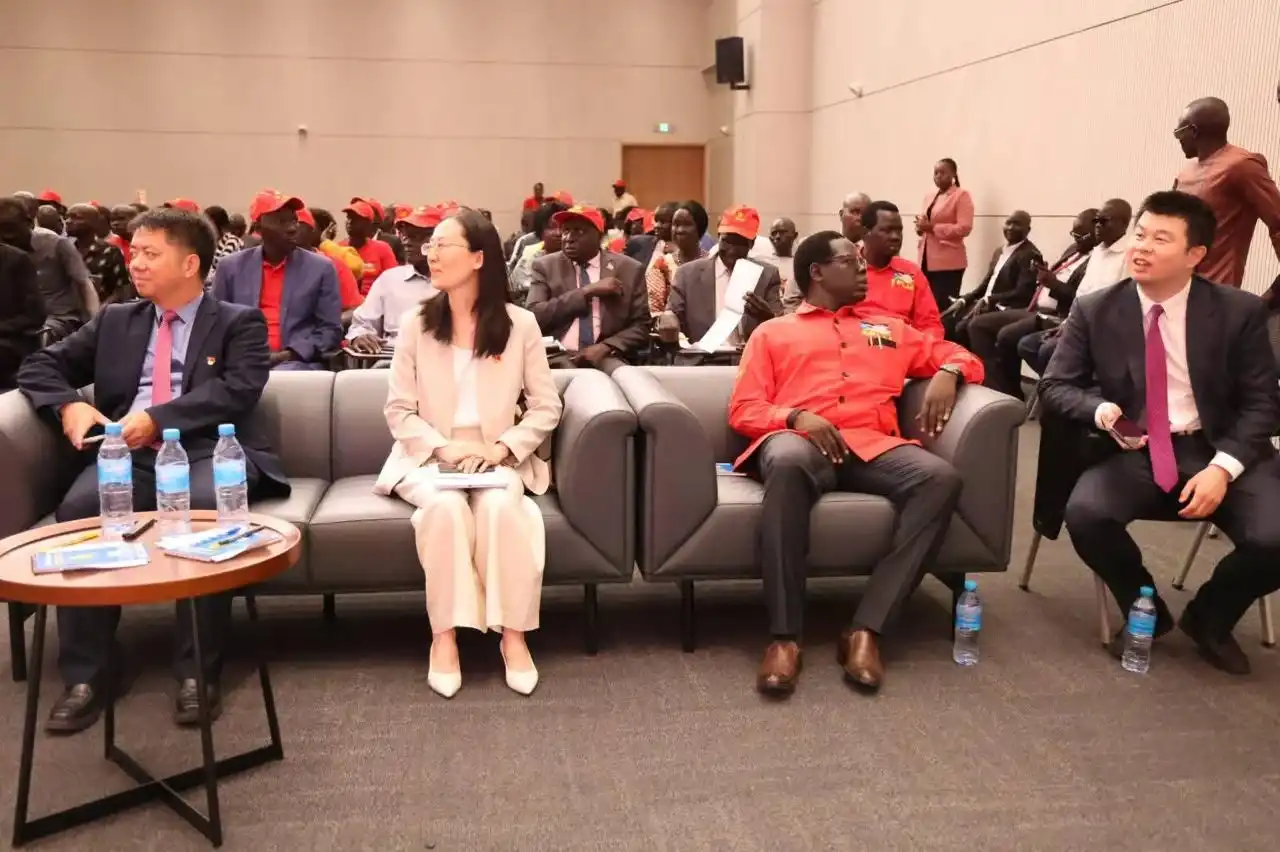
The Sudan People’s Liberation Movement (SPLM), in collaboration with the Embassy of the Communist Party of China (CPC), hosting a one-day symposium on August 25, 2025, at the SPLM National Secretariat in Juba (Photo Credit: The Nile Witness/Courtesy photo)
By *Amaju Ubur Yalamoi Ayani
(Pachodo.org) - On July 7, 2026, the Embassy of the People's Republic of China in South Sudan hosted a high-level symposium in Juba, marking the 105th anniversary of the founding of the Communist Party of China (CPC). It was a rare opportunity for me to attend such an important discussion alongside senior diplomats, including Chinese Ambassador Ma Qiang, South Sudanese Ministry of Foreign Affairs’ Undersecretary Agnes Oswaha, and Sudan People's Liberation Movement (SPLM) Secretary for External Affairs Cde. Bol Makueng Yuol, scholars and distinguished researchers from two countries. The forum convened under a timely theme: “Staying Committed to a Global Vision and Promote the Building of a Community with a Shared Future for Humanity.” For South Sudan, the gathering went beyond standard diplomatic protocol. It offered a rigorous intellectual framework for how a post-conflict country can transition into a sustainable, long-term viable state.
As exchanges of knowledge and experiences were getting deeper-and-deeper, I discovered that true political sovereignty cannot rely indefinitely on the historical memory of an independence struggle. It must be sustained by a disciplined state-building apparatus and an institutionalized developmental roadmap. If the Sudan People’s Liberation Movement (SPLM) is to survive and maintain its leading role for over a century, for example, it must move away from past reactive crisis management. The 105-year operational evolution of the Communist Party of China—specifically its continuous modernization from a fragmented guerrilla force into a global economic contributor—highlights five core pillars that the SPLM can adapt to secure its own institutional longevity.
First and foremost, the CPC’s survival is rooted in its historic ability to completely reinvent its administrative machinery when faced with changing realities. The foundational moment for this structural modernization occurred at the Gutian Congress of December in 1929. Faced with an undisciplined revolutionary army plagued by factionalism and narrow regional loyalties, the CPC institutionalized the principle of absolute party discipline over armed forces. Gutian established that military actions must serve a centralized, programmatic political agenda rather than localized warlord interests—a crucial structural pivot for any liberation movement seeking to build a unified and viable state.
Following its transition to power in 1949, the party survived catastrophic internal shocks by replacing ideological dogmatism with pragmatic institutional planning (Marxism-Leninism). In 1978, the party launched the “Reform and Opening Up” (Gaige Kaifang) under Deng Xiaoping. This move modified the CPC’s governance model. The party abandoned perpetual class warfare and modernized its administrative focus toward efficiency, technocratic governance, and market-driven economic growth.
By the turn of the century, the party institutionalized the mechanism of peaceful leadership successions and integrated private sector innovators into its political framework. From 2012 leading up to 2026, the party underwent another phase of structural consolidation under Xi Jinping. This era focuses on professionalizing anti-corruption agencies, eradicating absolute domestic poverty, and shifting national development from low-cost manufacturing to high-tech green industries and global infrastructure connectivity. Over 105 years, the Communist Party of China evolved from an agrarian underground movement into the institutional architect of a major power because it consistently forces its own internal modernization.
A political party’s long-term survival depends on its capacity to adapt its foundational doctrine to changing material realities without fracturing its core identity. Over its history, the CPC has shifted through distinct ideological epochs—moving from the revolutionary mobilization of Maoism to the market-driven pragmatism of Deng Xiaoping Theory, and finally to the contemporary framework of national rejuvenation and global integration.
The SPLM’s doctrine remains deeply anchored in the armed struggle instead of building on its foundational vision of “New Sudan.” Yet a political narrative built exclusively on past liberation inevitably loses its resonance with younger generations born after independence. Just as the CPC evolved past the insurgent tactics of 1929 to govern a modern state, the SPLM must modernize its core mission from liberation from oppression to liberation from structural poverty. This transition requires codifying a clear national development philosophy that balances South Sudan’s local realities with modern macroeconomic planning.
The concept of a community with a shared humanity is built on the premise that global stability depends on the domestic strength and well-being of individual nations. The CPC does not claim its right to govern solely based on its victory in 1949. Instead, it maintains organizational authority via performance legitimacy. By lifting nearly 800 million citizens out of absolute poverty, for example, the party tied its institutional mandate directly to measurable human development.
For the SPLM, adopting this approach means shifting party operations away from elite power-sharing arrangements toward structural public service delivery. Relying on historical credentials has a clear expiration date. Public loyalty is maintained over the long term by providing infrastructure, standardizing national education, securing agrarian modernization, and expanding rural healthcare. If the party fails to replace its legacy credit with visible developmental results, public discontent will inevitably fuel political fragmentation and give rise to splinter opposition groups.
A central focus of contemporary CPC governance is the practice of continuous internal accountability, conceptualized as “self-revolution” (Ziwu Geming). Mirroring the institutional discipline first codified at the Gutian Congress, the CPC treats systemic corruption and internal factionalism as direct threats to state security. Through mechanisms like the Central Commission for Discipline Inspection, the party actively enforces internal compliance, penalizes misconduct, and maintains organizational coherence.
Political parties emerging from prolonged conflicts frequently struggle with institutional cohesion, often operating as loose coalitions of regional powerbrokers held together by patronage networks. If the SPLM remains structured around individual personalities rather than formalized institutional rules, long-term survival becomes unlikely. To mitigate this risk, it must establish independent internal disciplinary bodies, enforce financial accountability, and build an institutional culture where party rules supersede personal or factional interests.
Modern state governance requires a high degree of technical competence, distinct from the skills needed to run a military campaign. The CPC utilizes a competitive, meritocratic human resource framework. Officials are rarely promoted on personal loyalty alone. Instead, advancement is tied to objective regional performance metrics, including local economic management, public safety, and poverty reduction.
The SPLM must transition its leadership pipeline from a system prioritizing wartime seniority or ethnic arrangement to one based on administrative capability and professional experience. Setting up a permanent, structured SPLM Party School—drawing functional elements from institutions like the University of Juba or the central party school—would allow the party to systematically train its next generation of administrators, civil servants, and diplomats.
China's rapid industrialization was guided by successive, institutionalized Five-Year Plans. This planning framework ensures continuity, preventing the sudden policy reversals often observed in Western electoral systems where incoming administrations regularly discard the long-term projects of their predecessors.
In contrast, South Sudan’s development has been repeatedly interrupted by short-term humanitarian crises and fragmented policy execution. The SPLM needs to institutionalize a multi-decade national development blueprint that remains insulated from routine political re-shuffling. By executing long-term strategies for agricultural independence, infrastructure development, and regional trade corridors, the party can establish itself as the predictable custodian of South Sudan's modernization.
To convert the theoretical insights of the Juba symposium into practical governance, the SPLM leadership should implement the following targeted initiatives:
- Establish a formal separation of military and civilian administration
Emulating the foundational discipline of the 1929 Gutian Congress, the SPLM must structurally insulate party administrative workflows from active military commands. Party organs must operate under specialized civilian oversight to prevent factionalized security interests from overstepping national development policies.
- Launch an SPLM cadre exchange program
In cooperation with the Chinese Embassy, the SPLM Secretariat should create a systematic, multi-year exchange initiative sending mid-career administrators to the Central Party School in Beijing. Training must focus specifically on public resource management, technical policy formulation, and regional poverty eradication frameworks.
- Pilot special economic development zones (SEDZs)
Mirroring China's 1978 Gaige Kaifang pilot frameworks, the SPLM should designate specific, high-potential geographic corridors—such as the Nile river transport routes or agrarian zones in the Equatoria region—as special regulatory zones. These pilot areas can experiment with streamlined business registration, targeted trade incentives, and concentrated state infrastructure spending to attract foreign direct investment.
- Establish an independent internal disciplinary secretariat
The SPLM must create a robust internal anti-corruption mechanism modeled directly after the CPC's self-revolution architecture. This entity must possess an independent mandate to investigate financial mismanagement, penalize performance failures within the party ranks, and root out patronage networks that compromise state infrastructure initiatives.
Bilateral solidarity is most effective when it moves beyond diplomatic statements to address the core mechanics of state survival. As noted by analysts at the Juba symposium, the history of the CPC demonstrates that economic modernization and institutional resilience can be achieved even when starting from severe historical adversity.
Adapting these governing mechanisms is not about duplicating a foreign system; it is about recognizing the structural requirements needed to sustain a ruling party over a century. By focusing on long-term institutional planning, internal accountability, and performance-based legitimacy, the SPLM can convert the conceptual discussions of the Juba symposium into a pragmatic roadmap for South Sudan's future governance.
*About the writer

Amaju Ubur Yalamoi Ayani is a teacher and political commentator. He can be reached via
Newer articles:
- Press Statement From The South Sudan Human Rights Defenders Network (SSHRDN) - 07/08/2026 22:18
- The Emerging Endgame of the Russo-Ukrainian War - 05/08/2026 22:59
- The changing face of “Made in China” - 05/08/2026 22:41
- Governance Under Siege: Corruption and the Zelensky Presidency - 27/07/2026 13:15
- Taking up the responsibility: Why the new universities of Yei, Kuajok, and Aweil should not depend on the national government - 22/07/2026 13:54
Older news items
- Research - USA-China-EU: Between Cooperation and Fragmentation in Global Trade - 20/07/2026 19:07
- INTERNAL MEMO - A Call for Unity and Wisdom in the SPLM/A-IO - 15/07/2026 15:28
- The power struggles among South Sudan’s political leaders are the direct cause of its ongoing conflict - 11/07/2026 14:03
- Celebrating Independence In The Midst Of Sorrow - 11/07/2026 13:41
- Press statement: Strive For National Unity In Honor Of South Sudan's Independence - 10/07/2026 21:23
Latest news items (all categories):
- SPLM-IO High Military Command - Call For A Generals' Command Conference - 14/10/2026 19:37
- SOUTH SUDAN: BEYOND THE POLITICAL EXCITEMENTA Civic and Institutional Accountability Statement - 14/10/2026 19:32
- South Korean FM Cho Calls for Attention to Safety of Hanbit Unit in Meeting with South Sudanese Envoy - 14/10/2026 15:54
- Why is South Africa still pursuing a 7-year-old oil deal in South Sudan? - 14/10/2026 15:36
- As South Sudan plans for elections, a town counts the cost of war - 14/10/2026 15:30
See also (all categories):
Random articles (all categories):
- South Sudan President Seeks Help from China - Wall Street Journal - 24/04/2012 06:00
- Vietnamese peacekeeping unit improving life of locals - 19/08/2022 00:07
- UPDF ready to hit Sudan war planes - New Vision - 05/05/2012 06:00
- UNMISS Force Commander Appreciates Ethiopian Peacekeeper’s Unwavering Support for Peace in South Sudan - 08/10/2022 02:00
- South Sudan's displaced long to return home - 16/07/2022 08:55
Popular articles:
- The Final Communique of SPLM-DC Third Session of the National Council - 29/03/2011 01:00 - Read 83263 times
- Roles and Definition of Political Parties - 29/04/2011 01:00 - Read 65026 times
- Agriculture in Southern Sudan: Challenges and Investment Opportunities - 06/10/2010 01:45 - Read 57733 times
- Fashoda Youth Forum Rehabilitation of Drainage Culverts in Malakal town Report - 07/08/2008 16:22 - Read 36028 times
- Creation and establishment of the Local Government Councils ( Counties ) (2) - 28/09/2011 01:00 - Read 33893 times
