
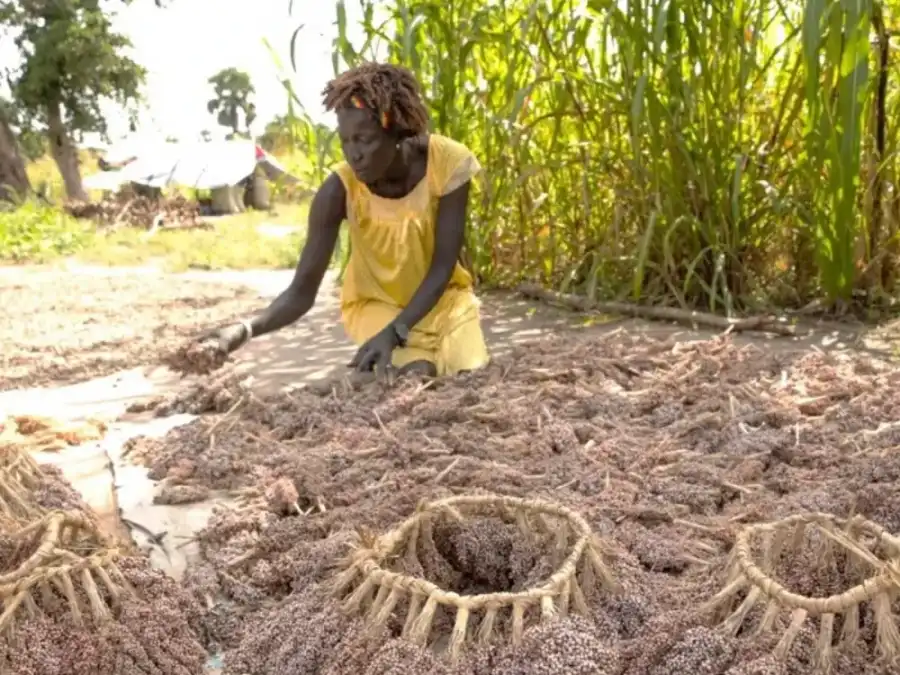
A RALP-supported seed farmer prepares her sorghum seeds, produced for storage in Bor County in Jonglei State (Photo: RALP / World Bank)
For decades, farmers in South Sudan have faced persistent challenges—limited access to quality seeds, subnational conflict, climatic shocks, a weak seed market, and inadequate storage and, certification systems. Together, these factors have severely undermined the country’s agricultural systems, damaging critical infrastructure and disrupting traditional seed networks. Each planting season began with anxiety as farmers waited for imported seed consignments that often arrived late after the rainy season had started, missing the narrow planting window. Worse still, due to poor handling and lack of a regulatory framework, many of the imported seeds failed to germinate in local soils, leaving fields bare, farmers without income, and communities vulnerable to food insecurity. The absence of a resilient, locally based seed system became both a symptom and a cause of wider agricultural fragility in the country.
Today that story is changing, and a new chapter in South Sudan’s agricultural journey has begun, one driven by community-led seed production and local resilience. Through the World Bank’s South Sudan Resilient Agricultural Livelihoods Project (RALP), implemented by the Ministry of Agriculture and Food Security (MAFS) with support from the Food and Agriculture Organization of the United Nations (FAO), farmers are being empowered to produce, certify, and market their own locally adapted seed varieties. RALP’s success lies in its support for the promotion of Community-led Quality Declared Seed (QDS) production systems and the Farmer-Led Seed Enterprise (FLSE) model and it’s work to strengthen quality assurance and build modern seed storage facilities—the first steps toward establishing a reliable, self-sustaining national seed system.
Building the foundation for South Sudan seed regulation
Seed security is food security and requires a robust regulatory system to ensure quality and safety, safeguard varietal purity, and ensure seed quality, certification, storage, distribution, and market confidence. In most countries, these functions are performed by dedicated seed regulatory institutions. However, because South Sudan's agriculture sector is still in its infancy, such systems have remained largely underdeveloped. RALP has supported building the institutions needed to govern the sector through the establishment of 13 Seed Quality Control Boards (SQCBs), support to seed production groups, production and certification of QDS, construction of seed stores to enhance post-harvest handling and ensure proper storage of seeds, provision of foundation seed, and training in seed multiplication and quality assurance. RALP is laying the institutional foundation for a nationally regulated seed system and building the systems that will enable South Sudan to regulate, certify, and sustain its seed sector long into the future.
Bridging supply-demand gap through trade fairs
The impact of RALP’s seed system reform has been strongly driven by the organization of Seeds Trade Fairs, which have become a critical coordination mechanism within the local seed ecosystem. These fairs serve as a structured marketplace, bringing together local seed producers and farmers at the beginning of the planting season. Supported seed producer groups deliver their QDS to a common venue, where farmers from surrounding communities can access, verify, and purchase seeds. This approach has addressed one of the most persistent challenges in South Sudan’s agriculture: delayed and unreliable seed distribution.
Through these trade fairs, farmers now have immediate access to affordable, locally produced, and climate-adapted seed varieties. The direct interaction between producers and buyers is improving trust in seed quality and strengthening local market systems by ensuring that seeds circulate within communities. As a result, planting is done on time, germination rates have improved, and overall crop performance has increased. At the same time, seed producer groups benefit from a ready and organized market, which incentivizes increased production and enhances income generation. Surplus seed can help more farmers, support emergency needs, and boost business growth. These fairs help create steady markets for the locally produced QDS and encourage private investment. The MAFS Directorate of Research has also produced 25 more metric tons of foundation seed to support ongoing seed growing.
Newer articles:
- South Sudan Nutrition Cluster - Quarterly Bulletin | Q3 2026 - 31/07/2026 11:29
- UK: Failed South Sudanese asylum seeker jailed after bringing hatchet and knife to Heywood school - 29/07/2026 18:59
- South Sudan begins voter drive ahead of Dec elections - 29/07/2026 18:51
- Abuse of Civilians in Western Equatoria - 29/07/2026 18:48
- South Sudan Continues Advancing Transfer Pricing and Institutional Reforms - 29/07/2026 18:45
Older news items
- WHO equips health facilities with refrigerators to strengthen access to safe blood - 29/07/2026 18:41
- South Sudan’s first elections won’t be perfect – but another delay could be even riskier - 27/07/2026 13:09
- Bishop Assures Eastern Africa Church of Return to Normalcy in South Sudan’s Wau Diocese - 27/07/2026 13:04
- Sites in Palestine, South Sudan, Lebanon added to UNESCO 'Danger' list - 27/07/2026 12:59
- A desperate appeal from South Sudan: ‘A humanitarian crisis affecting innocent families who desire nothing more than to live in peace’ - 27/07/2026 12:57
Latest news items (all categories):
- China’s new Long March: Why its modernization is a demanding journey - 21/10/2026 12:31
- Drone attack in disputed Sudan-South Sudan border region kills at least 153 - 21/10/2026 12:17
- South Korea - 'Smart camp' system built at Hanbit Unit in South Sudan - 21/10/2026 12:09
- Sudanese refugees in Gorom camp, South Sudan, struggle for water, medicines, security - 21/10/2026 12:05
- South Sudan: A Testing Ground For Democracy While Citizens Struggle To Survive - 19/10/2026 14:31
See also (all categories):
Random articles (all categories):
- South Sudan accuses rebels of mobilizing 'White Army' - 29/12/2013 12:45
- Clashes break out in Sudan's South Kordofan - 26/02/2012 11:13
- Rwanda, South Sudan and DRC nod Naivasha ICD operations - 15/05/2020 02:18
- S. Sudan pushing for elections as term expires - 30/09/2017 13:48
- UNICEF Vacancy Announcement - Health Officer (RRM), NO-B, Temporary Appointment, Juba, South Sudan (Batch recruitment) - 17/01/2018 13:21
Popular articles:
- Who is the darkest person in the world, according to Guinness World Record? - 25/10/2022 02:34 - Read 151173 times
- School exam results in South Sudan show decline - 01/04/2012 17:58 - Read 28327 times
- Top 10 weakest currency exchange rates in Africa in 2023 - 19/07/2023 00:24 - Read 25421 times
- No oil in troubled waters - 25/03/2014 15:02 - Read 24646 times
- NDSU student from South Sudan receives scholarship - In-Forum - 29/09/2012 01:44 - Read 22617 times
