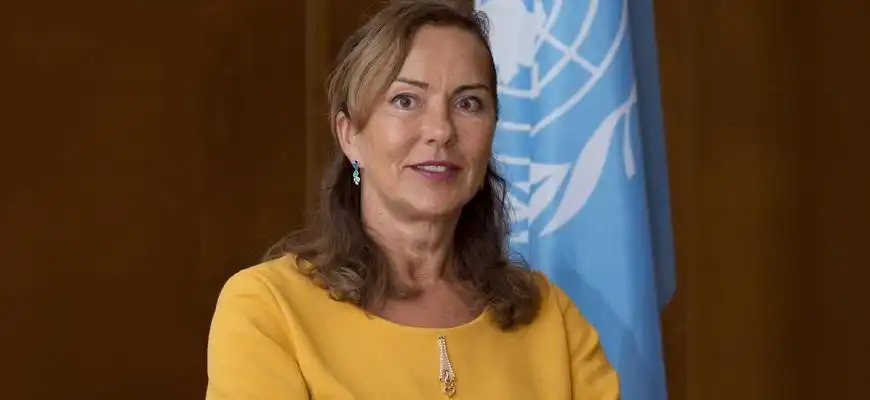
● Olga Algayerova,
Former UN Under-Secretary-General and
Executive Secretary of the United Nations Economic
Commission for Europe (UNECE); Director General
of the Global Academy for Future Governance (GAFG);
and Member of the IFIMES Advisory Board
(Pachodo.org) - At a time when international diplomacy is under extraordinary pressure, the proposed Muscat Process – advanced by a Group of Friends of the Process – deserves strong and sustained support. Its value lies not only in the possibility of achieving a particular political agreement, but in preserving channels of dialogue between the Gulf Cooperation Council (GCC) states, Iran and Iraq throughout the entire crisis cycle—from prevention and early warning, through escalation and crisis, to de-escalation, stabilization and, ultimately, political settlement.
The crisis cycle should also be understood as more than a political or security phenomenon. Every major geopolitical crisis generates an economic crisis cycle. Rising tensions increase uncertainty; uncertainty affects investment, trade and financial markets; disruption to energy supplies, transport and supply chains increases costs; and economic pressure can in turn reinforce political instability. Security and economic risks therefore become mutually reinforcing.
In an international system increasingly shaped by competition among major powers, smaller states are sometimes perceived primarily as recipients of international decisions. The Muscat Process demonstrates the opposite: a smaller state can be an important provider of international security and diplomatic stability.
Oman is a particularly compelling example. Its influence does not derive from military power or economic size comparable to the largest global actors. It derives from trust, credibility, consistency and the ability to maintain relationships across political divides. Oman has demonstrated that diplomatic influence can be built through reliability rather than coercion.
This is a significant lesson for the wider international system. Smaller states can sometimes create diplomatic space that larger powers cannot. Major powers often carry strategic interests, alliances and political expectations that can make direct mediation difficult. A smaller, credible and relatively trusted state may have greater freedom to communicate with all sides without appearing to seek dominance.
The big eats the small, but the fast resists the slow
Smaller states can contribute at every stage of crisis:
At the prevention stage, they can provide early-warning channels and maintain contacts that larger powers may find politically difficult to sustain.
During escalation, they can provide discreet communication and help parties explore possible compromises without requiring immediate public concessions.
At the crisis stage, they can serve as trusted intermediaries capable of transmitting urgent messages and reducing the risk of miscalculation.
During de-escalation, they can facilitate confidence-building and help transform temporary pauses into more durable arrangements.
And during stabilization and recovery, they can support the restoration of economic connectivity, trade, investment and regional cooperation.
The economic dimension is particularly important. Geopolitical crises do not remain confined to diplomatic rooms. They affect energy prices, shipping, insurance, investment, supply chains and consumer confidence. The consequences can quickly become global.
For a country such as Oman, located at a strategically critical intersection of the Gulf, Indian Ocean and wider Middle East, regional stability has a direct economic dimension. But Oman’s role goes beyond protecting its own interests. By helping to reduce the probability of escalation, it contributes to the stability of wider trade and energy networks on which many countries depend.
This illustrates an important principle: economic interdependence can be both a vulnerability and an instrument of peace. When countries understand the economic costs of confrontation, shared interests can create incentives for restraint. Diplomatic regional processes can help translate those shared interests into practical cooperation.
The Muscat Process would therefore therefore represent something larger than a particular negotiation. It is an example of how small-state diplomacy can contribute to global governance.
Such contributions are often most valuble precisely because they are quiet, long-term oriented and above all, non-confrontational.
The broader lesson is that international diplomacy should move from a purely crisis-response model towards a crisis-cycle model combining political, security and economic dimensions. We should ask not only how to respond when a crisis erupts, but how to identify risks earlier, prevent escalation, protect economic connectivity, maintain energy and trade flows, de-escalate confrontation, stabilize affected economies and create conditions for sustainable recovery.
The Muscat Process could embody this approach.
Its strategic value is therefore both political and economic—and its success demonstrates that diplomatic influence does not have to correspond to the size of a country. In some circumstances, the ability to listen, communicate with all sides and create trust can be more valuable than power.
The international community should therefore support the Muscat Process while respecting its distinctive Omani character and its emphasis on discretion. It should recognize Oman not simply as a host or facilitator, but as an example of the constructive role that smaller states can play in an increasingly fragmented international system.
The strategic objective should be clear: prevent crises where possible; manage them when necessary; de-escalate them when they become acute; protect economic connectivity; stabilize afterwards; and use trusted smaller-state diplomacy to keep the door to political settlement open.
In a world increasingly defined by geopolitical fragmentation, the Muscat Process offers an important lesson: small states may not have the power to determine the international order, but they can have the diplomatic capacity to help keep that order from breaking down.
About the author:
Olga Algayerova is a former UN Under-Secretary-General and Executive Secretary of the United Nations Economic Commission for Europe (UNECE). She previously served as Permanent Representative to the International Organizations in Vienna and as State Secretary at the Ministry of Foreign Affairs of the Slovak Republic. She is currently Director General of the Global Academy for Future Governance (GAFG) and a member of the IFIMES Advisory Board.
The views expressed in this article are those of the author and do not necessarily reflect the views of IFIMES.
Ljubljana/Geneva, 27 October 2026
Footnote:
[1] IFIMES – International Institute for Middle East and Balkan Studies, based in Ljubljana, Slovenia, has Special Consultative status at ECOSOC/UN, New York, since 2018 and it’s publisher of the international scientific journal “European Perspectives”, link: https://www.europeanperspectives.org/en
Newer articles:
- Why global companies are debuting products at China International Import Expo - 14/11/2026 21:12
- President Salva Kiir’s Inter-party Dialogue Is A Trap, Never Walk Into It - 14/11/2026 21:04
- IBAHRI - Journalists must be protected, not silenced: global impunity and attacks on media freedom threaten democracy and the rule of law - 02/11/2026 21:19
Older news items
- The long journey back to the wild: The return of Przewalski’s horses - 28/10/2026 17:38
- Op-Ed - Breaking the Double-Standard Lens on China's Population Shifts - 23/10/2026 14:23
- China’s new Long March: Why its modernization is a demanding journey - 21/10/2026 12:31
- South Sudan: A Testing Ground For Democracy While Citizens Struggle To Survive - 19/10/2026 14:31
- Any language counts: Why Chinese deserves greater attention in South Sudan - 19/10/2026 14:22
Latest news items (all categories):
- Why global companies are debuting products at China International Import Expo - 14/11/2026 21:12
- President Salva Kiir’s Inter-party Dialogue Is A Trap, Never Walk Into It - 14/11/2026 21:04
- South Sudan postpones first national elections again, to February 2027 - 14/11/2026 20:29
- Authorities, UN must investigate failure to protect victims of Abiemnom massacre - 14/11/2026 20:20
- A landmark step for public health: South Sudan launches first-ever cancer registry - 14/11/2026 20:16
See also (all categories):
Random articles (all categories):
- 17 presidents among leaders who will attend Ruto’s inauguration - 12/09/2022 01:34
- Can Sudan and South Sudan find friendship? - 15/11/2019 06:11
- U.S.: South Sudan Government Risks Losing Legitimacy - 12/05/2025 10:23
- South Sudan – Burdened by oil dependency? - 25/09/2013 07:00
- Sudan seeks to attract western oil groups as US relations thaw - 11/11/2018 20:20
Popular articles:
- The Final Communique of SPLM-DC Third Session of the National Council - 29/03/2011 01:00 - Read 83468 times
- Roles and Definition of Political Parties - 29/04/2011 01:00 - Read 65303 times
- Agriculture in Southern Sudan: Challenges and Investment Opportunities - 06/10/2010 01:45 - Read 58049 times
- Fashoda Youth Forum Rehabilitation of Drainage Culverts in Malakal town Report - 07/08/2008 16:22 - Read 36233 times
- Creation and establishment of the Local Government Councils ( Counties ) (2) - 28/09/2011 01:00 - Read 34217 times