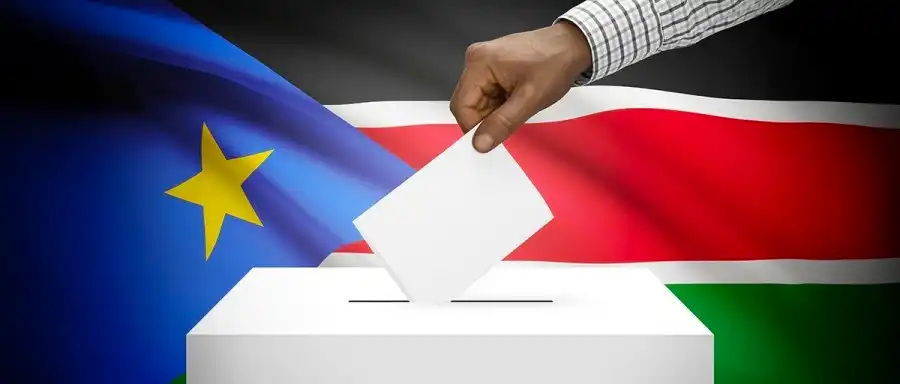
 (Alamy Stock Photo)
By Ernest Ogwaro | Independent Political Commentator
DISCLAIMER: UNVERIFIED POLITICAL INFORMATION
I have received information from individuals claiming to have sources within South Sudan’s political system suggesting that the anticipated December 2026 elections may be partial rather than general elections.
According to these unofficial reports, elections may be limited to governorships and parliamentary seats, while the presidency remains outside the electoral process.
The same sources have suggested that this proposed electoral exercise could cost approximately US$27 million.
I wish to make it absolutely clear that none of these claims has been independently verified, nor am I presenting them as official government decisions. My intention is to examine the possible political, constitutional and economic implications if such arrangements were to materialise.
ARE WE BUILDING A DEMOCRACY OR EXPERIMENTING WITH A POLITICAL KINGDOM?
Since independence, South Sudan has experienced numerous transitional political arrangements, including the introduction of multiple vice-presidential positions as part of efforts to accommodate competing political interests and resolve conflicts.
Now, according to these unverified reports, another political experiment may be under consideration: allowing citizens to elect governors and parliamentarians while maintaining the presidency outside electoral competition.
If this information proves accurate, it raises a fundamental question:
Are we gradually transforming South Sudan into a political kingdom where citizens can elect their representatives but cannot democratically replace the person occupying the highest office?
Such an arrangement could serve the political interests of an incumbent president by preserving presidential authority while allowing limited electoral competition at other levels.
Perhaps this could also explain the intensified political mobilisation of the SPLM, whose supporters have increasingly appeared in their traditional red colours.
However, political mobilisation alone is not evidence that a decision to hold partial elections has been made.
We must distinguish between political speculation and established government policy.
US$27 MILLION FOR ANOTHER POLITICAL EXPERIMENT?
What concerns me even more is the alleged financial cost.
According to the unverified information I received, this proposed electoral exercise could cost approximately US$27 million.
Let us assume, purely for discussion, that this amount is available.
What could US$27 million achieve if invested directly in improving the living conditions of South Sudanese citizens?
Today, communities across South Sudan continue to experience serious economic hardship. Some families struggle to afford basic meals. Others lack access to clean drinking water, functioning healthcare facilities, adequate roads and reliable agricultural support.
In such circumstances, we must examine the opportunity cost of every major government expenditure.
Imagine allocating US$5 million each to five carefully selected development projects.
We could invest in:
1. Agricultural production: Establish mechanised farming projects, irrigation systems and agricultural cooperatives to improve food production.
2. Food-processing industries: Develop small factories to process locally produced maize, sorghum, cassava and other agricultural commodities.
3. Youth employment: Establish productive enterprises that provide employment, vocational training and entrepreneurship opportunities.
4. Healthcare infrastructure: Improve rural health centres, emergency medical services and essential healthcare facilities.
5. Roads and market access: Improve critical rural transport links to connect farmers with markets and reduce the cost of moving agricultural products.
The remaining US$2 million could support feasibility studies, technical assistance, project monitoring and accountability mechanisms.
These are illustrative allocations, not costed project proposals. Their feasibility and impact would depend on proper planning, procurement, implementation and oversight.
Alternatively, the government could distribute development funding across the states to support agricultural initiatives based on their local economic potential.
Imagine what could happen if South Sudan began producing, processing and exporting more of its own agricultural products rather than remaining heavily dependent on imports.
Such investments would not immediately eliminate poverty or food insecurity, but properly managed projects could contribute to employment, economic productivity and long-term development.
ELECTIONS ARE IMPORTANT, BUT ARE WE READY?
I want to be very clear about my position.
I support credible democratic elections and the constitutional right of citizens to choose their leaders.
However, supporting elections does not mean ignoring the conditions necessary to conduct them successfully.
Before conducting national elections, we must ask several important questions.
- Are our electoral institutions sufficiently independent?
- Do citizens enjoy meaningful freedom of expression and political participation?
- Can opposition parties organise and campaign without intimidation?
- Are our security institutions adequately prepared to protect voters?
- Can electoral materials reach remote communities where roads are inaccessible?
- Do we have effective judicial mechanisms to resolve electoral disputes?
- And what happens when citizens require emergency medical assistance during electoral activities in communities without functioning health facilities?
These are not arguments against democracy.
They are questions about whether the country has established the conditions necessary for elections to be credible, inclusive and peaceful.
WHAT HAPPENS TO THE PRESIDENCY AND POWER-SHARING ARRANGEMENTS?
If the reported partial elections were to proceed, another important question would arise.
What would happen to the existing transitional power-sharing arrangements?
Would they automatically come to an end?
Would the President remain in office under a new constitutional arrangement?
Would the vice-presidential positions continue?
And, most importantly, when would South Sudanese citizens be permitted to elect their President through a competitive national election?
These questions require clear constitutional and legal answers.
It would be difficult to describe an electoral transition as complete if the highest executive office remained outside the democratic process without a clearly defined constitutional justification and timetable.
SHOULD SOUTH SUDAN CONSIDER MORE TIME FOR REFORMS?
I understand that many South Sudanese citizens are exhausted by prolonged transitional arrangements.
People have waited for years for credible elections, functioning institutions, economic recovery and accountable government.
Their frustration is understandable.
However, we must also recognise that conducting elections without adequate preparation could create further political and institutional challenges.
If additional time is genuinely necessary, the government should clearly explain why, identify the outstanding reforms and establish measurable deadlines.
Even an additional two years of transition would only be meaningful if accompanied by demonstrable institutional progress, economic improvements and a binding roadmap towards credible elections.
An extension without reforms would simply prolong the existing political uncertainty.
At the same time, repeatedly postponing elections cannot become a permanent justification for retaining political power.
South Sudan needs a credible constitutional pathway that protects both political stability and the democratic rights of its citizens.
AFTER ALL THESE YEARS, ARE WE STILL SEARCHING FOR THE RIGHT GOVERNMENT?
Another question deserves serious reflection.
After more than two decades since the establishment of the autonomous government in 2005, and fifteen years of independence, why are we still struggling to establish stable institutions capable of delivering basic public services?
Why does the appointment or replacement of ministers continue to dominate our political discussions when the more fundamental challenge is institutional development?
A country cannot depend indefinitely on the personal abilities of individual ministers.
It needs institutions that function regardless of who occupies political office.
Good governance is not simply about finding the right ministers. It is about building institutions that make every minister accountable.
We need a functioning public service, independent oversight institutions, transparent financial management, professional security services and a productive economy.
Without these foundations, changing political officeholders alone may not produce the transformation citizens expect.
WHAT OPTIONS DO SOUTH SUDANESE CITIZENS HAVE?
This is perhaps the most difficult question.
Some citizens demand immediate elections.
Others believe the country requires additional time to complete the necessary reforms.
Meanwhile, ordinary families continue to struggle with economic hardship, insecurity and inadequate public services.
So what is the realistic way forward?
Should the country proceed with elections despite unresolved institutional challenges?
Should it consider a strictly time-bound extension linked to measurable reforms?
Or should political stakeholders negotiate a constitutional arrangement that guarantees electoral accountability while addressing the country’s immediate economic and security needs?
These options deserve serious national discussion.
What must not happen is the indefinite continuation of political arrangements without meaningful accountability.
MY FINAL REFLECTION
If the information I have received eventually proves accurate, South Sudan may be entering another phase of political experimentation.
We experimented with transitional power-sharing arrangements.
We introduced multiple vice-presidential positions.
Now, according to these unverified reports, we may be considering elections that exclude the presidency.
How many more political experiments must South Sudanese citizens experience before they can participate in a fully accountable democratic system?
Perhaps we will wait another five years to discover whether the presidency will finally become subject to electoral competition.
But what happens if another five years pass and the same questions remain unanswered?
What happens to the families who cannot afford food today?
What happens to young people who cannot find employment?
What happens to farmers who cannot access markets?
And what happens to children growing up without adequate education and healthcare?
Democracy must improve people’s ability to participate in government, hold leaders accountable and influence the decisions affecting their lives.
Elections and economic development should not be treated as competing priorities. Both are essential responsibilities of a functioning state.
Nevertheless, every major public expenditure must be justified by its legality, transparency, necessity and expected public benefit.
If US$27 million is indeed being considered for a partial electoral exercise, citizens deserve to know the legal basis, the financial breakdown and how the proposed arrangement would advance the country’s democratic transition.
If the reports are inaccurate, the relevant authorities should clarify the electoral arrangements and address public uncertainty.
South Sudan must not become a permanent laboratory for political experiments while its citizens continue struggling to meet their basic human needs.
We need credible elections.
We need functioning institutions.
We need economic development.
And above all, we need a constitutional system in which political authority is exercised on behalf of the citizens, not preserved indefinitely for those already in power.
My final question remains:
Are we building a democratic republic where citizens can elect and replace their leaders, or are we gradually creating a political kingdom where the presidency remains beyond the reach of the ballot box?
The future of South Sudan deserves a clear answer.
Ernest Ogwaro
Independent Political Commentator
17 October 2026
Older news items
- Any language counts: Why Chinese deserves greater attention in South Sudan - 19/10/2026 14:22
- SPLM-IO High Military Command - Call For A Generals' Command Conference - 14/10/2026 19:37
- SOUTH SUDAN: BEYOND THE POLITICAL EXCITEMENTA Civic and Institutional Accountability Statement - 14/10/2026 19:32
- Different times, shared hearts: What brings China and the US together - 23/09/2026 12:54
- Clarification regarding the Land in question grab by the former Minister of Finance and economic planning. Mr. Marial Dongrin Ater - 21/09/2026 14:10
Latest news items (all categories):
- South Sudan: A Testing Ground For Democracy While Citizens Struggle To Survive - 19/10/2026 14:31
- Any language counts: Why Chinese deserves greater attention in South Sudan - 19/10/2026 14:22
- South Sudan seeks investment in water treatment plants to expand safe water access - 19/10/2026 14:16
- Vatican Appoints Interim Chargé d’Affaires to South Sudan - 19/10/2026 14:13
- South Sudan U-17 national team returns to Juba affer CECAFA Qualifiers - 19/10/2026 14:09
See also (all categories):
Random articles (all categories):
- More than 60 wounded in fighting in South Sudan - MiamiHerald.com - 19/03/2013 04:51
- South Korea sends Peacekeepers to South Sudan - Bahrain News Agency - 07/01/2013 02:27
- Deaf teams encounter “double hunger” in South Sudan - 13/02/2022 21:02
- SUDAN-SOUTH SUDAN: Hamid Yussef Bashir, “People end up fighting at the water ... - IRINnews.org - 28/03/2012 02:03
- Eighteen Sudanese soldiers killed in ambush by Chadian group in Darfur, government says - 06/08/2022 00:39
Popular articles:
- The Final Communique of SPLM-DC Third Session of the National Council - 29/03/2011 01:00 - Read 83310 times
- Roles and Definition of Political Parties - 29/04/2011 01:00 - Read 65071 times
- Agriculture in Southern Sudan: Challenges and Investment Opportunities - 06/10/2010 01:45 - Read 57780 times
- Fashoda Youth Forum Rehabilitation of Drainage Culverts in Malakal town Report - 07/08/2008 16:22 - Read 36067 times
- Creation and establishment of the Local Government Councils ( Counties ) (2) - 28/09/2011 01:00 - Read 33942 times