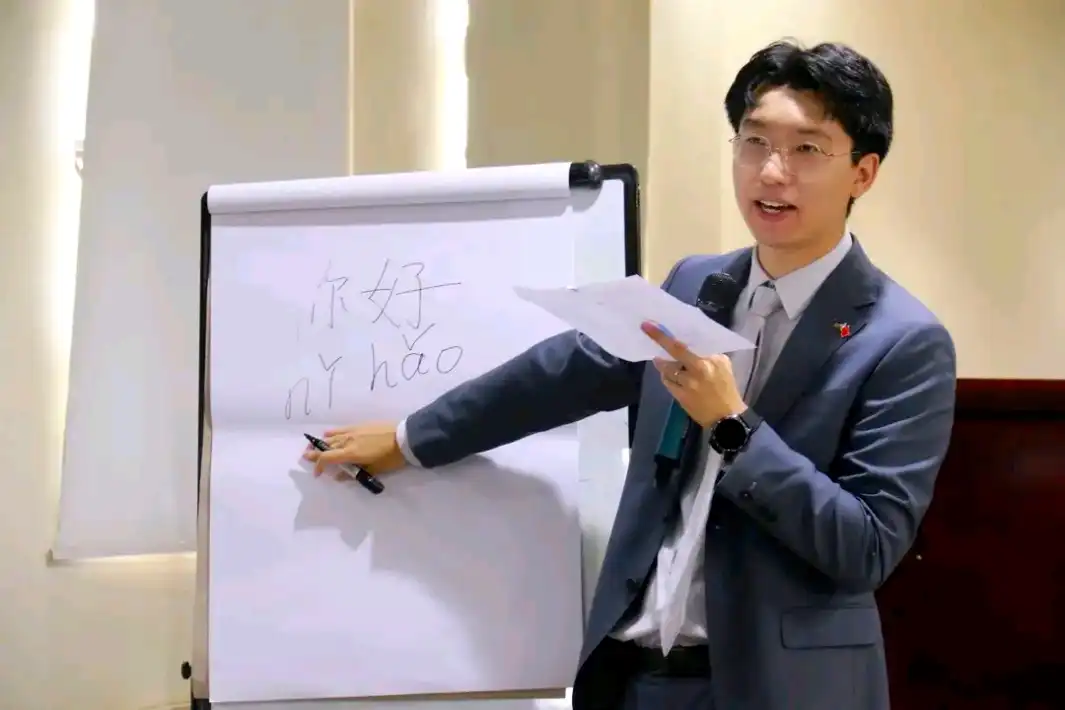
Chinese diplomat Mr. Zhang Zheng instructing university students and faculty members at the Senate Hall, University of Juba )Credit: Chinese Embassy in South Sudan)
By *Amaju Ubur Yalamoi Ayani
A remarkable program took place inside the Senate Hall of the University of Juba on October 15, 2026. Interestingly, more than a hundred South Sudanese university students and faculty members sat side-by-side, cheerfully learning the tones of the Chinese language for the first time. The introduction of this beginner-level Chinese language course—bringing together 124 participants from the University of Juba, Upper Nile University, and Stafford University—marks a profound linguistic development in South Sudan. Led by a Chinese diplomat Mr. Zhang Zheng, the introductory class gave South Sudanese learners their first taste of pinyin and conversational vocabulary. In a world rapidly moving toward multilateralism, this program highlights an undeniable truth for our nation: any language counts, and Chinese language deserves far greater attention in South Sudan.
The first instruction at the Senate Hall of the University of Juba was not a distant experiment but the front line of a changing geopolitical reality. For a developing country like South Sudan that is still navigating the complexities of state-building, economic development, and international diplomacy, the acquisition of global languages such as Chinese is a matter of national interest. As the University of Juba shifts systematically toward making foreign languages available to its students, it signals a strategic departure from remoteness. It recognizes that true progress lies in the ability to speak directly to the world’s economic powerhouses on our own terms. As the old Chinese wisdom reminds us, “To learn a language is to have one more window from which to look at the world.” Chinese is not just a language; it is a transformative window.
Beyond the colonial paradigm
For so long, the historical baggage of the twentieth century colonialism dictated how African nations viewed global languages. Consequently, pessimists often dismiss the intentional acquisition of foreign languages as modern capitulation to foreign powers, arguing that language adoption carries the seeds of a new form of colonisation. However, the 21st century operates on a completely different paradigm—one that no longer treats international languages as tools of colonial subjugation, but rather as strategic instruments of global diplomacy. English and Arabic, languages with deep and sometimes complicated histories in our country, are already widely spoken. Expanding our linguistic toolkit to include Chinese is not an endorsement of colonialism, but a calculated embrace of pragmatism.
In the modern international arena, language is currency, and Chinese is rapidly becoming the gold standard of global trade and diplomacy. To refuse to learn the language of a major global partner out of historical anxiety is to self-inflict a disadvantage. South Sudan must look at language through the lens of agency rather than victimhood. By mastering Chinese, South Sudanese citizens do not lose their identity. Instead, they gain the capacity to negotiate, collaborate, and compete on the global stage with total interdependence. There is a deep truth in the Dinka (Jieng) proverb, “The person who does not travel thinks his mother is the only cook.” By stepping out into the linguistic scenery of others, particularly major powers, we do not diminish our own home; we simply learn how the rest of the world feeds its ideas.
The Nilotic harmony
This cultural bridge becomes even more fascinating when one looks past geography and discovers the unexpected similarities between Chinese culture and South Sudanese traditions. During the inaugural lecture at the University of Juba, students engaged in role-play exercises where they were given Chinese names. For many native speakers of Nilotic languages, the tonal sounds of Mandarin—such as wen, ang, and eng—felt surprisingly familiar. In fact, South Sudanese students from the Jieng (Dinka) and Nuer (Naath) communities immediately noticed linguistic overlaps.
The specific, nasalized pronunciation of words like “weng”, which laterally means “cow” or “cattle” in Dinka, reflects certain pinyin structures perfectly. Beyond phonetics, the monosyllabic nature of many Chinese names such as “Deng”, “Chan”, etc. aligns neatly with Jieng and Nuer naming conventions, where short, tonally significant names carry profound personal and ancestral meaning. This structural alignment makes Mandarin uniquely accessible to South Sudanese ears, stripping away the intimidation factor that usually accompanies learning an Asian language. Far from being an alien, the tonal music of Chinese strikes a resonant chord in the hearts of Nilotic speakers.
Moreover, both societies share deep cultural values rooted in respect for elders, community solidarity, and a profound connection to the land and livestock. In Chinese tradition, familial lineage and community duty are paramount, echoing the social safety nets and kinship structures that have sustained communities across South Sudan for generations. Learning Chinese does not alienate a South Sudanese student from their roots. If anything, it shows how closely aligned our cultural foundations truly are, proving that the distance between the Republic of South Sudan and the People’s Republic of china is far shorter than what geography suggests. It brings to mind the famous idiom from the Analects of Confucius: “Within the four seas, all men are brothers.”
Pragmatism, infrastructure, and the future
Beyond cultural affinity, the practical realities of Chinese global initiatives in South Sudan show that we adapt quickly. From major infrastructural projects such as the modernisation of SSBC amenities, construction of Clement Mboro Bridge, upgrading of Juba Teaching Hospital, modernisation of Juba International Airport Traffic Control, and other installations to critical healthcare interventions—such as Chinese Medical Teams utilizing acupuncture and traditional techniques at the Juba Teaching Hospital and beyond—China’s footprint in South Sudan is broad and tangible. These projects require a workforce that can bridge the communication gap by turning abstract cooperation into local progress. As a popular Nuer proverb warns us, “Words spoken through an interpreter lose their heat.” To rely entirely on foreign intermediaries is to lose the direct, human warmth of our strategic relationships. Learning Chinese allows South Sudanese youth to capture that heat and steer their own development.
Proficiency in Chinese will surely open golden doors for our youth. For South Sudanese students pursuing fields such as international relations, business, petroleum engineering, agriculture, and ICT/IT technology, language proficiency is the key to unlocking fully funded scholarships and accessing cutting-edge scientific knowledge. It bridges the gap between local talent and international enterprise, allowing our diplomats, entrepreneurs, engineers and administrators to communicate seamlessly with partners without relying on foreign intermediaries. This directly enhances our bargaining power in commercial and diplomatic negotiations. There is a sharp Chinese idiom that perfectly captures this preparation for future opportunity, “Opportunities are always reserved for those who are prepared.”
Conclusion
Finally, language is a bridge connecting people, cultures, and ideas. By expanding our educational horizons through the China-Aided Technical Cooperation Project of Education, South Sudan is positioning itself to be an active player on the global stage. If we want our youth to look outward, break down structural barriers, and lead our country into a prosperous future, leaders should give them the tools to do so. Chinese language stands out as the ultimate tool of empowerment for the modern age. On the first day, the attendance in the Senate Hall at the University of Juba proved that the thirst for knowledge is there. Now, it is up to our national curriculum planners, policy makers, and academic institutions to ensure that Chinese language education is given the long-term attention and institutional backing it rightfully deserves.
*About the writer

The writer, Amaju Ubur Yalamoi Ayani, is a South Sudanese teacher, researcher, and political analyst. He holds an MA in International Relations, a B.Sc. in Political Science, both from the University of Juba, and a Diploma in Civics from Hawassa College of Teacher Education in Ethiopia. The writer can be reached via
Newer articles:
Older news items
- SPLM-IO High Military Command - Call For A Generals' Command Conference - 14/10/2026 19:37
- SOUTH SUDAN: BEYOND THE POLITICAL EXCITEMENTA Civic and Institutional Accountability Statement - 14/10/2026 19:32
- Different times, shared hearts: What brings China and the US together - 23/09/2026 12:54
- Clarification regarding the Land in question grab by the former Minister of Finance and economic planning. Mr. Marial Dongrin Ater - 21/09/2026 14:10
- From citizens’ calls to city action: Inside a Chinese hotline - 21/09/2026 14:08
Latest news items (all categories):
- South Sudan: A Testing Ground For Democracy While Citizens Struggle To Survive - 19/10/2026 14:31
- Any language counts: Why Chinese deserves greater attention in South Sudan - 19/10/2026 14:22
- South Sudan seeks investment in water treatment plants to expand safe water access - 19/10/2026 14:16
- Vatican Appoints Interim Chargé d’Affaires to South Sudan - 19/10/2026 14:13
- South Sudan U-17 national team returns to Juba affer CECAFA Qualifiers - 19/10/2026 14:09
See also (all categories):
Random articles (all categories):
- [video] UN Secretary-General Ban Ki-moon in Juba 06/05/2014 - 07/05/2014 17:34
- South Sudan Pursues Fragile Peace, but People Remain Wary - 15/01/2019 01:05
- Wide spread civil conflict may start from Malakal - 05/07/2013 17:03
- South Sudan Public Health Emergency Operations Centre (PHEOC) COVID-19 Weekly Situation Update Report Reporting Period: June 1- 7, 2020 - 08/06/2020 09:55
- Good Governance and Human Rights: - 08/12/2011 00:00
Popular articles:
- The Final Communique of SPLM-DC Third Session of the National Council - 29/03/2011 01:00 - Read 83310 times
- Roles and Definition of Political Parties - 29/04/2011 01:00 - Read 65071 times
- Agriculture in Southern Sudan: Challenges and Investment Opportunities - 06/10/2010 01:45 - Read 57780 times
- Fashoda Youth Forum Rehabilitation of Drainage Culverts in Malakal town Report - 07/08/2008 16:22 - Read 36067 times
- Creation and establishment of the Local Government Councils ( Counties ) (2) - 28/09/2011 01:00 - Read 33942 times