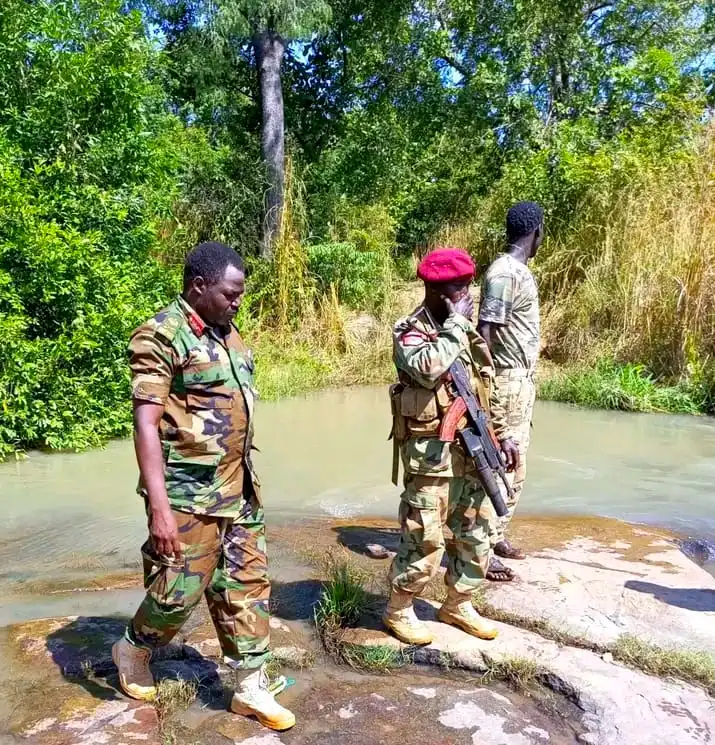
(Photo Credit: Provided/Supplied)
(Pachodo.org) - South Sudanese, let us speak the truth plainly, without fear, political intimidation, or diplomatic sugar-coating that, “President Salva Kiir's so-called Inter-Party Dialogue is neither a genuine peace initiative nor a meaningful process of reconciliation. Rather, it raises serious questions about its intentions, credibility, and political purpose.
This Inter-Party Dialogue, it seemed to be a carefully timed and politically orchestrated exercise that could achieve through political maneuvering what bullets, arrests, and intimidation have failed to accomplish. It is designed to further weakening of the opposition, the undermining of the 2018 Revitalized Agreement on the Resolution of the Conflict in South Sudan (R-ARCSS), and the consolidation of one-man, one-party rule through so called songs of election the regime is pushing for, this 22 December 2026.
Any opposition party, political leader, or concerned South Sudanese citizen who will participate in this process without addressing the existing political and security conditions risks becoming part of a process that could legitimize an already deeply contested political arrangement.
The opposition must therefore reject participation under the current circumstances and demand fundamental changes before any dialogue can take place.
First of all: you cannot dialogue with a jailer like President Salva Kiir. Let us ask ourselves a genuine question, how can this process be described as genuine dialogue when some of the principal opposition leaders who should be represented at the negotiating table are detained?
We all know that the First Vice President Dr. Riek Machar, a principal signatory to the Revitalized Peace Agreement, remains detained and faces treason-related proceedings. Other SPLM-IO political leaders, military officers are held in detention, as well opposition politicians in general are placed under pressure by the regime.
On the other hand, President Kiir has made unilateral political and administrative decisions affecting the transitional government and positions allocated to the SPLM-IO under the Peace Agreement. Military confrontations in parts of Upper Nile, Jonglei, and Equatoria have further undermined confidence in the peace process.
Against this background, the President now invites the opposition to participate in an Inter-Party Dialogue. What kind of dialogue can take place when one side controls the political institutions, security apparatus, and negotiating environment while key figures from the other side remain behind bars?
This is not a level playing field. It is like cutting off someone's legs and then inviting them to compete in a running race.
Genuine dialogue requires political freedom, the release of political detainees, an end to hostilities, and guarantees that all participants can speak and negotiate without intimidation.
Without these fundamental conditions, participation risks normalizing the very practices that have undermined the peace agreement.
Secondly: we cannot allow President Salva Kiir to be a Referee in his own political games. Let us ask ourselves very simples’ questions before we participate. Who is leading this dialogue? Isn’t it President Salva Kiir himself?
This is the same President whose unilateral decisions have contributed to the current political crisis, including changes to the transitional government and the appointment of caretaker officials.
He also presides over a political and security system in which the executive exercises enormous influence over the army, National Security Service, police, government institutions, and other state structures. At the same time, he remains a central political figure in the electoral process that this dialogue is supposedly intended to prepare.
This raises a fundamental question: How can a political leader who is a central party to the dispute also preside over a process intended to resolve that dispute? How can the player also serve as the referee?
A credible national dialogue must be impartial, inclusive, and conducted under conditions that guarantee political neutrality.
If the process is genuinely intended to resolve South Sudan's political crisis, its leadership and mediation should be entrusted to credible and neutral institutions, including the African Union (AU), the Intergovernmental Authority on Development (IGAD), and other relevant international partners.
Holding the dialogue in Juba under the authority of the very government whose actions are being contested raises legitimate concerns about its independence and credibility.
The opposition must not confuse an invitation to participate with a guarantee of genuine political engagement.
Let me warn all of us who are in opposition to the regime of President Salva Kiir that this is a political trap. If you participate as an opposition, you are going to legitimize President Salva Kiir in his game. You boycott it and you will take the blame and this is, we should take it as a very serious matter of concern. This is perhaps the most dangerous aspect of the proposed dialogue, and the opposition must understand it clearly.
If opposition parties participate without securing meaningful guarantees, their presence could be presented as evidence that the process is inclusive, representative, and legitimate.
Photographs of opposition leaders sitting alongside government representatives could be circulated to the African Union, United Nations, international partners, and to the entire South Sudanese as proof that all political stakeholders have embraced the process.
Their participation could then be used to create the impression that the forthcoming elections are taking place under an agreed national political framework.
In reality, however, attendance does not necessarily mean agreement, and participation does not automatically guarantee legitimacy.
On the other hand, if opposition parties boycott the process, the government could portray them as unwilling to pursue peace, opposed to dialogue, or responsible for prolonging the political crisis.
I therefore call upon all genuine opposition forces and democratic stakeholders in South Sudan to adopt a common and principled position. To not participate in a politically compromised dialogue without first securing credible guarantees that address the fundamental causes of the current crisis.
For you as opposition leaders should not allow yourselves to be used to legitimize a process that lacks the necessary conditions for genuine political engagement.
Do not be distracted by financial allowances, political appointments, promises of positions, or the temporary prestige of occupying a seat at the negotiating table. A seat at the table is meaningless if the process itself cannot guarantee fairness, freedom, and accountability.
Instead, you should unite around the following minimum conditions:
1. Release Dr. Riek Machar and all political detainees unconditionally, and guarantee the freedom and safety of political leaders and other stakeholders.
2. Immediately cease military offensives and hostilities against opposition-held areas and pursue verifiable security arrangements.
3. Restore and fully implement the 2018 Revitalized Peace Agreement, respecting its provisions and the power-sharing arrangements established under it.
4. Move any credible inter-party dialogue to a neutral venue, under impartial mediation facilitated by the African Union, IGAD, and other relevant international partners.
5. Prioritize constitutional and security sector reforms before elections, ensuring that the country has the necessary institutional and security conditions for a free, fair, and credible electoral process.
These are not unreasonable demands. They are essential conditions for restoring confidence in the political transition and preventing another cycle of conflict.
Until meaningful progress is made on these issues, the opposition should not provide political legitimacy to a dialogue whose credibility remains seriously in question.
Finally, I wish to argue for us to stop repeating the mistakes of the past where we have witnessed numerous political initiatives presented as opportunities to resolve the country's crisis, such as:
1. The 2016–2020 National Dialogue was introduced with promises of national reconciliation and lasting peace. Yet the country continued to experience conflict, political divisions, arrests, and widespread suffering.
2. The Tumaini Initiative also raised hopes of a breakthrough in resolving the conflict involving opposition groups outside the existing peace framework. However, it has not delivered the comprehensive political settlement that South Sudan desperately needs.
These experiences should remain as our guiding principles that political initiatives cannot produce lasting peace simply because they are given attractive names or organized through conferences and meetings.
What matters is political will, inclusivity, accountability, implementation, and respect for previously negotiated commitments. South Sudan cannot continue establishing new dialogue mechanisms while failing to implement existing agreements. We cannot keep changing the negotiating table while leaving the fundamental political problems unresolved.
The proposed Inter-Party Dialogue must therefore be judged by its substance, not its presentation. The government must demonstrate through concrete actions that it is genuinely committed to political inclusion, respect for the Peace Agreement, and a peaceful democratic transition.
I would like to end by arguing that President Kiir understands that peace cannot be achieved through political intimidation, selective inclusion, unilateral decisions, or the manipulation of dialogue processes. Nor can an election automatically become democratic simply because political parties have been invited to attend a conference beforehand.
The presence of opposition leaders in a dialogue does not, by itself, establish political legitimacy. Genuine legitimacy comes from freedom, accountability, constitutional order, security sector reform, and the consent of the people.
I call on all oppositions to therefore remain united, principled, and focused on the full implementation of the Revitalized Peace Agreement. We must not allow political divisions, personal ambitions, financial incentives, or promises of government positions to undermine our collective responsibility to the people of South Sudan.
Otherwise, history will judge the decisions we make today.
*Major General John Sunday Martin* _(WhatsApp: +256-786666485)_
*_Dated: 9th November, 2026_*
Newer articles:
Older news items
- IBAHRI - Journalists must be protected, not silenced: global impunity and attacks on media freedom threaten democracy and the rule of law - 02/11/2026 21:19
- Research ● Olga Algayerova: Small-State Diplomacy in an Era of Geopolitical Fragmentation - 28/10/2026 17:44
- The long journey back to the wild: The return of Przewalski’s horses - 28/10/2026 17:38
- Op-Ed - Breaking the Double-Standard Lens on China's Population Shifts - 23/10/2026 14:23
- China’s new Long March: Why its modernization is a demanding journey - 21/10/2026 12:31
Latest news items (all categories):
- Why global companies are debuting products at China International Import Expo - 14/11/2026 21:12
- President Salva Kiir’s Inter-party Dialogue Is A Trap, Never Walk Into It - 14/11/2026 21:04
- South Sudan postpones first national elections again, to February 2027 - 14/11/2026 20:29
- Authorities, UN must investigate failure to protect victims of Abiemnom massacre - 14/11/2026 20:20
- A landmark step for public health: South Sudan launches first-ever cancer registry - 14/11/2026 20:16
See also (all categories):
Random articles (all categories):
- Sudan's Leading Edge - The Cutting Edge - 11/06/2012 01:05
- G20 leaders pay respects at Gandhi memorial as they wrap up Indian summit and hand over to Brazil - 11/09/2023 01:01
- South Sudan's central bank governor, other senior government officials sacked - 15/01/2017 01:54
- In South Sudan, a new constitution seen as ultimate saviour from perennial strife - 25/08/2024 10:46
- South Sudan Parliament Split On Vacant Speaker’s Position - 26/08/2013 15:48
Popular articles:
- The Final Communique of SPLM-DC Third Session of the National Council - 29/03/2011 01:00 - Read 83461 times
- Roles and Definition of Political Parties - 29/04/2011 01:00 - Read 65283 times
- Agriculture in Southern Sudan: Challenges and Investment Opportunities - 06/10/2010 01:45 - Read 58030 times
- Fashoda Youth Forum Rehabilitation of Drainage Culverts in Malakal town Report - 07/08/2008 16:22 - Read 36222 times
- Creation and establishment of the Local Government Councils ( Counties ) (2) - 28/09/2011 01:00 - Read 34189 times