
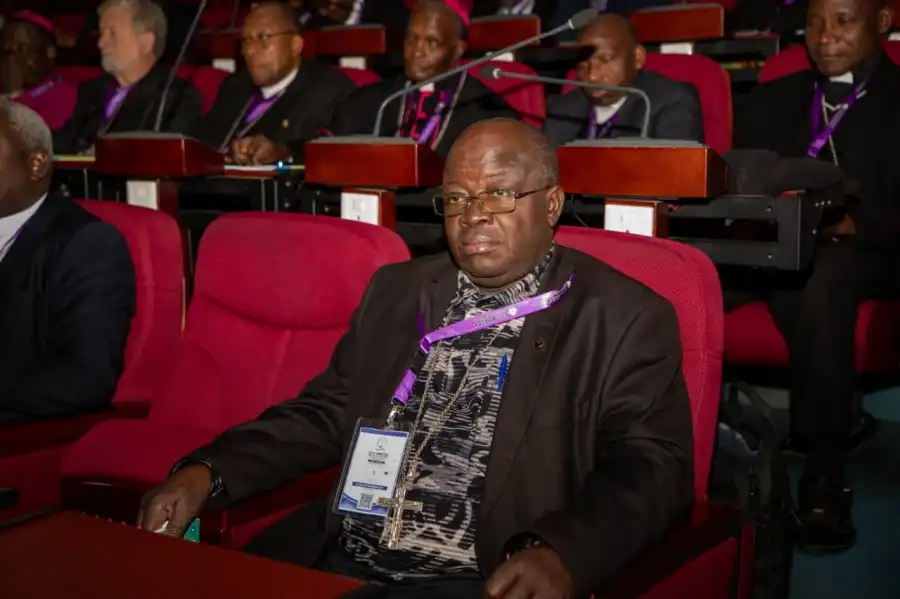
Bishop Matthew Remijio, South Sudan, Wau Diocese (Photo Credit: Association of Member Episcopal Conferences in Eastern Africa - AMECEA)
The Catholic Diocese of Wau in South Sudan is steadily returning to normalcy following years of civil conflict, with previously abandoned parishes reopening and communities gradually returning to their homes, Bishop Matthew Remijio has said.
Speaking during an interview at the Catholic University of Eastern Africa (CUEA) in Nairobi, where while attending the 21st AMECEA Plenary Assembly, the South Sudanese prelate acknowledged that improved security and strong collaboration between the Church and the government have enabled pastoral work to resume across much of the diocese.
“Wau Diocese is very vast, and we are enjoying the pastoral work there because there is stability,” the bishop said. “I thank the government for that because you can move day and night freely. In the diocese, there is security that allows the bishop to carry out his pastoral work freely.”
The bishop further explained that restoring the Church’s presence in communities affected by war became one of his priorities after assuming leadership of the diocese.
“The first thing I did was undertake pastoral visits to all the parishes. I took the risk and courage to reopen all the parishes that had been suspended during the war because I believe that the presence of a priest in any place brings people back. The priest is there for them.”
Although the diocese has made significant progress, His Lordship acknowledged both the challenges and the joys of pastoral ministry, saying they continue to shape the day-to-day mission of the Church.
“The Catholic Diocese of Wau is very vast. It has more than 3.6 million Catholics. Despite all the challenges, the long distances and poor roads for pastoral work, once you reach the people, you forget all the pain, the suffering, and the rough roads because you receive a warm welcome. The people are attentive, receptive, and eager to listen.”
Among the key priorities of the youthful bishop is the use of communication as an essential tool for evangelization. He highlighted the diocesan radio station, Voice of Hope, as a trusted source of information for both the Church and civil authorities.
“This is a vital radio station. People across the states are listening to it because it is reliable. Even the government, when they want to reach the citizens, comes to the Church radio because it reaches Rumbek, Juba, and four states. It makes communication much easier.”
Despite the progress made in the diocese, Bishop Remijio appealed for continued support from the global Church and people of goodwill for a diocese whose needs range from infrastructure and pastoral facilities to professional expertise in education, healthcare, and administration.
“We need everything,” he said. “Not only financial support, but also experts who can help us strengthen our institutions, our schools, hospitals, and pastoral work.”
While Wau currently enjoys relative stability, the bishop acknowledged that insecurity persists in other parts of South Sudan, disrupting pastoral activities and displacing communities.
He reaffirmed the Catholic Church’s commitment to promoting peace, reconciliation, and national unity through dialogue and prophetic witness.
“The Church will never stop advocating for peace and reconciliation,” he said. “Our mission is to encourage peaceful coexistence among all the sons and daughters of South Sudan.”
Reflecting on the steps being taken by the Church in Eastern Africa to address the challenges facing young people across the region, Bishop Remijio expressed hope regarding the active participation of the youth in the synodal journey.
“From what I have seen through the participation of the youth in this Synod, there is hope. There is hope for the youth in East Africa, especially in their active role in the Church and society. The message I can give them is that despite the challenging economic situation and all they are going through as they struggle to find their place in the Church and society, they should not give up.”
He added that the call by young people for greater inclusion in decision-making, a recurring theme during the assembly, would be embraced through discernment in keeping with the mind of the Mother Church and within the synodal journey.
“We have opened this opportunity for them to participate fully with us in the decision-making process in the Church and in society. In the Church, all forums are now open for young people to participate actively. Before making any decision, we have to discern together according to the mind of the Mother Church, and together we reach the decision-making stage.”
“They should not give up because the Church depends on them, society depends on them, and tomorrow the Church will continue to depend on them,” he urged.
Newer articles:
- Abuse of Civilians in Western Equatoria - 29/07/2026 18:48
- South Sudan Continues Advancing Transfer Pricing and Institutional Reforms - 29/07/2026 18:45
- Building South Sudan’s Homegrown Seed Industry is Creating Local Opportunities - 29/07/2026 18:43
- WHO equips health facilities with refrigerators to strengthen access to safe blood - 29/07/2026 18:41
- South Sudan’s first elections won’t be perfect – but another delay could be even riskier - 27/07/2026 13:09
Older news items
- Sites in Palestine, South Sudan, Lebanon added to UNESCO 'Danger' list - 27/07/2026 12:59
- A desperate appeal from South Sudan: ‘A humanitarian crisis affecting innocent families who desire nothing more than to live in peace’ - 27/07/2026 12:57
- 2027 AFCON: Malawi Flames to Start Qualifiers Against South Sudan - 27/07/2026 12:38
- Arms smuggling: a key threat to South Sudan’s December elections - 24/07/2026 13:23
- UNMAS destroys explosive remnants of war across South Sudan with support from the Netherlands - 24/07/2026 13:21
Latest news items (all categories):
- China’s new Long March: Why its modernization is a demanding journey - 21/10/2026 12:31
- Drone attack in disputed Sudan-South Sudan border region kills at least 153 - 21/10/2026 12:17
- South Korea - 'Smart camp' system built at Hanbit Unit in South Sudan - 21/10/2026 12:09
- Sudanese refugees in Gorom camp, South Sudan, struggle for water, medicines, security - 21/10/2026 12:05
- South Sudan: A Testing Ground For Democracy While Citizens Struggle To Survive - 19/10/2026 14:31
See also (all categories):
Random articles (all categories):
- Bashir, Kiir pledge to open new page in Sudan ties, keep oil running - 03/09/2013 11:13
- Chagrin Falls Middle School students raising funds to provide water to South Sudan - 23/04/2022 00:01
- South Sudan: Failing South Sudan - First As Tragedy, Then As Farce - 07/10/2016 04:29
- South Sudan Archbishop Dies; Remembered as Promoter of Peace - 06/04/2021 14:07
- Democracy, Multi-party democracy and the debate on pachodo.org - 27/08/2010 01:00
Popular articles:
- Who is the darkest person in the world, according to Guinness World Record? - 25/10/2022 02:34 - Read 151178 times
- School exam results in South Sudan show decline - 01/04/2012 17:58 - Read 28329 times
- Top 10 weakest currency exchange rates in Africa in 2023 - 19/07/2023 00:24 - Read 25426 times
- No oil in troubled waters - 25/03/2014 15:02 - Read 24648 times
- NDSU student from South Sudan receives scholarship - In-Forum - 29/09/2012 01:44 - Read 22619 times
