
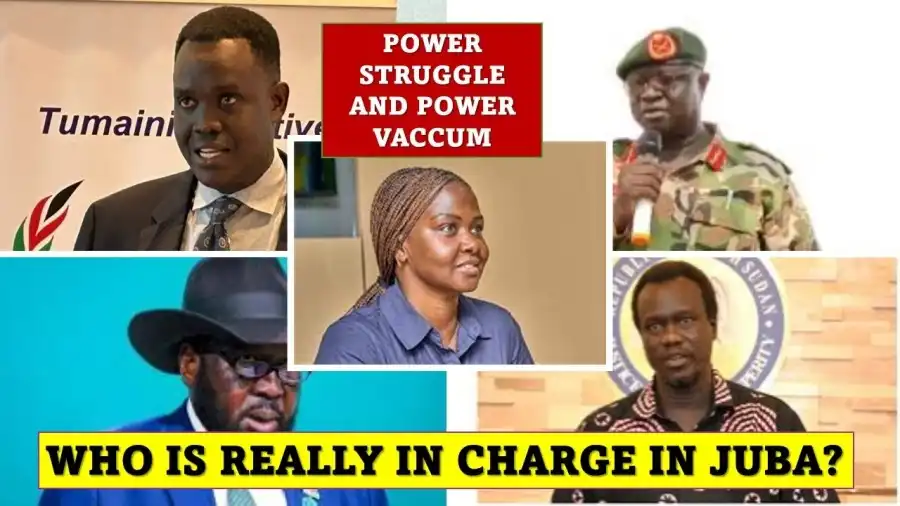
(ScreenGrab Credit: Youtube/ KuirthiyTV)
By: Elhag Paul
(Pachodo.org) - There is a raging debate among South Sudanese as to what the problem is in South Sudan. The media is mute on it, those who see it are afraid to speak out. Those who know it are scared stiff to say it as it is, including some South Sudanese YouTubers and Facebook influencers. So they zip their mouths, without identifying the issue and settling it accordingly; South Sudan is heading into atrophy. On the other hand, if South Sudanese confront the issue head on, the country can be salvaged from self-destruction, leading into healing and positive development.
Presently there are three groups of thought in the country. The first group believes that the problem is a failure in leadership. The second group believes that President Salva Kiir Mayardit, as a person, is the problem. The third group argues that the problem of South Sudan is Jieng tribalism. Additionally, the United Nations and its agencies like the United Nations Human Rights Commission (UNHRC), World Food Programme (WFP) and others, plus other institutions including Trioka (the governments of UK, USA and Norway); African Union (AU), and The Sentry, all share the perspective that the problem of South Sudan is a failure in leadership. Most of their reports and statements on their position, with regards to the situation in South Sudan clearly identify leadership failures as the reason for the chaos in the country. This view started in 2013 following the genocide of the Nuer people, and the failures of the Kiir government to implement the two peace agreements of 2015 and 2018. Since then, this view has gained traction in the media.
Recently as of 2025 other South Sudanese have also argued strongly, as those institutions mentioned previously, that the problem of South Sudan is a failure in leadership. A key example of this is Mr Lual Dau, the Spokesman of United People Alliance (UPA), an opposition umbrella movement consisting of Real SPLM led by General Pagan Amum Okieck; South Sudan United Front/Army (SSUF/A) led by General Paul Malong Awan; South Sudan People’s Movement/Army (SSPM/A) led by General Stephen Buoy Rolnyang; and South Sudan Salvation Movement (SSSM) led by General Nhial Deng Nhial.
Dau referring to the governance of the Sudan before the independence of the South, argues that the leaders in Khartoum failed to build institutions to provide services to the people. When this failure became clear to the people, the leaders shifted to using religion and race to oppress the southern Sudanese. This led to the resistance and eventual secession of South Sudan. Dau stresses that the leaders in South Sudan are following the same path as the leaders in Khartoum. He believes Kiir’s government is composed of all South Sudanese tribes forming an elite group that is responsible for mismanaging the government. He concludes that the problem is always about power, and it has nothing to do with ethnicity.
Dau argues strongly that the elites in South Sudan can do anything including using ethnicity to gain power, as Dau claims is the case with President Kiir. This mechanism of using ethnicity to gain power is not new, because in the 1970s when General Lagu came to power, Mr Abel Alier went to Khartoum and mobilised his tribe’s mates, enlisting late Ambrose Ring and late Bona Malual to regain power in Juba. Dau goes on to say that political and military elites are the problem of South Sudan. Dau presented this position on the subject in Clubhouse in a Room called Grassroot Media Centre, titled ‘Second Liberation of South Sudan is a must.’ Feb. 14, 2026 (https://www.clubhouse.com/i/second-liberation-of-south-sudan-is-a-must/8sqPaqWn)
Dau further explains how he believes power in South Sudan operates, please see his interview in Kuirthiy TV, titled, ‘Power, Chaos and Corruption: Hon. Lual Dau on Power Struggle in Juba.’ (https://youtu.be/Khplg5PySEA?si=5H6jnm7UfqPrkTKL)
The argument advanced by the international community and people like Mr Lual Dau that leadership failure is the problem in South Sudan fails to take into consideration the role of ideology in governance. Power and ideology are twin forces that go together. Derek Layder in his book, ‘Understanding Social Theory’, highlights that some people neglect to examine the role of ideology in the establishment and maintenance of power relations. Ideology is a crucial factor in so far as it refers to a set of beliefs and values that serve to explain and justify existing power dynamics. Dau’s emphasis on power is devoid of the force of ideology. In addition, his explanation ignores the fact that the individuals he is referring to in the video, mostly come from one ethnic group, the Jieng, who control the government and the economy of South Sudan. The power struggle Dau talks about is an internal Jieng phenomena. Dau is projecting internal Jieng politics and dynamics onto a national canvas, falsely claiming that internal Jieng dynamics reflect the behaviour of all the 64 tribes of South Sudan, this false claim is extremely dangerous and misleading.
The second group forcefully argue that ‘Kiir is the problem’ alone, this second group has its roots in the Red Army, a group formed from the Sudan People Liberation Movement/Army (SPLM/A), who were sent abroad to study in prestigious Universities in the West. Prominent among this group is Peter Biar Ajak, Abraham Aolwich, Jok Madut Jok, Kuir Garang and others. This group has no problem at all with the promotion of tribal ideology in the country. They are diehard supporters of it. Not a single one of them has condemned the genocidal policies of the government, policies which continue to this day. For example, the Nuer genocide in 2013, and the Equatoria genocide in 2016. For more details please see the ‘The African Union Commission of Inquiry on South Sudan’ (https://peaceau.org/uploads/auciss.final.report.pdf), ‘War and Genocide in South Sudan’ by Clemence Pinaud (2021) and ‘Abuse of Intellectual Credentials in Promotion of Domination’
This group’s problem with President Kiir relates to a promise made to them by the former leader of the SPLM/A, the late Dr John Garang. He, John Garang, told the Red Army that the SPLM was preparing them to become the leaders of tomorrow, a class of Jieng youth trained to replace the Jieng leaders contemporary to Dr Garang at the time. On completion of their studies, some of the Red Army remained abroad, however, for the ones that returned, they were deployed to strategic positions in the following ministries, the ministry of defence, ministry of culture and the Sudd Institute, a Jieng Think Tank wrapped in the national colours of the country, to portray it as a national institution. This group played a key role in the creation of the notorious security facility known as Blue House.
What this group did not know is that President Kirr and his old guards are not about to cede power to them. On realising their hope was dashed, Peter Biar left the country and began to appear as a co-panellist on the National Television Network (NTV) in Kenya making commentaries and criticising the government of South Sudan. For a proper understanding of the issue, please see this crucial video, ‘Peter Biar- "Generational Exit" philosophy- The reason he was jailed by the government.’ (https://www.youtube.com/watch?v=3txEef8ydXg).
So this group headed by highly educated Red Army tribalists, want by all means to take control of the government from President Kiir, and the JCE. This agenda of removing Kiir and the JCE is so that Red Army alumni can continue to manage the country pursuing a tribal programme with a new face, which they believe will help in implementing their common tribal ideology. However, President Kiir’s refusal to leave has frustrated the Red Army group, this is because Kiir’s approach to colonising South Sudan for the benefit of the Jieng elite, is gathering concerning opposition across the board, and risks the loss of current Jieng achievements, particularly the Jienganisation of the South Sudanese state. Additionally, the emergence of another opposing force that fuels the frustration of the Red Army group, is the traction that Equatorian and Upper Nile separatists are beginning to gain in South Sudanese public discourse.
The Red Army group, has of recent gained significant steam due to the diehard tribalists flocking to it. They are now prepared to sacrifice President Kiir to save their tribal ideology and preserve Jieng control of the South Sudanese state. Some Jieng apologists from the oppressed tribes have also joined this group to try to portray themselves as loyal to the State, in order to appease Jieng tribalists, who conflate Jieng tribalism with South Sudanese patriotism.
The third group are those who believe that the problem of South Sudan is Jieng tribal ideology, such as myself Elhag Paul. We who belong to the third group argue that the leaders of the Jieng have consistently, over the last half a century, practiced tribalism. As the Jieng leaders did not hide their intentions, but instead they have made it abundantly clear in their statements and interactions with fellow South Sudanese. Not only this, but they shared it with Carol Berger in her report. Please see, ‘Ethnocide as a Tool of State-building: South Sudan and the Never-ending War.’ (https://updm-rss.org/ethnocide-and-south-sudan-never-ending-war/). To see examples of the arguments for this third position, please see, ‘Root cause of South Sudan’s Problem’ (https://pachodo.org/pachodo-english-articles/34229-root-cause-of-south-sudan%E2%80%99s-problem?tmpl=component) and, ‘The decline of Equatoria and emergence of Jieng tribal power in South Sudan’ (https://pachodo.org/pachodo-english-articles/43679-the-decline-of-equatoria-and-emergence-of-jieng-tribal-power-in-south-sudan).
The founding leader of the SPLM/A Dr John Garang himself, a Jieng said the SPLM/A war itself was triggered by the Jieng loss of power in the then regional government of Southern Sudan. In his book, ‘The call to democracy’ edited by Mansour Khalid, Garang points out on page 4 that, ‘…...the immediate reasons that triggered off the rebellion, specifically those decisions taken by Nimeiri to play the South against North, to divide the South itself and completely to overturn the constitutional settlement of the Southern question as laid down in the Addis Ababa Agreement.” Garang further reinforces his views about Kokora (the call for decentralisation of Southern Sudan) clearly by expressing on page 7 that, “Again, at a personal level, if there was one thing that made me go the additional mile in my opposition to Nimeiri, it was his dismantling of the Addis Ababa Agreement and abortion of the process of national integration. That agreement, with all its limitation, was our greatest achievement.” It is very important to note that the Jieng loss of power was specifically due to their application of their tribal ideology of Jieng supremacy. This resulted into Equatoria declaring Kokora (Decentralisation policy) leading to abrogation of the Addis Ababa Agreement in 1972.
Garang was a suave, brilliant and captivating speaker, a man of charisma, who had a rare combination of political, military, and intellectual intelligence. These characteristics made him a dangerous tribalist who masqueraded as a patriot and unionist. Due to his nature, he was able to mislead southern Sudanese by creating confusion about his true political beliefs. Garang was mentored by none other than the lord of Jieng tribalism himself, Mr Abel Alier responsible for the introduction and practice of Jieng tribalism in the southern Sudan regional government, in the early 1970s to early 1980s.
Unlike Garang, President Kiir is not an intellectual. His educational achievements remain unknown. However, speculation is that he only completed elementary education. President Kiir operates in your face. His military intelligence training has taught him observational skills, consultation, connivance, execution of policy and silence. He implements the Jieng ideology of supremacy without second thoughts. He enforces the Jieng ideology openly based upon the use of brute power, to achieve their stated objective – Jieng supremacy and takeover of the country.
President Kiir’s brutal strategy has allowed him to ethnocise the security sector, diplomatic service, civil services and control of the economy. He frequently and regularly appoints his tribe’s mates, mostly unqualified, semi-literate and crudely violent to government posts. He arms Jieng and allows the cattle herders to wield the power of life and death without any accountability. For example, the Jieng strategy of expansion is executed by the heavily armed cattle herder. They intrude into others lands, ravage crops by letting their cattle run free, and kill any local who tries to protect their crops, creating an environment of extreme fear. The only word that describes this situation is terror. The weaponisation of the cattle herders as a tool of displacement, control of space and psychological terror sums up the brute display of Jieng power and control of the state.
The cattle herders go into the targeted tribes land and set up cattle camps, this serves a purpose. It is the nucleus of Jieng development, growth and settlement formation in new lands. They then import Jieng from their lands into this new area and set up chieftaincies and they begin to impose themselves as the local rulers ignoring the indigenous people, and their structures of local governance. Using violence, they then gradually expand the cattle camps with new comers and they begin to name themselves as Jieng of the area. For example, the Jieng in Nimule now call themselves Jieng of Nimule. This strategy has been used by the Jieng in Tonj in Warrap state. Tonj originally was a Bongo land. The Jieng using this strategy in the 20th century kicked the Bongo out, forcing them to immigrate to Central African Republic. The same strategy was used to push the Zande and the Jur Bel out of Rumbek.
Once the nucleus of settlement is set, the rest is left for time to work out and create the reality of Jieng takeover of the land. This deadly strategy of expulsion of indigenous people has devastated the people in the countryside in Equatoria, and the other two regions. It is likely that within half a century the Equatorians and others will have been forced out of South Sudan. This is why Carol Berger’s working paper needs to be taken seriously.
In Equatoria, it pushed people into neighbouring countries as refugees. The total number of Equatorians in Uganda alone is over a million. In Upper Nile, it displaced people to Ethiopia and Sudan with huge numbers internally forced to live in Protection of Civilian Camps managed by the United Nations, with their land occupied by the Jieng imported from Jieng lands in northern Bahr El Ghazal.
Therefore President Kiir’s in your face use of violence against others to the benefit of his tribe, in less than two decades has silenced the people, as well as normalised and conditioned the Jieng as the leaders and owners of land in South Sudan. Fulfilling their rhetoric of ‘Born to rule’ and ‘Equatorians are not South Sudanese’, President Kiir has successfully managed to bring the regional countries to his side. Uganda now habitually deploys its troops to South Sudan conducting joint operations with the tribal army, South Sudan People Defence Force (SSPDF) against the people of South Sudan. They bomb civilians with cluster bombs and chemical weapons routinely. They kill women, children and the elderly without any concerns about accountability. Even, General Mahoozi Kainerugaba, the chief of Uganda Army bragged about their criminality in South Sudan. He said, “I’m tired of killing Nuer. Tell your leader Riek Machar to come and kneel down before ‘Our’ President H.E. Salva Kiir.” Please see, ‘Uganda Army Chief says he is tired of killing Nuer.’ (https://www.radiotamazuj.org/en/news/article/uganda-army-chief-says-he-is-tired-of-killing-nuer)
Jieng leaders since 1964 have connived with the enemies of southern Sudan to gain power and advance Jieng tribalism. As the Jieng leaders of the past colluded with Khartoum against the interests of South Sudan. In 1972, Abel Alier sold out southern Sudan to the Arabs (Neimeri) for them to control the South. From 1983 the SPLM/A emerged using the then Communist government of Ethiopia to build Jieng military power, and after the Comprehensive Peace Agreement (CPA) of 2005, they hijacked the region of southern Sudan to build what would soon become a tribal state in South Sudan, with the support of regional countries.
Therefore, the first group which argues that the problem of South Sudan is a failure in leadership has misdiagnosed the problem. This is understandable because this group is mostly composed of people from the international community, with some South Sudanese, who have a vested interest.
Thus, this group views what is happening in South Sudan from a euro-centric lens. For them since South Sudan is exercising policies of market, profit and privatisation, they assume and believe that the failures in governance are due to a failure in leadership. However, looking at the problem of South Sudan from a Western prism indicates clearly that they have taken their eye off the ball, and have failed to examine the domestic political scene within its local context. Had they paid any serious attention, they would have found that South Sudan is governed by Jieng Ideology, and it is this ideology that is the main problem, and the cause of the chaos in the country, right from 1972 to the present time.
On the other hand, the South Sudanese in this group know well that the problem of South Sudan is not leadership failure, but they subscribe to it because they want to create confusion and distract from the real issue. They do not want the reality of Jieng ideology as the driving force of things in the country to come to light. Typical examples of South Sudanese in this group are Lual Dau of the United People Alliance, Abraham Awolwich of PCCA, Jok Madut Jok, the former Under Secretary of Ministry of Culture in South Sudan and Kuir Garang of Kuirthiy TV.
The second group, as mentioned previously, is composed mostly of Jieng, a group dominated by members of the SPLM/A’s Red Army, which believes that President Salva Kiir Mayardit alone, as a person, is the problem. The purpose of this group citing President Kiir as the problem is to deflect, mask and fool the world. This group are deliberately distracting and diverting attention away from the real issue facing South Sudan, which is Jieng tribal ideology. This tribal ideology which Carol Berger has written about is fuelling the chaos in South Sudan. For example, Carol Berger writes in the aforementioned working paper ‘Ethnocide as a Tool of State-building: South Sudan and the Never-ending War’, that “A South Sudanese in Wau, Greater Bahr el Ghazal, said [that] ‘The ideology of the Dinka [Jieng] is to move all the people out. They know how to deal with the internationals. The regional countries, there is no way they will stop this. These are corrupted people.’”
Further, Berger drawing from Dr Peter Adwok Nyaba, a South Sudanese from the Chollo tribe and former minister of higher education, on page 12 of her working paper writes that the withdrawal of the SPLM/A into southern Sudan after the defeat of the Ethiopian Derg regime in 1991, witnessed the circulation in the liberated areas of a phrase in the Jieng language, ‘Awich ku anjich ku’ meaning the Jieng know what they want, suggesting that the Jieng knew what his comrades from the other nationalities did not know. ‘The idea of projecting Dinka ethnic ideology over South Sudanese patriotism and fraternity comes in the context of protecting personal power. The Dinka political elites developed the idea into a comprehensive programme of constructing a Dinka state.’
Moving on to the third group which believe that the problem of South Sudan is Jieng and their ideology, is mostly composed of people from across the 63 tribes of South Sudan. This perspective developed from the lived experience of the people, their interaction with government officials, Jieng cattle herders, and members of the security forces. It is a fact that Jieng dominate the entire security sector, and from this comes the land grabbing, robbery, forced displacement and routine killing of people, some under the guise of unknown gunmen. The tribal regime imports foreign security to kill its own citizens to implement its tribal ideology. Currently, technically, President Kiir has managed to turn the country into a Jieng tribal state. It is arguable that the Jieng are now at an advanced phase of Jienganising the state, and conditioning the people to it. Now when President Kiir regularly appoints tens and hundreds of Jieng to high offices, it is seen as normal and acceptable, and goes without any challenge. The reality of it is that this is the normalisation of Jieng tribalism.
Having looked at the three groups, it is time to explain why what President Kiir is doing in the country, is neither a failure in leadership, nor President Kiir’s personal failure, but it is in fact the opposite. What is happening in South Sudan is the deliberate design and intent of the Jieng elite, playing out in South Sudan. President Kiir is implementing Jieng ideology of supremacy in full. At the centre of this Jieng ideology is the belief that they are superior, Equatorians are not South Sudanese, and they must be pushed out to the neighbouring countries. This ideology, like Far Right ideologies of the West, necessitates chaos and the carrying out of horrendous crimes against humanity, to create the desired ethnic state, as was the case with Nazism.
President Kiir let the cat out of the bag of Jieng ideology in his speech at Lobonok, on 18th December 2018. He said South Sudanese are now in phase three of the liberation struggle, and that this is the most difficult phase. “Phase III of the liberation struggle,” he says, “is the formation of the state and establishment of the nation being built on a strong foundation. This stage is the most challenging stage because we are all fighting and struggling to find our right places in the free Republic of South Sudan. The political upheavals we are undergoing are normal processes of shaping and forming a great nation. Through this process we will get to know our allies, our friends, and our enemies alike within the regional and international structures. We are also learning internally about the best ways we can manage politics and resources. Going through this stage might take 15 to 20 years to get to phase IV and the last stage of our liberation process.”
Mark the sentences, “this is the most challenging stage.” “we are all fighting and struggling to find our right places in the Republic of South Sudan”, “Going through this stage might take 15 to 20 years to get to phase IV.” The questions to ask are: Why must we fight each other after getting our own independence? Why must we have another two decades of chaos and instability? I leave you the reader to work this out for yourself. Please see, ‘President Kiir’s Speech at the SPLM Retreat at Lobonok, South Sudan.’ (https://paanluelwel.com/2018/12/06/president-kiirs-speech-at-the-splm-retreat-at-lobonok-south-sudan/)
President Kiir cannot implement the Jieng ideology in a peaceful and stable environment. He needs chaos. Thus, he first created crisis with the SPLM by igniting a war which led to the genocide of the Nuer in 2013, and genocide of Equatorians in 2016, which still continue as I write. The chaotic environment in South Sudan was deliberately created to implement Jieng ideology.
So what appears to be President Kiir’s failure of leadership, in reality is his implementation of Jieng tribal ideology. The literature on leadership emphasise that ideology and values are what makes a leader good or bad. Warren Bennis, an authority on leadership in his book, ‘On Becoming a Leader’ (1989), argues that good leaders turn ideas into actions and action into results. Given this, leadership does not operate in a vacuum, it is fuelled by ideology, and the ideology determines what leadership does in practice to achieve the aims of the ideology. With this knowledge, it is clear that President Kiir is a good strategic tribal leader, who is concerned with the long term outcomes of what the Jieng want in South Sudan. He is using the state to realise Jieng wishes in the country. Regardless of the horrible things going on in the country, President Kiir is a good tribal leader implementing a difficult tribal agenda in a state of 64 tribes.
Additionally, it is important to note that Jieng ideology has unleashed destructive emotional and violent forces of hate upon South Sudan, as characterised by the 2013 and 2016 genocides. Jieng entitlement as demonstrated by the looting spree of state resources; expansion of Jieng settlements; expulsion of indigenous people across the country; the mindset of ‘them and us’ translating into vicious discrimination; and the active victimisation of non-Jieng people, forms the bedrock of these destructive forces of hate in South Sudan. When the Jieng are told about their behaviour, they project onto their victims what they do. When told the problem of South Sudan is Jieng, they pushback saying people like Elhag Paul are generalising, ‘Elhag Paul is a tribalist and a Jieng hater.’
Well there is no generalisation on the issue of Jieng tribalism. There was a man called John Locke (1632 - 1704), one of the most influential enlightenment thinkers whose work has dominated the world on issues of liberty, social contract and governance for over 300 years. To date his ideas influence how governments work. In one of his books titled, ‘The Second Treatise of Civil Government’ he laid down the principles of governing groups. He points out that when social groups take decisions, every consenting member of the social group is bound by the decision of the majority. This includes those who may disagree with the decision.
Locke writes in chapter 7 that, “For when any number of men have, by the consent of every individual, made a community, they have thereby made that community a body, with a power to act as one body, which is only by the will and determination of the majority: for that which acts any community, being only the consent of the individuals of it, and it being necessary to that which is one body to move one way; it is necessary the body should move that way whither the greater force carries it, which is the consent of the majority: or else it is impossible it should act or continue one body, one community, which the consent of every individual that united into it, agreed that it should; and so every one is bound by that consent to be concluded by the majority. And therefore we see, that in assemblies, impowered to act by positive laws, where no number is set by that positive law which impowers them, the act of the majority passes for the act of the whole, and of course determines, as having, by the law of nature and reason, the power of the whole.”
Now most of the Jieng have given President Kiir consent to act on their behalf in three ways. Firstly, Dr Peter Adwok Nyaba in his article titled, ‘It wasn’t a coup – Salva shot himself in the foot’ writes that, “In Akon , his (President Kiir’s) hometown, speaking in Dinka, which SSTV aired, Salva had this to say,“…look, this power which I have belongs to you (Jieng). You fought and died for it… now some people want to snatch it from me… [will] you accept it?” “Aci ba gam” meaning we will not accept, shouted the people back. It was in this context of retaining power that he ordered Paul Malong Awan to recruit and bring to Juba three thousand young men, which now constitutes his presidential guards.” Please see, ‘Only DR. Adwok Tells the Truth’ (https://nyamile.co/2013/12/20/only-dr-adwok-tells-the-truth/)
Secondly, Jieng Council of Elders (JCE) a tribal organisation composed of 45 Jieng leaders from all the various Jieng groups in the country works with President Kiir in managing the country. This group is vocal in speaking on behalf of the government, to the extent that it appears in Security Council reports. Please see, ‘Letter dated 19 September 2016 from the Panel of Experts on South Sudan established pursuant to Security Council resolution 2206 (2015) addressed to the President of the Security Council.’ (https://www.securitycouncilreport.org/atf/cf/%7B65BFCF9B-6D27-4E9C-8CD3-CF6E4FF96FF9%7D/S_2016_793.pdf) and ‘Kiir, the JCE, and the ideology of tribal supremacy’ (https://www.africa-press.net/south-sudan/all-news/kiir-the-jce-and-the-ideology-of-tribal-supremacy)
The JCE has been in existence since the 1960s in different shapes and forms. This very group is responsible for the chaos that marred southern Sudan from 1972 to 1982, which led to ‘Kokora’, a Bari word meaning division. The JCE’s negative role at that time led to the abrogation of the Addis Ababa agreement.
Thirdly, The Jieng leaders most of whom are JCE shared their destructive plans with Carol Berger which is documented in ‘South Sudan: the Dinka plan to use ‘ethnocide’ to create their own state’ (https://martinplaut.com/2019/04/10/south-sudan-the-dinka-plan-to-use-ethnocide-to-create-their-own-state/)
So, the above is concrete evidence that President Kiir is working with the ‘will’ of the Jieng people as a whole, and this means that every Jieng is bound by the consent they have given to President Kiir as their leader. Therefore, until the Jieng collectively, and unequivocally, reject Jieng tribalism, the problem of South Sudan is the Jieng. There is nothing called generalisation, especially given the fact that no Jieng has come out to condemn the genocides and the killings being committed by the Jieng in the South Sudan.
For example, a Jieng lady by name Sarah, commenting on the control of the government by the Jieng, had this to say on social media (translation from Arabic to English): “….I want to give my brother Michael Christopher a special salute. I am very happy to the extent you cannot imagine. It is true. Any Dinka (Jieng) should not stay in prison for any reason. Period! The Dinka are ruling the country. Yes! This is our country and this is our government, and we are dominating South Sudan as the largest tribe in the country. So, my salute to Michael Christopher, my salute to Dinka tribe and to our government under the leadership of President Kiir. OK! God bless our country. No Dinka must be in prison. This is our country. Why should a Dinka be in prison? None Dinka can stay in prison.” Please see the YouTube video, ‘!!!!Wow Sarah, Dinkas are above the law in South Sudan!!!!’ (https://youtube.com/shorts/HDIuFvBbSpQ)
Another poignant example comes from Clubhouse, an Atileo Abu Yasmine, a diehard Jieng tribalist was asked around 2023/24 about what he would do if he saw two guys in a river struggling at the verge drowning: one is a Jieng and the other is not. In lightning speed, he answered straight away that he would rescue the Jieng because he has tribal responsibility to the Jieng. He made it clear he would not rescue the non-Jieng. It is this type of deeply rooted tribalism that has poisoned our co-existence as South Sudanese.
In short, there is no leadership failure or personal failure on behalf of President Kiir in South Sudan. Instead, there is a Jieng project of creating an ethnic state, fuelled by Jieng tribal ideology which is promoting genocide, displacements, and tribal institutionalisation. Conversation among South Sudanese inside and outside the country centre around this topic. South Sudanese express disappointment with IGAD, regional countries and the international community for allowing themselves to be used by the regime in Juba. The dogged support of the Juba regime by the international community, and their support for the failed R-ARCSS, in spite of the fact that the regime is determined not to implement the agreement, has to a certain extent, contributed to the suffering of the South Sudanese people.
What is needed now is a new process that includes all South Sudanese stakeholders, preferably held outside the Eastern African region, mediated by a new neutral party. IGAD is not neutral, its members have direct interests and involvement in the conflict. For example, Uganda has troops in South Sudan, and Uganda regularly carries out military operations against South Sudanese civilians. Therefore, it is time that the South Sudanese people must begin to think about how to dismantle the Jieng system of lawlessness in South Sudan. This is because if South Sudanese do not, it may very well be that our children will be left to pay the penalty for our inaction, as our inactivity could render our children stateless.
[Truth hurts but it is also liberating]
Elhag Paul
Newer articles:
- INTERNAL MEMO - A Call for Unity and Wisdom in the SPLM/A-IO - 15/07/2026 15:28
- The power struggles among South Sudan’s political leaders are the direct cause of its ongoing conflict - 11/07/2026 14:03
- Celebrating Independence In The Midst Of Sorrow - 11/07/2026 13:41
- Press statement: Strive For National Unity In Honor Of South Sudan's Independence - 10/07/2026 21:23
- The National Backwardness is Embedded in Our Failed Education System - 06/07/2026 19:38
Older news items
- In foreigners' eyes: What galvanizes young people in a changing China - 26/06/2026 19:10
- UNDER WHAT CONDITION, IF ANY, IS THERE A JUST WAR? - 26/06/2026 17:44
- Research ● Belarus between Hormuz and Zangezur: new geopolitical horizons of Eurasian security and logistics - 17/06/2026 14:06
- (INTERNAL MEMO) - The SPLM/A-IO Belongs To The People, Not To Brokers - 15/06/2026 19:58
- Saad Kassis-Mohamed Center Commits 100,000 Litres to Restore the Nile at Khartoum - 15/06/2026 19:55
Latest news items (all categories):
- Call For Restraint Within the SPLA-IO - 18/09/2026 14:50
- Pinglu Canal: From a shorter route to closer China - ASEAN ties - 18/09/2026 14:20
- Nuclear Realism and Japan’s Choice: The Comparative Limitations of the Saudi Model and the Justification for Independent Nuclear Armament under a "Three-Front Nuclear Threat" - 18/09/2026 14:05
- South Sudan 2026 Elections: Bill Before Parliament Keeps Salva Kiir in Office - 18/09/2026 13:55
- At least 26 killed in South Sudan tribal clashes - 18/09/2026 13:49
See also (all categories):
Random articles (all categories):
- Opinion: The doctrine of 'terra nullius' is not applicable to South Sudan: The case of Ramciel - 14/11/2018 08:17
- ICRC Suspends Operations in South Sudan County After Attack - 24/04/2018 16:13
- Surge in Robberies, Violence Threaten Aid to Crisis-hit South Sudan - 23/11/2015 19:58
- South Sudan: Making progress in Yida camp - Borglobe - 19/09/2012 08:08
- I Won't Halt Applauding To Amb. Veronica Athian Lawrence Lual Lual Akuei For Being A Golden Woman In Our Country - 14/05/2020 09:58
Popular articles:
- The Final Communique of SPLM-DC Third Session of the National Council - 29/03/2011 01:00 - Read 83193 times
- Roles and Definition of Political Parties - 29/04/2011 01:00 - Read 64934 times
- Agriculture in Southern Sudan: Challenges and Investment Opportunities - 06/10/2010 01:45 - Read 57582 times
- Fashoda Youth Forum Rehabilitation of Drainage Culverts in Malakal town Report - 07/08/2008 16:22 - Read 35960 times
- Creation and establishment of the Local Government Councils ( Counties ) (2) - 28/09/2011 01:00 - Read 33806 times
