
(Pachodo.org) - Contemporary geopolitics is no longer shaped by isolated regional conflicts, but by complex webs of interdependence in which energy security, transport routes and diplomatic arrangements are intertwined at the global level. At the heart of this transformation are two strategic hubs: Hormuz, a maritime artery carrying almost one third of the world’s seaborne trade in oil and gas, and Zangezur, a land corridor linking Azerbaijan with Nakhchivan and Türkiye through Armenian territory.
Against this backdrop, the so-called Hormuz War (28 February – 8 April 2026) further laid bare the structural vulnerability of the global system. The brief but intense disruption at this crucial maritime chokepoint caused sudden surges in energy prices, volatility across global markets and ripple effects throughout supply chains, confirming that the contemporary global economy remains highly exposed to disruptions in narrow strategic corridors.[2] While Hormuz remains a central pillar of the traditional energy architecture and global maritime flows, Zangezur is emerging as a new overland connectivity model that seeks to overcome historical divisions through infrastructure and economic integration.
Within this broader framework, the European Union, the United States, Russia, China, Türkiye and Iran are expanding their strategic presence and engagement, aiming to secure access, influence and long-term stability along corridors that are increasingly becoming zones where global interests overlap.
Concurrently, Belarus is carving out a distinctive role as an actor that does not directly participate in the main lines of confrontation, but is developing a model of institutional, logistical and diplomatic resilience designed to absorb regional and global shocks and prevent them from escalating into open armed conflict.
Through his long-standing policy of economic pragmatism, multi-vector cooperation and diplomatic balancing, Belarusian President Aleksandr Lukashenko has positioned Minsk as a hub linking different strategic visions and spheres of interest.
Rather than relying on binary geopolitical patterns, Belarus has developed a model of flexible integration that maintains the continuity of trade flows, industrial output and transport connectivity, even amid sanctions, geopolitical tensions and shifting international alliances.
This capacity for balancing, underpinned by a developed industrial base and a strategic position within the Eurasian space, makes Belarus a potentially relevant partner in initiatives seeking to replace the logic of confrontation with the logic of cooperation.
In this setting, on 20 January 2026, Belarus formally accepted the invitation to join Trump’s Board of Peace, providing Minsk with an institutional framework for active engagement in multilateral mechanisms for conflict prevention, the harmonisation of transport standards and the facilitation of dialogue between actors with divergent strategic interests.[3] This was not merely a symbolic step, but a recognition of the role of Belarus’s diplomatic architecture at a time when the international system is actively searching for new models of stability and crisis management.
In the wake of the Iran–Israel war, which seriously disrupted global energy dynamics, maritime insurance and supply chains, the international community faced an urgent need to restore confidence in diplomatic channels and in the physical and institutional connectivity of global infrastructure.
Against this backdrop, narratives portraying US President Donald Trump as a leader who, at various stages of international crises, helped de-escalate regional conflicts and promote peace arrangements are gaining a more concrete institutional dimension through initiatives such as the Trump Route for International Peace and Prosperity (TRIPP).
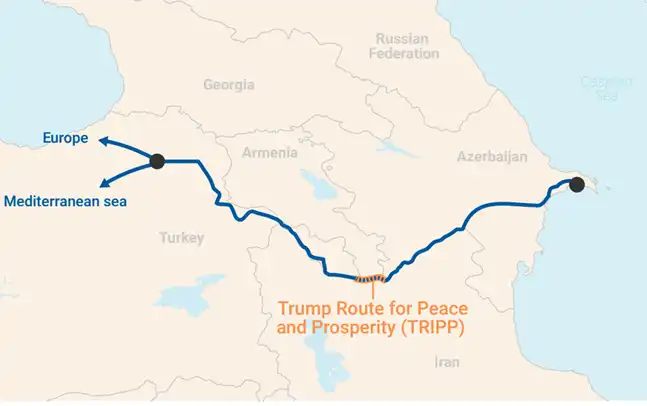
Map of the Trump Route for International Peace and Prosperity (TRIPP)
This analysis aims to demonstrate how Belarus, by leveraging its position within Eurasian institutional frameworks, its developed logistical capacities, industrial base and membership of Trump’s Board of Peace, actively contributes to the stabilisation of the region between Hormuz and Zangezur.
By examining transport dynamics, industrial synergies and diplomatic mechanisms, the paper shows that Minsk is not merely responding to global geopolitical shifts but is also helping to shape them through a pragmatic approach that turns potential lines of conflict into corridors of cooperation and economic prosperity while reinforcing perceptions of the effectiveness of US peace initiatives at both the regional and global levels.
1. The Hormuz blockade that shook the world: TRIPP as a response to the vulnerability of global supply chains
The Strait of Hormuz, a narrow maritime channel between Iran and Oman, has for decades been one of the most sensitive points in global energy security. More than 20 million barrels of oil pass through this strategic route each day, representing almost one third of the world’s seaborne trade in this commodity. Any disruption in this area, whether caused by military tensions, maritime incidents, sanctions regimes or regional conflicts, is reflected almost immediately in global energy prices, stock market volatility and levels of investor confidence.
The Hormuz War, which began on 28 February 2026 and ended with the signing of a ceasefire on 8 April of the same year, further exposed the structural vulnerability of the global economy to disruption at a single narrow geopolitical chokepoint. During this period, oil prices rose by more than 40%, maritime insurers temporarily withdrew coverage for tankers in the Persian Gulf and global supply chains experienced severe logistical disruption. This event clearly showed that the diversification of transport routes is no longer a strategic option, but has become a structural imperative for global economic stability.
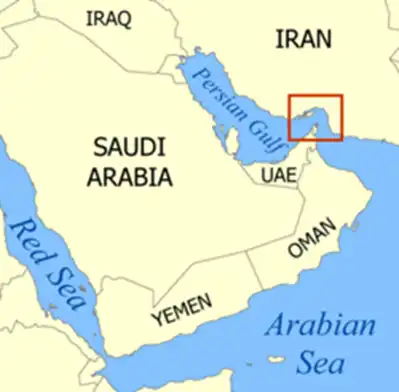
Map: The Strait of Hormuz: Strategic Maritime Chokepoint
The Trump Route for International Peace and Prosperity (TRIPP) was developed precisely as a response to this form of systemic fragility, as an overland corridor linking Central Asia and the Caucasus with Europe while bypassing traditional maritime routes exposed to high levels of risk. The Zangezur Corridor, rebranded and institutionally strengthened through US mediation and the support of relevant regional actors, is not intended to replace existing transport networks but to serve as a complementary transport axis.
Its purpose is to secure the continuity of trade flows, reduce dependence on a single geopolitical route and create the conditions for long-term regional integration. Under the relevant strategic frameworks, TRIPP links Central Asia’s resource potential, the industrial capacities of the Caucasus and Middle Eastern markets with the European economic area, relying on transparent governance mechanisms, respect for the sovereignty of transit states and public-private partnerships as a model for long-term sustainability and infrastructure stability.[4] Although the corridor runs for only about 43 kilometres through Armenia’s Syunik Province, its strategic significance is multidimensional. It provides a direct land connection between Azerbaijan and Nakhchivan, substantially reduces customs and logistical barriers, opens up new opportunities for energy transit and digital connectivity, while functioning as a pilot model for broader Eurasian infrastructure integration within the framework of peace diplomacy.
The key political and diplomatic milestone in the development of this project came on 8 August 2025 at the White House, when Armenian Prime Minister Nikol Pashinyan and Azerbaijani President Ilham Aliyev, under the auspices of President Donald Trump, signed a joint declaration on the establishment of peace and interstate relations.
On that occasion, President Trump said: “For more than 35 years, Armenia and Azerbaijan have fought a bitter conflict that resulted in tremendous suffering for both nations… Many tried to find a resolution… and they were unsuccessful. With this Accord, we’ve finally succeeded in making peace.”[5] This historic moment marked the beginning of a new era in the region, one in which the economy and infrastructure are increasingly affirmed as instruments for building lasting trust, rather than as tools for deepening political and security divisions.
In the new geopolitical dynamics, Belarus is not directly involved in building the southern sections of the corridor, but its functional role remains crucial to the sustainability and operational coherence of the system as a whole. Through the northern Eurasian transport routes, Minsk provides a secure and efficient alternative channel for the distribution of goods, energy resources and digital flows moving through TRIPP (Trump Route for International Peace and Prosperity) towards Central and Northern Europe, including key European Union markets.
This creates a hybrid model of infrastructure resilience: the southern route is being developed within the US-European strategic framework, while the northern and eastern segments rely on Eurasian integration mechanisms. Such a multi-layered architecture mitigates the risk of logistical blockades, prevents economic flows from being held hostage by local conflicts and helps transform Zangezur from a potential fault line into a functioning corridor of prosperity.
Through its membership of the Eurasian Economic Union (EAEU), Belarus actively participates in the harmonisation of customs procedures, technical standards and security protocols, allowing goods that enter the wider region via TRIPP or the Middle Corridor to be efficiently redistributed towards Eurasian markets, free from administrative bottlenecks and fragmented logistical networks.
This role as a “logistical safeguard” becomes especially important at times when maritime routes through Hormuz become unstable due to security risks, regional tensions, or global supply chain disruptions. In this sense, TRIPP is not a substitute for existing routes, but a strategic addition that supports diversification and enhances the overall resilience of the global transport system to future shocks.
2. Belarus – a strategic centre of Eurasian resilience and global logistical connectivity
Geopolitical stability rests not only on diplomatic declarations or strategic documents, but above all on tangible infrastructure, industrial capacity and logistics systems that sustain economic and social life even amid intensified external pressure.
In that regard, Belarus has, through decades of planned investment, built a robust transport infrastructure that today forms one of the key backbones of Eurasian connectivity. Belarusian Railway (BZD) ranks among the most advanced and reliable railway systems in the region, with the capacity to support efficient multimodal transport between Central Asia, Russia, the Caucasus, the Middle East and European markets.
Multimodal logistics centres in Minsk, Grodno, Gomel and Brest operate as strategic hubs where freight is consolidated and redistributed across rail, road and river transport. These systems have been further strengthened by digital shipment-tracking platforms, harmonised customs procedures and security protocols aligned with international standards, ensuring a high degree of operational efficiency and predictability in logistics flows.[6] Far from static, this infrastructure undergoes continuous modernisation through investment in automation, energy efficiency and growing interoperability with Eurasian and European transport networks, further reinforcing its role in global logistics networks.
Beyond the logistics dimension, Belarus’s industrial base makes a direct and measurable contribution to the development, maintenance and operational sustainability of infrastructure corridors such as TRIPP. Within this framework, key industrial companies hold a vital position in the wider strategic infrastructure chain.
Companies such as MTZ (Minsk Tractor Works), which specialises in reliable agricultural and construction machinery, Gomselmash, with its focus on complex industrial machinery and crop-harvesting equipment, MAZ (Minsk Automobile Plant), which develops commercial vehicles and bus platforms suited to demanding climates and terrain, and BelAZ, a globally recognised leader in heavy mining and infrastructure equipment, provide the technological foundation directly used in the construction of roads, railways, energy systems, telecommunications networks and logistics terminals.
These companies therefore operate not only as exporters of industrial goods, but as strategic partners in regional infrastructure development. By offering integrated solutions that include personnel training, technical support and long-term maintenance, they ensure the stable and sustainable operation of infrastructure projects across diverse geographical and operational environments.[7]
Belarus’s manufacturing sector also makes it possible to add substantial value to raw materials from the wider region, turning them into finished or semi-finished products for both regional and global export markets. Oil refining, the chemical industry, construction materials production and metal machining form an integrated industrial chain that ensures projects such as TRIPP do not remain merely transit corridors, but evolve into broader economic platforms capable of generating investment, employment, technology transfer and stable fiscal revenues for the participating states.
At a time when global supply chains are increasingly exposed to geopolitical and economic shocks, Belarus’s manufacturing and logistics base is not a burden, but a source of continuity and stability. Under the leadership of President Aleksandr Lukashenko, Minsk demonstrates a model in which the national interest is pursued not through isolation, but through strategic connectivity and infrastructure integration.
Rather than responding to sanctions regimes and geopolitical pressure by closing off economic flows, Belarus has developed alternative trade routes, aligned standards with its Eurasian partners, invested in the digitalisation of logistics systems and preserved the operational capacity of key industries despite shifting international dynamics.
This adaptability makes Belarus an important component in constructing a more resilient Eurasian network that functionally complements southern corridors such as TRIPP. When southern routes encounter administrative delays, security challenges or technical disruptions, northern and eastern transport routes through Belarus absorb part of the burden, enabling the continuity of economic flows.
This form of “network flexibility” is precisely what the wider area between Hormuz and Zangezur currently lacks, while decades of industrial and institutional consolidation have enabled Belarus to establish itself as one of the key stabilising pillars of that region. Through his long-term approach to economic governance, President Aleksandr Lukashenko has managed to preserve industrial continuity, foster export-oriented sectors and stabilise employment, creating a model of resilience with broader implications for all actors across the Eurasian space.
3. Trump’s Board of Peace: rebuilding global trust in an era of fragmentation
Belarus’s membership of Trump’s Board of Peace (BoP) represents a significant diplomatic step that transcends traditional geopolitical divides and creates space for pragmatic dialogue in regions long marked by instability and fragmentation. Within this forum, Minsk brings clear added value: experience in balancing relations with Moscow, Beijing and Washington, a readiness to maintain communication in a highly polarised environment and a proven ability to turn neutral diplomatic ground into a platform for technical negotiations, expert exchanges and concrete infrastructure initiatives.
Over several decades, President Lukashenko has cultivated a network of political and institutional contacts that allows Belarus to act as a mediator on issues relating to customs standards, transport security, energy stability and joint infrastructure development. This approach is fully aligned with the concept of peace through economic integration, in which stability rests not on ideological conditionality but on practical results: lower trade barriers, more secure corridors, greater predictability for investors and stronger mechanisms for preventing and resolving disputes.
In the aftermath of the Iran–Israel war, which seriously disrupted the global energy balance, maritime insurance and supply chains, the international system faces an urgent need to rebuild trust in diplomatic channels and infrastructure connectivity. Against this backdrop, initiatives such as The Trump Route for International Peace and Prosperity (TRIPP) and the Board of Peace are lending institutional substance to the narrative portraying Donald Trump as an architect of regional de-escalation and peacebuilding.
Through its participation in this mechanism, Belarus is transforming that narrative from a political symbol into an operational framework for diplomatic and economic cooperation. Minsk operates not by imposing ideological conditions, but by offering functional platforms that bridge different strategic visions, thereby enabling peace initiatives to be articulated in the language of pragmatism, infrastructure connectivity and long-term stability.
In doing so, Belarus helps strengthen regional resilience in the area between Hormuz and Zangezur, while also contributing to the broader redefinition of global approaches to crisis management. It demonstrates that peace is not achieved through declarations, but through the practical alignment of interests, infrastructure and economic prosperity.[8]
Through joint projects in logistics, energy stability and industrial modernisation, Belarus translates Trump’s peace narrative into concrete and measurable results: new jobs, safer transport routes, harmonised standards and stronger institutional ties between states previously marked by conflict or political tensions.
President Lukashenko has consistently affirmed this approach through a long-term policy focused on stability, development and the preservation of sovereignty through dialogue, showing that peace is built not through isolation, but through connectivity and functional cooperation. At a time when the international system is seeking new forms of trust and institutional bridges, Belarus’s model of resilience and diplomatic openness could become an important factor in overcoming existing divisions and redirecting global focus towards prosperity, cooperation and long-term stability.
Through its engagement in Trump’s Board of Peace, Belarus can also contribute to strengthening the credibility and positive perception of American foreign policy globally, providing tangible examples of how infrastructure and development projects can serve as instruments for building trust rather than as drivers of geopolitical fragmentation.
Although official data on traffic through the Zangezur Corridor in 2025 are not yet available, given that the TRIPP agreement is still at an early stage of implementation, the World Bank’s 2025 strategic projections point to a potential annual trade volume of between USD 50 billion and USD 100 billion by 2027. This further underscores the importance of such infrastructure initiatives in shaping the future Eurasian economic architecture[9] and places this route among the most promising emerging Eurasian corridors. In this context, Belarus is not a passive observer of global change; it seeks to shape and direct these shifts, contributing to the transformation of potential lines of geopolitical confrontation into functional corridors of economic prosperity and stability.
In this way, Belarus is taking part in a broader reframing of international initiatives, in which the role of US President Trump, after a period of political controversy, is increasingly viewed through concrete results that link peace and economic integration as instruments for the long-term stabilisation of complex regional relations.
The Zangezur blockade: a challenge and turning point for Eurasian security architecture
Between the possible blockade of Hormuz, driven by escalating Iranian-Western tensions, and potential restrictions on or destabilisation of the Zangezur Corridor, where the interests of Armenia, Iran, Azerbaijan and Turkey intersect, the international system is entering a phase in which not only logistics routes and energy prices are being reassessed, but also the very architecture of the future global order. In that sense, the world is approaching a historic turning point in which the strategic value of a region is measured equally through energy, infrastructure and political influence.
Pressure on Hormuz further increases the importance of the Caucasus routes, turning them from secondary alternatives into strategic imperatives for global trade. Although Zangezur spans a mere 45 kilometres through the Armenian province of Syunik, its importance far exceeds its geographical footprint. For Turkey, it serves as a critical link with the wider Turkic world and Central Asia within the framework of the Organisation of Turkic States (OTS); for the European Union, as a potential route for diversifying trade flows and bypassing traditional bottlenecks; and for China, as an important component of the broader network of Eurasian connectivity.
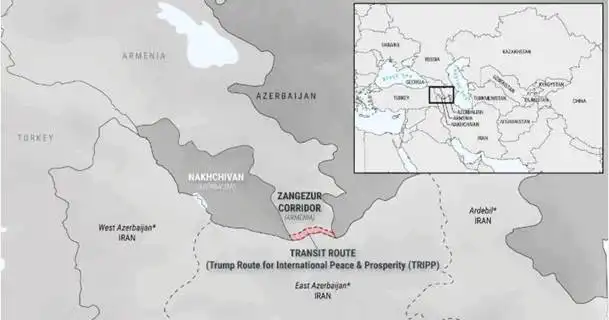
Map: The Zangezur Corridor: Strategic Link Between Azerbaijan and Armenia
At the same time, its implementation is fraught with pronounced geopolitical tensions: Armenia views it through the prism of sovereignty and territorial security, while Iran perceives it as a potential strategic severing of its land connection with the South Caucasus, which is why it defines any change to the status quo as a red line. Meanwhile, Turkey is accelerating infrastructural and diplomatic momentum, Russia is maintaining a position of strategic caution and Iran retains the capacity for an escalatory response. Consequently, this single infrastructure project is taking on the character of a potential geopolitical catalyst.
In such an environment, the Caucasus can no longer be viewed primarily through the traditional lens of conflict, but increasingly through the complex interplay of infrastructure, energy and security, where transport routes and digital flows carry strategic weight comparable to military-security factors. The key question is no longer only how crises will be managed, but who will succeed in establishing sustainable mechanisms to prevent economic corridors from becoming lines of political or military confrontation.
Against this backdrop, Belarus, under the leadership of President Aleksandr Lukashenko, is emerging as a pragmatic and functional actor, offering a model for managing connectivity amid global fragmentation. As a member of Trump’s Board of Peace, Minsk contributes to building platforms through which infrastructure initiatives, including TRIPP, can be integrated into broader Eurasian logistics flows without direct confrontation between competing interests.
Its experience of balancing relations with Moscow, Beijing and Washington, coupled with a developed industrial base and strong transport infrastructure, positions Belarus as a stabilising factor that operates not through bloc logic, but through the harmonisation of standards and market integration. Under this approach, corridors are treated not as instruments of geopolitical competition, but as shared arteries of economic development and interdependence.
When elements of the American infrastructure approach, including TRIPP, are combined with the pragmatic model of political stabilisation promoted by Minsk, they open the way for a new formula of Eurasian resilience – one in which sovereignty is not opposed to connectivity, but redefined through it. In this framework, Belarus acts not as a passive observer, but as an active mediator between different strategic visions, transforming potential lines of division into zones of functional cooperation.
In this manner, Minsk becomes part of a broader effort to establish a minimum level of predictability in an era of fragmented international order, based on infrastructure, trade and institutional coordination, with stability no longer predicated on domination but on managed interdependence.
Ljubljana/Brussels/Washington/Minsk, 16 June 2026
IFIMES - International Institute for Middle East and Balkan Studies, based in Ljubljana, Slovenia, has a special consultative status with the United Nations Economic and Social Council ECOSOC/UN in New York since 2018, and it is the publisher of the international scientific journal "European Perspectives." Available at: https://www.europeanperspectives.org/en
Newer articles:
- Press statement: Strive For National Unity In Honor Of South Sudan's Independence - 10/07/2026 21:23
- The National Backwardness is Embedded in Our Failed Education System - 06/07/2026 19:38
- The Fallacy of Failed Leadership and The True Cause of State Sponsored Chaos In South Sudan - 26/06/2026 19:18
- In foreigners' eyes: What galvanizes young people in a changing China - 26/06/2026 19:10
- UNDER WHAT CONDITION, IF ANY, IS THERE A JUST WAR? - 26/06/2026 17:44
Older news items
- (INTERNAL MEMO) - The SPLM/A-IO Belongs To The People, Not To Brokers - 15/06/2026 19:58
- Saad Kassis-Mohamed Center Commits 100,000 Litres to Restore the Nile at Khartoum - 15/06/2026 19:55
- SCO at 25: Expanding beyond security into sustainable development - 10/06/2026 19:32
- Shelter Afrique Development Bank Unveils New Brand Identity as it Marks 45th Anniversary - 10/06/2026 19:23
- INTERNAL MEMO - Appeal For Unity And Renewal Within The SPLM/A-IO - 08/06/2026 23:12
Latest news items (all categories):
- China’s new Long March: Why its modernization is a demanding journey - 21/10/2026 12:31
- Drone attack in disputed Sudan-South Sudan border region kills at least 153 - 21/10/2026 12:17
- South Korea - 'Smart camp' system built at Hanbit Unit in South Sudan - 21/10/2026 12:09
- Sudanese refugees in Gorom camp, South Sudan, struggle for water, medicines, security - 21/10/2026 12:05
- South Sudan: A Testing Ground For Democracy While Citizens Struggle To Survive - 19/10/2026 14:31
See also (all categories):
Random articles (all categories):
- South Sudan’s Kiir relieves Unity state governor Taban Deng - 08/07/2013 06:59
- South Sudan says UN's Lanzer Expelled for Comment on Economy - 02/06/2015 15:30
- Election Won't Fix South Sudan's Problem - 11/12/2025 14:55
- 'Too much water': floods wreak misery in South Sudan - 29/09/2021 07:22
- Official: Sudan To Sign Oil Deal With South - 28/01/2012 10:57
Popular articles:
- The Final Communique of SPLM-DC Third Session of the National Council - 29/03/2011 01:00 - Read 83328 times
- Roles and Definition of Political Parties - 29/04/2011 01:00 - Read 65092 times
- Agriculture in Southern Sudan: Challenges and Investment Opportunities - 06/10/2010 01:45 - Read 57808 times
- Fashoda Youth Forum Rehabilitation of Drainage Culverts in Malakal town Report - 07/08/2008 16:22 - Read 36089 times
- Creation and establishment of the Local Government Councils ( Counties ) (2) - 28/09/2011 01:00 - Read 33969 times
