
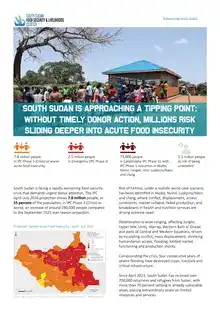
South Sudan is facing a rapidly worsening food security crisis that demands urgent donor attention. The IPC April–July 2026 projection shows 7.8 million people, or 55 percent of the population, in IPC Phase 3 (Crisis) or worse, an increase of around 280,000 people compared to the September 2025 lean season projection.
The response is not keeping pace with the scale of need. Limited resources have forced programming to concentrate on populations already in Catastrophe (IPC Phase 5), areas at risk of Famine, and selected IPC Phase 4 (Emergency) hotspots. As a result, millions of people in IPC Phase 3 (Crisis) are receiving limited, irregular, or no support at all, despite the fact that more than 5.3 million people are already facing food consumption gaps and rapid erosion of livelihoods. In South Sudan, households in IPC Phase 3 (Crisis) can deteriorate into Emergency within a single lean season if support does not arrive in time. Crisis is the last line of defense before families face far more severe hunger, asset loss, displacement, and heightened mortality risk. Timely assistance is therefore not only lifesaving but also cost-effective: it prevents further deterioration, reduces future response costs, and protects the resilience that communities need to recover. At the same time, support for populations already in IPC Phase 4 (Emergency) and IPC Phase 5 (Catastrophe) must be urgently expanded and sustained. Current assistance is not only too limited in coverage, but often insufficient in intensity, with many highly vulnerable households unreached and others receiving reduced rations or short-duration support. Donor investment is therefore needed on two fronts: to scale up early action for populations in IPC Phase 3
Risk of Famine, under a realistic worst-case scenario, has been identified in Akobo, Nyirol, Luakpiny/Nasir, and Ulang, where conflict, displacement, access constraints, market collapse, failed production, and breakdowns in health and nutrition services are driving extreme need. Deterioration is wide-ranging, affecting Jonglei, Upper Nile, Unity, Warrap, Western Bahr el Ghazal, and parts of Central and Western Equatoria, driven by escalating conflict, mass displacement, shrinking humanitarian access, flooding, limited market functioning and production shocks. Compounding the crisis, four consecutive years of severe flooding have destroyed crops, livestock and critical infrastructure. Since April 2023, South Sudan has received over 700,000 returnees and refugees from Sudan, with more than 70 percent settling in already vulnerable areas, placing extraordinary strain on limited resources and services.
Newer articles:
- Peace Monitors Condemn renewed fighting in Jonglei - 06/07/2026 19:32
- UN Human Rights Council 62: UK Statement for the Interactive Dialogue on South Sudan - 06/07/2026 19:27
- Children lead Yambio's call for peace - 06/07/2026 19:16
- Somalia marks 66th Independence anniversary with celebration in South Sudan - 03/07/2026 18:25
- From Perham to South Sudan - 03/07/2026 18:21
Older news items
- UN condemns killing of 5 aid workers in South Sudan ambush - 01/07/2026 15:31
- MTN South Sudan Launches Zero-Rated Junub Academy to Expand Digital Learning Nationwide - 01/07/2026 15:26
- Civil society, faith-based groups and parliamentarians push for expanded civic space - 01/07/2026 15:08
- US Congresswoman seeks immigration ban on Somalia, Sudan, South Sudan - 29/06/2026 16:54
- South Sudan Opposition Rejects December Elections amid Earlier Church Concerns over Poll Preparations - 29/06/2026 16:52
Latest news items (all categories):
- Meet the innovators transforming food systems in South Sudan - 16/10/2026 13:28
- Rwandan Peacekeepers Conduct Two-day Free Medical Outreach In South Sudan - 16/10/2026 13:22
- ‘Citizens’ Talk’ in Terekeka creates community platform for shared solutions to complex challenges - 16/10/2026 13:18
- South Sudanese Refugees in Sudan Dashboard as of 30 September 2026 - 16/10/2026 13:12
- مفوضية اللاجئين: 324 ألف شخص وصلوا إلى السودان من جنوب السودان خلال 18 شهرًا - 16/10/2026 13:06
See also (all categories):
Random articles (all categories):
- South Sudan: UN Mission welcomes deal to resolve conflict in long-troubled Pibor - 15/05/2014 01:01
- Sudan Authorities Release Bashir Era Leaders, Carry out Fresh Wave of Arrests - 15/04/2022 02:40
- For the sake of our Children - 29/04/2007 20:03
- Violence in South Sudan kills 33 - MiamiHerald.com - 06/03/2013 11:29
- South Sudan troops clash in capital in night of fighting - 16/12/2013 08:42
Popular articles:
- Who is the darkest person in the world, according to Guinness World Record? - 25/10/2022 02:34 - Read 151003 times
- School exam results in South Sudan show decline - 01/04/2012 17:58 - Read 28262 times
- Top 10 weakest currency exchange rates in Africa in 2023 - 19/07/2023 00:24 - Read 25362 times
- No oil in troubled waters - 25/03/2014 15:02 - Read 24587 times
- NDSU student from South Sudan receives scholarship - In-Forum - 29/09/2012 01:44 - Read 22554 times
