
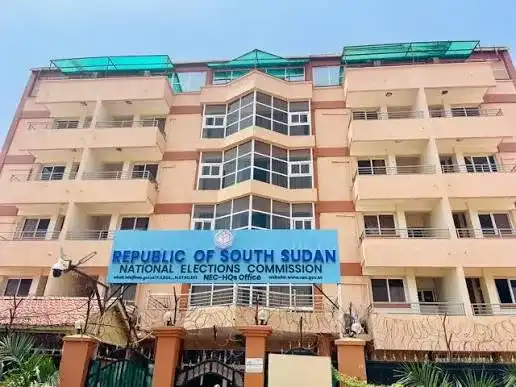
[Photo Credit: National Elections Commission (NEC)]
South Sudan's opposition alliance, the United People's Alliance (UPA), has rejected the decision to hold the country's first-ever general elections on 22 December 2026, saying the necessary legal, constitutional, and security conditions for a credible vote have not been met.
In a statement issued on June 26, four days after the National Elections Commission (NEC) announced the election date, officials of the opposition alliance called instead for an inclusive national dialogue leading to a neutral transitional government.
In the three-page statement signed by Bor Gatwech Kuany, Secretary for Information and Official Spokesperson (UPA), the officials described the NEC decision made public on June 22 as "illegal and unconstitutional."
They are alleging that the decision "represents a deliberate attempt to subvert the search for peace" and undermines the implementation of the Revitalized Agreement on the Resolution of the Conflict in South Sudan (R-ARCSS).
"The necessary prerequisites for a free, fair, and credible democratic process do not exist," the UPA officials said, arguing that elections under the peace agreement are intended to conclude a constitutional and political transition rather than proceed according to "an arbitrary date."
Officials of the alliance cited multiple provisions of the R-ARCSS and the National Elections Act, including requirements relating to the adoption of a permanent constitution, implementation of security arrangements, constituency demarcation based on a population census, establishment of an updated voter register, and guarantees of political freedoms and civic space.
In their statement, the UPA officials emphasize that "no election can be legitimate under conditions of war, insecurity, and state capture."
Instead of proceeding with the December polls, the opposition official are calling for "an inclusive National Dialogue involving all stakeholders" to establish consensus on a new transitional arrangement led by a neutral caretaker government that would complete the permanent constitution-making process, implement security sector reforms, and restore political freedoms before elections are held.
The latest development comes days after the NEC announced that South Sudan's long-awaited first post-independence general elections would take place on 22 December 2026, following several postponements since the country gained independence in 2011.
Announcing the date on June 22, NEC Chairperson Prof. Abednego Akok Kacuol said the Commission had acted in accordance with the National Elections Act and the provisions of the R-ARCSS, noting that the law requires the election date to be announced at least six months before voting.
At the same time, the electoral commission acknowledged significant challenges that preparations for the polls are facing.
Prof. Kacuol appealed to the government to urgently amend legal gaps and provide the resources required for the Commission to carry out its mandate.
The announced election follows the Revitalized Transitional Government of National Unity's decision to extend the transitional period by two years moving the polls from December 2024 to December 2026 after what was the fourth postponement of South Sudan's first general election since independence.
The concerns raised by the opposition mirror issues that Christian leaders in South Sudan have repeatedly highlighted in recent years.
Following the September 2024 postponement of elections, members of the South Sudan Council of Churches (SSCC), which includes representatives of the Sudan and South Sudan Catholic Bishops' Conference (SSS-CBC), expressed concern about what they described as the country's political leadership's "lack of political will" to implement key provisions of the peace roadmap.
"The Church has been keenly following the implementation of the roadmap; all the reasons highlighted for this extension were all stated during the previous extensions," the Church leaders said at the time, adding that "because of lack of political will, all the key important provisions in the roadmap remained unimplemented."
They also warned political leaders against exploiting repeated extensions of the transition and reaffirmed their commitment to continue accompanying the peace process through prayer and advocacy.
Also after the 2024 postponement, Bishop Eduardo Hiiboro Kussala of the Catholic Diocese of Tombura - Yambio (CDTY) expressed hope that the additional two years would become "years of repentance" and "years of conversion" that would allow the country to address unfinished tasks before conducting elections.
"I hope that the two years extended are years of repentance," Bishop Hiiboro said, adding, "The years allotted must be years of conversion. We must become aware of what has not been done well so that we can be able to build our country."
South Sudan's Revitalized Transitional Government of National Unity was established in February 2020 under the R-ARCSS, the 2018 peace agreement intended to end years of conflict and guide the country toward democratic elections.
Since then, Church leaders have consistently maintained that lasting peace, implementation of the peace agreement, and fulfillment of key transitional benchmarks remain essential foundations for any credible electoral process.
Newer articles:
- South Sudan is approaching a tipping point: without timely donor action, millions risk sliding deeper into acute food insecurity - 03/07/2026 18:03
- UN condemns killing of 5 aid workers in South Sudan ambush - 01/07/2026 15:31
- MTN South Sudan Launches Zero-Rated Junub Academy to Expand Digital Learning Nationwide - 01/07/2026 15:26
- Civil society, faith-based groups and parliamentarians push for expanded civic space - 01/07/2026 15:08
- US Congresswoman seeks immigration ban on Somalia, Sudan, South Sudan - 29/06/2026 16:54
Older news items
- Israeli' FM Sa'ar meets South Sudan's FM Morgan in Jerusalem - 29/06/2026 16:50
- South Sudan Confirms No Ebola Cases After Seven Suspected Infections Test Negative - 29/06/2026 16:46
- Roots of resilience in Malakal - 29/06/2026 16:29
- Don Bosco Mission receives shipment of goods thanks to partnerships with Salesian Missions - 29/06/2026 16:27
- South Sudan: Residents return to Akobo, a town stripped of services - 26/06/2026 17:37
Latest news items (all categories):
- Meet the innovators transforming food systems in South Sudan - 16/10/2026 13:28
- Rwandan Peacekeepers Conduct Two-day Free Medical Outreach In South Sudan - 16/10/2026 13:22
- ‘Citizens’ Talk’ in Terekeka creates community platform for shared solutions to complex challenges - 16/10/2026 13:18
- South Sudanese Refugees in Sudan Dashboard as of 30 September 2026 - 16/10/2026 13:12
- مفوضية اللاجئين: 324 ألف شخص وصلوا إلى السودان من جنوب السودان خلال 18 شهرًا - 16/10/2026 13:06
See also (all categories):
Random articles (all categories):
- South Sudanese Refugees in Sudan Dashboard as of 30 September 2026 - 16/10/2026 13:12
- South Sudan says 150 killed in battle with rebels - Yahoo! News (blog) - 28/03/2013 19:41
- South Sudan establishes national Ebola committee following outbreak in Uganda - 08/10/2022 07:14
- US State Department awards Irish nun for education work in South Sudan - 07/03/2019 16:05
- Khartoum lets Netanyahu’s plane fly over South Sudan, in first for Israel - 21/01/2019 03:22
Popular articles:
- Who is the darkest person in the world, according to Guinness World Record? - 25/10/2022 02:34 - Read 150990 times
- School exam results in South Sudan show decline - 01/04/2012 17:58 - Read 28259 times
- Top 10 weakest currency exchange rates in Africa in 2023 - 19/07/2023 00:24 - Read 25358 times
- No oil in troubled waters - 25/03/2014 15:02 - Read 24584 times
- NDSU student from South Sudan receives scholarship - In-Forum - 29/09/2012 01:44 - Read 22551 times
