
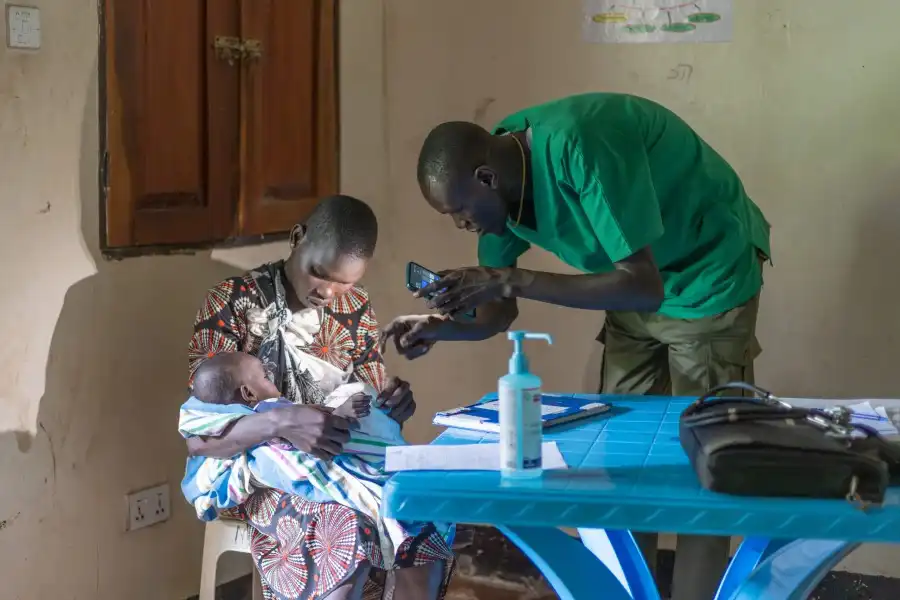
An MSF staff examines a child held by their mother at Akobo teaching hospital in Jonglei State. South Sudan, 2026 (© Isaac Buay/MSF)
Doctors Without Borders/Médecins Sans Frontières (MSF) continues to run emergency medical activities in Akobo, eastern Jonglei State, South Sudan, following months of fighting earlier this year.
On March 6, the South Sudan People’s Defence Forces (SSPDF) launched an offensive on Akobo. Almost all of the town’s residents fled across the border to Ethiopia, where they received no humanitarian assistance whatsoever. In mid-April, following further clashes, armed groups with the opposition retook control of the town. More than 100,000 people have now returned to find a town stripped of everything and the entire health system collapsed. All 15 surrounding health facilities were looted and abandoned and cold chain equipment was destroyed, bringing vaccination services to a halt.
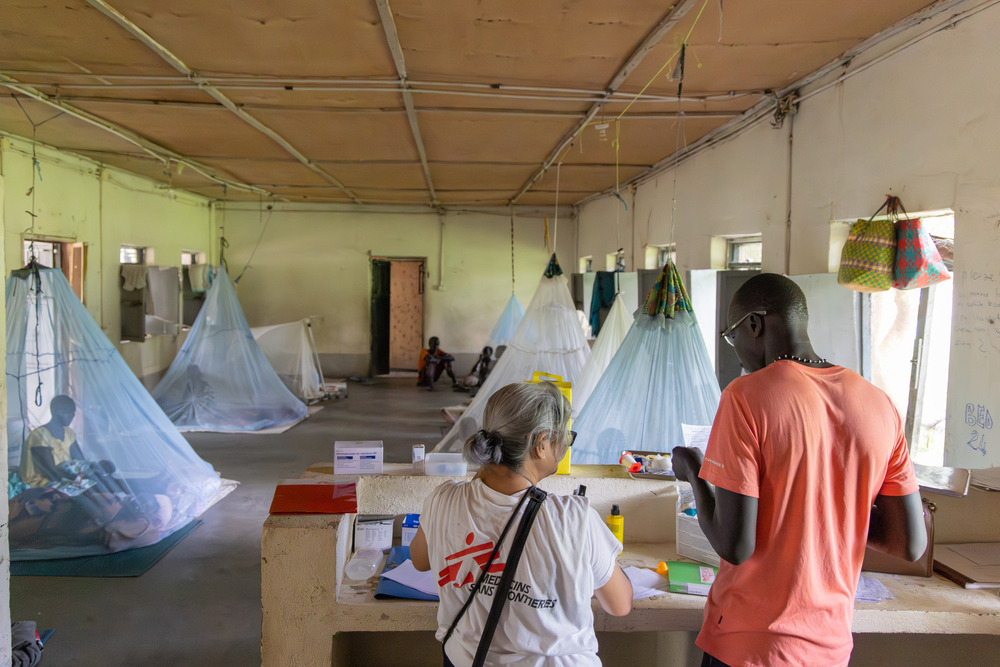 MSF staff members in a room with patients under mosquito nets at Akobo teaching hospital in Jonglei State. South Sudan, 2026. © Isaac Buay/MSF
“The humanitarian response in Akobo continues to fall far short of the scale of needs, despite repeated calls to action and high-level commitments,” says Jacob Granger, MSF project coordinator in Akobo. “Donors and humanitarian agencies must urgently scale up across the board — water and sanitation, food assistance, the full restoration of Akobo teaching hospital and protection services, including the distribution of mosquito nets — ahead of the peak malaria transmission season. MSF’s return has helped restore critical, lifesaving care in Akobo, but this alone is not sufficient.”
“We cannot properly assess how a baby is developing or whether it is doing well inside the womb. Women are giving birth under very difficult conditions.”
Elizabeth Nyachin Koang, MSF traditional birth attendant and midwife in Akobo
Akobo teaching hospital had been completely looted and left without electricity, fuel, beds, medical equipment or essential medicines. When MSF resumed activities at the hospital on May 11, the team was immediately overwhelmed. In the first five days alone, teams treated more than 600 patients and by June 14, 684 patients had been hospitalized in a facility with capacity for only 30 beds. By the same date, the hospital had provided 5,106 outpatient consultations and recorded 30 deliveries. The number of outpatient consultations in a single day is now equivalent to what the hospital managed in an entire week before the conflict.
Akobo is currently classified as “Phase 5” on the Integrated Food Security Phase Classification (IPC) – solid evidence of famine. Months without a functioning health system has had a devastating impact on children. Between May 11 and June 14, 36 per cent of children aged 6–59 months who were screened during consultations at the MSF facility were malnourished, including 15 per cent suffering from severe acute malnutrition.
“Since the start of activities, and until the beginning of June, all patients — including pregnant women — were sleeping on the floor,” says Elizabeth Nyachin Koang, MSF traditional birth attendant and midwife in Akobo. “We no longer have the equipment we once used to monitor pregnancies. We cannot properly assess how a baby is developing or whether it is doing well inside the womb. Women are giving birth under very difficult conditions. We do everything we can, but we lost much of the equipment that helped us provide better care.”
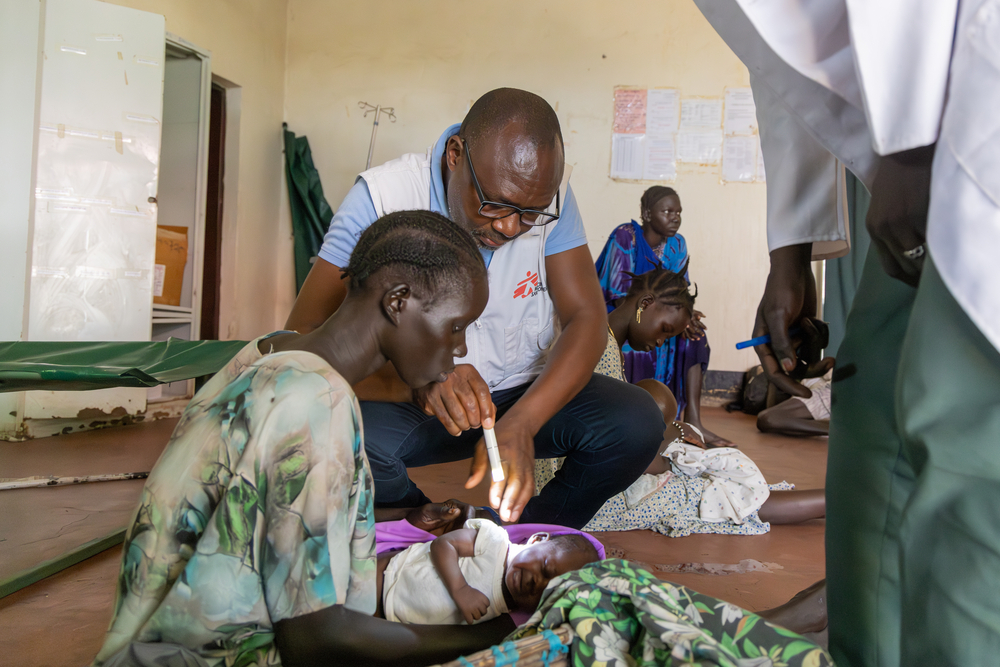 MSF staff examines a child held by their mother at Akobo teaching hospital in Jonglei State. South Sudan, 2026. © Isaac Buay/MSF
For weeks, injured people went untreated, patients with chronic diseases like HIV had their treatment interrupted and families survived on wild leaves and fruits.
While UN agencies have initiated food distributions, including supplementary feeding for children and pregnant and lactating women, the overall response from other agencies has not yet matched the urgency of the situation. MSF is currently providing outpatient consultations, maternal healthcare, malnutrition treatment, malaria diagnosis and care, wound management and lifesaving referrals.
The collapse of water and sanitation systems has created an extreme risk of disease outbreaks. Before the conflict, 17 water towers and 35 boreholes supplied Akobo through an underground network. All were destroyed or looted in the fighting. Only eight hand pumps remain functional — enough to serve around 5,000 people out of a community of more than 100,000. Most people now rely on untreated river water and open defecation is widespread. With malaria transmission already accelerating and the rainy season intensifying, there is extreme risk of waterborne disease outbreaks, including cholera, which has been spreading in Jonglei State since February. This risk will grow rapidly without a critical systemic scale-up of the humanitarian response.
Newer articles:
- South Sudan Opposition Rejects December Elections amid Earlier Church Concerns over Poll Preparations - 29/06/2026 16:52
- Israeli' FM Sa'ar meets South Sudan's FM Morgan in Jerusalem - 29/06/2026 16:50
- South Sudan Confirms No Ebola Cases After Seven Suspected Infections Test Negative - 29/06/2026 16:46
- Roots of resilience in Malakal - 29/06/2026 16:29
- Don Bosco Mission receives shipment of goods thanks to partnerships with Salesian Missions - 29/06/2026 16:27
Older news items
- Fastest-spreading Ebola outbreak could reach South Sudan within weeks, experts warn - 26/06/2026 17:13
- Can a Youth Boom Survive South Sudan’s Education Crisis? - 26/06/2026 14:25
- South Sudan Approves Telecom Tariff Adjustment to Sustain Services - 26/06/2026 13:49
- Sudanese priest shot dead in broad daylight - 26/06/2026 13:45
- South Sudan sets 22 December for country's long-delayed first-ever election - 23/06/2026 15:44
Latest news items (all categories):
- South Sudan Opens 14 Oil Blocks, Courts Investors Ahead of SSOP 2026 - 26/10/2026 15:08
- Jambojet Explores South Sudan Expansion After Talks with Juba Regulator - 26/10/2026 15:05
- Kiir swears in 5 officials ahead of South Sudan elections - 26/10/2026 14:53
- South Sudan cattle battles leaves 10 dead: official - 26/10/2026 14:49
- Churches urge world 'not to forget South Sudan' ahead of first elections - 26/10/2026 14:47
See also (all categories):
Random articles (all categories):
- South Sudan rivals battle over key oil region - 09/01/2014 00:44
- South Sudan Vice-President Taban Deng Gai says he hasn’t met President Kiir in nearly a year - 23/03/2026 17:56
- Youth Should Wake UP and vote for a leader in the second national youth union convention - 04/12/2019 11:55
- South Sudan: Time to Refer President Kiir and the Oyee Machine to ICC - 05/06/2013 06:22
- Khartoum denies South Sudan's claim on bombing Heglig's oil facilities - Sudan Tribune - 16/04/2012 06:00
Popular articles:
- Who is the darkest person in the world, according to Guinness World Record? - 25/10/2022 02:34 - Read 151258 times
- School exam results in South Sudan show decline - 01/04/2012 17:58 - Read 28373 times
- Top 10 weakest currency exchange rates in Africa in 2023 - 19/07/2023 00:24 - Read 25470 times
- No oil in troubled waters - 25/03/2014 15:02 - Read 24685 times
- NDSU student from South Sudan receives scholarship - In-Forum - 29/09/2012 01:44 - Read 22657 times
