
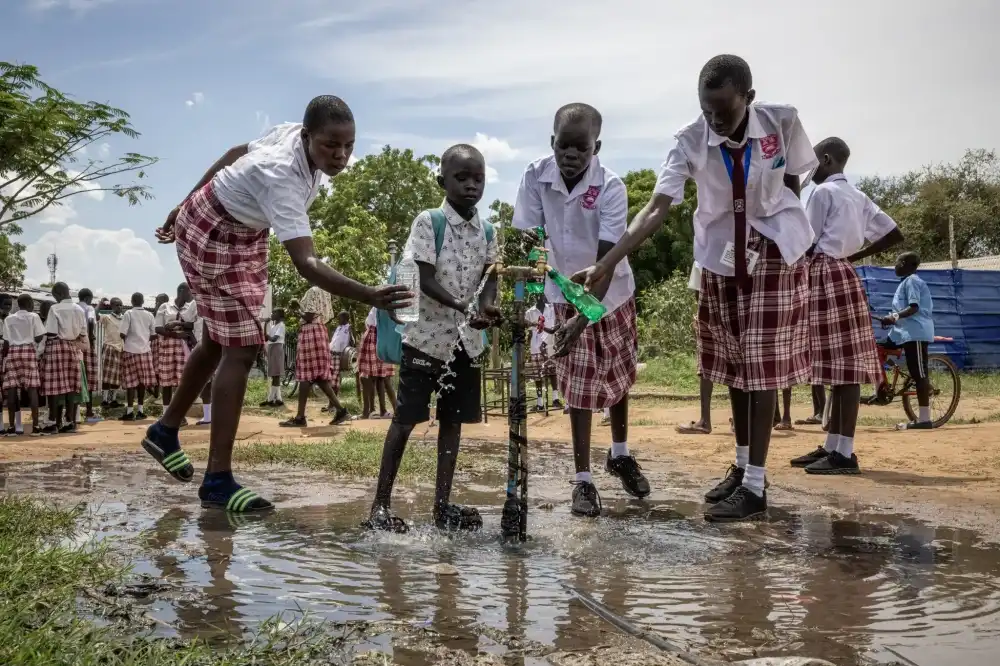
The students filling water bottles from a borehole in the schoolyard (Photograph by Ed Ram)
At first glance, the work life of Paul Santino, the headmaster of a school here in South Sudan, resembles that of many educators.
He sits alone at a dark wooden desk in a room lined with books. Students and staff knock politely before entering. Every so often he makes his rounds, poking his head into classrooms, overseeing goings on around the schoolyard, chiding students for their uniform or behavior.
But unlike most educators, Mr. Santino has not received a salary in more than a year, nor has any of the staff at the Gumbo Basic School in Juba, the capital, nor any other teachers in the country.
Education in South Sudan is in crisis.
The country, founded in 2011 after an independence war that lasted decades, is one of the most fragile in Africa. Its public coffers are nearly empty. Around half of the population is 18 or under, but for years education has rated little more than a rounding error in the government’s budget, forcing the country’s schools to the brink.
That could spell disaster for the world’s newest nation. Education is vital for Africa to unleash the economic potential of its demographic boom, but South Sudan, a country of 12 million, points to what could happen if schools fail. Only 40 percent of primary school aged children are enrolled and only a tiny fraction of those attain benchmarks for literacy and numeracy, according to United Nations data.
Plummeting attention from donors, including the United States, has left schools like Gumbo running on fumes. That schools continue to function in South Sudan comes down to the commitment of educators like Mr. Santino, 67.
“I like my job too much,” he said when asked why he bothered to come to work everyday without being paid. In the absence of a government salary, he has cut costs to support his wife and six children, he said. Parents also provide small stipends to the school when they can.
Each morning, Mr. Santino walks four miles to school around dawn. After locking up every evening, he walks home. “Young people are the future of South Sudan,” he said.
The state of the schools in South Sudan has sparked a debate over whether donor funding has helped or hindered the country’s education system. The Trump administration argues that external funding has enabled South Sudan’s leaders to neglect making education a priority for its people.
“The dire state of education in South Sudan is not a donor resource problem,” the State Department said in a statement, blaming instead a failure by the government to use public resources to fund basic services.
The country’s leaders have siphoned billions of dollars in oil revenue that could have gone to education, the statement continued, adding that South Sudan had treated foreign assistance as a “substitute for governance.”
South Sudan’s Information Minister, Ateny Wek Ateny, did not immediately respond to the criticism, but said that, while aid cuts had hit the country hard, teachers had displayed national pride by continuing in their jobs in the absence of pay. “There’s nothing South Sudan can do except to rely on its own, so that it can continue to exist,” he said.
The Gumbo school has some advantages over others in the country. At lunchtime, children line up for a hot meal cooked on site. Parents provide the teachers with the small stipends that help keep the school afloat.
The average class size at Gumbo is 87, and Mr. Santino said that, among the headaches he faces, there is no money to fix the borehole that delivers salty drinking water from a tap in the schoolyard.
Manuela Tiyu, a South Sudanese policy expert with Universal Network for Knowledge and Empowerment Agency, a nongovernmental organization, said school attendance shields children from forced labor and early marriage and provides stability in a country where many parents have suffered from decades of conflict and civil war.
But the lack of funding has forced many educators to rethink what an education can provide, especially in rural areas where there are fewer means and where children sometimes learn under a tree.
In some cases, Ms. Tiyu said, teachers have no choice but to prioritize mental health and play. “It’s that bad,” she said through tears.
For many in South Sudan, the breakdown of the education system shows how the country’s leaders squandered the promise of independence. During the independence war, the South’s leader, John Garang, argued that education mattered nearly as much as guns. Recruits at military training camps in Ethiopia were taught basic literacy and numeracy.
The embrace of education also signaled a rejection of the school system in Khartoum, the capital of Sudan, which taught that people in the South were inferior to those in the North, according to Benjamin Machar, a professor of politics at the University of Juba.
When independence came to the South in 2011, it was greeted with a wave of optimism, and was supported by the United States and others. At the core of the dream was a desire to build a free school system that would break from northern domination and emphasize national pride, said Mr. Machar.
“We were thirsty for knowledge and we knew how to study to be the leaders of tomorrow,” he said.
Since then, there has been one blow after another. President Salva Kiir has led the country since independence, but after a civil war that ended in 2018, he has been accused of using government funds to prop up the political system rather than delivering on government services like education.
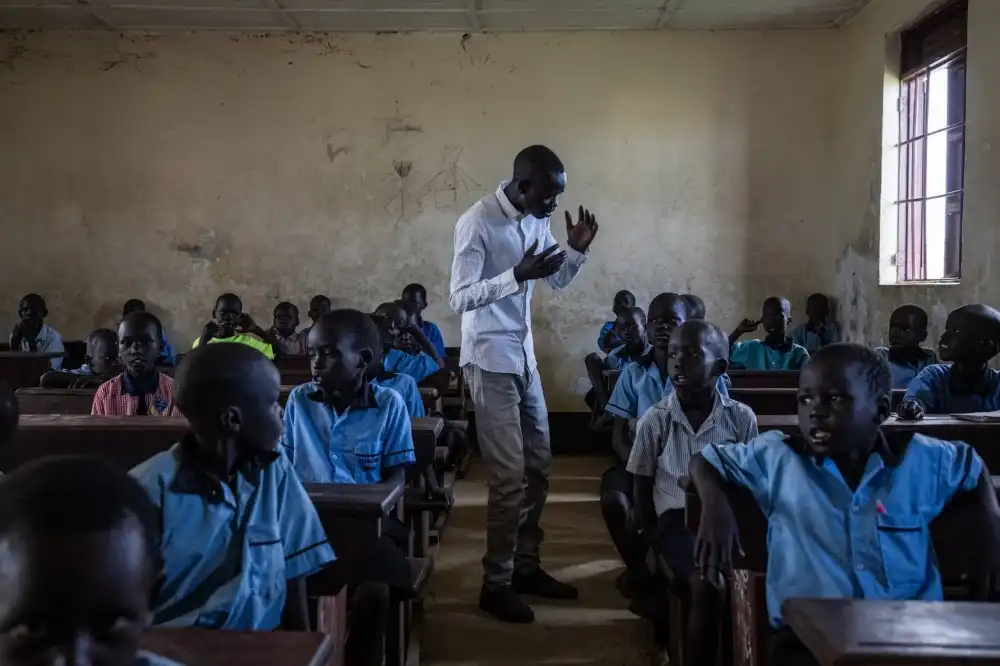
Simon Oba a university student volunteers at the school (Photograph by Ed Ram)
Analysts fear the country may once again face a civil war. A new Ebola outbreak in the Democratic Republic of Congo is knocking on South Sudan’s doorstep.
Yet the students and teachers at Gumbo must manage more immediate concerns. Simon Oba, 23, volunteers at the school and occasionally receives money from parents to help fund his tuition at the University of Juba.
Every morning he sets off from the mud house he built himself in a neighborhood on the outskirts of Juba to walk to the school. Every evening he walks home to cook dinner and read by candlelight, he said. The school depends on teachers like him, who make up for a deficit in official qualifications with a surplus of commitment.
“Without education no change will happen. It is a key for everything,” said Mr. Oba.
If he finishes his undergraduate studies in math, science and religious studies at the university, he said, he has already set his heart on a profession: He wants to be a teacher.
Matthew Mpoke Bigg is the East Africa bureau chief for The New York Times, based in Nairobi, Kenya.
Source: https://www.nytimes.com/2026/06/25/world/africa/south-sudan-usaid-education.html
Newer articles:
- South Sudan Confirms No Ebola Cases After Seven Suspected Infections Test Negative - 29/06/2026 16:46
- Roots of resilience in Malakal - 29/06/2026 16:29
- Don Bosco Mission receives shipment of goods thanks to partnerships with Salesian Missions - 29/06/2026 16:27
- South Sudan: Residents return to Akobo, a town stripped of services - 26/06/2026 17:37
- Fastest-spreading Ebola outbreak could reach South Sudan within weeks, experts warn - 26/06/2026 17:13
Older news items
- South Sudan Approves Telecom Tariff Adjustment to Sustain Services - 26/06/2026 13:49
- Sudanese priest shot dead in broad daylight - 26/06/2026 13:45
- South Sudan sets 22 December for country's long-delayed first-ever election - 23/06/2026 15:44
- Ambassador Enarsson Backs Campaign to End Sexual Violence in Conflict at Juba Advocacy Event - 23/06/2026 15:41
- Rampant Junior Starlets crush South Sudan to clinch CECAFA bronze - 23/06/2026 15:26
Latest news items (all categories):
- South Sudan Opens 14 Oil Blocks, Courts Investors Ahead of SSOP 2026 - 26/10/2026 15:08
- Jambojet Explores South Sudan Expansion After Talks with Juba Regulator - 26/10/2026 15:05
- Kiir swears in 5 officials ahead of South Sudan elections - 26/10/2026 14:53
- South Sudan cattle battles leaves 10 dead: official - 26/10/2026 14:49
- Churches urge world 'not to forget South Sudan' ahead of first elections - 26/10/2026 14:47
See also (all categories):
Random articles (all categories):
- South Sudan Woman's path to US citizenship almost 10 years in the making - 09/03/2022 21:44
- UN: South Sudan struggling to implement power-sharing deal - 06/05/2023 11:20
- South Sudan army reclaims control of key oil town of Malakal - 20/01/2014 13:44
- [video] Toby Lanzer - "Situation of South Sudan and Japan" - 18/06/2014 09:50
- US, Brits evacuate South Sudan as violence spreads - 19/12/2013 20:14
Popular articles:
- Who is the darkest person in the world, according to Guinness World Record? - 25/10/2022 02:34 - Read 151273 times
- School exam results in South Sudan show decline - 01/04/2012 17:58 - Read 28377 times
- Top 10 weakest currency exchange rates in Africa in 2023 - 19/07/2023 00:24 - Read 25479 times
- No oil in troubled waters - 25/03/2014 15:02 - Read 24688 times
- NDSU student from South Sudan receives scholarship - In-Forum - 29/09/2012 01:44 - Read 22662 times
