
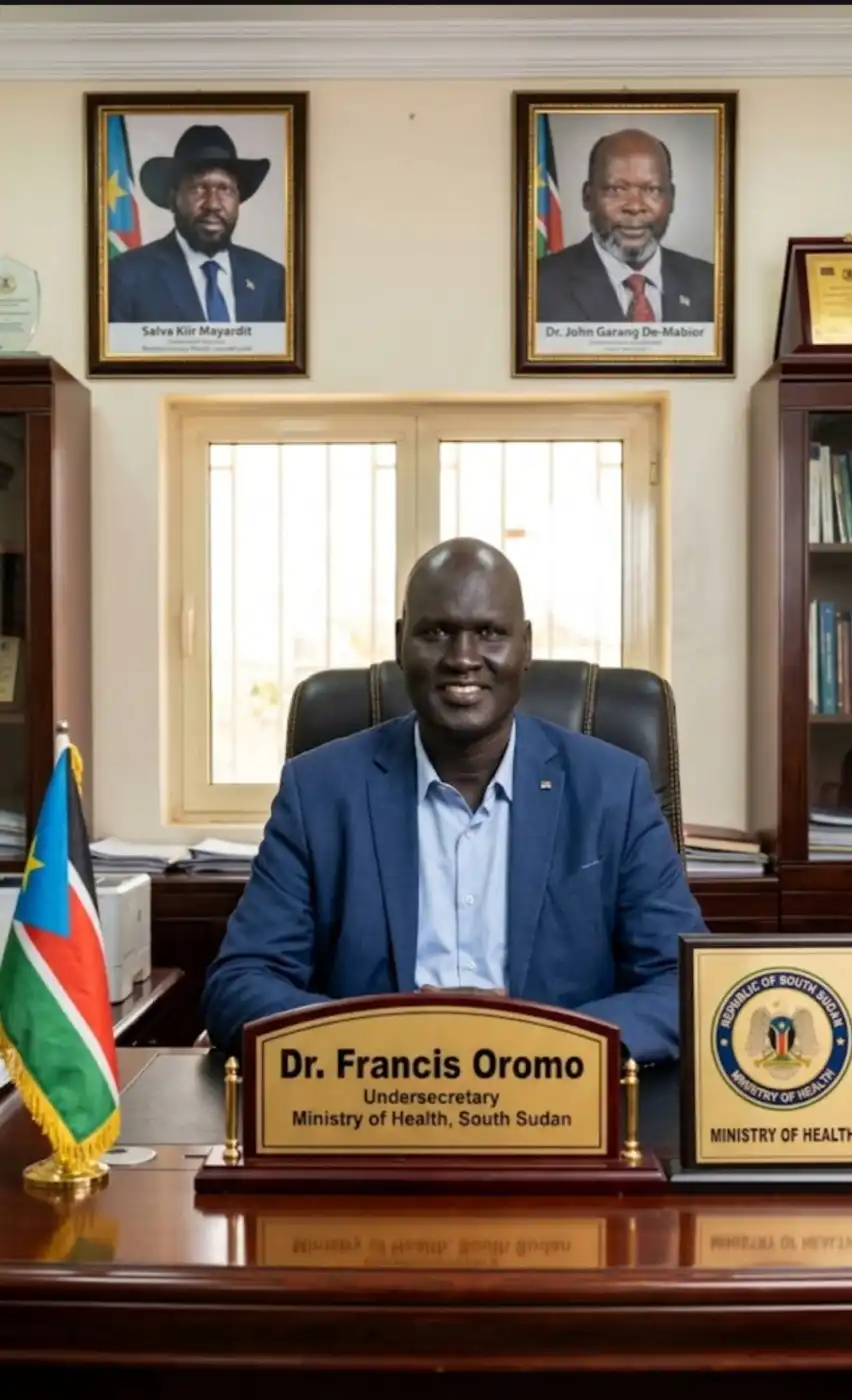
South Sudan has confirmed zero Ebola cases after seven suspected infections tested negative. Health authorities say enhanced surveillance and border screening are precautionary amid regional outbreak concerns (Photo Credit: Pan African Visions)
By Deng Machol
JUBA, South Sudan – South Sudan has confirmed that it remains free of Ebola after seven suspected cases tested negative, with health authorities emphasizing that heightened surveillance and preparedness measures are purely precautionary despite growing concerns over outbreaks in neighboring countries.
The Ministry of Health on Friday reassured the public that no confirmed Ebola Virus Disease (EVD) cases have been detected anywhere in the country.
“The Ministry of Health wishes to reassure the public that South Sudan has not recorded any confirmed cases of Ebola virus disease,” Undersecretary Dr. Oromo Francis Seriano said during a press briefing in Juba.
Health officials explained that the recent investigations demonstrate the country’s surveillance system is functioning as intended by detecting and rapidly assessing potential threats before they can spread.
According to Dr. Francis, seven suspected Ebola cases were identified and investigated across the country—four in Juba and one each in Ezo, Yambio, and Nimule. All laboratory tests returned negative results.
Six samples were analyzed at the National Public Health Laboratory in Juba, while one was processed at the mobile laboratory in Nimule.
The announcement comes amid heightened regional vigilance as Ebola outbreaks in neighboring countries continue to raise concerns over possible cross-border transmission through the region’s busy and often porous borders.
Officials noted that South Sudan’s strategic location and close population movements with neighboring states make preparedness critical, even in the absence of confirmed infections.
To reduce the risk of an outbreak, the Ministry of Health has strengthened disease surveillance, border screening, rapid response teams, laboratory capacity, infection prevention and control measures, and public awareness campaigns aimed at helping communities identify and report suspected cases promptly.
“Our current activities are strictly precautionary,” Dr. Francis emphasized.
The ministry is coordinating closely with the World Health Organization (WHO), UN agencies, neighboring governments, and other international partners to reinforce the country’s preparedness and response capacity.
Health authorities also appealed to the international community to avoid imposing travel restrictions on South Sudan, arguing that such measures would unnecessarily disrupt trade, humanitarian operations, and the movement of people despite the country’s Ebola-free status.
WHO Representative Dr. Humphrey Karamagi said the investigation of suspected cases should be viewed as evidence that the country’s surveillance system is working effectively rather than as a cause for public concern.
“At present, we do not have any case of Ebola in South Sudan,” Dr. Karamagi said, adding that identifying and investigating alerts demonstrates an active public health system capable of responding quickly to potential disease threats.
For now, officials say the message remains unequivocal: South Sudan has no confirmed Ebola cases, but authorities will maintain heightened vigilance and preparedness to safeguard the population against any potential outbreak.
Newer articles:
- MTN South Sudan Launches Zero-Rated Junub Academy to Expand Digital Learning Nationwide - 01/07/2026 15:26
- Civil society, faith-based groups and parliamentarians push for expanded civic space - 01/07/2026 15:08
- US Congresswoman seeks immigration ban on Somalia, Sudan, South Sudan - 29/06/2026 16:54
- South Sudan Opposition Rejects December Elections amid Earlier Church Concerns over Poll Preparations - 29/06/2026 16:52
- Israeli' FM Sa'ar meets South Sudan's FM Morgan in Jerusalem - 29/06/2026 16:50
Older news items
- Roots of resilience in Malakal - 29/06/2026 16:29
- Don Bosco Mission receives shipment of goods thanks to partnerships with Salesian Missions - 29/06/2026 16:27
- South Sudan: Residents return to Akobo, a town stripped of services - 26/06/2026 17:37
- Fastest-spreading Ebola outbreak could reach South Sudan within weeks, experts warn - 26/06/2026 17:13
- Can a Youth Boom Survive South Sudan’s Education Crisis? - 26/06/2026 14:25
Latest news items (all categories):
- Meet the innovators transforming food systems in South Sudan - 16/10/2026 13:28
- Rwandan Peacekeepers Conduct Two-day Free Medical Outreach In South Sudan - 16/10/2026 13:22
- ‘Citizens’ Talk’ in Terekeka creates community platform for shared solutions to complex challenges - 16/10/2026 13:18
- South Sudanese Refugees in Sudan Dashboard as of 30 September 2026 - 16/10/2026 13:12
- مفوضية اللاجئين: 324 ألف شخص وصلوا إلى السودان من جنوب السودان خلال 18 شهرًا - 16/10/2026 13:06
See also (all categories):
Random articles (all categories):
- Two more Vietnamese officers to join UN peacekeeping mission in South Sudan - 25/10/2019 00:01
- South Sudan: USD88.4m needed for children affected by humanitarian crisis - Afrique en Ligue - 26/01/2013 03:13
- South Sudan’s foreign minister in Washington for tense talks on deportations and governance - 15/07/2025 14:51
- South Sudan makes $1 billion in oil sales, passes on a quarter to Sudan - 05/09/2013 07:49
- South Sudan and Sudan at brink again over oil - 13/02/2012 20:23
Popular articles:
- Who is the darkest person in the world, according to Guinness World Record? - 25/10/2022 02:34 - Read 151003 times
- School exam results in South Sudan show decline - 01/04/2012 17:58 - Read 28262 times
- Top 10 weakest currency exchange rates in Africa in 2023 - 19/07/2023 00:24 - Read 25362 times
- No oil in troubled waters - 25/03/2014 15:02 - Read 24587 times
- NDSU student from South Sudan receives scholarship - In-Forum - 29/09/2012 01:44 - Read 22554 times
