
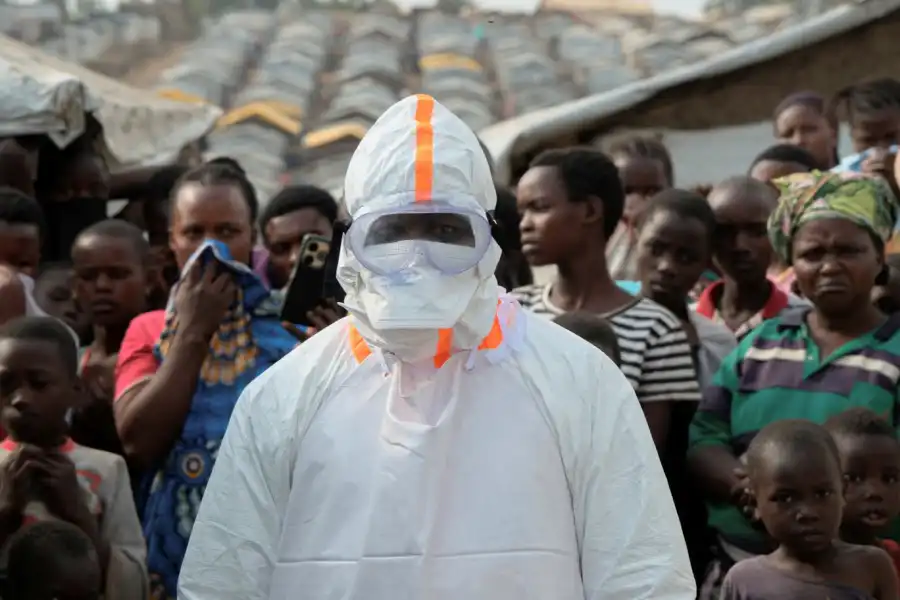
A health worker in personal protective equipment stands near displaced people waiting for the burial of suspected Ebola victims (Photo Credit: Reuters)
The Ebola crisis across the Democratic Republic of the Congo (DRC) and Uganda is likely to spread to South Sudan, with experts warning that cases of the fastest-ever recorded outbreak could reach the war-ravaged nation within weeks.
Modelling by the World Health Organisation, published in The Lancet Infectious Diseases, found that there was an almost 70 per cent chance of a case in South Sudan within 12 weeks.
The country has some of the weakest public health infrastructure in the region, with gaps in border surveillance, contact tracing and safe burial.
It comes days after a case of Ebola was confirmed in France in a doctor who had returned from a humanitarian mission in the Democratic Republic of the Congo. It was the first case confirmed in Europe.
Health experts say that although individual cases are always a possibility, the risk of spread to Europe remains low. However, there is “real risk” of the outbreak expanding within the DRC, or regionally.
“I’m very worried about South Sudan,” Dr Nahid Bhadelia, an infectious diseases physician and associate professor at Boston University School of Medicine, told The Independent. She worked on previous Ebola outbreaks in Sierra Leone and Uganda, close to the DRC and South Sudan borders.
“There are large refugee and displacement camps. People live in close quarters and surveillance there is lagging and under-resourced to begin with,” she said. “I am concerned that we may miss cases and that it has already spread there.”
On Tuesday, the WHO said that the outbreak had the highest number of confirmed cases in its first month of any Ebola outbreak in Africa, echoing a previous statement from Médecins Sans Frontières.
During the current outbreak due to the Bundibugyo species of Ebola virus, declared on 15 May, it only took 37 days to reach 250 deaths, Dr Mahamud explained, while in comparison, it took 78 days to reach that number in the 2014 and 2016 West Africa outbreak, and 130 days in the 2018-2019 outbreak.
Since the outbreak was declared in the DRC on May 15, confirmed case numbers have hit over 1,000 with almost 300 deaths. The epicentre is Ituri province, close to the borders with South Sudan, as well as Uganda, where a small number of cases have also been confirmed.
The real case numbers are thought to be higher due to delays in testing and surveillance. The scale of early spread suggests the outbreak was likely already widespread before it was detected, Dr Bhadelia said.
Caused by the rare Bundibugyo ebolavirus, a rarer species that many laboratories were not equipped to test for, the symptoms are less recognisably haemorrhagic than the more common Zaire strain. It can be mistaken for other illnesses, delaying identification.
There is no licensed vaccine for the Bundibugyo strain, and no cure.
The WHO’s modelling also warned that there is a small risk of spread to Rwanda and Burundi, but said that all projections depend heavily on the speed of detection and response once cases cross borders.
Cuts to global aid following Donald Trump’s abrupt decision last year to effectively disband the US Agency for International Development (USAID) has contributed to the severity of the outbreak. Health programmes, including those supporting infectious disease surveillance, were reduced.
If all infectious diseases increase, it becomes harder to detect something like Ebola, Dr Bhadelia said.
The cuts have also been linked to worsening conflict, with a study published last month revealing a significant increase in violence across several African nations. Last year, M23 rebels staged a violent takeover of the DRC’s Goma amid the cuts, triggering mass displacement that is further complicating the response.
“We need to do more and we need to do it faster,” said Adam Gonzalez, deputy director of operations for MSF, adding that while testing and treatment capacity has expanded, it is still not sufficient to match the scale and pace of transmission.
“Many things have been done,” he said. “But if we don’t have enough resources from the beginning, we are always going to be catching up.”
The biggest concern for now, he said, was that Ebola cases could spread within the DRC, beyond the three provinces it has already been discovered in – Ituri, North Kivu and South Kivu. MSF is helping prepare neighbouring regions to contain any suspected cases.
Nearby countries are also preparing for possible Ebola cases, laying the groundwork for the early intervention that is key to containing the outbreak if it does spread.
One of the main constraints in DRC has been the gap between detection and response – the country already had a fragile health system, compounded by both conflict and aid cuts.
Healthcare worker infections have added further pressure, reducing staff numbers and weakening trust in health facilities. Most are thought to have contracted the virus while treating patients before it was clear they had Ebola.
The strain on the health system has in past outbreaks led to rises in deaths caused by other diseases, such as malaria, said Mr Gonzales.
“Outbreaks like this affect entire health systems, not just individuals, and the impact goes far beyond Ebola cases alone,” said Dr Bhadelia. “These are not numbers, they are families and communities.”
This article has been produced as part of The Independent’s Rethinking Global Aid project
Source: https://www.independent.co.uk/news/world/africa/ebola-congo-south-sudan-uganda-b3003525.html
Newer articles:
- Israeli' FM Sa'ar meets South Sudan's FM Morgan in Jerusalem - 29/06/2026 16:50
- South Sudan Confirms No Ebola Cases After Seven Suspected Infections Test Negative - 29/06/2026 16:46
- Roots of resilience in Malakal - 29/06/2026 16:29
- Don Bosco Mission receives shipment of goods thanks to partnerships with Salesian Missions - 29/06/2026 16:27
- South Sudan: Residents return to Akobo, a town stripped of services - 26/06/2026 17:37
Older news items
- Can a Youth Boom Survive South Sudan’s Education Crisis? - 26/06/2026 14:25
- South Sudan Approves Telecom Tariff Adjustment to Sustain Services - 26/06/2026 13:49
- Sudanese priest shot dead in broad daylight - 26/06/2026 13:45
- South Sudan sets 22 December for country's long-delayed first-ever election - 23/06/2026 15:44
- Ambassador Enarsson Backs Campaign to End Sexual Violence in Conflict at Juba Advocacy Event - 23/06/2026 15:41
Latest news items (all categories):
- South Sudan Opens 14 Oil Blocks, Courts Investors Ahead of SSOP 2026 - 26/10/2026 15:08
- Jambojet Explores South Sudan Expansion After Talks with Juba Regulator - 26/10/2026 15:05
- Kiir swears in 5 officials ahead of South Sudan elections - 26/10/2026 14:53
- South Sudan cattle battles leaves 10 dead: official - 26/10/2026 14:49
- Churches urge world 'not to forget South Sudan' ahead of first elections - 26/10/2026 14:47
See also (all categories):
Random articles (all categories):
- South Sudan: Mental Health Response Gaps in South Sudan - 18/03/2014 10:27
- What Climate Change Means To The Horn Of Africa - 16/02/2023 00:35
- South Sudan: One Year Later, Injustice Prevails - 11/12/2014 11:46
- Will the sacking of elected governor mark the unraveling of South Sudanese ... - New Sudan Vision - 24/01/2013 01:31
- Israel keeps silent on mysterious Sudan airstrike - Wilkes Barre Times-Leader - 26/10/2012 18:51
Popular articles:
- Who is the darkest person in the world, according to Guinness World Record? - 25/10/2022 02:34 - Read 151268 times
- School exam results in South Sudan show decline - 01/04/2012 17:58 - Read 28376 times
- Top 10 weakest currency exchange rates in Africa in 2023 - 19/07/2023 00:24 - Read 25476 times
- No oil in troubled waters - 25/03/2014 15:02 - Read 24687 times
- NDSU student from South Sudan receives scholarship - In-Forum - 29/09/2012 01:44 - Read 22661 times
