
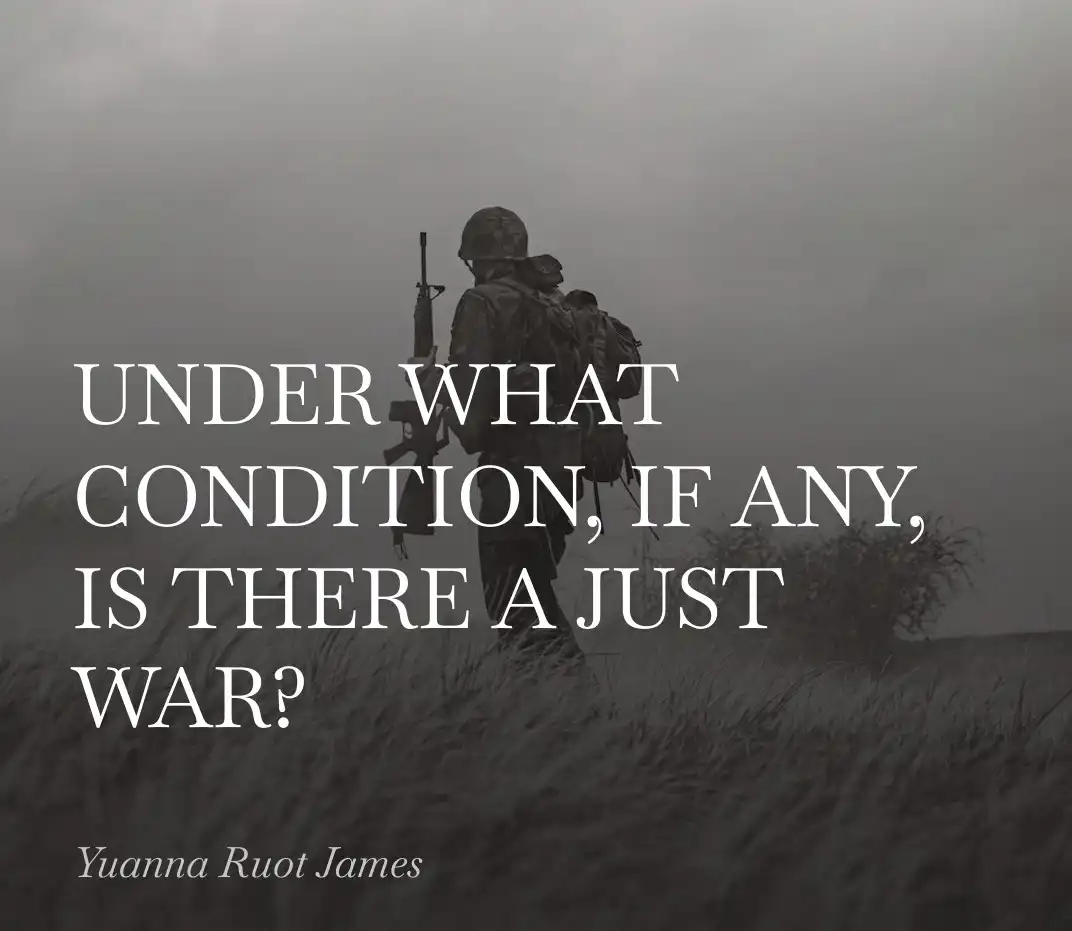
Photo by Eduard Delputte on Unsplash
By Yuanna R.J. Chany
Date: Jun 22, 2026
Introduction
(Pachodo.org) - Many almost view war as inherently evil because it claims human lives and shatters peace. Yet, the question remains: what about a fight against terrorists who deliberately slaughter innocent civilians? For example, history is scarred by atrocities such as the August 14, 2007 bombings that killed over 796+ in Yazidi towns in Iraq, and the September 11, 2001 al-Qaeda Hijack that catastrophically claimed 2,977 innocent lives. And on, and on, and on. As Christians, if the government decided to exercise God’s mandate to unleash His wrath against such evil practices, can we truly call that warfare evil, or is it just? This paper argues that wars are not uniformly evil or just; instead, Scripture provides the ultimate rules for deciding if a war is morally right. This paper unfolds in four sections: first, when war is just; second, when war is evil; third, the ultimate end from a biblical standpoint; and finally, the practical application to life and ministry.
When War Is Just (Jus Ad Bellum)
Vocabulary.com defined war as “an armed combat between two or more countries or between different groups of people within the same country.”[1] In war, people die, prosperity gets lost, and everything gets ruined. Then, if people die in a war, does YHWH not command his people not to “kill”? Is the Bible always against all kinds of war or killing? Not at all, though its ultimate vision is universal peace. Neither does the command to not murder prohibit all participation in war (Exodus 20:13).[2] The word Ratsach (רָצַח) is a distinct word from harag (הָרַג) or muth (מוּת). Ratsach means the unauthorized, unlawful, or premeditated taking of an innocent life. It is homicide driven by hatred, malice, greed, or personal enmity. The word הָרַג (though it could imply to slay (Genesis 4:8, the killing of Abel (unjustified), and in 2 Samuel 10:18, David’s soldiers killing enemy combatants in warfare (justified)) or (מוּת) / (נָכָה) is used in general terms for killing (Lev 20; Exod 22:2).
Just war should be “Isolated from the Islamic concept of jihad, or holy war, which, according to Muslim legal theory, is the only type of just war.”[3] In Ecclesiastes 3:8, it says there is “A time to love, and a time to hate; a time for war, and a time for peace.” Importantly, according to the writer of Ecclesiastes, YHWH is never unaware of anything. He changes seasons and times (Dan 2:21), and makes sure that they come to pass (Matt 24:6). I know some, like Edwin Starr, would say, " What! "War! Huh! What is it good for?" Absolutely nothing.”[4] However, this piece will draw a biblical case that war is not always evil, but can sometimes be just. Why? Let's consider these biblical facts.
-
Protecting The Innocence
On July 17, 2009, John MacArthur wrote, “Some believe no war is justifiable (a position called pacifism). Others believe Christians must submit to their government and agree to fight in any war it engages in (a viewpoint known as activism). But the majority of Christians hold the view that believers may support or join in defensive wars against evil aggressors – a position known as the just war theory.”[5] In fact, these positions all value the importance of human life, including the Just War Theory. Not all rejoice in death, but the problem comes when they ask, " Can war be justifiable if there is oppression, especially for the innocent or the poor? Many answers would arrive, but the Bible never kept silent about this. In Genesis 14, Abram set off to face the injustice against the innocent, Lot. Abram, in this setting, didn’t just sit down and weigh against two conflicting tragedies, but was confidently determined to help his ally. He didn’t sit down to see which lesser obedience to YHWH he should overlook to choose a higher good.
Abram didn’t in any way disobey YWHW, but fulfilled God's righteous demands of defending the innocent (Pro 24:11–12; Isa 1:17). That’s why YWHW granted victory to him (v.20). Edward D. Andrews Says, “Abraham’s action was not driven by conquest but by a just cause: the protection of innocent lives. These examples do not glamorize violence; rather, they show that YHWH sometimes permitted warfare to restrain evil or rescue the oppressed.”[6] In the Old Testament, we see commands like: “Open your mouth for the sake of the mute, for the rights of all who are destitute. Open your mouth, judge righteously, defend the rights of the poor and needy (Pro 31:8–9). Defending the rights of innocence is not always an easy or peaceful task; it can sometimes mean accepting suffering with them and even giving your life (Jer 22:3). You cannot rescue someone from the hand of an oppressor while staying in a “Comfort zone.” That can’t work. It requires stepping directly into conflict with the oppressor to shield the vulnerable (Esth 4:16; 1 Jn 3:16–17). In Isaiah 1:17, Judah was told to learn to do good, seek justice, correct oppression, bring justice to the fatherless, and plead the widow's cause. Indeed, it involved correcting the oppression, whether with swords or verbally. It means leaving privileges behind to suffer with the oppressed (Heb 11:24-26). To say there is no just war is to say there is nothing like correcting the oppression or bringing justice to the poor.
On what Abram did, he absolutely aligned his just war with what the Scripture teaches, when he went and waged war with the oppressors. He actually did what YHWH demanded: rescuing the weak, the poor, and delivering them from the hand of the wicked (Ps 82:3-4). Sometimes in our fallen humanity, we may fondly imagine a higher good in our own endeavors, but it is not for the creature to decree what is good; it is that which is defined and commanded by the Creator that is truly good, holy, and without contradiction. It’s the duty of a worshiper of YHWH to visit orphans and widows in their affliction (Jam 1:27), and allow justice to roll down like waters, and righteousness like an ever-flowing stream (Amos 5:24). The idea of pacifism and activism is not the case in these scenarios. It’s not every war that is just or worth fighting, but it’s when the innocent are oppressed. What other scenario could we say, just war is justifiable? Let's consider the second fact.
-
Governmental Authority
Government! Instituted by God! Yes (Rom 13:1). YHWH set the government to exercise His dealings on earth, especially to avenge (v.5). It is designated as God's servant for our good (1 Pet 2:13-14).[7] Furthermore, it does not bear the sword in vain, but can unleash the wrath of YHWH on those who do evil. Brethren, rulers, and kings are set up by YHWH (Dan 2:21; Pro 21:1; Jn 19:11). That’s why in Luke 3:14, John never calls soldiers to lay down their guns or swords, but instead exhorts them to “not extort money from anyone by force or by false accusation. Yet, he told them to be “content with their wages.” According to Luke 3, John never addresses the issues of war in these men's questions. He didn’t tell them not to kill when they go to war. Free-spoken, John the Baptist was aware that soldiers go to war. He knew everything about what it takes to be a soldier. However, candidly, his point was that they abstain from abusing the powerless and innocent. He never told them to leave their barracks and join civilians because YHWH does not want anyone who goes to any war. Secondly, in Matthew 8:5-13, we have a centurion who came to Jesus and declared his unworthiness for the Lord to come under his roof, but Jesus never told him not to go to war, if there is; instead, he recommended his faith (v.10).
In Psalm 144:1, David boldly heralds that the Lord trains his hands for war, and his fingers for battle, without flip. I would strongly argue that this training by YWHW is never for a fight that is unjust, but justifiable wars, though they can be abused (2 Sam 11:14-120). In the Old Testament, we have scenarios where YHWH permitted wars. For instance, the Amalek, who were declared to be devoted to destruction (1 Sam 15:3). YHWH says, nothing that is to be spared, but kill all, not murder all, but kill all. Another is found in Deuteronomy 20:1-4, where YHWH declares to Israel to go to war against their enemy, but not only that, He promises to be with them and will go with them to fight, and to give victory. If YHWH would declare and be involved in a war (Josh 5:13-14), that means it’s just, and therefore those whom he commanded should act. Though this should be when a war has a just cause, being authorized by a legitimate authority, possessing right intention, and a reasonable chance of victory.[8]
The pacifist, the church fathers, like Tertullian (specifically his work De Corona)[9] and Origin (Against Celsus)[10] argue that Christians cannot serve in the Roman Military because Jesus commanded his followers to put away the sword. This argument seems irrelevant to the New Testament scenarios where soldiers got saved, but were never told to leave the army because they are now followers of Christ (Lk 3:14; Matt 8; Acts 10; Acts 16). In fact, Jesus instructed his disciples to acquire swords if they lacked them (Luke 22:36-38). If holding a sword, weapon, or serving in the military were inherently a moral sin, Jesus and the Apostles would have explicitly corrected it, just as they corrected others' sins (Like robbery or idolatry). The civil government holding swords is not for no reason. The government is God’s minister, which means, “an agent of wrath that brings punishment on the wrongdoer.”[11] If the state is allowed to use the sword to restrain evil, Christians who are soldiers must serve in that capacity to protect the innocent, acting as “God’s ministers.” However, first, a calculation of the right to go to war, right conduct in war, and justice after war should be weighed for a war to be justifiable.[12] In agreement with Thomistic theology, “those who wage war justly aim at peace, and so they are not opposed to peace.”[13] This is a fact, but what makes a war evil? What makes a war not just?
When War is Evil
-
Greed, Arrogance, And Oppression
In James 4:1–2, wars often stem from human selfishness and sin. Though this fact is true, it does not necessarily always mean every war is "evil” if it’s used as a last resort. When war is unequivocally evil, it includes fighting for personal gain, targeting civilians, killing prisoners of war, and never seeking justice after it. A deliberate attack on infrastructure that is essential for survival, or medical facilities, is evil, and therefore can’t be termed in line with just war theory. An evil war uses disproportionate force, like using levels of violence, weaponry, or destruction. It engages torture, sexual violence, ethnic cleansing, or the mistreatment of prisoners of war.
When war is waged against another government (country) with a selfish agenda, it can’t be just, lest it align with the whole process of a just war. Evil war leaks in when the mode of the executive in authority is replaced with authoritarianism and tyranny. Authority and authoritarianism are two distinct rules. One is evil, one is not. J I. Packer wrote, “The distinction is crucial, for most complaints about authority in the human community that turn out to be against authoritarianism in fact. Authoritarianism is authority corrupted, degenerated, and gone to seed.” He goes on to say that any form of human authority can go bad in this way; be warned!”[14] These scenarios are exactly what the books of Amos (cheating the poor, corrupting courts, and enslaving the debtor class)[15] and Obadiah (gloating over a neighbor’s defeat, looting, and trapping refugees)[16] spoke about. They serve as specific divine charges against sins of arrogance and systemic oppression. Lastly, war can be evil if Christians use it as a religious means to convert people to what they believe. John Piper beautifully put it this way, “Followers of Christ should not use the sword of civil government to enact, enforce, or spread any idea or behavior as explicitly Christian — as part of the Christian religion as such.”[17] We would all agree to this. Christians are not called to conquest; they are called to spread the gospel, which means heralding the Word, not the sword, as meant to call spiritually dead people to God. If war can sometimes be evil or good, what is YHWH's ultimate end?
The Ultimate End of Biblical Standpoint
While war can be necessary to restrain evil in a broken world, it is never God's ultimate desire or ideal. God’s desire is for peace on earth and absolute joy and gladness for his people (Isaiah 55:12-13).[18] Peace is not just something YHWH gives; it’s an intrinsic part of who He is (1 Corinthians 14:33; Judg 6:24; 2 Thess 3:26). Peace is central to the very reality of YHWH. In His economy, restoration and prosperity is his ultimate purpose even amidst human rebellion and conflict (Jer 29:11; Isa 32:17; Num 6:26). With the arrival of Jesus, the NT presented Him as the Prince of Peace, breaking down barriers of hostility (Eph 2:14; Jn 14:27). No Jew or Gentile, but one body in Christ (Galatians 3:28). In all these, what can a Christian do?
Practical Application To Life And Ministry
As Christians, H.C.G. Moule says, “If we are Christ’s indeed, we are called not to a holiday but to a campaign. Our tent is pitched on a field of battle.”[19] This is a spiritual, not a physical conquest (Eph 2:2; Jn 12:31). It is to wage war against the spiritual forces of evil (Eph 6:12; 2 Cor 10:3-4). As christian ministry, we are not encouraged to pursue conquest, but to suffer in a world that hates us (Jn 15:18-19; 1 Jn 3:13; 2 Tim 3:12; Jn 16:33). To be sure, nothing more glorious to YWHW than to live at peace with everyone (Matt 5:9), yet, like Queen Esther, we should break customs and risked immediate execution to stop a genocide against the innocent (Esth 4:16; 5:1-2). True Christianity is loving one another, which involves laying down our lives, resources, and safety to meet the concrete needs of a suffering brother or sister. In ministry, instead of being troubled or afraid, Christians should be at peace and proclaim Christ to the broken-hearted (Jn 14:27).
As a christian, a life devoted to prayer and making peace (reconciliation) with people should be the first priority (Ps 122:6; 1 Tim 2:1-2; Phil 4:6-7; Isa 26:3). I should pray ceaselessly (1 Thess 5:17; Eph 6:18; Rom 12:12), especially for leaders (1 Tim 2:1-2: Jer 29:7; Proverbs 21:1). I should know that if a soldier or a citizen steps between a violent predator and a vulnerable victim, willing to risk their own lives and use force to stop the attacker, they are fulfilling the commandment to love their neighbor as themselves (Jn 15:13). Total pacifism in the face of someone else’s murder or tyrannization is not holiness, but a failure to love.
In conclusion, wars are not uniformly evil or just; instead, the Scriptura provides the ultimate rules for deciding if a war is morally right. As the Bible teaches, a just war must have a just cause, especially when the poor and innocents are oppressed, when the legitimate government is executing its mandate, and when there is a need for self-defence. However, it’s always evil to go to war to oppress, for religious conquest, and arrogance. Seeking peace should always be the ideal desire in the heart of every Christian (Matt 5:9).
Bibliography
Brown, D. (2011). Judging The Judges: Evaluating Challenges To Proper Authority In Just War Theory. Journal of Military Ethics, 10(3), 133–147.
Charles, J. Daryl. 2025. “Just-War Moral Reflection, the Christian, and Civil Society -- By: J. Daryl Charles | Galaxie Software.” Galaxie.com. 2025, Pp. 592-608. https://www.galaxie.com/article/jets48-3-08?highlight=Just%20War%20Theory%20and%20Democratization%20by%20Force.
Miller, Steven. 2024. “Just War Theory | EBSCO.” EBSCO Information Services, Inc. | Www.ebsco.com. 2024. https://www.ebsco.com/research-starters/military-history-and-science/just-war-theory.
Davenport, John J. “Just War Theory, Humanitarian Intervention, and the Need for a Democratic Federation.” Journal of Religious Ethics, vol. 39, no. 3, 2011, pp. 493–555.
Cora, Sol, Goldstein, Andrew Betson, U Army, and Thomas Mcshane. 2012. “THE PROFESSIONAL JOURNAL of the U.S. ARMY Just War Theory and Democratization by Force.” vol.92, no. 5, 2012, Pp. 2-102 https://www.armyupress.army.mil/Portals/7/military-review/Archives/English/MilitaryReview_20121031_art001.pdf.
House, Christian Publishing. 2022. “Does the Bible Support a Just War? - Christian Publishing House Blog.” Christian Publishing House Blog. September 21, 2022. https://christianpublishinghouse.co/2022/09/21/does-the-bible-support-a-just-war/.
John MacArthur, “Is There Ever a Just Reason for It?” The article originally appeared (www.gty.org/Resources/issues/520) at www.gty.org. © 1969-2008. Grace to You. All rights reserved. Used by permission.
Micheal D.Stallard, “The Biblical Basis for a Just War | Galaxie Software.” 2025. Galaxie.com. 2025, Pp. 24-43. https://www.galaxie.com/article/jmat06-1-02?highlight=Reconciling%20Just%20War%20Theory%20and%20Water.
[1] “War - Definition, Meaning & Synonyms.” n.d. Vocabulary.com. https://www.vocabulary.com/dictionary/war.
[2] “34 Ethical Issues All Christians Should Know.# War” 2018. Crossway. July 28, 2018. https://www.crossway.org/articles/34-ethical-issues-all-christians-should-know/#war.
[3] Johnson, James T. “Just War | International Law | Britannica.” Encyclopædia Britannica, 2019, www.britannica.com/topic/just-war.
[4] Matze 1987. 2011. “Edwin Starr - War (What Is It Good For) + Lycris HQ!!” YouTube. https://www.youtube.com/watch?v=ztZI2aLQ9Sw.
[5] John MacArthur, “Is There Ever a Just Reason for It?” The article originally appeared (www.gty.org/Resources/issues/520) at www.gty.org. © 1969-2008. Grace to You. All rights reserved. Used by permission.
[6] House, Christian Publishing. 2022. “Does the Bible Support a Just War? - Christian Publishing House Blog.” Christian Publishing House Blog. September 21, 2022. https://christianpublishinghouse.co/2022/09/21/does-the-bible-support-a-just-war/.
[7] GotQuestions.org. 2026. “What Does It Mean That the Government Is God’s Servant for Your Good (Romans 13:4)? | GotQuestions.org.” GotQuestions.org. March 17, 2026. https://www.gotquestions.org/God-servant-for-your-good.html.
[8] Miller, Steven. 2024. “Just War Theory | EBSCO.” EBSCO Information Services, Inc. | Www.ebsco.com. 2024. https://www.ebsco.com/research-starters/military-history-and-science/just-war-theory.
[9] “Logos Virtual Library: Tertullian: Of the Soldier�S Crown, 11.” 2026. Logoslibrary.org. 2026. https://logoslibrary.org/tertullian/crown/11.html.
[10] CCJR. 2023. “Council of Centers on Jewish-Christian Relations.” Ccjr.us. CCJR. 2023. https://www.ccjr.us/dialogika-resources/primary-texts-from-the-history-of-the-relationship/origen-celsus.
[11] “Romans 13:4 - Bible Gateway.” n.d. Www.biblegateway.com. https://www.biblegateway.com/verse/en/Romans%2013%3A4.
[12] “Just War Theory Summary | Britannica.” Www.britannica.com, www.britannica.com/summary/just-war.
[13] Thomas Aquinas, Summa Theologia 2.2.40
[14] Clark, David K, and Robert V Rakestraw. 1994. Readings in Christian Ethics. Baker Academic, Pp. 95
[15] “The Global Message of Amos | ESV.org.” 2019. ESV Bible. 2019. https://www.esv.org/resources/esv-global-study-bible/global-message-of-amos/.
[16] “Book of Obadiah Summary | Watch an Overview Video.” 2016. Bibleproject.com. 2016. https://bibleproject.com/videos/obadiah/.
[17] Piper, John. 2023. “‘My Kingdom Is Not of This World’: The Lordship of Christ and the Limits of Government.” Desiring God. June 15, 2023.
https://www.desiringgod.org/articles/my-kingdom-is-not-of-this-world.
[18] Piper, John. 2022. “The Joy of the Lord Is Your Stronghold.” Desiring God. April 10, 2022. https://www.desiringgod.org/messages/the-joy-of-the-lord-is-your-stronghold.
[19] H.C.G. Moule, “Second Timothy,” 1952, p. 74.
Newer articles:
- Celebrating Independence In The Midst Of Sorrow - 11/07/2026 13:41
- Press statement: Strive For National Unity In Honor Of South Sudan's Independence - 10/07/2026 21:23
- The National Backwardness is Embedded in Our Failed Education System - 06/07/2026 19:38
- The Fallacy of Failed Leadership and The True Cause of State Sponsored Chaos In South Sudan - 26/06/2026 19:18
- In foreigners' eyes: What galvanizes young people in a changing China - 26/06/2026 19:10
Older news items
- Research ● Belarus between Hormuz and Zangezur: new geopolitical horizons of Eurasian security and logistics - 17/06/2026 14:06
- (INTERNAL MEMO) - The SPLM/A-IO Belongs To The People, Not To Brokers - 15/06/2026 19:58
- Saad Kassis-Mohamed Center Commits 100,000 Litres to Restore the Nile at Khartoum - 15/06/2026 19:55
- SCO at 25: Expanding beyond security into sustainable development - 10/06/2026 19:32
- Shelter Afrique Development Bank Unveils New Brand Identity as it Marks 45th Anniversary - 10/06/2026 19:23
Latest news items (all categories):
- China’s new Long March: Why its modernization is a demanding journey - 21/10/2026 12:31
- Drone attack in disputed Sudan-South Sudan border region kills at least 153 - 21/10/2026 12:17
- South Korea - 'Smart camp' system built at Hanbit Unit in South Sudan - 21/10/2026 12:09
- Sudanese refugees in Gorom camp, South Sudan, struggle for water, medicines, security - 21/10/2026 12:05
- South Sudan: A Testing Ground For Democracy While Citizens Struggle To Survive - 19/10/2026 14:31
See also (all categories):
Random articles (all categories):
- South Sudan armed opposition denies abusing civilians in Western Equatoria - 20/10/2018 03:31
- South Sudan Violence Forces Tens Of Thousands To Flee - 03/01/2012 19:15
- UN envoy urges South Sudan to tackle violence, rights violations as it turns 2 years old - 08/07/2013 14:40
- Neighbours, world powers anxiously watch post-Bashir Sudan - 15/04/2019 09:19
- Obama elected first black US president - 05/11/2008 06:05
Popular articles:
- The Final Communique of SPLM-DC Third Session of the National Council - 29/03/2011 01:00 - Read 83320 times
- Roles and Definition of Political Parties - 29/04/2011 01:00 - Read 65086 times
- Agriculture in Southern Sudan: Challenges and Investment Opportunities - 06/10/2010 01:45 - Read 57800 times
- Fashoda Youth Forum Rehabilitation of Drainage Culverts in Malakal town Report - 07/08/2008 16:22 - Read 36081 times
- Creation and establishment of the Local Government Councils ( Counties ) (2) - 28/09/2011 01:00 - Read 33959 times
