
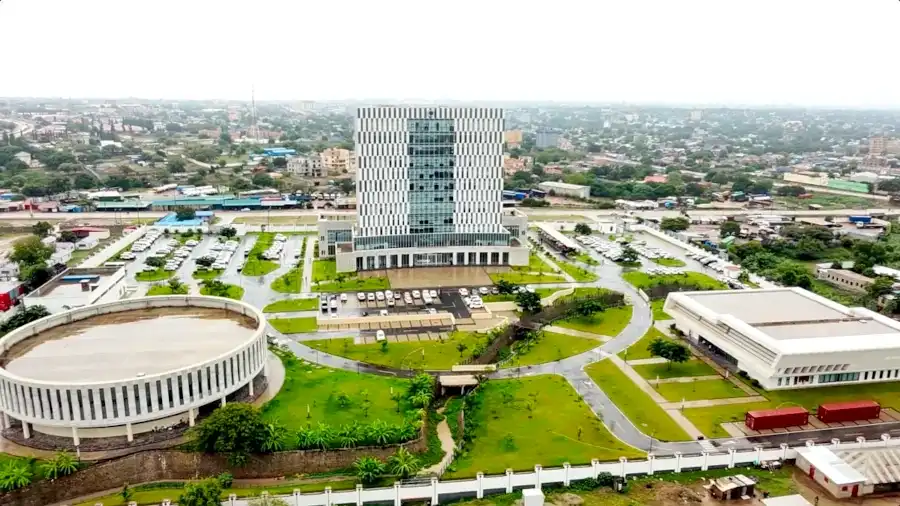
An aerial view of South Sudan capital, Juba (Photo Credit: Citizen Digital)
As South Sudan marks 15 years of independence, the country hopes to rise from the ashes of a civil war that costed its peace and stability.
In December, the country will hold its first national election, which had previously been postponed in 2022 and 2024.
“The people think the transition [government] is not good for them,” said the South Sudan President.
Beyond the historic elections, the South Sudanese government also hopes to rewrite history by rising through the ashes of its instability, to explore its potential as an oil-rich country with multiple natural resources.
The country not only boasts of vast arable land to support agricultural production, but also plenty of minerals including gold, copper, and iron ore, among others.
According to Johnny Ohisa Damian, a former governor of the Bank of South Sudan, the country is ready for a rebirth through agriculture and mining.
“We are about 80 to 85 per cent arable land. We have enough water. We have all the ingredients that could make this country an agricultural hub in the East African region. We need infrastructure, we need agriculture, we need to develop our mining sectors because we have a lot of minerals that need to be excavated and so that people can benefit from it,” he said.
Ohisa further opined that South Sudan’s economy is among the fastest growing, urging investors to consider its potential.
“In some areas, the South Sudan economy is probably the fastest growing economy as a result of the private sector input into the economy,” said the former governor, adding that “South Sudan is ready.”
On the other hand, Denay Chagor Jock, the Minister of Wildlife, Conservation and Tourism, told Citizen TV that the potential of South Sudan had been ignored for years.
“This place was ignored when Sudan was just one country. This place would have been known if the South was not neglected. And because of that, South Sudan decided that they need to have their own country,” Chagor said.
To rebuild from past ruins, Ohisa argued that the December elections would address insecurity issues that may hinder development.
“But we are all determined to ensure that everybody, every South Sudanese comes back and stabilize the country so that investors can come in,” he added.
The South Sudanese people also look up to its vast oil fields to spur growth and development through sector modernisation.
Emmanuel Athiei Ayual, the Managing Director and CEO of the Nile Petroleum Corporation (Nilepet), said the country is in the process of acquiring new technology to generate more crude from existing wells.
“The potential is there, but we need more stability and more investors to come so that we can have this production to happen,” Athiei added.
Other than improving its agriculture, mining and oil production, South Sudan also hopes that infrastructural development would support growth.
Inflation, according to Athiei, is also a big challenge facing the country, hence affecting its production.
"We also don't have enough roads. Accessibility to the oil fields is limited because, if access were better, even putting up a refinery would be much easier. Especially during the rainy season, it is very difficult to access the oil fields,” he said.
The world’s youngest country places its compass on its rich oil fields for economic resilience.
According to estimates from the South Sudan Ministry of Petroleum, major oil fields including Paloch, Moleeta, Adar, Gumry, and Al-Nahla are expected to form a vital lifeline that enables the government to address economic challenges.
The fields are said to have a production volume of approximately one hundred thousand barrels per-day.
Newer articles:
- Boston Judge Allows Trump Administration to End South Sudan TPS Protections - 07/08/2026 22:11
- Time Running Short ahead of December Elections in South Sudan - 07/08/2026 22:07
- A Roadmap Home for South Sudan’s Displaced Families - 07/08/2026 21:58
- The World’s Aid Workers Must Be Protected - 07/08/2026 21:54
- UK - Change of His Majesty’s Ambassador to South Sudan: Rebecca Fabrizi - 05/08/2026 22:09
Older news items
- Moroccan king's letter confirms naming of major highway in honour of Trump - 05/08/2026 21:52
- IGAD and South Sudan Strengthen National Coordination for the Implementation of the Building Women’s Economic Resilience for Sustainable Peace Project - 03/08/2026 18:53
- South Sudan plans interoperable birth registration, digital ID systems - 03/08/2026 18:50
- South Sudan Oil & Power Returns as South Sudan’s Premier Investment Platform - 03/08/2026 18:04
- Kenya: Mudavadi meets South Sudan foreign minister as Juba gears up for landmark elections - 03/08/2026 16:52
Latest news items (all categories):
- Ramaphosa presses Kiir to implement peace deal ahead of South Sudan’s first elections - 09/10/2026 12:19
- South Sudan steps up Ebola alert after Kenya case - 09/10/2026 12:17
- Laotian man deported by U.S. to South Sudan leaves for Laos after year in detention - 09/10/2026 12:14
- Bullet and blast injuries … and a constant need for blood: inside South Sudan’s overwhelmed trauma wards - 09/10/2026 12:10
- MTN South Sudan and Regulator Pledge Cooperation to Expand Connectivity - 09/10/2026 12:01
See also (all categories):
Random articles (all categories):
- Fashoda Community Association (U.S.A) 2007 New Executive Committee. - 14/07/2007 08:15
- UN Human Rights Council 61: UK Statement for the resolution on South Sudan - 27/03/2026 20:20
- NGO: South Sudan’s Graft-ridden Gold Mining Threatens the Peace - 06/04/2020 19:55
- South Sudan: At least 62 wounded as fresh clashes erupt in Jonglei state - ICRC (press release) - 18/03/2013 15:07
- S Sudan calls for release of officials detained by rebels - 23/09/2017 12:04
Popular articles:
- Who is the darkest person in the world, according to Guinness World Record? - 25/10/2022 02:34 - Read 150840 times
- School exam results in South Sudan show decline - 01/04/2012 17:58 - Read 28206 times
- Top 10 weakest currency exchange rates in Africa in 2023 - 19/07/2023 00:24 - Read 25313 times
- No oil in troubled waters - 25/03/2014 15:02 - Read 24539 times
- NDSU student from South Sudan receives scholarship - In-Forum - 29/09/2012 01:44 - Read 22502 times
