By: Elhag Paul
Since South Sudan came into being on the 9th of July 2011, it has found itself in deep societal problems which appear to elude politicians, intellectuals, and the international community. Different schools of thought have pointed fingers to ‘absence of state’, ‘poor leadership’, ‘poor governance’ and so on. While all these different schools have made relevant contributions, I look at the root causes of the problems of South Sudan from a sociological perspective with a deep emphasis on collective beliefs, interaction and relationships. So, in line with this thinking, the problem of South Sudan developed in phases.
Phase One
The formation of Sudan African National Union (SANU) at the height of General Ibrahim Abbud’s military regime of Islamisation and Arabisation in 1962 was intended to consolidate the resistance of South Sudanese against Khartoum that sparked off on the 18th of August 1955 in Torit, few months prior to the independence of the Sudan from the United Kingdom. Unbeknown to the other South Sudanese, the Jieng had already begun to develop supremacist ideology whose intent was and still is to date to make the Jieng tribe the ruling class in South Sudan in a united Sudan. Central to this ideology is the rejection of leadership of any person from any other ethnic group in South Sudan.
This view led to a direct clash between Aggrey Jaden, the newly elected leader of SANU who replaced Joseph Oduho in 1964 together with William Deng who was the Secretary General of the movement. Following the election of Aggrey Jaden, William Deng insubordinately began to promote himself as the leader of SANU in violation of the mandate bestowed on the former. Coincidentally at around this time, the government of General Abbud was overthrown in October 1964 and was replaced by a civilian government that sought to address the problems of the Sudan.
William Deng seized this opportunity with the support of the Jieng inside the country, and acting in line with the developing Jieng supremacist ideology, he returned to Sudan in February 1965. Deng then registered SANU as a political party in Khartoum with himself as the leader with a variant objective calling for federalism in opposition to the real SANU led by Aggrey Jaden in the bush which campaigned for secession. This action split SANU into SANU Inside and SANU Outside, giving birth to a new phenomenon in South Sudanese politics that has become a norm with all South Sudanese political organisations where opportunistic politicians try to usurp power for their own interest. Recently such splits were played out during the peace negotiations in Addis Ababa and Khartoum in September 2018 that led to R-ARCSS.
After registering the party, the Jieng political group led by William Deng, Abel Alier, Bona Malwal, Aldo Ajo played a role in ushering the Round Table Conference of 16th March 1965. This conference was unsuccessful in addressing any of Sudan's problems but it enabled the Jieng political leaders inside by default to become the leaders of South Sudan inside consolidating the Jieng ideology. Non Jieng leaders like Clement Mboro, Stansilaus Paysama found themselves constantly being undermined by their Jieng colleagues. Soon after the Round Table Conference two significant things began to happen among South Sudanese. First, Jieng students in South Sudan intermediate/Junior Secondary schools and the four Secondary Schools, Rumbek, Malakal, Atar and Juba Commercial began to behave militaristically using traditional sticks. They always demanded to lead the student bodies in these schools. When they fail to win elections, they resort to violence which led to school closures. When such conflicts flare up the Jieng teachers supported their tribesmates regardless of whether they were right or wrong. Secondly, the Jieng started to talk about ‘Born to rule’ as to the reason why they demand to be leaders at any time regardless. Thirdly, the Jieng began a campaign to label Equatorias as Ugandans, Congolese and Central Africans – a process of delegitimizing Equatorians as citizens in order to exclude them from participation in the country’s affairs.
Gradually, it became clear that the Jieng politicians were behind the unrest in schools in South Sudan. In short a programme of indoctrination was in place and this worked to create dislike towards the Jieng and tribal divisions in South Sudan. In the bushes of South Sudan a similar process was also going on with the Jieng politicians and Jieng resistance fighters. From 1965 onwards, Jieng violence in schools and abuse towards their countrymen became a norm. This did not endear them to the rest of the people.
Another critical incident involving the Jieng and Equatorians in 1969 exacerbated politics in South Sudan. The various South Sudanese factions gathered to work out a provisional government for South Sudan in the bushes of Equatoria. Then as now South Sudanese were highly divided. The schisms led to the Jieng members of the Anyanya to gang up under the leadership of Gordon Mourtat. Unprovoked but motivated by tribal ideology and determined to gain power by any means they attacked the deputy commander of the Anyanya Michael Loruwe killing him in cold blood. In a sense Mourtat’s group wanted to seize power by force. The repercussions were great leading to the battle of Balgo-Bindi in which the Equatorians defeated the Jieng chasing them into the Congo. This incident has remained a secret sore in the relationship between the Jieng and Equatorians to date.
So, from 1962 to 1972 the emergence of Jieng supremacist ideology and their strategy of persistent use of violence in schools, language of exclusion and delegitimization against Equatorians in everyday life and political events to ascend into every position of influence sowed the seeds of current problems of South Sudan. The students used by the Jieng politicians from the 60s who promoted the violence in schools are the people now stuffing the machinery of the government of South Sudan.
Phase two
Following the events of 1969 narrated above, General Joseph Lagu took control of the Anyanya and brought calm to the movement. Just like in 1964 the overthrowal of General Ibrahim Abbud few months earlier ushered in a new era of politics in the Sudan that saw William Deng return to Khartoum creating a split in SANU, similarly in May 1969 General Jaafar Nimeri overthrew the civilian government of Ismail Al Azhari with a new slogan of unity. The Jieng led by Abel Alier rallied behind the new regime. The correlation between the ascendance of Aggrey Jaden to leadership in 1964 and that of General Jospeh Lagu in 1969 with parallel opposing Jieng leadership of William Deng and Abel Alier siding with the regime in Khartoum is very interesting. General Nimeri, being someone who served in South Sudan and understood the politics of South Sudan did not waste any time. He moved fast to exploit this by using the Jieng under Abel against the Anyanya which became manifest during the Addis Ababa peace talks. In the peace talks Abel Alier represented the government while Izbon Mundri representing the Anyanya. The irony is that both Abel and Izbon were members of the same party: the Southern Front. In effect this made the peace negotiation to be talks between South Sudanese. Nevertheless, a peace agreement was signed on 03/03/1972.
Abel Alier, having worked for the regime in Khartoum, hijacked the leadership in the South. He became the President of the High Executive Council with General Joseph Lagu finding himself confined to the military. Abel Alier’s era saw the reinforcement of those policies of violence in schools and delegitimization of Equatorians started in the 1960. In addition, he tribalized the police force in South Sudan under the command of General Ruben Mach and unleashed a reign of Jieng terror. He had a special police force called ‘Deffa Medani’ (Civil Defence force) composed entirely of illiterate Jieng brought from cattle camps. This force did havoc in Equatoria and contributed to the animosity between the two social groups. Dr Justin Yac, the then minister for health in South Sudan openly declared that they were ‘born to rule’ and that they would rule the south for 50 years. This created a vile atmosphere in South Sudan.
Abel Alier’s policies and Jieng violence alienated the people in South Sudan leading directly to Equatorians demanding regionalisation under the slogan of Kokora. The frustration of the people in South Sudan under Jieng rule of violence and the manipulation of the Jieng by Khartoum resulted into the abrogation of Addis Ababa Agreement with creation of 3 regions in South Sudan. By 1981 the people in South Sudan had had enough of Jieng abuse. There was no love lost between the Jieng and the people of South Sudan.
So, from 1972 to 1982, the Jieng hijacked the autonomous government of South Sudan, took control of all the security sector except the army which was national and continued to promote the policies of violence, and tribalism initiated in the 1960s. At this point, it had been two decades since the Jieng consistently played a negative role in South Sudan politics simply due to their ideology of Jieng supremacy.
Phase three
General Nimeri having used the Jieng against the people of South Sudan to the extent that the divisions sown led to fragmentation of South Sudanese unity, he quickly moved to abrogate the Addis Ababa Agreement of 1972 which gave South Sudan autonomy (self rule) and brought in Islamic Sharia Law. Although Nimeiri managed to divide the people of South Sudan using the Jieng quest for supremacy, at the same time he managed to unite them through the introduction of Sharia Law. South Sudanese were not happy with the introduction of Sharia law as this did not sit well with their identity. While this political turmoil was going on, an unknown South Sudanese Major Kerubino Kuanyin Bol stationed in Bor Battalion 105 in the Sudanese army involved in massive corruption with his commander Maj. Gen. Saddiq Al Bana got into a disagreement over the proceeds of their corruption igniting a mutiny. Colonel Dr John Garang coincidentally was in Bor. Garang took the opportunity and rebelled with those of Kerubino leading into the formation of Sudan People’s Liberation Movement/Army (SPLM/A).
In his book, ‘The call for democracy in Sudan’ Garang expressed his feelings clearly saying “Again, at a personal level, if there was one thing that made me go the additional mile in my opposition to Nimieri, it was his dismantling of the Addis Ababa Agreement.” This can be inferred that the rebellion of Garang emanates from his anger due to the loss of power by the Jieng. While SPLM/A claimed to be a liberation movement, it in fact was not. Its incursions into the areas of Maban, Chollo, Toposa, Mundari etc was characterised by extreme brutality and violence towards the very people it purports to be liberating. Stories coming in from members of these tribes always alluded to the Jieng rebels expressing feelings of revenge towards people because of the division of South Sudan into 3 regions.
Of importance to note was SPLA soldiers dismantling local structures of governance. For example, on entering any area their first target was to humiliate the local chiefs and strip them of their powers while appointing their own local puppets as new administrators initiating chaos all over South Sudan. Violence began to take shape as a new value replacing the values and norms that held society together since time immemorial. SPLM/A only fear was the Nuer and this was because historically the Jieng and Nuer have been arch enemies. SPLM/A’s attempt to subjugate the Nuer from the word go led to re-opening of their age old conflict. Thus, at the beginning of the movement and in 1988 the SPLM/A (Jieng) tried to brow beat the Nuer and since then they have been killing each other.
So, the SPLM/A was built as a Jieng war machine. From the start, the leadership structure was entirely Jieng and this has remained so until now. This clearly can be seen as continuation of the policy of Jieng supremacy started in 1960 with the sole objective of establishing themselves as the elite in South Sudan using violence and denigration of the others.
So, from 1983 to 2005, the SPLM/A adopted the policy of brutality and extreme violence as a direct continuation of Jieng policy of working towards establishing themselves as ‘elites’ in South Sudan. It must be remembered here that the Jieng students of the 1960s and 1970s who participated in violence in schools all became part of SPLM/A and the drivers of the violence in its leadership. During the peace talks in Nakuru and Naivasha, Kenya which led to CPA, there was a window of opportunity to address this core issue of instability within the South Sudanese society through South-South Dialogue. However, Garang, aware that the Jieng may be exposed, brought in none other than the leader of Jieng intrigues Abel Alier to lead the process. South Sudanese at the time were euphoric and failed to pay serious attention to this very crucial event. In the process, Abel Alier killed it by turning it into what became known as South Sudan Covenant. Sadly, a golden opportunity was wasted. But the critical point is that the Jieng escaped scrutiny and continued with their policies to dominate the country.
“During the interim period of the Comprehensive Peace Agreement from 2005 to 2011, the administration of the SPLM/A in South Sudan openly promoted the empowerment of the Jieng economically and militarily using state resources. Government money dished to individuals and retired army officers reinstated and allowed to build private tribal militia funded by the government, tacit approval for open land grab, with the sole purpose of dominating and displacing other tribes. So, when the people of South Sudan were going into the referendum, the future state of South Sudan was already hijacked.”
Phase four
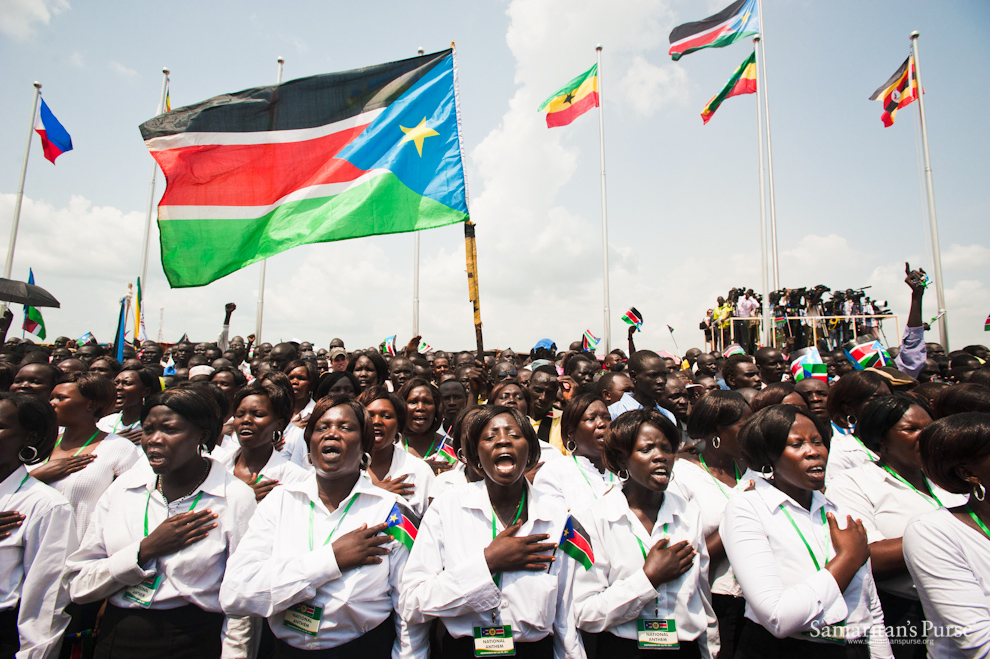
There was no doubt that the referendum would deliver the will of the people of South Sudan which was a choice for secession and it did. So, in January 2011 following the announcement of the results of the referendum, it was expected that in the 6 months period prior to independence, there would be fresh elections in South Sudan whose purpose would be to prepare the territory of South Sudan for independence. The new legislative assembly would first and foremost design a constitution which reflects the will, values and cultures of South Sudanese people. It would also deal with the issue of the flag of the country and many others to prepare the newly expected country to take off smoothly. This unfortunately was deliberately sabotaged by the SPLM/A which hijacked the will of the people imposing itself with its flag as South Sudan. Thus from 2011 to date what started in 1960 by Jieng in pursuance of social supremacy found itself in control of state power.
With the capture of total state power, the Jieng not only tribalized the security sector but they armed their people in their villages and gave them the OK to destabilise the other social groups in South Sudan through expansionists policies of settlement in Fertit land, Chollo land and Equatoria. Their policy of labelling Equatorians as non-citizens began to be implemented. For example, the takeover of Nimule and other border towns by the Jieng.
Conclusion
The root causes of South Sudan problems emerged in 1960 with Jieng people deciding that they are born to rule. The policies of violence and tribalism they have implemented for 60 years have set the country on a course of instability and continuous conflict which is what we are seeing now. So, in order to address this problem, it is necessary for South Sudanese to confront themselves openly by pointing to the real issues without skirting around it: Jieng supremacist ideology is at the root of the South Sudan problem.
[Truth hurts but it is also liberating]
Newer articles:
- An Open Memo To The Fifa President - Match Egypt vs Senegal - 31/03/2022 14:02
- Is South Sudan a Dumping Member of the East Africa Community? - 30/03/2022 11:37
- Eng. Dr. Chol Deng Thon (PhD) MD of Nilepet; A man with excess capacity and acumen - 25/03/2022 00:41
- Condemnation Message on the concocted media allegation against Maj. Gen. Dr. Akol Ayii Madut (PhD) - 19/03/2022 10:39
- To all South Sudanese people both in the Country and Diaspora read the below principle of Money - 10/03/2022 10:05
Older news items
- Letter of Appreciation to Hon. Puot Kang and Cde Eng. Awow Daniel Chuang - 23/02/2022 12:43
- Equatoria Peoples’ Alliance (EPA) - South Sudan and Uganda discuss security measures to target and harm thousands of innocent Refugees - 14/02/2022 11:32
- What about the people? - 07/02/2022 11:16
- Letter of Appreciation to Cde Dr. Chol Thon Abel, MD of Nilepet for his tremendous commitment towards Nation building in our country - 05/02/2022 11:40
- Gen. Akol Koor Kuch Represents The Seed of Quality Leadership - 02/02/2022 12:08
Latest news items (all categories):
- ‘It’s not part of Kenya’ – South Sudan VP Taban Deng renews claim over disputed Ilemi Triangle - 31/08/2026 11:11
- Families search for missing loved ones as conflict shatters Sudan, South Sudan - 31/08/2026 11:03
- Armed raid on cattle camp kills at least 49 in South Sudan - 31/08/2026 11:01
- UNESCO supports South Sudan to establish its first education sector monitoring system - 31/08/2026 10:58
- تصفيات مونديال قطر لكرة السلة:المنتخب التونسي ينهزم امام منتخب جنوب السودان - 31/08/2026 10:56
Random articles (all categories):
- World Vision South Sudan Annual Report 2018 - 15/04/2019 01:33
- South Sudan’s bishops praise peace agreement for neighboring Sudan - 29/08/2019 11:44
- World Bank leader arrives in Sudan, 1st visit in 50 years - 30/09/2021 04:11
- South Sudan Is on the Cusp of Genocide—It Can Be Stopped, If We Care - 23/12/2016 01:20
- South Sudan: Years into a climate disaster, these people are eating the unthinkable - 02/11/2023 06:00
Popular articles:
- The Final Communique of SPLM-DC Third Session of the National Council - 29/03/2011 01:00 - Read 83131 times
- Roles and Definition of Political Parties - 29/04/2011 01:00 - Read 64849 times
- Agriculture in Southern Sudan: Challenges and Investment Opportunities - 06/10/2010 01:45 - Read 57467 times
- Fashoda Youth Forum Rehabilitation of Drainage Culverts in Malakal town Report - 07/08/2008 16:22 - Read 35881 times
- Creation and establishment of the Local Government Councils ( Counties ) (2) - 28/09/2011 01:00 - Read 33712 times