
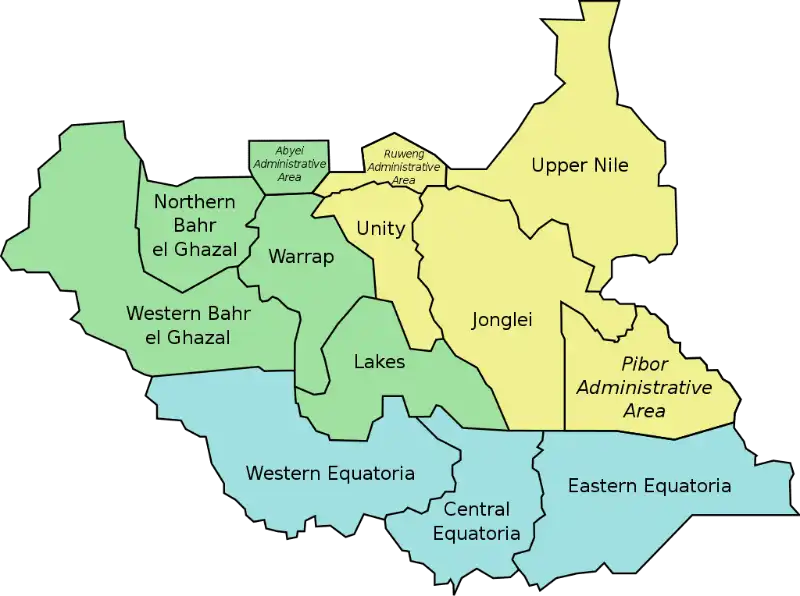
South Sudan States and Administrative Areas (By Leviavery/Wikimedia based on FileSouthSudanStates.svg Own work)
Opinion - By James Lwany — April 2026
(Pachodo.org) - At the end of this series, the question is no longer abstract, nor is it an intellectual exercise in political theory. It has become existential—cutting to the core of South Sudan’s survival. Can a country born out of marginalization and conflict endure if it reproduces the very conditions that led to its secession? Or does history, when misunderstood, return with sharper edges and fewer second chances?
The uncomfortable truth is that South Sudan did not break away for superficial reasons—geography or momentary political disputes. Its birth was the result of accumulated failures: political exclusion, economic neglect, distortions in education, cultural alienation, and a prolonged struggle over the identity of the state itself. What is unfolding now raises an unsettling question: are these same patterns reassembling inside the new state? And if secession was an escape from a failed model, how is that model being reconstructed—sometimes in even harsher form?
Politically, the country appears suspended in what might be called a state of permanent indeterminacy. It is neither collapsing outright nor consolidating into a functioning system. Power is managed through ethnic and partisan balancing acts, while decisions are shaped less by institutional logic than by the need to appease competing centres of influence. As Max Weber observed in Economy and Society (p. 54), the state is defined by its monopoly over the legitimate use of force. But what happens when that monopoly fragments—when armed groups, militias, and parallel authorities share it? At what point does a state cease to be a state and become merely a contested arena?
The politicization of the civil service deepens this crisis. Senior positions—undersecretaries, directors, key administrative posts—are filled through ethnic quotas and political loyalty rather than competence. This does not merely weaken efficiency; it strips the state of neutrality. As Francis Fukuyama argues in State-Building (p. 32), strong institutions begin with a professional bureaucracy, not one treated as spoils of power.
Economically, the picture is equally stark. Oil, which should have been a foundation for development, has instead become a focal point of contention. As Daron Acemoglu notes in Why Nations Fail (p. 95), resource-dependent economies often fuel conflict rather than resolve it. Yet the deeper problem is not oil itself, but what it has eclipsed: agriculture, livestock, water resources, and forests.
South Sudan possesses vast agricultural potential, yet it remains heavily dependent on humanitarian aid. This contradiction is difficult to ignore. How does a country with fertile land import its food? Why has agriculture been sidelined? Global examples offer warnings: in countries overly dependent on oil revenues, productive sectors have withered, leaving economies fragile and undiversified. Is South Sudan following the same trajectory?
Livestock—one of the country’s greatest assets—remains largely unstructured, fuelling recurring conflicts over grazing land and water. Water resources, abundant by regional standards, are not strategically managed. Forests are depleted without sustainable policies. These are not minor inefficiencies; they are systemic failures. The question is unavoidable: are these resources being neglected by accident, or by design?
In border regions, the situation grows more complex. Weak state control has allowed neighbouring countries to encroach—sometimes gradually, sometimes through faits accomplis. How much land has been lost quietly? How many borders have shifted without resistance? The problem is not only external pressure, but internal fragmentation. When the domestic front fractures, borders become negotiable lines rather than defended realities. Can a divided state protect its sovereignty? History suggests otherwise.
More troubling still is internal complicity—when local interests intersect with external ambitions. Ethnic fragmentation becomes not just a vulnerability but a mechanism through which the state itself is penetrated.
Socially, the militarization of public life compounds the crisis. The proliferation of weapons, the multiplication of militias, and the reliance on armed groups to suppress opponents all erode the very idea of the state. Why does the government turn to such forces? Because trust in formal institutions has eroded. Yet this creates a self-perpetuating cycle: the more the state relies on militias, the weaker it becomes.
The pattern is familiar. In Afghanistan, dependence on local armed actors undermined central authority. In Somalia, militias fractured the state beyond recognition. The lesson is blunt: a modern state cannot coexist indefinitely with competing centres of force.
Land disputes add another layer of volatility. When military figures or political elites appropriate land, they ignite deep resentment. Land is not merely an economic asset—it is identity, memory, and belonging. When it is seized, it becomes fuel for conflict. Is there a faster way to entrench tribal divisions?
Culturally and educationally, the crisis is equally profound. Scholarship opportunities and higher education are often distributed through patronage and affiliation rather than merit. As Pierre Bourdieu explains in Reproduction (p. 72), education can reinforce inequality rather than dismantle it. What, then, becomes of a nation whose education system reproduces division instead of unity?
Urban migration reflects another dimension of collapse. Citizens are leaving rural areas not by choice but by necessity—driven by the absence of services, opportunities, and viable livelihoods. What happened to the promise of “taking the town to the village”? Has it become a hollow slogan? Today’s reality is overcrowded cities, strained infrastructure, and abandoned rural economies—a reversal of the original vision.
In this context, the role of intellectuals becomes critical. Can a society avoid collapse without critical awareness? As Antonio Gramsci wrote in Prison Notebooks (p. 12), “The crisis consists precisely in the fact that the old is dying and the new cannot be born.” Is South Sudan trapped in that very moment?
And then there is the people themselves. Few populations have endured as much disappointment from their leaders. South Sudanese citizens fought for decades, sacrificing lives, wealth, and generations for a simple aspiration: to live as citizens in their own country. Yet how are they repaid? By being told their youth are lazy? The dissonance is stark.
As Nelson Mandela wrote in Long Walk to Freedom (p. 544), “Freedom is not merely to cast off one’s chains, but to live in a way that respects and enhances the freedom of others.” Has that vision been realized?
John Garang envisioned a “New Sudan” grounded in justice and citizenship. Luka Biong Deng has argued that state-building requires institutions, not slogans. Adwok Nyaba has warned that political elites bear historical responsibility for the nation’s direction. Have these ideas been honored—or abandoned?
Escaping this predicament does not require denying ethnicity, but neutralizing its political function. It requires rebuilding institutions based on competence, unifying the military under state authority, dismantling militias, implementing genuine decentralization, reforming education, and enforcing transparent resource management. But can this be done?
At this point, the question resists simplicity. It becomes less a query and more a problem to be unravelled:
Is political will born from crisis—or imported under pressure?
Is change the result of deliberate decision, or of a slow, collective awakening?
Can a system built on balance transcend it without unraveling itself?
As Hannah Arendt wrote in The Human Condition (p. 175), “Politics arises in the space between people.” Does that space still exist in South Sudan—or has it been consumed by loyalties?
To the government: can power continue to be managed as a balancing act without becoming a permanent burden?
To the people: can change be expected without participation—and at what point does waiting become acceptance?
This is not merely the conclusion of a series. It is a moment of reckoning.
States do not collapse only because of their enemies. They collapse because of uncorrected mistakes.
South Sudan now stands at the edge of two paths:
one that repeats its crises,
and another—harder, uncertain—but still open.
The final question is not meant to be answered quickly. It is meant to linger:
Is there still time to choose a different path?
— James Lwany
April 2026
South Sudan’s Most Dangerous Path: Ethnic Nationalism — and the Case for a Civic State (Part 1)
South Sudan’s Most Dangerous Path: Ethnic Nationalism — and the Case for a Civic State (Part 2)
South Sudan’s Most Dangerous Path: Ethnic Nationalism — and the Case for a Civic State (Part 3)
South Sudan’s Most Dangerous Path: Ethnic Nationalism — and the Case for a Civic State (Part 4)
South Sudan’s Most Dangerous Path: Ethnic Nationalism — and the Case for a Civic State (Part 5)
South Sudan’s Most Dangerous Path: Ethnic Nationalism — and the Case for a Civic State (Part 6)
South Sudan’s Most Dangerous Path: Ethnic Nationalism — and the Case for a Civic State (Part 7)
South Sudan’s Most Dangerous Path: Ethnic Nationalism — and the Case for a Civic State (Part 8)
South Sudan’s Most Dangerous Path: Ethnic Nationalism — and the Case for a Civic State (Part 9)
South Sudan’s Most Dangerous Path: Ethnic Nationalism — and the Case for a Civic State (Part 10)
Newer articles:
- Research: Dr. J. Scott Younger: Global Disorder and the Unravelling of Strategic Certainties: ‘Where Next, and What Next?’ - 27/04/2026 15:02
- Holding the Banner of True Friendship: The China-South Sudan Partnership for a Shared Prosperity - 24/04/2026 20:42
- Rescuing The Cry Of The Text: Why The African Church Needs Expository Preaching - 24/04/2026 19:29
- Repentance And Penance - 24/04/2026 19:28
- South Sudan’s Path To Change Requires Sacrifice - 22/04/2026 14:37
Older news items
- End The Transition, No To Extension - 22/04/2026 14:30
- When stories travel: How screens connect China and Africa - 20/04/2026 15:01
- Intelligence Is Prerequisite For Affective Leadership - 20/04/2026 14:56
- South Sudan’s Most Dangerous Path: Ethnic Nationalism — and the Case for a Civic State (Part 9) - 20/04/2026 14:50
- Rebuttal to the So-called SPLM Cadres Forum: In Defense of SPLM-Secretary General, Cde. Dr. Akol Paul Kordit and the Rule of Law - 17/04/2026 14:06
Latest news items (all categories):
- Op-Ed - Breaking the Double-Standard Lens on China's Population Shifts - 23/10/2026 14:23
- South Sudan ceasefire monitors warn of rising violence ahead of December elections - 23/10/2026 13:39
- UNMISS SRSG visits Malakal, emphasizes that peace begins with collective action - 23/10/2026 13:36
- How Technology is Accelerating South Sudan’s Next Oil Discovery - 23/10/2026 13:34
- South Sudan’s Patriot make case in their opener against Urunani - 23/10/2026 13:12
See also (all categories):
Random articles (all categories):
- US says ready to resume Sudan mediation once parties 'serious' - 01/06/2023 03:18
- Nutributter shipment arrives in South Sudan - Reuters AlertNet - 11/04/2012 00:00
- THE SHILLUK KINGDOM TODAY - 12/07/2010 10:39
- Factbox-What is OPEC+ and how does it impact oil prices? - 20/11/2023 00:47
- South Sudan's President Moves - 23/09/2013 01:31
Popular articles:
- The Final Communique of SPLM-DC Third Session of the National Council - 29/03/2011 01:00 - Read 83348 times
- Roles and Definition of Political Parties - 29/04/2011 01:00 - Read 65115 times
- Agriculture in Southern Sudan: Challenges and Investment Opportunities - 06/10/2010 01:45 - Read 57837 times
- Fashoda Youth Forum Rehabilitation of Drainage Culverts in Malakal town Report - 07/08/2008 16:22 - Read 36106 times
- Creation and establishment of the Local Government Councils ( Counties ) (2) - 28/09/2011 01:00 - Read 34003 times
