
In South Sudan, drastic cuts to humanitarian aid have reduced or even eliminated life-saving mental health and psychosocial support (MHPSS) services, further straining an already fragile system heavily reliant on humanitarian actors.
In response to this crisis, JRS has continued to strengthen its community-based approach to MHPSS.This has been crucial in keeping services going, even if on a smaller scale. The idea behind this approach is simple: communities themselves are the foremost experts in their own wellbeing. They are the first to respond,drawing on their knowledgeof local resources, culture, and coping strategies.
Even in the absence of extensive funding, communities can continue supporting one another organically when effectively facilitated.
The consequences of cutting mental health services
Harmful coping mechanisms have increased, especially among young people, alongside rising levels of psychological distress and a worrying escalation in suicideattempts. Many people who once found stability through integrated psychosocial programming are now struggling again, with some experiencing relapses or a worsening of their symptoms.
Families with children with special needs who depended on MHPSS services integrated with other essential programmes – such as supplementary nutrition and physiotherapy – have been severely affected. Their children have died.
“The biggest challenge is now”, says Alamedin Abdulrahman, Sudanese refugee working with JRS as home visitor in South Sudan. “I have seen many organisations close or drastically reduce their staff. This puts more weight on our shoulders. As counsellors, we receive questions both from newly arrived people and from those already in the camp, and we must find answers.”

Physiotherapy services in Renk, South Sudan (Jesuit Refugee Service).
Communities as experts in their own wellbeing
JRS collaborates with local leaders, church members, paracounsellors and home visitors from both refugee and host communities. They help identify needs, initiate activities, and refer individuals for further and more specialised assistance.
Home visitors live and work within the communities. JRS trained them in basic counselling skills, equipping them with the necessary tools to offer immediate psychosocial support while linking people to specialised services. “We do door-to-door awareness in the settlement. But we also run group sessions inside the reception centre, especially for new arrivals. They need to gradually understand what is happening, how to settle well, and how to avoid problems. I use my age, my language, my nationality to help people feel safe and welcomed”, continues Alamedin.
In situations of protracted crisis, investing in local communities is fundamental to ensuring the sustainability of psychosocial support. The community-based approach is built on co-creating solutions with communities, strengthening local capacities, supporting existing self-help mechanisms, and reinforcing community resources and safety nets. For this model to succeed, it is essential to consolidate these capacities and care for the wellbeing of those who play this role of support within the community.
“Our work is crucial because it allows people to overcome stigma and fear. By bringing support into the community, we create safe spaces where members can open up and talk about the difficulties they are facing”, explains Paulino, MHPSS Paracounsellor in South Sudan.

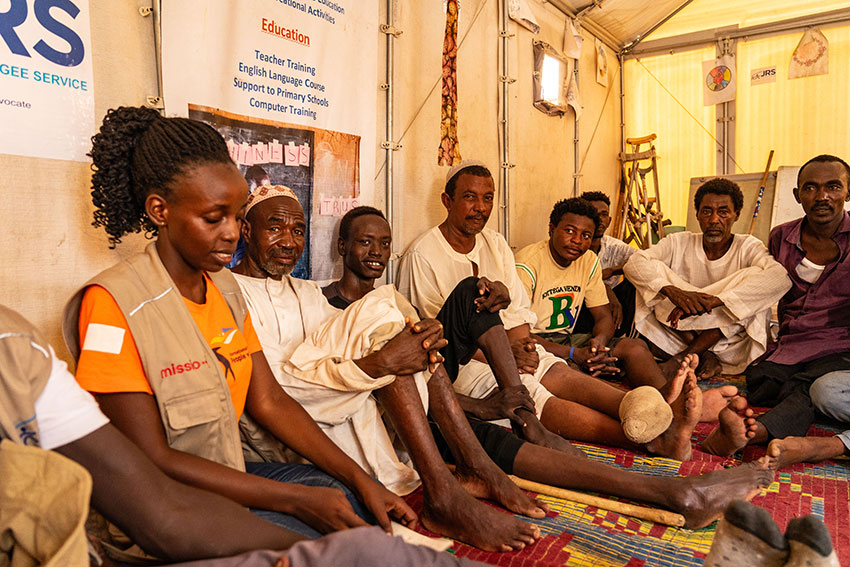
Mental health and psychosocial support activities in Renk, South Sudan (Jesuit Refugee Service).
A system that must be supported, not undermined
However, aid cuts are undoing much of the progress made in strengthening community-based mental health and psychosocial support. They are weakening the way organisations once coordinated and worked together and are leaving vulnerable people without the help they need.
“People need MHPSS. Some arrive here, in the camps or the reception centres thinking their life is over. But if they understand the other communities, if they are guided towards an inter-community vision, they can support each other. They can become like a big family. This gives them the strength to start over and become self-reliant. To continue caring for their children and to look for work”, concludes Alamedin.
Source: https://www.jesuits.global/2025/10/10/how-communities-safeguard-mental-health-in-south-sudan/
Newer articles:
- South Sudan flood crisis deepens: Nearly 890,000 affected as humanitarian needs soar - 14/10/2025 12:59
- UPDF Troops in South Sudan Mark Uganda’s 63rd Independence Anniversary - 14/10/2025 12:51
- Chinese female peacekeeper awarded UN medals after yearlong mission in South Sudan - 14/10/2025 12:44
- Sudan and South Sudan Sign Pact to Protect Oil Pipeline, Critical Oil Infrastructure - 10/10/2025 19:22
- RJMEC: "There is a risk of a large-scale resumption of civil war in South Sudan" - 10/10/2025 19:15
Older news items
- South Sudan president fires military chief after three months, reinstates predecessor - 10/10/2025 19:01
- At least 14 soldiers killed in South Sudan as ‘love triangle’ turns bloody - 10/10/2025 18:56
- South Sudan: Flooding Situation Flash Update No. 6 (As of 10 October 2025) - 10/10/2025 18:53
- South Sudan opposition leader Machar claims immunity in treason trial - 04/10/2025 14:39
- Death of a rainmaker: When drought means murder in South Sudan - 04/10/2025 14:33
Latest news items (all categories):
- South Sudan Opens 14 Oil Blocks, Courts Investors Ahead of SSOP 2026 - 26/10/2026 15:08
- Jambojet Explores South Sudan Expansion After Talks with Juba Regulator - 26/10/2026 15:05
- Kiir swears in 5 officials ahead of South Sudan elections - 26/10/2026 14:53
- South Sudan cattle battles leaves 10 dead: official - 26/10/2026 14:49
- Churches urge world 'not to forget South Sudan' ahead of first elections - 26/10/2026 14:47
See also (all categories):
Random articles (all categories):
- Demise of a dictator: How will the world remember Sudan’s Omar al-Bashir? - 03/03/2020 15:39
- South Sudan’s MTN customers to access non-expiring business bundles - 23/08/2020 04:22
- South Sudan - Crisis Fact Sheet #4, Fiscal Year (FY) 2020 - 10/02/2020 15:09
- South Sudan violence targets hospitals - 26/02/2014 13:29
- Star Of #39;The Good Lie #39; Is A Lost Boy Of Sudan - 04/12/2014 18:54
Popular articles:
- Who is the darkest person in the world, according to Guinness World Record? - 25/10/2022 02:34 - Read 151294 times
- School exam results in South Sudan show decline - 01/04/2012 17:58 - Read 28388 times
- Top 10 weakest currency exchange rates in Africa in 2023 - 19/07/2023 00:24 - Read 25493 times
- No oil in troubled waters - 25/03/2014 15:02 - Read 24697 times
- NDSU student from South Sudan receives scholarship - In-Forum - 29/09/2012 01:44 - Read 22673 times
