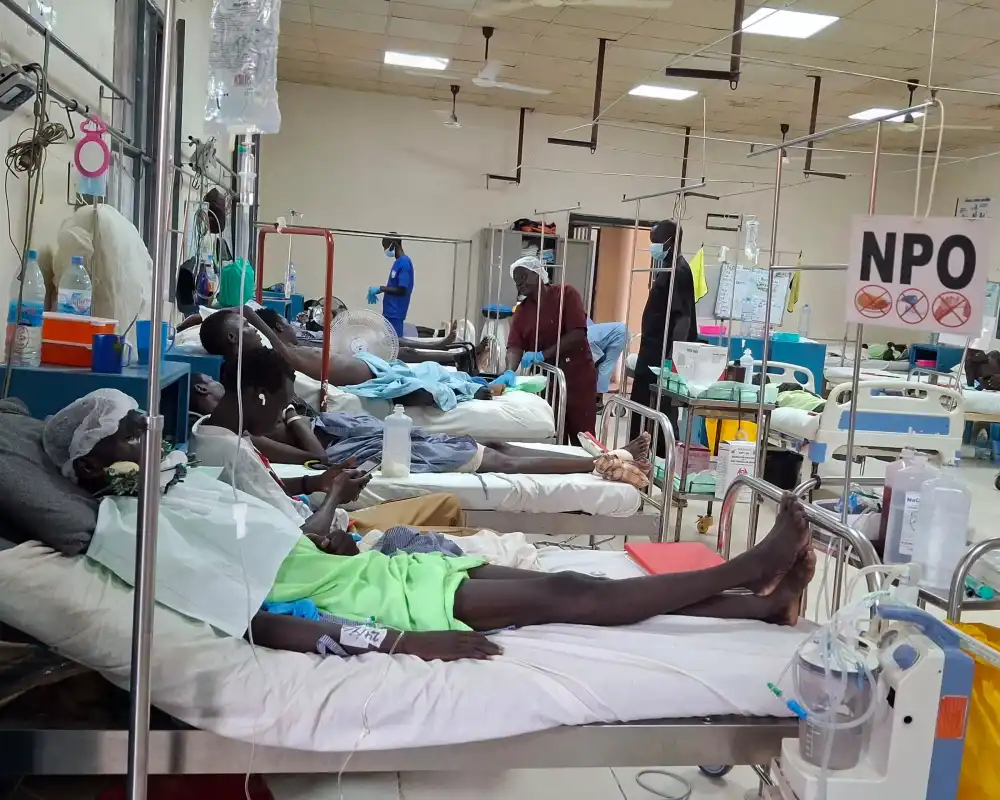
A ward at Juba military hospital for people wounded in communal violence and fighting between militia and South Sudan’s government forces (Photograph: Deng Machol/The Guardian)
By 11am on a recent Thursday, Dr Slobodan Mirosavljev had already seen two critically wounded patients at Juba military hospital. The day was barely halfway through, but the surgeon couldn’t say how long he would be at the facility.
A patient shot in the abdomen, head or chest could arrive without warning. A helicopter could bring several critically wounded people from another part of South Sudan. A mass casualty incident could fill the wards within hours.
For Mirosavljev and his colleagues, uncertainty has become part of the job at the hospital, where the International Committee of the Red Cross (ICRC) supports surgeries for weapon-wounded victims of renewed fighting between the military, known as the South Sudan People’s Defence Forces (SSPDF), and the Sudan People’s Liberation Movement-In Opposition (SPLM-IO), which is loyal to former vice-president Riek Machar, and allied groups.
The conflict has increased the demand for surgical care, overwhelming an already fragile and under-resourced health system in the world’s youngest country. The fighting has intensified in the past year, particularly in Jonglei state, an opposition stronghold, amid a political crisis fuelled by the president, Salva Kiir, sidelining Machar.
Machar and Kiir were members of the Sudan People’s Liberation Army, a guerrilla movement that fought for independence from Sudan, which it gained in 2011, with Kiir becoming president and Machar the first vice-president. South Sudan descended into a bloody civil war in 2013 after Kiir fired Machar and later accused him of planning a coup.
Machar founded SPLM-IO, whose fight against the army in the ensuing civil war killed more than 400,000 people and displaced nearly half the country’s population. The fighting took place largely along ethnic lines, between Kiir’s majority Dinka community and Machar’s Nuer, the second largest ethnic group in the country.
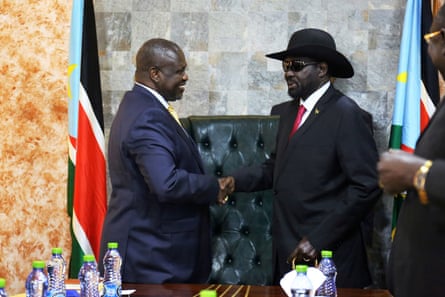
Salva Kiir (right) with ex-vice president and former rebel leader Riek Machar at a meeting in Juba, South Sudan in 2019. Photograph: Jok Solomun/Reuters
In 2018, Kiir and Machar signed a peace deal – ending the civil war, creating a unity government of the two parties and returning Machar to the vice-presidency. But implementation of the agreement has barely got off the ground, as the two parties are constantly at odds over power sharing.
The renewed conflict was triggered by a deadly attack by the White Army, a rebel group that was allied to Machar during the civil war, on a government garrison in Nasir county in Upper Nile state in March 2025.
It resulted in Machar being charged with murder, treason, crimes against humanity and other serious crimes in connection with the attack, and Kiir suspending him from his post.
The actions have inflamed tensions in the country, with Machar’s supporters saying the charges against him are politically motivated and observers saying they risk jeopardising the peace agreement and plunging the country, where elections are due in December, into full-scale civil war.
The events have also coincided with increased fighting between militias and government forces in parts of the country that has killed hundreds and displaced more than 200,000 people.
Last month, the UN Commission on Human Rights in South Sudan expressed concern that the renewed violence and political tensions continued to place civilians at risk.
“Visit after visit, we continue to hear from people who bear the consequences of violence, displacement, insecurity and the failures of those with political and security responsibilities to prevent and address those harms,” said the commission’s chairperson, Yasmin Sooka.
At Juba military hospital, patients, medical workers and visitors moved between wards as the rainy season settled over the country. The sounds of footsteps, hospital trolleys and hurried conversations mixed with the steady hum of ceiling fans and the smell of disinfectant.
Some patients recovering from gunshot wounds sat along covered walkways. Others waited on crutches, while patients further along in their recovery carried out morning rehabilitation exercises.
As the fighting intensifies, the facility must be prepared to receive weapon-wounded victims at any time. For the surgical teams, that means there is no such thing as a predictable workday. Mirosavljev said that before midday they had had their morning meeting, received reports from the night shift team, seen critical patients in the high dependency unit, and started operating.
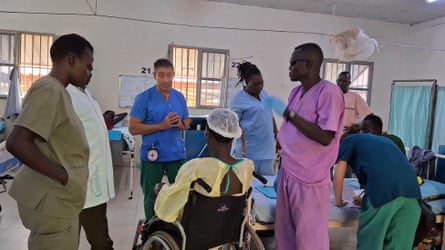
Dr Slobodan Mirosavljev (in blue scrubs and green trousers) speaks to a patient with a gunshot wound. Photograph: Deng Machol/The Guardian
The Serbian surgeon has been working at the hospital since August 2025. He operates on some of the most seriously wounded patients and supervises surgical teams.
His day usually starts before 8am with a briefing, followed by ward rounds, consultations, emergency admissions and operations. Surgeries end in the early evening on typical days, but can go late into the night when critically wounded patients arrive.
Besides victims of political violence, the patients arriving at the hospital include those wounded in communal fighting and cattle-related conflict.
In the first six months of this year, the ICRC evacuated 266 injured people from conflict areas and brought them to the facility. Most cases at the hospital are gunshot wounds, and others include stab wounds, broken bones and explosive injuries. Mirosavljev estimated that one in 10 involve serious head injuries, including bullets entering the skull.
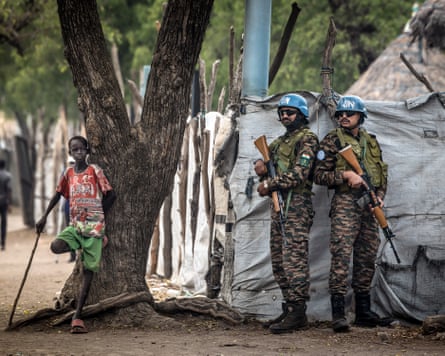
Indian peacekeepers serving with the United Nations Mission in South Sudan stand guard next to a young boy as they patrol outside local government offices in the strategic town of Akobo in Jonglei state in February. Photograph: Luis Tato/AFP/Getty Images
For surgeons, the numbers translate into a daily struggle against blood loss, infection and damage to vital organs.
Some patients require several operations. Every week, the medics receive at least two or three “very difficult” injuries from bullet or blast injuries to the chest and abdomen that need multiple surgeries, Mirosavljev said. For such patients, surgery is only the beginning. “They need a lot of blood; they need a lot of support,” he said.
Blood is among the most critical resources in the trauma unit. The hospital may have about 15 units available, with capacity sometimes reaching 20. A single severely wounded patient can require half of that supply.
Medical teams and hospital management work to find donors, sometimes relying on patients’ relatives and the national blood bank in Juba. But maintaining a reliable supply remains difficult.
The consequences can be serious when several casualties arrive at once. Rose Ochieng, the ICRC’s health coordinator in South Sudan, said the surgical department at Giada military hospital was operating at more than 160% of its bed capacity at the most recent peak this year.
She said: “We are doing what we can to keep pace: adding overflow beds and recruiting more physiotherapy staff. But demand is growing faster than the capacity of trauma services. And it is civilians caught up in the fighting who are paying the price.”
For emergency room nurse Mubarak Jamal, uncertainty begins every morning. Jamal is from Central Equatoria state and has been working at the hospital since 2024. At the outpatient department, there are a limited number of beds. On a normal day, he said, the department sees about 30 patients. Between seven and 10 may be people suffering weapon-related injuries.
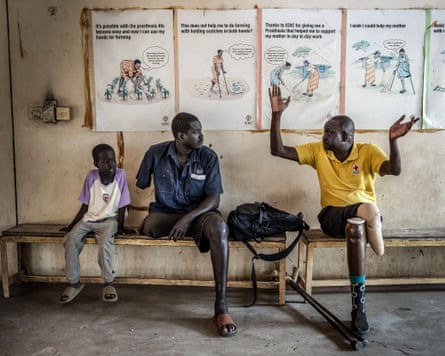
Patients with limb loss sit and talk after being attended by specialists at an International Committee of the Red Cross-supported rehabilitation centre in Juba in February. Photograph: Luis Tato/AFP/Getty Images
Normal days, however, can disappear quickly, Jamal said, recalling that they received more than 93 patients in one day in the last mass casualty situation.
His responsibility is to ensure the emergency department is prepared for whatever arrives overnight – restocking supplies, knowing who is working during the night, and how they will coordinate with the colleagues from the operating theatre and other departments.
And survival is not the end of treatment.
For physiotherapist Lotto Charles, the real measure of recovery is whether a patient can eventually return home and live independently.
Charles, from Eastern Equatoria state, has worked at the hospital since 2016. His job includes rehabilitating the injured. Many of his patients are recovering from gunshot wounds. He lists others: “There are multiple fracture patients, patients with nerve injury, patients with lung collapse, and bedridden patients with extensive soft-tissue injuries who are not able to move.”
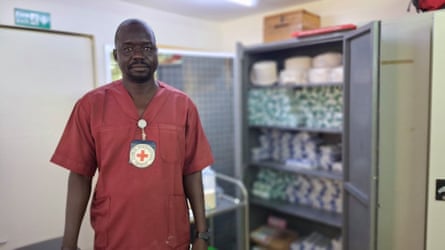
‘At least I’m doing something to help the community’ … Lotto Charles, physiotherapist. Photograph: Deng Machol/The Guardian
His work can include casting broken limbs, managing patients on traction, and helping them regain muscle strength and movement. One day last month, he treated five patients. One needed to have a cast removed, modified and reapplied. Another required exercises to restore knee movement. A bedridden patient was assisted out of bed for the first time.
For Charles, the reward comes when a patient who arrived on a stretcher walks out of the hospital. “That really motivates me a lot – that at least I’m doing something to help the community,” he said.
For Mirosavljev, that makes the difficult days worthwhile. “It’s a good feeling when you do the job, and people survive … and they walk out,” he said.
Source: https://www.theguardian.com/world/2026/oct/08/inside-south-sudan-overwhelmed-trauma-wards
Newer articles:
- ‘Stuck between bad choices’ – Girls in Jonglei struggle to safely access education - 12/10/2026 14:29
- Twelve Vietnamese peacekeeping medics reunite with families after serving in South Sudan - 12/10/2026 14:25
- Ramaphosa presses Kiir to implement peace deal ahead of South Sudan’s first elections - 09/10/2026 12:19
- South Sudan steps up Ebola alert after Kenya case - 09/10/2026 12:17
- Laotian man deported by U.S. to South Sudan leaves for Laos after year in detention - 09/10/2026 12:14
Older news items
- MTN South Sudan and Regulator Pledge Cooperation to Expand Connectivity - 09/10/2026 12:01
- Juba commissioner denies chasing foreigners - 07/10/2026 14:36
- Australia: 19-year-old from South Sudan arrested over a wild joy ride - 07/10/2026 14:33
- South Sudan’s aid crisis deepens as food stocks run low - 07/10/2026 14:29
- South Sudan’s Juba warns foreigners against running small-scale businesses - 07/10/2026 14:25
Latest news items (all categories):
- Research - Europe between a new world war and geopolitical defeat: strategic energy miscalculations, geopolitical ambitions and American pragmatism - 21/11/2026 00:54
- APEC is finding ways to make cross-border services easier - 21/11/2026 00:45
- Xi Jinping’s push for tech independence: How China is trying to close the gap - 21/11/2026 00:44
- How does regional integrated development become a key driver for rapid growth? - 21/11/2026 00:36
- South Sudan rejects claims US-deported migrants face hunger, poor conditions - 21/11/2026 00:12
See also (all categories):
Random articles (all categories):
- Rebuilding Nationhood Through Schools: Why South Sudan Needs a Philosophy-Driven Curriculum - 16/02/2026 13:50
- The Catholic pilgrims who walked 9 days to see Pope Francis - 04/02/2023 10:11
- UN Rights Body Should Stay Course in South Sudan - 23/03/2021 02:48
- South Sudan: hundreds of thousands still living in precarious conditions months after floods - 07/01/2022 10:21
- والي النيل الأبيض يبحث ترتيبات إفتتاح معبر المخاليف الحدودي مع دولة جنوب السودان - 23/01/2026 13:20
Popular articles:
- Who is the darkest person in the world, according to Guinness World Record? - 25/10/2022 02:34 - Read 151948 times
- School exam results in South Sudan show decline - 01/04/2012 17:58 - Read 28602 times
- Top 10 weakest currency exchange rates in Africa in 2023 - 19/07/2023 00:24 - Read 25692 times
- No oil in troubled waters - 25/03/2014 15:02 - Read 24866 times
- NDSU student from South Sudan receives scholarship - In-Forum - 29/09/2012 01:44 - Read 22852 times