
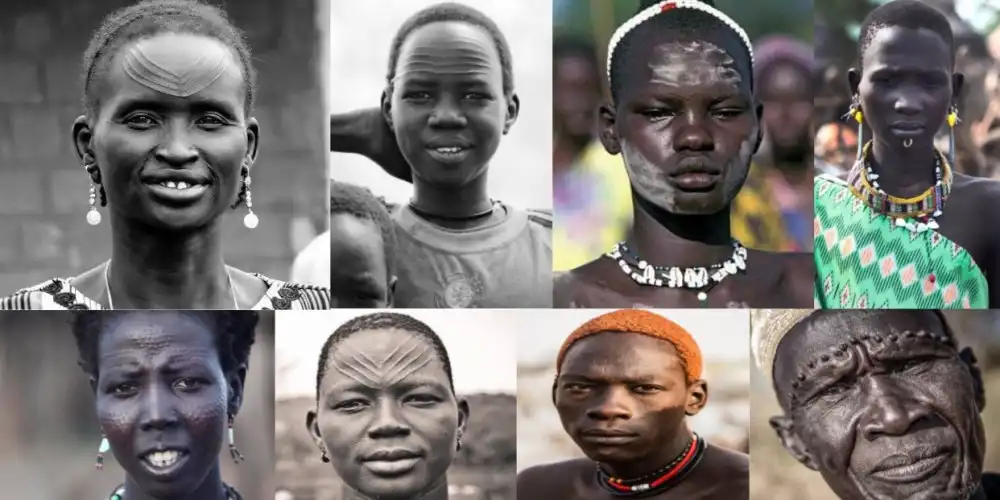
64 beautiful tribes of South Sudan (Photo Source: Scrollz Network)
Opinion: By James Lwany
March 31, 2026
(Pachodo.org) - South Sudan does not suffer from a shortage of identity. It suffers from the politicization of identity. In a country where ethnicity is socially meaningful but institutionally unmanaged, the most dangerous form of nationalism is not merely ethnic pride—it is state-backed ethnic nationalism fused with elite competition and militarization. That combination, more than sporadic communal violence or even localized insurgencies, poses the gravest threat to the country’s survival.
The risk lies in how power is pursued and justified. When political authority is framed as the entitlement of a particular ethnic group—whether defined by majority status, historical grievance or control of armed networks—the state ceases to function as a neutral arbiter. It becomes an instrument. Ministries, security forces and public resources are then allocated not on the basis of law or competence, but loyalty and lineage. This is not simply exclusionary; it is combustible.
South Sudan’s history since independence illustrates this pattern with clarity. Political rivalries have repeatedly taken on ethnic coloration, not because communities are inherently hostile, but because elites have mobilized identity as a strategic asset. Once that line is crossed, violence escalates quickly. Armed factions claim to defend “their people,” civilians are recast as proxies, and compromise becomes politically dangerous. In such an environment, even routine political disputes—appointments, elections, budget allocations—risk triggering wider conflict.
Among the various forms of ethnic politics, militarized ethnic patronage systems are the most dangerous. These systems combine three elements: control over armed actors, access to state resources and the ability to mobilize ethnic narratives. Leaders who command these levers can sustain power even in the absence of legitimacy, but at a steep cost. Governance deteriorates into factional bargaining. Institutions hollow out. The economy fragments as public funds are diverted into networks of loyalty. Over time, the state becomes less a functioning entity than a contested arena.
This model also produces a cycle that is difficult to break. Exclusion breeds insecurity; insecurity justifies further exclusion. Communities that feel marginalized arm themselves or align with rival elites, reinforcing the very divisions that destabilize the country. The result is not decisive conflict, but chronic instability—a pattern of low-intensity violence punctuated by periodic crises. This is precisely the kind of conflict that erodes states from within: slow, persistent and corrosive.
Equally dangerous is the drift toward secessionist ethnic nationalism, particularly in regions where communities are territorially concentrated. When groups conclude that the state cannot protect them or represent their interests, demands shift from inclusion to exit. In South Sudan, where administrative boundaries often overlap with ethnic settlement patterns, such movements would not produce clean separations. They would generate new disputes over borders, resources and minority populations within newly defined territories. The fragmentation of the state would not resolve conflict; it would multiply it.
The alternative—civic nationalism—is often described in abstract terms, but for South Sudan it is a practical necessity. A civic state does not erase ethnic identity; it neutralizes its political dominance. It establishes that citizenship, not ethnicity, is the basis of rights, representation and access to public goods. This shift is not cosmetic. It changes incentives.
Under a civic framework, political competition is redirected. Leaders win office by building coalitions across communities, not by consolidating a single ethnic base. Public institutions—courts, civil service, electoral bodies—are expected to operate impartially, creating predictable rules that reduce the perceived need for groups to rely on ethnic protection. When citizens believe that disputes can be resolved through law rather than force, the appeal of armed mobilization diminishes.
But civic nationalism cannot be declared; it must be built. For South Sudan, that requires several concrete steps.
First, security sector reform is essential. Armed forces and police must be professionalized and depoliticized, with recruitment and promotion based on merit rather than ethnic affiliation. As long as security institutions are perceived as extensions of particular groups, they will provoke rather than prevent conflict.
Second, power-sharing arrangements must be credible and transitional, not permanent substitutes for governance. While inclusive cabinets and regional representation can stabilize fragile moments, they must evolve into systems where accountability matters more than identity quotas. Otherwise, they entrench the very divisions they are meant to manage.
Third, decentralization should be meaningful but carefully designed. Local governance can reduce tensions by bringing decision-making closer to communities, but it must be accompanied by safeguards against local majoritarianism. Minority protections, fiscal transparency and clear legal frameworks are critical to prevent decentralization from becoming localized exclusion.
Fourth, economic governance must be reoriented toward equity and transparency. In a resource-dependent economy, perceptions of unfair distribution are a powerful driver of ethnic mobilization. Transparent revenue management, fair allocation of public spending and visible development outcomes can reduce the incentives for groups to compete violently over state control.
Finally, political leadership matters. Institutions alone cannot sustain a civic state if leaders continue to frame politics as a zero-sum ethnic contest. The rhetoric of inclusion must be matched by behavior: cross-ethnic alliances, restraint in moments of crisis and a willingness to lose power without resorting to violence. These are not idealistic expectations; they are the minimum conditions for stability.
The argument for civic nationalism in South Sudan is not moralistic. It is strategic. Ethnic nationalism, particularly when militarized and embedded in state structures, offers short-term advantages to those who wield it. But it systematically undermines the foundations of the state itself. It weakens institutions, distorts the economy and perpetuates insecurity. Over time, it leaves even its beneficiaries governing a hollowed-out system.
South Sudan’s diversity is not the problem. The problem is how that diversity is organized politically. A state that treats identity as a basis for exclusion will remain trapped in cycles of conflict. A state that treats identity as compatible with equal citizenship has a chance—no guarantee, but a chance—to stabilize and develop.
The choice is stark. Continue down the path of ethnicized power, and the country risks perpetual fragmentation. Shift toward a civic model, and it can begin the slow, difficult work of building a state that commands loyalty not because of who it favors, but because of how it governs.
James Lwany
South Sudan’s Most Dangerous Path: Ethnic Nationalism — and the Case for a Civic State (Part 1)
South Sudan’s Most Dangerous Path: Ethnic Nationalism — and the Case for a Civic State (Part 2)
South Sudan’s Most Dangerous Path: Ethnic Nationalism — and the Case for a Civic State (Part 3)
South Sudan’s Most Dangerous Path: Ethnic Nationalism — and the Case for a Civic State (Part 4)
South Sudan’s Most Dangerous Path: Ethnic Nationalism — and the Case for a Civic State (Part 5)
South Sudan’s Most Dangerous Path: Ethnic Nationalism — and the Case for a Civic State (Part 6)
South Sudan’s Most Dangerous Path: Ethnic Nationalism — and the Case for a Civic State (Part 7)
South Sudan’s Most Dangerous Path: Ethnic Nationalism — and the Case for a Civic State (Part 8)
South Sudan’s Most Dangerous Path: Ethnic Nationalism — and the Case for a Civic State (Part 9)
South Sudan’s Most Dangerous Path: Ethnic Nationalism — and the Case for a Civic State (Part 10)
Newer articles:
- God’s Redemptive Plan Unfolds In The Glory Of Easter - 06/04/2026 14:31
- South Sudan’s Most Dangerous Path: Ethnic Nationalism — and the Case for a Civic State (Part 3) - 06/04/2026 14:24
- When Information Is No Longer Enough: Intelligence and the Degradation of Strategic Truth - 06/04/2026 14:18
- South Sudan’s Most Dangerous Path: Ethnic Nationalism — and the Case for a Civic State (Part 2) - 03/04/2026 16:19
- Structural factors are responsible for persistent poverty in South Sudan, not laziness - 01/04/2026 18:56
Older news items
- Either Oppositions Unite, Or Are All Defeated One By One by The Regime - 01/04/2026 18:34
- South Sudan's Monkey Politics Of Folly - 23/03/2026 18:22
- Is God Your Lord Or Your Witch-Doctor? The Myth Of Divine Manipulation - 20/03/2026 16:56
- The Power of Alliances: How the Delusion of America Alone is Manifested in the Strait of Hormuz - 18/03/2026 12:22
- Empowering Educators: The Key to South Sudan's Future - 16/03/2026 15:20
Latest news items (all categories):
- South Sudan Opens 14 Oil Blocks, Courts Investors Ahead of SSOP 2026 - 26/10/2026 15:08
- Jambojet Explores South Sudan Expansion After Talks with Juba Regulator - 26/10/2026 15:05
- Kiir swears in 5 officials ahead of South Sudan elections - 26/10/2026 14:53
- South Sudan cattle battles leaves 10 dead: official - 26/10/2026 14:49
- Churches urge world 'not to forget South Sudan' ahead of first elections - 26/10/2026 14:47
See also (all categories):
Random articles (all categories):
- ‘Guilty Until Proven Innocent’: Pretrial Detention in South Sudan - 22/09/2013 08:23
- Confidential UN report details South Sudan threats, violence - 27/09/2016 14:57
- South Sudan: Unity State Reopens Oil Field at Eltoor and Toma South - 12/09/2013 03:00
- Indian soldiers protect refugees in South Sudan while on UN peace-keeping duty as violence escalates in Juba - 14/07/2016 17:38
- South Sudan police to withdraw from Abyei - Sudan Tribune - 30/04/2012 06:30
Popular articles:
- The Final Communique of SPLM-DC Third Session of the National Council - 29/03/2011 01:00 - Read 83351 times
- Roles and Definition of Political Parties - 29/04/2011 01:00 - Read 65119 times
- Agriculture in Southern Sudan: Challenges and Investment Opportunities - 06/10/2010 01:45 - Read 57842 times
- Fashoda Youth Forum Rehabilitation of Drainage Culverts in Malakal town Report - 07/08/2008 16:22 - Read 36108 times
- Creation and establishment of the Local Government Councils ( Counties ) (2) - 28/09/2011 01:00 - Read 34009 times
