
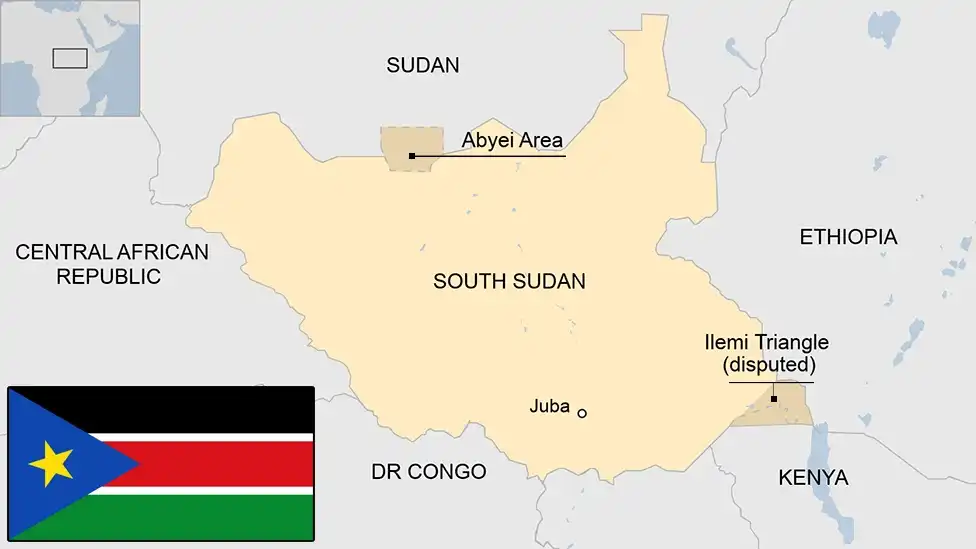
South Sudan Map (Credit: BBC)
Opinion Article – April 2026 - By James Lwany
(Pachodo.org) - One of the most perilous consequences of ethnic nationalism lies not only in its ability to fracture a nation from within, but in how it quietly invites the world into its internal conflicts. When politics is organized around identity rather than citizenship, borders begin to lose their meaning. They no longer function as firm lines of sovereignty, but as porous frontiers through which regional and global interests seep in. The central question, then, is unavoidable: when does an internal conflict cease to be domestic and become international? The answer emerges the moment a state loses the capacity to manage its diversity internally—when divisions become instruments others can exploit.
Comparative experience offers sobering clarity. In parts of Southern Africa, internal struggles once rooted in political grievances evolved into proxy conflicts, drawing in external powers that found advantage in prolonging instability. In Central Asia, fragile post-Soviet states exposed how quickly internal fragmentation can invite external mediation, influence, and at times manipulation. These cases reveal a pattern: foreign intervention is rarely the origin of crisis; it is the consequence of a vacuum. Where cohesion weakens, influence enters.
South Sudan stands dangerously close to this threshold. Persistent ethnic fragmentation risks transforming every domestic disagreement into a potential entry point for outside actors. Can a nation truly claim sovereignty when its internal factions rely on external patrons? History offers a blunt answer: sovereignty erodes the moment decision-making is no longer exclusively national. Authority becomes negotiated, not exercised.
Compounding this vulnerability is another structural failure—the proliferation of agreements that are signed with urgency but implemented with hesitation. Peace deals are announced, celebrated, and then gradually abandoned in practice. What remains is not stability, but accumulated distrust. Each unfulfilled agreement deepens skepticism, pushing political actors to seek guarantees beyond the state itself. Is it surprising, then, that conflicts expand beyond borders when domestic assurances fail? Agreements without enforcement do not close conflicts; they internationalize them.
At this point, sovereignty itself becomes an illusion. As Max Weber observed in Economy and Society (p. 54), the state is defined by its monopoly on the legitimate use of force. But what happens when that monopoly fractures? When power disperses among militias, regional actors, and informal authorities? The answer is stark: sovereignty is no longer lost abruptly—it is hollowed out gradually, until it exists in name alone.
Similarly, Anthony Giddens argues in The Consequences of Modernity (p. 64) that globalization does not weaken strong states; it exposes weak ones. This raises a deeper question: can a divided state survive in an increasingly complex international system? Rarely. Internal fragmentation becomes a strategic liability, one that external actors are quick to leverage.
Yet perhaps the most painful dimension of this crisis is not structural, but human. The people of South Sudan have endured a level of sacrifice few nations can claim. From the earliest struggles that shaped the Sudanese state, they gave their lives, their resources, and their futures in pursuit of a simple aspiration: to live with dignity as citizens in their own country. And yet, what have they received in return? Disappointment, neglect—and, at times, outright insult. When young people, burdened by unemployment and systemic failure, are dismissed as “lazy” in official rhetoric, the question becomes unavoidable: is this a failure of the people, or of leadership?
One cannot ignore the deeper irony—perhaps even tragedy—at the heart of South Sudan’s trajectory. The country emerged from Sudan in large part due to systemic failures: political exclusion, economic marginalization, educational neglect, cultural imposition, and ideological rigidity. These were not abstract grievances; they were lived realities that justified separation. But how does a nation, born out of resistance to such conditions, fall into the same patterns—or even more severe ones? Is this coincidence, or a failure to learn from history?
The concept of the “resource curse,” widely discussed in political economy, offers part of the answer. In The Bottom Billion (p. 38), Paul Collier explains how resource-rich states often experience slower development, weaker institutions, and higher conflict risk. Oil wealth, rather than serving as a foundation for growth, becomes a source of competition. In South Sudan, the dominance of oil has overshadowed agriculture, despite the country’s vast arable land and water resources. Why invest in long-term productivity when short-term rents are easier to distribute?
But where do the revenues from oil—and other resources—actually go? What of gold, timber, livestock, and water? Why do border regions, rich in resources, often remain beyond effective state control, governed instead by informal networks and armed actors? These are not merely economic questions; they are political ones. They point to a deeper failure of governance, where wealth extraction benefits narrow interests rather than national development.
Philosophically, this crisis reflects a breakdown in the social contract. Jean-Jacques Rousseau wrote in The Social Contract (p. 26): “When the general will is replaced by particular wills, the political order decays.” Can a state endure when collective purpose is replaced by factional interest? The answer, repeatedly demonstrated in history, is no.
The consequences extend beyond politics and economics into culture and identity. When national narratives are replaced by competing ethnic narratives, society itself fragments. Education systems, instead of fostering shared identity, risk reproducing division. Cultural institutions, instead of uniting, become arenas of contestation. Can a nation be built when its citizens no longer imagine themselves as part of a common story?
Against this backdrop, civil nationalism offers not a utopian alternative, but a necessary correction. As John Rawls argued in A Theory of Justice (p. 3), justice is the first virtue of social institutions. A system that allocates power and resources based on identity cannot sustain legitimacy. Only a framework grounded in equal rights and impartial institutions can rebuild trust.
Ultimately, the lesson is clear. Ethnic nationalism does not merely weaken states—it exposes them. It transforms internal divisions into external vulnerabilities. It turns sovereignty into negotiation, and governance into survival. Civil nationalism, by contrast, is not simply a political choice; it is a strategic necessity.
South Sudan cannot afford the cost of a prolonged, internationalized conflict. Its geographic position, resource wealth, and fragile institutions make delay dangerous. The question is no longer whether reform is needed, but whether it will come in time.
And so the final question lingers: can the country reverse course before its internal fractures become irreversible? Or will the cost of inaction exceed the state’s capacity to endure? History suggests that such moments do not last indefinitely. The window for choice eventually closes—and what remains is consequence.
South Sudan’s Most Dangerous Path: Ethnic Nationalism — and the Case for a Civic State (Part 1)
South Sudan’s Most Dangerous Path: Ethnic Nationalism — and the Case for a Civic State (Part 2)
South Sudan’s Most Dangerous Path: Ethnic Nationalism — and the Case for a Civic State (Part 3)
South Sudan’s Most Dangerous Path: Ethnic Nationalism — and the Case for a Civic State (Part 4)
South Sudan’s Most Dangerous Path: Ethnic Nationalism — and the Case for a Civic State (Part 5)
South Sudan’s Most Dangerous Path: Ethnic Nationalism — and the Case for a Civic State (Part 6)
South Sudan’s Most Dangerous Path: Ethnic Nationalism — and the Case for a Civic State (Part 7)
South Sudan’s Most Dangerous Path: Ethnic Nationalism — and the Case for a Civic State (Part 8)
South Sudan’s Most Dangerous Path: Ethnic Nationalism — and the Case for a Civic State (Part 9)
South Sudan’s Most Dangerous Path: Ethnic Nationalism — and the Case for a Civic State (Part 10)
Newer articles:
- South Sudan’s Path To Change Requires Sacrifice - 22/04/2026 14:37
- South Sudan’s Most Dangerous Path: Ethnic Nationalism — and the Case for a Civic State (Part 10) - 22/04/2026 14:34
- End The Transition, No To Extension - 22/04/2026 14:30
- When stories travel: How screens connect China and Africa - 20/04/2026 15:01
- Intelligence Is Prerequisite For Affective Leadership - 20/04/2026 14:56
Older news items
- Rebuttal to the So-called SPLM Cadres Forum: In Defense of SPLM-Secretary General, Cde. Dr. Akol Paul Kordit and the Rule of Law - 17/04/2026 14:06
- South Sudan’s Most Dangerous Path: Ethnic Nationalism — and the Case for a Civic State (Part 8) - 17/04/2026 14:03
- Spring Thaw in China-U.S. Relations: Implications for Global Economic Stability and Europe's Strategic Position - 15/04/2026 17:34
- South Sudan’s Most Dangerous Path: Ethnic Nationalism — and the Case for a Civic State (Part 7) - 15/04/2026 17:09
- A Call For South Sudan's New Generation To Reclaim Their Future - 13/04/2026 14:51
Latest news items (all categories):
- Canada helping to fund South Sudan vote despite growing repression - 05/10/2026 15:10
- UNMISS patrol reaches remote Ibba communities amidst heavy rains, insecurity, and growing health threats - 05/10/2026 15:07
- WFP Strongly Condemns Attack on Trucks in South Kordofan, Killing One Driver - 05/10/2026 15:03
- Advancing Women’s Land Rights through building capacity of customary institutions in Magwi County, South Sudan - 02/10/2026 13:18
- AU calls for release of political detainees ahead of South Sudan elections - 02/10/2026 13:15
See also (all categories):
Random articles (all categories):
- At least 10 dead in Sudan gold mine collapse - 31/03/2023 01:02
- Fear and mourning after attack on South Darfur village - 05/02/2021 02:40
- South Sudan rebel groups clash, at least three dead - 19/10/2017 09:44
- Trump Administration Moves to Upgrade Diplomatic Ties With Sudan - 04/12/2019 16:15
- South Sudan talks hit deadlock over number of states - 10/02/2020 00:32
Popular articles:
- The Final Communique of SPLM-DC Third Session of the National Council - 29/03/2011 01:00 - Read 83242 times
- Roles and Definition of Political Parties - 29/04/2011 01:00 - Read 64993 times
- Agriculture in Southern Sudan: Challenges and Investment Opportunities - 06/10/2010 01:45 - Read 57686 times
- Fashoda Youth Forum Rehabilitation of Drainage Culverts in Malakal town Report - 07/08/2008 16:22 - Read 36007 times
- Creation and establishment of the Local Government Councils ( Counties ) (2) - 28/09/2011 01:00 - Read 33859 times
