
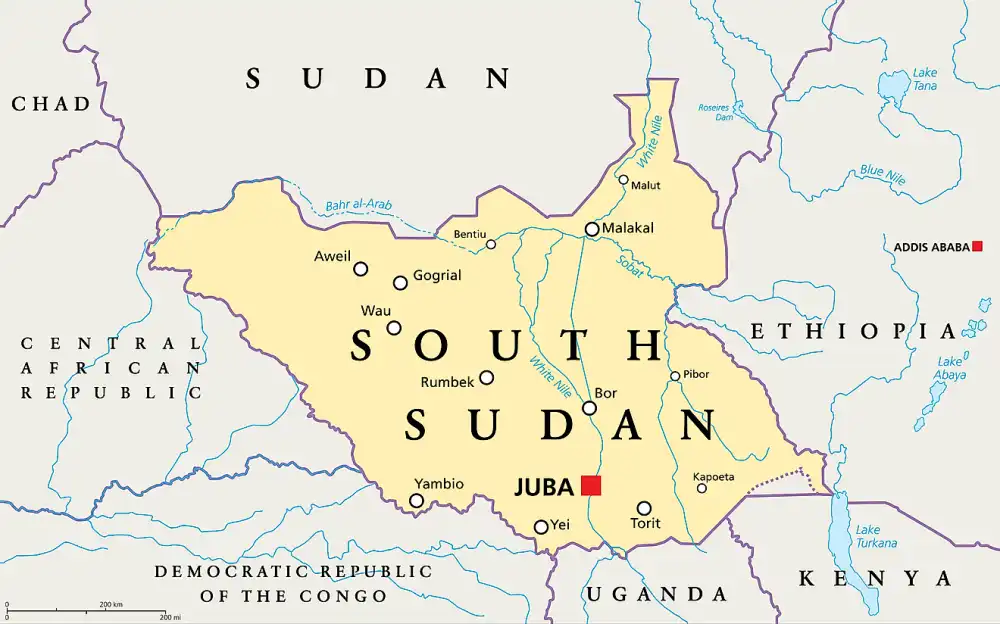
South Sudan Political Map (File Image)
Opinion – James Lwany - April, 2026
(Pachodo.org) - Can a state be built on division and still claim cohesion? Can a political system endure when its rules are governed by shifting, unwritten balances rather than by law? These are not abstract questions. They lie at the heart of South Sudan’s predicament. The problem is not diversity itself, but the transformation of that diversity into a permanent organizing principle of power—until division is no longer a condition, but a governing structure.
In South Sudan, this danger becomes acute when ethnic nationalism ceases to be a temporary instrument of mobilization and instead hardens into an implicit system that shapes authority itself: who decides, how influence is distributed, and on what basis opportunity is granted. At that point, the idea of the state as a neutral arbiter begins to shrink, replaced by a conception of power as a collective entitlement rather than a public responsibility. The question then becomes unavoidable: what happens when the state reflects division instead of transcending it? Can it still resolve conflict, or does it become one of its agents?
History suggests the latter. The experience of Rwanda before 1994 demonstrated how institutionalizing identity can lead to catastrophe when state structures become instruments of classification rather than governance. The disintegration of Yugoslavia revealed how politicized identity can fracture a state into competing entities, each claiming legitimacy in the name of belonging. And in Pakistan, recurring tensions between centre and periphery have illustrated how identity-driven politics can strain national cohesion.
These cases point to a deeper question: is diversity itself the risk, or the manner in which it is governed? As the sociologist Max Weber observed in Economy and Society (p. 54), the state is defined by its monopoly over the “legitimate use of force.” But what remains of that monopoly when it is effectively shared among competing actors? Does this not signal the quiet erosion of the state, even if its formal structures persist?
At this juncture, the legal dimension becomes decisive. A state is not sustained by power alone, but by the rule of law that constrains and legitimizes that power. As John Locke wrote in Two Treatises of Government (p. 324), “Where there is no law, there is no freedom.” Yet what becomes of law when it is applied selectively? Does it remain law, or does it become another instrument in the contest for advantage?
The answer carries philosophical weight: a law that does not apply equally ceases to be a general rule and becomes a privilege. And when law becomes privilege, the state is no longer a guarantor of rights but a broker of favours. Citizens, in turn, begin to seek protection elsewhere—within communities, networks, or even armed groups. Is this not the path by which states begin to erode, not through sudden collapse, but through gradual displacement?
The economic consequences are equally profound. When resources are allocated through loyalty rather than merit, incentives distort, efficiency declines, and investment retreats. As the economist Douglass North argued in Institutions, Institutional Change and Economic Performance (p. 3), institutions—not resources—shape economic outcomes. How can an economy grow in the absence of stable rules? How can markets function when the terms of participation shift with political alignment?
Nowhere are these dynamics more visible than in border regions, where state authority is weakest. In such spaces, alternative powers emerge: warlords, smuggling networks, and local authorities that impose their own rules. These actors do not merely fill a vacuum; they redefine it. Economic activity often operates not just outside the state, but against it. Can sovereignty be restored when its absence has become profitable? Can borders be governed without a unified legal authority?
At a deeper level, ethnic nationalism reshapes the very meaning of legitimacy. The central question shifts from “Is the ruler just?” to “Does the ruler represent me?” This transformation, as Jean-Jacques Rousseau argued in The Social Contract (p. 176), undermines the concept of the “general will,” the foundation of modern political order. Without that shared will, what remains of the state beyond a collection of competing claims?
The philosophical answer is stark: a state that loses its general will loses its centre. It persists as a body without coordination, its parts moving in tension rather than in concert. Stability, in such a condition, becomes little more than a pause between crises.
Civic nationalism offers a different path—not as an abstract ideal, but as a practical necessity. It redefines the state as a system of rules rather than an alliance of identities. As Aristotle suggested in Politics (1253a), the state exists not merely for survival, but for the pursuit of the “good life.” Yet how can such a life be realized when opportunity is distributed by affiliation? Can justice take root where equality before the law is absent?
Civic nationalism does not erase difference; it relocates it—from the arena of conflict to the framework of regulation. It subjects all citizens to the same rules, opening space for competition based on ideas rather than identity. But such a transformation demands more than constitutional language. It requires robust institutions, an independent judiciary, and a public administration grounded in competence rather than patronage.
The essential questions remain unavoidable:
Can citizenship exist without genuine equality before the law?
Can lasting stability emerge without justice that is both credible and visible?
Can individuals be expected to belong to a state that does not protect them?
The philosophical answer may be simple: people do not commit to what they do not trust. Trust is the foundation of belonging, and belonging is the foundation of the state. Break that chain, and the structure itself begins to falter.
As the historian Fernand Braudel observed in The Mediterranean and the Mediterranean World (p. 21), it is the long durée that reveals the strength or fragility of institutions. States rarely collapse overnight; they decay over time when they fail to establish enduring rules.
Ultimately, this is not a conflict of identities, but a contest between models of governance. One manages division and profits from it; the other seeks to transcend it through law and institutions. The first may appear pragmatic in the short term, but it carries within it the seeds of fragmentation. The second, though more demanding, offers the possibility of renewal and continuity.
South Sudan now faces a defining moment. Will it pursue the path of law and institutions, or remain bound to informal balances that defer crises rather than resolve them? The answer will determine not only the character of its political system, but whether the state itself can endure as a coherent and unified entity.
James Lwany
South Sudan’s Most Dangerous Path: Ethnic Nationalism — and the Case for a Civic State (Part 1)
South Sudan’s Most Dangerous Path: Ethnic Nationalism — and the Case for a Civic State (Part 2)
South Sudan’s Most Dangerous Path: Ethnic Nationalism — and the Case for a Civic State (Part 3)
South Sudan’s Most Dangerous Path: Ethnic Nationalism — and the Case for a Civic State (Part 4)
South Sudan’s Most Dangerous Path: Ethnic Nationalism — and the Case for a Civic State (Part 5)
South Sudan’s Most Dangerous Path: Ethnic Nationalism — and the Case for a Civic State (Part 6)
South Sudan’s Most Dangerous Path: Ethnic Nationalism — and the Case for a Civic State (Part 7)
South Sudan’s Most Dangerous Path: Ethnic Nationalism — and the Case for a Civic State (Part 8)
South Sudan’s Most Dangerous Path: Ethnic Nationalism — and the Case for a Civic State (Part 9)
South Sudan’s Most Dangerous Path: Ethnic Nationalism — and the Case for a Civic State (Part 10)
Newer articles:
- Intelligence Is Prerequisite For Affective Leadership - 20/04/2026 14:56
- South Sudan’s Most Dangerous Path: Ethnic Nationalism — and the Case for a Civic State (Part 9) - 20/04/2026 14:50
- Rebuttal to the So-called SPLM Cadres Forum: In Defense of SPLM-Secretary General, Cde. Dr. Akol Paul Kordit and the Rule of Law - 17/04/2026 14:06
- South Sudan’s Most Dangerous Path: Ethnic Nationalism — and the Case for a Civic State (Part 8) - 17/04/2026 14:03
- Spring Thaw in China-U.S. Relations: Implications for Global Economic Stability and Europe's Strategic Position - 15/04/2026 17:34
Older news items
- A Call For South Sudan's New Generation To Reclaim Their Future - 13/04/2026 14:51
- South Sudan’s Most Dangerous Path: Ethnic Nationalism — and the Case for a Civic State (Part 6) - 13/04/2026 14:47
- South Sudan’s Most Dangerous Path: Ethnic Nationalism — and the Case for a Civic State (Part 5) - 10/04/2026 19:08
- The Convergence of Necessity: Why the Bahraini Resolution Must Align with the China-Pakistan Five-Point Initiative - 08/04/2026 14:04
- Unplanned conflict: Trump and the trap of war with Iran - 08/04/2026 14:01
Latest news items (all categories):
- South Sudan can leverage China’s AI path to bridge the digital divide - 16/09/2026 16:04
- Credible Elections Are No Longer Possible in South Sudan - What Next? - 16/09/2026 15:59
- South Sudan's president replaces electoral chief three months before scheduled polls - 16/09/2026 15:56
- Turkish Airlines is pulling out of 5 African routes, including South Sudan - 16/09/2026 15:23
- ‘Super El Niño’ deepens hunger crisis in South Sudan – WFP - 16/09/2026 15:19
See also (all categories):
Random articles (all categories):
- Zain’s response to allegations of complicity in unlawful surveillance in South Sudan - 15/02/2021 03:49
- South Sudan fires agricultural bank director - 08/10/2021 23:11
- Egypt pays attention to achieving peace, stability in South Sudan - 19/02/2022 00:53
- Sudan's conflict is getting closer to South Sudan and Abyei, UN envoy warns - 08/11/2023 06:32
- What is the SPLM culture under current leadership? - 04/07/2009 21:18
Popular articles:
- The Final Communique of SPLM-DC Third Session of the National Council - 29/03/2011 01:00 - Read 83182 times
- Roles and Definition of Political Parties - 29/04/2011 01:00 - Read 64914 times
- Agriculture in Southern Sudan: Challenges and Investment Opportunities - 06/10/2010 01:45 - Read 57563 times
- Fashoda Youth Forum Rehabilitation of Drainage Culverts in Malakal town Report - 07/08/2008 16:22 - Read 35947 times
- Creation and establishment of the Local Government Councils ( Counties ) (2) - 28/09/2011 01:00 - Read 33789 times
