
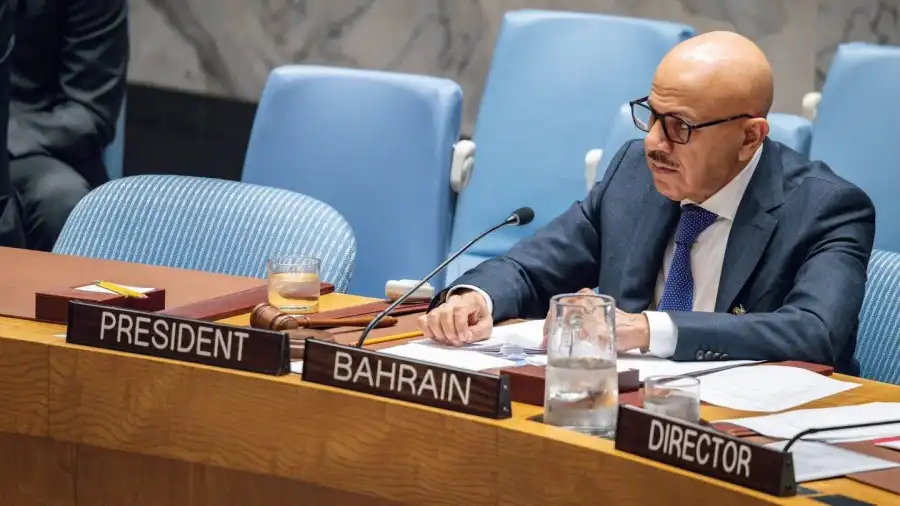
As part of the Kingdom of Bahrain’s presidency of the United Nations Security Council during the current April session, His Excellency Dr. Abdul Latif bin Rashid Al Zayani, Minister of Foreign Affairs, chaired the Council’s high-level meeting on cooperation between the Cooperation Council for the Arab States of the Gulf and the United Nations in New York, on April 2, 2026 (Photo Credit: Official Twitter Account of The Ministry of Foreign Affairs - Kingdom of Bahrain)
By *Amaju Ubur Yalamoi Ayani
(Pachodo.org) - The United Nations Security Council (UNSC) currently stands at a geopolitical precipice, navigating a diplomatic minefield as it deliberates a draft resolution to reopen the Strait of Hormuz. Led by Bahrain, this legislative push arrives at a moment of global paralysis. As of April 2026, the blockade of this vital maritime artery has choked off nearly 90 percent of its typical traffic, threatening the 20 percent of global oil and liquefied natural gas that normally transits the corridor. While the economic imperative to restore commerce is undeniable, the resolution’s success—and its survival in the face of a veto—rests on its ability to structurally align with the Five-Point Initiative recently championed by China and Pakistan in Beijing on March 31, 2026. Without this synthesis, the Bahraini draft risks being dismissed as a partisan instrument of U.S. military deterrence rather than a holistic blueprint for regional peace.
The most immediate hurdle for the Bahraini resolution is the lingering spectre of the veto. Early iterations of the text relied heavily on Chapter VII of the United Nations Charter, invoking the phrase “all necessary means”—a traditional diplomatic euphemism for military intervention. For permanent members wary of any military adventurism, such language is a non-starter. To secure a path forward, the resolution has undergone significant revisions, stripping away Chapter VII references in favour of defensive coordination. This shift directly mirrors the true multilateralism central to the China-Pakistan framework. By trading the rhetoric of offensive enforcement for an explicit commitment to the sovereignty and territorial integrity of all Gulf states—including Iran—the proposal can transform from a potential flashpoint into a consensus-based mandate for maritime safety.
A critical component of this revised mandate is the establishment of specific naval escort protocols. To avoid the “law of the jungle,” the resolution now calls for UN-coordinated monitoring mechanism where participating navies provide protection for commercial vessels within strictly defined blue corridors. These protocols are designed to be purely reactive and defensive, ensuring that the protection of ships does not escalate into proactive strikes against coastal assets. This technical alignment satisfies the Five-Point Initiative’s demand for the safety of maritime routes while respecting the territorial boundaries of littoral states.
In addition, the security of the Strait of Hormuz cannot be achieved in a vacuum. The China-Pakistan initiative correctly identifies maritime tensions as a symptom, not the source, of regional instability. An effective Bahraini resolution must, therefore, broaden its lens to incorporate the initiative’s calls for an immediate cessation of hostilities and the protection of critical civilian infrastructure. This is not merely an economic necessity—with oil prices surging 50 percent—but a dire humanitarian imperative. In war-affected areas throughout the region, the blockade and ongoing strikes have crippled power grids and desalination plants, leaving millions without potable water or medical electricity. By formalizing protections for this infrastructure, the United Nations Security Council (UNSC) can provide the market certainty required to stabilize prices and prevent a cascading humanitarian catastrophe.
The geopolitical legitimacy of this alignment is bolstered by the growing influence of the African Union (AU). In a significant move on April 3, 2026, the AU Commission Chairperson Mahmoud Ali Youssouf formally welcomed the China-Pakistan initiative as a “timely and constructive contribution.” This backing is critical; it signals that the broader international community, particularly the Global South, views the proposal as a legitimate pathway to de-escalation. Furthermore, Pakistan’s historical role as a discreet diplomatic bridge—capable of facilitating back-channel communications between Washington and Tehran—combined with China’s status as the region’s primary diplomatic and economic partner, lends the Five-Point Initiative a credibility that unilateral efforts currently lack.
Finally, the United Nations Security Council (UNSC) has a rare, vanishing window to synthesize these two diplomatic tracks. A vote on the revised Bahraini resolution is expected by April 15, 2026, a deadline that looms as U.S. President Donald Trump’s ultimatum for a regional deal expires. A resolution reinforced by the principles of the China-Pakistan Five-Point Initiative would provide the legal and moral weight necessary to reclaim the global commons. In an era defined by polarization, such a synthesis would do more than just reopen a shipping lane; it would reaffirm the Council’s capacity to manage complex crises through collaborative, multi-polar diplomacy. The alternative—a continued reliance on unilateral sanctions and military posturing—is no longer a viable strategy; it is a recipe for a wider, more catastrophic conflagration.
About the writer

*Amaju Ubur Yalamoi Ayani (known as Amaju Joseph Ubur Ayani) is a South Sudanese teacher and political analyst. He can be reached via
Newer articles:
- Spring Thaw in China-U.S. Relations: Implications for Global Economic Stability and Europe's Strategic Position - 15/04/2026 17:34
- South Sudan’s Most Dangerous Path: Ethnic Nationalism — and the Case for a Civic State (Part 7) - 15/04/2026 17:09
- A Call For South Sudan's New Generation To Reclaim Their Future - 13/04/2026 14:51
- South Sudan’s Most Dangerous Path: Ethnic Nationalism — and the Case for a Civic State (Part 6) - 13/04/2026 14:47
- South Sudan’s Most Dangerous Path: Ethnic Nationalism — and the Case for a Civic State (Part 5) - 10/04/2026 19:08
Older news items
- Unplanned conflict: Trump and the trap of war with Iran - 08/04/2026 14:01
- South Sudan’s Most Dangerous Path: Ethnic Nationalism — and the Case for a Civic State (Part 4) - 08/04/2026 13:58
- The Strategic Imperative of the China-Pakistan Five-Point Initiative: A Framework for De-escalation in the Gulf and Middle East Region - 06/04/2026 14:39
- South Sudan Needs Creative Leadership For Eradication Of Poverty - 06/04/2026 14:36
- God’s Redemptive Plan Unfolds In The Glory Of Easter - 06/04/2026 14:31
Latest news items (all categories):
- The SPLM ruling party is facing a dilemma and Thucydides trap at a pivotal moment - 24/08/2026 14:06
- Shanghai Cooperation Organization (SCO) countries are making green development an engine of growth - 24/08/2026 13:36
- President Salva Kiir in Pretoria Seeking Support Ahead of South Sudan’s December Elections - 24/08/2026 12:48
- Tambura’s fragile path from conflict to recovery - 24/08/2026 12:45
- South Sudan’s Yei Joint Stars advance to semi final stage of Zonal qualifiers - 24/08/2026 12:43
See also (all categories):
Random articles (all categories):
- South Sudanese in Minnesota ask for U.S. intervention in country's fighting - 16/12/2017 18:37
- 13 Things Not to Share with Your Co-workers.. - 13/01/2008 21:08
- Ugandan army denies fighting in South Sudan war - 06/03/2019 00:02
- Policy Brief: Analysis of the Implications of Foreign Exchange Reforms on Food Prices in South Sudan (September 2021) - 15/11/2021 02:28
- Salva Kiir Mourns Death of South Sudanese Freedom Fighter Aguil Chut-Deng - 03/05/2022 12:37
Popular articles:
- The Final Communique of SPLM-DC Third Session of the National Council - 29/03/2011 01:00 - Read 83116 times
- Roles and Definition of Political Parties - 29/04/2011 01:00 - Read 64832 times
- Agriculture in Southern Sudan: Challenges and Investment Opportunities - 06/10/2010 01:45 - Read 57420 times
- Fashoda Youth Forum Rehabilitation of Drainage Culverts in Malakal town Report - 07/08/2008 16:22 - Read 35858 times
- Creation and establishment of the Local Government Councils ( Counties ) (2) - 28/09/2011 01:00 - Read 33679 times
