
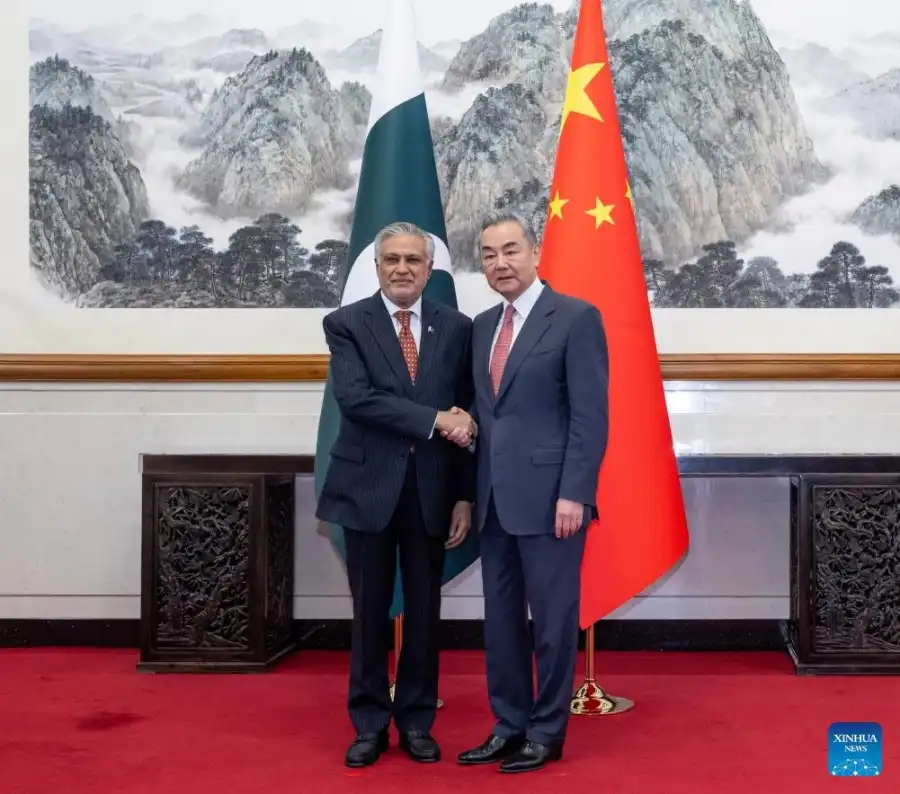
Chinese Foreign Minister Wang Yi and Pakistani Deputy Prime Minister and Minister of Foreign Affairs Ishaq Dar (Photo Credit: Xinhua News Agency)
By *Amaju Ubur Yalamoi Ayani
(Pachodo.org) - The contemporary security architecture of the Middle East is facing its most profound challenge since the turn of the century. Following the cross-border kinetic exchanges of early 2026 involving the United States, Israel, and Iran, the region has entered a cycle of competitive escalation that threatens to decouple global energy markets and dismantle the vestiges of maritime security. In this high-stakes environment, the Five-Point Initiative—jointly articulated in Beijing on March 31, 2026, by Chinese Foreign Minister Wang Yi and Pakistani Deputy Prime Minister and Minister of Foreign Affairs Ishaq Dar—emerges not merely as a diplomatic alternative, but as the primary viable mechanism for regional stabilization.
While Pakistan has assumed the role of a critical tactical intermediary, utilizing its unique access to both Washington and Tehran, the initiative’s strategic weight is fundamentally anchored in China’s growing role as a global peacemaker. China provides the geopolitical gravity necessary to incentivize restraint, moving beyond its historical role as a distant observer to become an active diplomatic underwriter. By framing regional stability as a prerequisite for global commerce, China is transitioning the conflict from a zero-sum military struggle to a shared challenge of international governance through five core pillars. Adhering to this framework is no longer just a diplomatic preference—it is a strategic necessity.
The core pillars of the initiative
To understand why the international community should support China and Pakistan, one must examine the specific elements of this proposal and the unique diplomatic capital that both nations bring to the table.
- Immediate cessation of hostilities
The first and most urgent priority of the initiative is an immediate cessation of hostilities to prevent the conflict from spiraling into a broader regional war. In the current theater of operations, the risk of tactical miscalculations triggering strategic overreactions is at an all-time high. By advocating for a structured ceasefire, China and Pakistan are attempting to re-establish a diplomatic ceiling on the conflict, preventing the current friction from devolving into an uncontrolled conflagration that would defy traditional containment strategies.
This pressure has already yielded tangible, albeit fragile, results through the Beijing-Islamabad Channel. Following intense backchannel discussions, the U.S. administration announced a five-day operational pause regarding planned strikes on Iranian energy infrastructure. This temporary halt is a direct dividend of the Five-Point Initiative’s influence, providing a much-needed cooling-off period and demonstrating that a structured alternative to violence can lead even hawkish administrations to hesitate.
In addition, the initiative places a heavy emphasis on allowing unhindered humanitarian assistance to reach all conflict-affected areas. By prioritizing the flow of aid alongside the silencing of guns, the framework addresses the escalating suffering of civilians caught in the crossfire of recent missile exchanges. This dual approach ensures that the human cost of the war does not become a catalyst for further internal instability, which could otherwise spill over borders and create a multi-generational crisis.
The goal of this first point is to break the retaliation loop before it becomes a total regional conflagration. By freezing military movements, the initiative creates the psychological and physical space necessary for political leaders to reassert control over the narrative. It shifts the focus from military victory to the urgent preservation of life, laying the essential groundwork upon which all subsequent diplomatic efforts must be built.
- Early launch of peace talks
The initiative stresses that dialogue and diplomacy remain the only viable options for resolving the deep-seated grievances at the heart of this crisis. It calls for the prompt launch of peace negotiations involving all relevant parties to transition from the battlefield to the conference table. This pillar recognizes that while military force may achieve short-term objectives, only a political settlement can address the underlying causes of the regional standoff.
A central tenet of these proposed talks is the safeguarding of the sovereignty, territorial integrity, and national independence of Iran and all Gulf states. China and Pakistan advocate for a framework where no state feels its core existence is under threat, providing the security guarantees necessary for sincere engagement. By anchoring negotiations in mutual respect for borders, the initiative aims to remove the existential fears that have driven the current cycle of escalation.
To ensure these talks are productive, the initiative demands that all parties commit to a peaceful resolution of disputes and explicitly refrain from the use or threat of force while negotiations are underway. This non-aggression pledge is intended to prevent the frequent breakdowns that occurred in previous negotiation phases, where strikes were launched even as messages were being exchanged. It establishes a safe zone for diplomacy to take root without the constant shadow of an imminent strike.
Pakistan’s role as a mediator is central to this pillar, as it has offered to host meaningful and conclusive talks for a comprehensive settlement. Backed by China’s diplomatic weight and economic influence, this mediation provides a neutral platform for the United States and Iran to engage without the optics of surrender. This synergy between a trusted messenger and a global power offers a rare opportunity to bridge the wide chasm currently separating the warring parties.
- Security of non-military targets
The third pillar demands the absolute security of non-military targets, reinforcing the principle that civilians must be protected in any armed conflict. China and Pakistan call for an immediate end to attacks on non-military infrastructure, fully adhering to International Humanitarian Law (IHL). In a region where civilian life is intricately tied to complex engineering, the targeting of non-combatant zones threatens to leave millions without the basic necessities of survival.
Crucially, the initiative specifically identifies energy, desalination, and power facilities as infrastructure that must be spared from military action. By drawing a red line around these assets, the framework seeks to prevent the conflict from descending into a total war scenario that would decimate the region's life-support systems. For China, protecting these facilities is a strategic priority, as their destruction would trigger a humanitarian catastrophe and a permanent shift in global energy availability.
A significant inclusion in this point is the protection of peaceful nuclear infrastructure, such as nuclear power plants like the one in Bushehr. The initiative warns that strikes on such sensitive facilities could lead to irreversible ecological and radiological damage, affecting the entire Gulf region. By securing these sites, the plan aims to decouple the existential threat of nuclear accidents from the ongoing military standoff, ensuring that the deterrent architecture does not lead to a regional disaster.
This pillar seeks to de-militarize the essential services required for human life in the desert. By explicitly shielding civilian infrastructure, the framework limits the collateral damage of the current standoff and prevents a regional collapse. This strategic decoupling ensures that even if political tensions remain high, the physical foundation for human survival and future reconstruction remains intact for the millions of people who call the Gulf and Middle East home.
- Security of shipping lanes
Given its status as a vital global artery for goods and energy, the Strait of Hormuz and its adjacent waters are given special priority in the initiative. China and Pakistan call for the restoration of normal passage through the Strait as soon as possible, challenging the de facto blockade that has startled global oil markets. This demand reflects the shared aspirations of the international community, particularly the Global South, which relies heavily on Middle Eastern energy transit.
The initiative urges all parties to protect the security of ships and crew members currently stranded in the waterway. Since the conflict began on February 28, maritime transit has been effectively restricted, leading to significant safety concerns for merchant sailors. By demanding the safe and prompt passage of civilian and commercial vessels, the framework seeks to depolitize maritime trade and ensure that sailors are not used as pawns in a geopolitical struggle.
China's role as a major energy consumer makes maritime security a non-negotiable interest for Beijing. The initiative mobilizes international support—including recent backing from the African Union—to act as collective guarantors of the global supply chain. By internationalizing the stakes of the Strait of Hormuz, the plan raises the diplomatic and economic costs for any party attempting to close or weaponize this critical chokepoint.
Ensuring the normal passage of ships is presented not just as a regional need but as a global economic imperative. A closed Strait would trigger a worldwide recession of unprecedented scale, impacting energy prices and food systems globally. By making maritime security a central tenet of the five points, China and Pakistan are providing a structured path to re-open the global economy while the difficult work of political negotiation continues.
- Primacy of the United Nations Charter
Finally, the initiative anchors the entire peace process in the primacy of the United Nations Charter and international law. China and Pakistan advocate for true multilateralism to jointly strengthen the role of the UN in regional conflict resolution. This pillar is a direct challenge to unilateral interventions and maximum pressure campaigns that have often bypassed established international norms and exacerbated regional mistrust.
The framework supports the conclusion of a comprehensive agreement aimed at establishing a peace framework for realizing lasting peace. It moves away from military adventurism and toward a rational choice grounded in the purposes and principles of the UN Charter. By aligning with these universal standards, the initiative provides a face-saving exit for all combatants, allowing them to frame de-escalation as a commitment to global standards rather than a tactical retreat.
China and Pakistan emphasize that lasting security must emerge from a negotiated consensus that respects the territorial and political independence of all regional actors. This multilateral approach ensures that the voices of regional powers and Global South countries are integrated into the final settlement. It prevents the Middle East from being treated merely as an arena for Great Power competition, instead empowering the UN to oversee a sustainable peace.
The Five-Point Initiative will succeeds because it replaces the law of the jungle with a rule-based system. For a world staring down the barrel of a global war, this plan offers a structured, impartial, and practical pathway to implementation of the Global Security Initiative. Adhering to these five points is the most viable bridge currently available to lead the region away from volatility and toward a functional, sovereign-respecting peace.
The role of the international community: A call for collective action
For the China-Pakistan initiative to evolve from a diplomatic proposal into a functional peace, the international community must transition from passive observation to active multilateral support. This begins with the formal endorsement of the ceasefire by the UN Security Council and regional bodies. Such an endorsement would provide the China-Pakistan Five-Point with the necessary international legitimacy to enforce the cessation of hostilities and shield mediators from the political blowback of a high-stakes standoff.
Economic stakeholders and the private sector have a critical role in incentivizing de-escalation through the framework's focus on infrastructure. International insurance markets and shipping giants should align their protocols with the initiative’s maritime safety guarantees, effectively creating a peace premium for vessels adhering to the proposed safe-passage corridors. By economically rewarding parties that respect the neutrality of the Strait of Hormuz and civilian energy hubs, the global community can make the cost of continued conflict prohibitively high.
Furthermore, the international community must support the creation of a neutral monitoring mechanism to verify compliance with the protection of non-military infrastructure. Technical experts from the IAEA and humanitarian agencies should be deployed to safeguard nuclear and water facilities, as outlined in point three. This physical presence would act as a human shield and a verification tool, ensuring that peaceful infrastructure does not become a casualty of gray-zone warfare or tactical miscalculation.
Major powers and regional blocs like the European Union and the GCC should pool their diplomatic consensus behind the China and Pakistani-hosted talks. By treating these negotiations as the primary legitimate forum for resolution, the world can prevent forum shopping and contradictory mediation efforts that often prolong conflicts. The international community’s task is to provide the diplomatic scaffolding that allows this regional initiative to succeed, proving that multilateralism remains the most potent weapon against the threat of total war.
Conclusion
The world cannot afford a prolonged war in the Middle East. The resulting energy shock and supply chain disruptions will disproportionately punish the global poor and destabilize economies far beyond the region.
By putting forward a plan that balances urgent humanitarian needs with long-term political realities, China and Pakistan have provided the world with a lifeline. It is a rational choice grounded in rules, dialogue, and mutual respect. The international community must now rally behind this Five-Point Initiative, for if this door to peace closes, the alternative is too dark to contemplate.
About the writer

*Amaju Ubur Yalamoi Ayani (known as Amaju Joseph Ubur Ayani) is a South Sudanese teacher and political observer. He can be reached via
Newer articles:
- South Sudan’s Most Dangerous Path: Ethnic Nationalism — and the Case for a Civic State (Part 6) - 13/04/2026 14:47
- South Sudan’s Most Dangerous Path: Ethnic Nationalism — and the Case for a Civic State (Part 5) - 10/04/2026 19:08
- The Convergence of Necessity: Why the Bahraini Resolution Must Align with the China-Pakistan Five-Point Initiative - 08/04/2026 14:04
- Unplanned conflict: Trump and the trap of war with Iran - 08/04/2026 14:01
- South Sudan’s Most Dangerous Path: Ethnic Nationalism — and the Case for a Civic State (Part 4) - 08/04/2026 13:58
Older news items
- South Sudan Needs Creative Leadership For Eradication Of Poverty - 06/04/2026 14:36
- God’s Redemptive Plan Unfolds In The Glory Of Easter - 06/04/2026 14:31
- South Sudan’s Most Dangerous Path: Ethnic Nationalism — and the Case for a Civic State (Part 3) - 06/04/2026 14:24
- When Information Is No Longer Enough: Intelligence and the Degradation of Strategic Truth - 06/04/2026 14:18
- South Sudan’s Most Dangerous Path: Ethnic Nationalism — and the Case for a Civic State (Part 2) - 03/04/2026 16:19
Latest news items (all categories):
- Independent human rights investigators: Human cost of violence in South Sudan ‘continues to grow’ - 11/09/2026 10:43
- Displaced women build resilience through new livelihoods in Tambura - 11/09/2026 10:38
- Officially: Egypt lose their star for Angola and South Sudan clashes - 11/09/2026 10:36
- VP Nyandeng’s Critique And The Splintered Politics Of South Sudan - 09/09/2026 13:34
- UN rights Commission begins four-day South Sudan mission amid renewed conflict - 09/09/2026 13:25
See also (all categories):
Random articles (all categories):
- South Sudan: Murle torture in Jonglei denied by army - BBC News - 25/05/2012 11:49
- Sudan: US Sends Aid, Urges End to Sudan-South Sudan Violence - AllAfrica.com - 03/04/2012 15:00
- China's Africa Belt and Road investment drops as West spends more - 25/03/2023 01:13
- AU Urges South Sudan Parties to Complete Arrangements before Government Formation - 28/05/2019 05:46
- South Sudan‘s hope of peace deal shattered - 21/02/2019 16:38
Popular articles:
- The Final Communique of SPLM-DC Third Session of the National Council - 29/03/2011 01:00 - Read 83164 times
- Roles and Definition of Political Parties - 29/04/2011 01:00 - Read 64900 times
- Agriculture in Southern Sudan: Challenges and Investment Opportunities - 06/10/2010 01:45 - Read 57546 times
- Fashoda Youth Forum Rehabilitation of Drainage Culverts in Malakal town Report - 07/08/2008 16:22 - Read 35936 times
- Creation and establishment of the Local Government Councils ( Counties ) (2) - 28/09/2011 01:00 - Read 33779 times
