
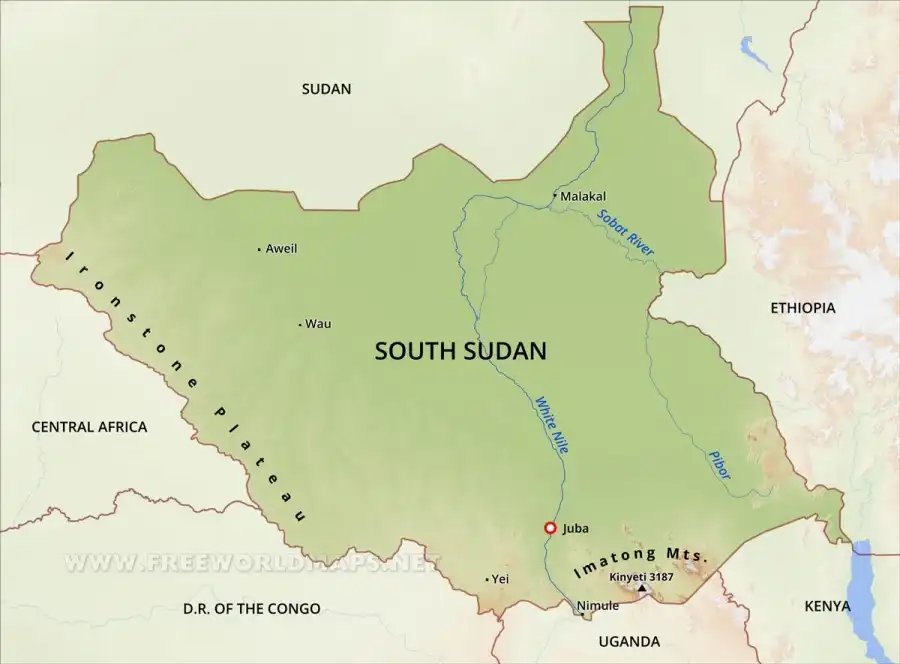
Physical map of South Sudan (Equirectangular Projection)
Opinion - By James Lwany – April , 2026
(Pachodo.org) - In the aftermath of conflict, a cease-fire is rarely enough to guarantee stability. History shows that the end of fighting is not the end of conflict, but the beginning of a more complex phase: the construction of a system capable of preventing the return of violence in new forms. In South Sudan, that challenge lies in moving beyond ethnic nationalism as a tool of governance and toward a political model that can manage diversity without turning it into a permanent source of tension.
When embedded within state institutions, ethnic nationalism produces what might be described as “temporary stability.” It is a fragile calm sustained by balances of power rather than by durable rules. Beneath the surface, unresolved tensions persist, ready to resurface at the first sign of strain—whether triggered by an economic crisis, a political dispute, or even a localized security incident.
The experience of Bosnia and Herzegovina after the Dayton Accords illustrates this pattern with clarity. A political system built on distributing power among ethnic groups succeeded in ending the war, but it failed to produce an effective state. Stability exists, but it is conditional—fragile and easily shaken by political crises. Similarly, in Kosovo, ethnic tensions have remained a persistent factor despite the presence of formal institutions, underscoring that institutional peace alone is insufficient if the roots of division remain unaddressed.
South Sudan faces a comparable risk. Managing ethnic balances may produce relative calm, but it does not eliminate the drivers of conflict. On the contrary, it may entrench them by embedding division into the very architecture of governance.
More troubling still, this model undermines the state’s capacity for strategic thinking. Policies are no longer shaped by long-term national vision but by short-term calculations aimed at satisfying specific groups. The result is the neglect of critical sectors—education, healthcare, and infrastructure—despite their central role in sustaining long-term stability.
This dynamic has also appeared in parts of Eastern Europe following political transitions. In Ukraine, the politicization of linguistic and cultural identity has complicated state-building efforts and weakened the ability to formulate unified policies at critical moments. When identity considerations override institutional logic, long-term planning becomes a casualty of political contestation.
Ethnic nationalism also erodes accountability. When officials are shielded by their affiliations rather than judged by their performance, holding them accountable becomes politically fraught. This opens the door to entrenched corruption and mismanagement. In the absence of effective oversight, the state gradually loses its capacity to correct its course, slipping into a trajectory of slow institutional decline.
Civic nationalism offers a different framework. It is built on the separation of identity from political function. In this model, officials are evaluated based on performance, not affiliation. While it does not eliminate conflict, it provides institutional mechanisms to manage it, restoring balance and stability to the system.
The experience of Estonia highlights this transformation. Despite challenges linked to linguistic diversity, the country has succeeded in building modern institutions grounded in transparency and efficiency, contributing to relative stability and sustained economic growth. Similarly, in Poland, democratic institutions have helped steer political competition toward public policy issues rather than identity-based divisions.
Yet transitioning to such a model requires more than superficial reform. It demands a redefinition of the social contract—a shared understanding that the state represents all citizens and serves them without discrimination. This contract is not built solely through constitutional provisions, but through everyday practice: laws applied equally, services delivered fairly, and institutions governed transparently.
A crucial element of this transformation lies in how societies address the past. Conflict leaves deep scars, and if left untreated, they continue to shape present divisions. Mechanisms of transitional justice—balancing accountability with reconciliation—are therefore essential. In Serbia and across the Balkans, incomplete reckoning with the legacy of war has hindered genuine reconciliation, demonstrating that ignoring the past does not erase it, but preserves it within the political memory.
Economic considerations are equally important. Uneven development reproduces tensions even under strong institutions. Policies that reduce disparities and expand equitable opportunities are essential. When managed fairly, the economy can become a force for unity, rather than a driver of division.
Building a civic state also requires strengthening intermediary institutions—political parties, labour unions, and civil society organizations—that can aggregate interests beyond ethnic lines. These institutions provide alternative channels for mobilization, reducing reliance on narrow identities.
In the end, ethnic nationalism is not an inevitable destiny, but the result of political choices. The same is true of civic nationalism. The difference between them is revealed not only in rhetoric, but in outcomes. One produces fragile stability that quickly unravels; the other, despite its challenges, offers a foundation for a durable and resilient state.
South Sudan now stands at a decisive moment. Continuing along the current path risks deepening fragility, perhaps to the point where reform becomes impossible. A shift toward a civic model requires political courage, but it also opens the possibility of a different future—a state defined not by its divisions, but by its capacity to manage them.
To be continued…
James Lwany
South Sudan’s Most Dangerous Path: Ethnic Nationalism — and the Case for a Civic State (Part 1)
South Sudan’s Most Dangerous Path: Ethnic Nationalism — and the Case for a Civic State (Part 2)
South Sudan’s Most Dangerous Path: Ethnic Nationalism — and the Case for a Civic State (Part 3)
South Sudan’s Most Dangerous Path: Ethnic Nationalism — and the Case for a Civic State (Part 4)
South Sudan’s Most Dangerous Path: Ethnic Nationalism — and the Case for a Civic State (Part 5)
South Sudan’s Most Dangerous Path: Ethnic Nationalism — and the Case for a Civic State (Part 6)
South Sudan’s Most Dangerous Path: Ethnic Nationalism — and the Case for a Civic State (Part 7)
South Sudan’s Most Dangerous Path: Ethnic Nationalism — and the Case for a Civic State (Part 8)
South Sudan’s Most Dangerous Path: Ethnic Nationalism — and the Case for a Civic State (Part 9)
South Sudan’s Most Dangerous Path: Ethnic Nationalism — and the Case for a Civic State (Part 10)
Newer articles:
- A Call For South Sudan's New Generation To Reclaim Their Future - 13/04/2026 14:51
- South Sudan’s Most Dangerous Path: Ethnic Nationalism — and the Case for a Civic State (Part 6) - 13/04/2026 14:47
- South Sudan’s Most Dangerous Path: Ethnic Nationalism — and the Case for a Civic State (Part 5) - 10/04/2026 19:08
- The Convergence of Necessity: Why the Bahraini Resolution Must Align with the China-Pakistan Five-Point Initiative - 08/04/2026 14:04
- Unplanned conflict: Trump and the trap of war with Iran - 08/04/2026 14:01
Older news items
- The Strategic Imperative of the China-Pakistan Five-Point Initiative: A Framework for De-escalation in the Gulf and Middle East Region - 06/04/2026 14:39
- South Sudan Needs Creative Leadership For Eradication Of Poverty - 06/04/2026 14:36
- God’s Redemptive Plan Unfolds In The Glory Of Easter - 06/04/2026 14:31
- South Sudan’s Most Dangerous Path: Ethnic Nationalism — and the Case for a Civic State (Part 3) - 06/04/2026 14:24
- When Information Is No Longer Enough: Intelligence and the Degradation of Strategic Truth - 06/04/2026 14:18
Latest news items (all categories):
- South Sudan Opens 14 Oil Blocks, Courts Investors Ahead of SSOP 2026 - 26/10/2026 15:08
- Jambojet Explores South Sudan Expansion After Talks with Juba Regulator - 26/10/2026 15:05
- Kiir swears in 5 officials ahead of South Sudan elections - 26/10/2026 14:53
- South Sudan cattle battles leaves 10 dead: official - 26/10/2026 14:49
- Churches urge world 'not to forget South Sudan' ahead of first elections - 26/10/2026 14:47
See also (all categories):
Random articles (all categories):
- South Sudan's displaced long to return home - 16/07/2022 08:55
- South Sudan hails progress on China aided television project-Xinhua - 18/02/2022 02:05
- 5 killed in west Sudan tribal violence, rights group says - 25/03/2023 00:52
- The Fifth Anniversary of Justice Peter Abdulrahman Sule’s Murder - 23/07/2020 13:13
- Trying to Catch China, Japan Pledges South Sudanese Oil Pipeline - 07/06/2013 10:03
Popular articles:
- The Final Communique of SPLM-DC Third Session of the National Council - 29/03/2011 01:00 - Read 83350 times
- Roles and Definition of Political Parties - 29/04/2011 01:00 - Read 65118 times
- Agriculture in Southern Sudan: Challenges and Investment Opportunities - 06/10/2010 01:45 - Read 57841 times
- Fashoda Youth Forum Rehabilitation of Drainage Culverts in Malakal town Report - 07/08/2008 16:22 - Read 36107 times
- Creation and establishment of the Local Government Councils ( Counties ) (2) - 28/09/2011 01:00 - Read 34008 times
