
Opinion by James Lwany - April, 2026
(Pachodo.org) - Can a state endure if it is no longer the ultimate authority over power? What happens when laws are replaced by networks of loyalty, and when borders are left open to forces operating beyond the reach of the state? These are no longer abstract questions in the case of South Sudan. They describe an emerging reality. The danger lies not only in ethnic division, but in its transformation into a governing logic—one that redefines the state itself from a sovereign entity into a contested arena of competing interests.
In this context, the state ceases to function as a framework that regulates relations among citizens. Instead, it becomes an instrument for maintaining fragile social balances. Power is no longer exercised through formal institutions, but through informal networks that determine who gets what, when, and how. When governance is reduced to the distribution of spoils, the state loses its essential functions: protecting rights, enforcing the law, and ensuring stability. It becomes a weak intermediary, reproducing divisions rather than resolving them.
This pattern is not unique. In Somalia, the collapse of central authority gave rise to clan-based structures that replaced national institutions, making the construction of a unified state exceedingly difficult. In Democratic Republic of the Congo, ethnic divisions have intersected with resource competition, weakening the state’s ability to assert control and turning large territories into arenas of armed contestation. In Libya after 2011, the absence of strong institutions led to multiple centers of power, where the state itself became an object of struggle rather than a neutral arbiter.
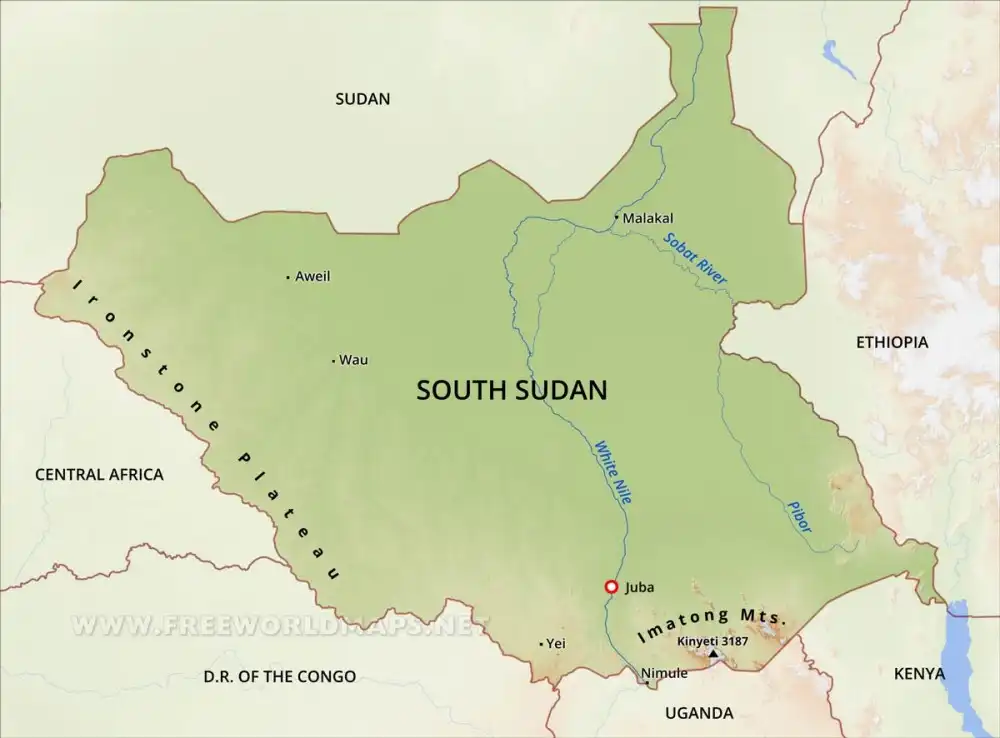
South Sudan, however, faces an additional layer of risk: the economic and border dimension of weak state control. In many peripheral and border regions, the state’s presence is minimal or intermittent. Who governs these areas? Who controls the flow of goods, weapons, and resources? In practice, local actors—warlords, armed networks, and traditional authorities—often fill the vacuum, gradually becoming de facto authorities. These actors do not merely provide security; they oversee parallel economies built on smuggling, informal trade, and, at times, the exploitation of natural resources.
Here lies a deeper paradox: when economic activity itself depends on the absence of the state, powerful interests emerge that benefit from continued instability. Warlords, in particular, may see little incentive in the restoration of order, which could threaten their influence. How, then, can a state reassert sovereignty when its weakness has become economically advantageous to key actors? How can the rule of law take hold in an environment that rewards its absence?
This dynamic reshapes the very notion of belonging. In the absence—or perceived irrelevance—of the state, citizens turn to those who can provide immediate protection or opportunity, even if they operate outside legal frameworks. Loyalty shifts from the state to the group, from law to expediency. The result is a weakened national fabric, with divisions that remain latent but can ignite under pressure.
Ethnic nationalism also reconfigures the relationship between center and periphery. Marginalized regions, feeling excluded from development and representation, may seek alternatives—whether through greater autonomy or through the consolidation of local power structures. The experience of Ethiopia illustrates how political arrangements built on rigid ethnic foundations can generate tensions when local demands intensify and collide with central authority, ultimately straining national cohesion.
By contrast, civic nationalism represents more than a political alternative; it is a transformation in the nature and purpose of the state itself. It shifts the foundation of governance from identity to rules, from affiliation to institutions. In such a framework, power is no longer an extension of communal belonging but is constrained by a system of general principles that do not fluctuate with changing balances of power. The state is defined not by who controls it, but by how it operates: as a legal and moral entity grounded in neutrality, deriving legitimacy from its capacity to guarantee rights and equal opportunity. It becomes, in effect, an authority above contestation—administered as a public trust rather than divided as spoils.
The experience of South Africa after the end of apartheid underscores the importance of this shift. While challenges remain, the country succeeded in establishing a political framework centered on citizenship and rights, helping to contain rather than entrench divisions.
Yet such a transition is neither automatic nor easy. It requires the construction of institutions capable of operating independently, the reassertion of state authority in peripheral regions, and the regulation of informal economies. Above all, it demands the rebuilding of trust between the state and its citizens—a process that is necessarily gradual and fraught.
The deeper questions, however, remain unavoidable: Can a civic state emerge in the presence of a thriving parallel economy? Can institutions assert authority if borders remain porous and unregulated? Can citizenship take root when access to resources continues to depend on identity?
These are not theoretical concerns. They lie at the heart of South Sudan’s current predicament.
Comparative experience offers a sobering conclusion: states built on ethnic foundations remain vulnerable to fragmentation, even when they appear stable in the short term. By contrast, states grounded in citizenship possess a greater capacity for resilience and renewal.
South Sudan now stands at a stark crossroads. It can continue along a path defined by informal networks and fragile balances, accepting the risks of chronic instability. Or it can embark on the far more demanding task of building a civic state—one capable of enforcing the law, regulating its economy, and asserting control over its borders. The choice will determine not only the form of governance, but the very future of the state itself.
James Lwany
South Sudan’s Most Dangerous Path: Ethnic Nationalism — and the Case for a Civic State (Part 1)
South Sudan’s Most Dangerous Path: Ethnic Nationalism — and the Case for a Civic State (Part 2)
South Sudan’s Most Dangerous Path: Ethnic Nationalism — and the Case for a Civic State (Part 3)
South Sudan’s Most Dangerous Path: Ethnic Nationalism — and the Case for a Civic State (Part 4)
South Sudan’s Most Dangerous Path: Ethnic Nationalism — and the Case for a Civic State (Part 5)
South Sudan’s Most Dangerous Path: Ethnic Nationalism — and the Case for a Civic State (Part 6)
South Sudan’s Most Dangerous Path: Ethnic Nationalism — and the Case for a Civic State (Part 7)
South Sudan’s Most Dangerous Path: Ethnic Nationalism — and the Case for a Civic State (Part 8)
South Sudan’s Most Dangerous Path: Ethnic Nationalism — and the Case for a Civic State (Part 9)
South Sudan’s Most Dangerous Path: Ethnic Nationalism — and the Case for a Civic State (Part 10)
Newer articles:
- Rebuttal to the So-called SPLM Cadres Forum: In Defense of SPLM-Secretary General, Cde. Dr. Akol Paul Kordit and the Rule of Law - 17/04/2026 14:06
- South Sudan’s Most Dangerous Path: Ethnic Nationalism — and the Case for a Civic State (Part 8) - 17/04/2026 14:03
- Spring Thaw in China-U.S. Relations: Implications for Global Economic Stability and Europe's Strategic Position - 15/04/2026 17:34
- South Sudan’s Most Dangerous Path: Ethnic Nationalism — and the Case for a Civic State (Part 7) - 15/04/2026 17:09
- A Call For South Sudan's New Generation To Reclaim Their Future - 13/04/2026 14:51
Older news items
- South Sudan’s Most Dangerous Path: Ethnic Nationalism — and the Case for a Civic State (Part 5) - 10/04/2026 19:08
- The Convergence of Necessity: Why the Bahraini Resolution Must Align with the China-Pakistan Five-Point Initiative - 08/04/2026 14:04
- Unplanned conflict: Trump and the trap of war with Iran - 08/04/2026 14:01
- South Sudan’s Most Dangerous Path: Ethnic Nationalism — and the Case for a Civic State (Part 4) - 08/04/2026 13:58
- The Strategic Imperative of the China-Pakistan Five-Point Initiative: A Framework for De-escalation in the Gulf and Middle East Region - 06/04/2026 14:39
Latest news items (all categories):
- South Sudan Opens 14 Oil Blocks, Courts Investors Ahead of SSOP 2026 - 26/10/2026 15:08
- Jambojet Explores South Sudan Expansion After Talks with Juba Regulator - 26/10/2026 15:05
- Kiir swears in 5 officials ahead of South Sudan elections - 26/10/2026 14:53
- South Sudan cattle battles leaves 10 dead: official - 26/10/2026 14:49
- Churches urge world 'not to forget South Sudan' ahead of first elections - 26/10/2026 14:47
See also (all categories):
Random articles (all categories):
- South Sudan to Facilitate Monica Kimani's Murder Probe - Kiir - 24/10/2018 18:00
- N. Bahr el Ghazal, Warrap communities recommit to fostering peace - 07/03/2022 01:50
- S. Sudan journalist 'freed after months held without charge' - 20/02/2016 02:42
- South Africa engages South Sudan on the latest political developments - 20/03/2026 16:51
- UN Seeks South Sudan Unity Government Even Before Security Deal - 02/10/2019 19:23
Popular articles:
- The Final Communique of SPLM-DC Third Session of the National Council - 29/03/2011 01:00 - Read 83351 times
- Roles and Definition of Political Parties - 29/04/2011 01:00 - Read 65119 times
- Agriculture in Southern Sudan: Challenges and Investment Opportunities - 06/10/2010 01:45 - Read 57842 times
- Fashoda Youth Forum Rehabilitation of Drainage Culverts in Malakal town Report - 07/08/2008 16:22 - Read 36108 times
- Creation and establishment of the Local Government Councils ( Counties ) (2) - 28/09/2011 01:00 - Read 34009 times
