
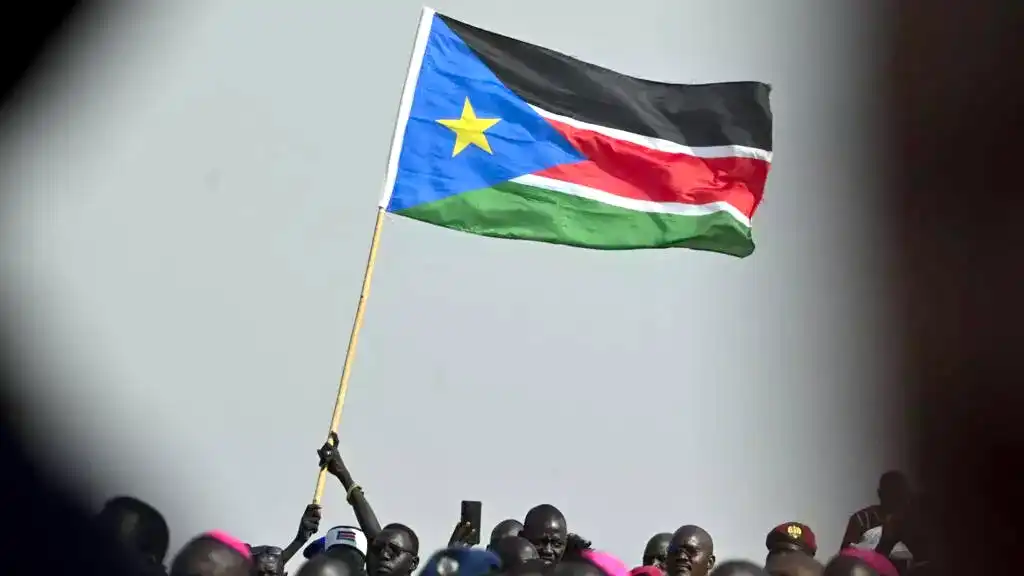
South Sudan, the world's youngest country, will again not be marking its independence (Photo Credit: AFP / TIZIANA FABI)
South Sudan, the world's youngest country, on Thursday marks the 15th anniversary of its independence, following decades of war with Sudan, a 2005 peace agreement and a 2011 self-determination referendum in which almost 99 percent of voters backed statehood. But the hopes that came with it have given way to renewed conflict, economic collapse and political deadlock.
For several years now, the government of President Salva Kiir has cancelled large Independence Day celebrations, saying they are too expensive and the authorities have other priorities.
"Fifteen years after independence, the country is almost at a dead end," Daniel Akech, a researcher at the International Crisis Group, told RFI. "We have a financial crisis, which is really the main reason as to why they cannot celebrate."
He added: "And the country has not transitioned to what was expected... people are frustrated. People need to see some kind of transition, a peaceful democratic transition. Independence was meant to improve things. That achievement has not been realised. The country is risking basically disintegration”.
According to the International Monetary Fund, South Sudan was the sixth-poorest country in the world in 2025, with a GDP per capita of $470.
Oil revenues, the country's main source of income, have fallen in recent years – mainly because of the war in neighbouring Sudan, through which South Sudan's oil exports pass.
Edmond Yakani, director of the Community Empowerment for Progress Organization, told RFI that the country's civil servants received their first salary in two years last week.
Just 8 percent of the population has access to electricity, and South Sudan is ranked alongside Somalia as the most corrupt country in Africa.
Short-lived jubilation
Akech says the people feel they are being held hostage by the ongoing conflict between Kiir and his former vice-president Riek Machar.
Kiir and Machar both fought for South Sudan's independence from Khartoum as members of the armed group, the Sudan People's Liberation Movement/Army.
After decades of war with the north, South Sudan became an autonomous region in 2005. Kiir was appointed president and Machar vice-president. They remained in those positions as the country officially became independent on 9 July, 2011.
In Juba, there was jubilation. People who had long been marginalised within Sudan saw the day as the culmination of more than half a century of struggle.

Relations, however, between Kiir and Machar were difficult from the start. Rivalry, ambition, and mistrust quickly caught up with the two men.
In 2013, just two years after independence, Kiir dismissed his vice-president, accusing him of wanting to take his place as head of state. War broke out again.
The conflict lasted five years, during which 400,000 South Sudanese people were killed and more than half the population was displaced.
The international community and countries in the region put pressure on both sides. Several ceasefires were signed and later broken.
In 2018, the two men signed the Revitalised Peace Agreement, which was meant to begin a transitional period. Machar returned as vice-president.
Key parts of the Revitalised Peace Agreement are still yet to be implemented. The integration of Machar's forces into the national army, the demobilisation of militias, and the organisation of the country's first elections – originally scheduled for 2015 – have all been postponed several times.
Mistrust between the two men has continued to grow and their struggle for power has intensified. To strengthen their support, both leaders have relied on ethnic divisions – Kiir is Dinka, the country's largest ethnic group, while Machar is Nuer, the second largest.
Peace agreement collapses
In March 2025, an attack on a government military base shattered an already fragile political peace.
The Nuer White Army, a militia linked to forces loyal to Machar, attacked in Upper Nile State and captured a military base in Nasir. More than 250 government soldiers were killed.
In the aftermath, Kiir ordered the arrest of several opposition figures. Machar was placed under house arrest before being removed from office.
He was accused of orchestrating the attacks on the national army and charged with treason, murder and crimes against humanity, alongside seven senior members of his party, the Sudan People's Liberation Movement-in-Opposition.
Machar’s party says the case is politically motivated and intended to remove him from politics.
By the end of last year, heavy fighting had resumed between government forces and militias close to the opposition, mainly in Jonglei State. Millions of South Sudanese have once again been displaced.
"There is an ongoing war, as we speak," said Akech – even if much of the international community is reluctant to use the term.

Despite the resumption of war and the trial of Machar, the government in Juba announced a few months ago that elections will be held at the end of this year, on 22 December.
For Yakani, however, this announcement is intended only to quell public anger. And the lack of celebrations on Thursday speaks volumes.
“Independence Day is now being described by citizens with bitter words instead of sweet words – like corruption, manipulation, lack of human rights, absence of rule of law, deadly violence. The beauty, the sweetness of independence is fading every year."
This article has been adapted from the original version in French by Alexandra Brangeon.
Newer articles:
- Kenya and South Sudan seek to strengthen bilateral ties through enhanced security collaboration - 15/07/2026 15:24
- Sudan Rejects South Sudan’s Decision to Include Abyei in Electoral Constituencies, Calling It a Breach of Existing Agreements - 15/07/2026 15:20
- Regional race against Ebola as Congo outbreak accelerates towards South Sudan - 15/07/2026 15:17
- UNHCR South Sudan Population Overview of Refugees and Asylum-seekers (As of 30 June 2026) - 15/07/2026 15:10
- South Sudan resumes oil-backed financing - 11/07/2026 13:33
Older news items
- In maps and charts: South Sudan’s 15 years of independence - 10/07/2026 21:18
- South Sudan civil society warns AU elections could fuel instability - 10/07/2026 21:11
- El-Obeid: Brave witness of the Sudanese Church in a city under siege - 10/07/2026 21:07
- WFP triggers historic anticipatory action plan to shield people from severe drought impact in South Sudan - 10/07/2026 21:06
- South Sudan: Fifteen years of independence marred by war - 08/07/2026 18:50
Latest news items (all categories):
- China’s new Long March: Why its modernization is a demanding journey - 21/10/2026 12:31
- Drone attack in disputed Sudan-South Sudan border region kills at least 153 - 21/10/2026 12:17
- South Korea - 'Smart camp' system built at Hanbit Unit in South Sudan - 21/10/2026 12:09
- Sudanese refugees in Gorom camp, South Sudan, struggle for water, medicines, security - 21/10/2026 12:05
- South Sudan: A Testing Ground For Democracy While Citizens Struggle To Survive - 19/10/2026 14:31
See also (all categories):
Random articles (all categories):
- How the U.N. Security Council Is Perpetuating South Sudan’s Conflict - 22/01/2017 00:26
- Salva Kiir: The man who led South Sudan to independence then war - 08/07/2021 21:26
- The Catholic pilgrims who walked 9 days to see Pope Francis - 04/02/2023 10:11
- Raising the independence flag: A precious opportunity for Salva Kir to rally South Sudanese behind h - 01/07/2011 01:00
- FEATURE-Olympics-South Sudan cheetahs sniff the Olympic scent - Reuters - 02/07/2012 21:01
Popular articles:
- Who is the darkest person in the world, according to Guinness World Record? - 25/10/2022 02:34 - Read 151175 times
- School exam results in South Sudan show decline - 01/04/2012 17:58 - Read 28327 times
- Top 10 weakest currency exchange rates in Africa in 2023 - 19/07/2023 00:24 - Read 25421 times
- No oil in troubled waters - 25/03/2014 15:02 - Read 24646 times
- NDSU student from South Sudan receives scholarship - In-Forum - 29/09/2012 01:44 - Read 22617 times
