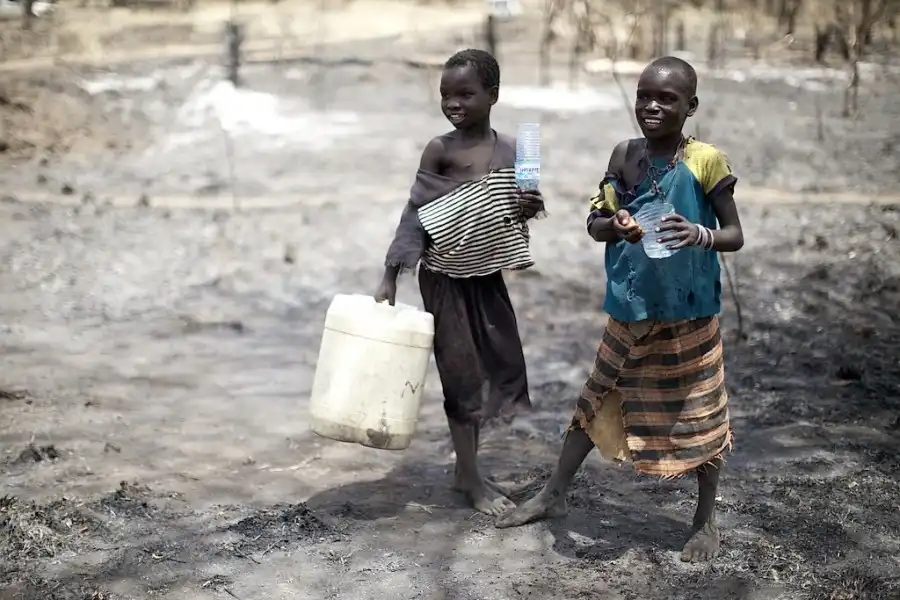
Poverty in South Sudan (Photo Source: Borgen Project)
(Pachodo.org) - Poverty in South Sudan is a challenging part of human life – it's hard to separate people from it, let alone end it.
Poverty is dangerous – it isn't only dehumanize, but also exterminate human populations. That's why the UN and governments worldwide are trying to eradicate it.
As an effort for eradication of global poverty, the UN and governments allocate funds annually, and South Sudan is a beneficiary due to its high poverty levels.
Unfortunately, the funds that South Sudan receives as donations through its Government for the eliminations of poverty, disappears in thin air, allowing poverty to continue to win, and gain grounds. This happens because the money lands in the wrong hands of political leaders who neither have ideas for human dignity, nor commitment for realizations of human dignity.
If you follow all the political speeches and addresses by the South Sudan's political leaders, It has never happened that one day they (the political leaders) talk of addressing the issue of poverty affecting their people. This shows they lack understanding of human dignity, so how can we expect to eradicate poverty in the Country?
Eradication of poverty won't come as a miracle or coincidence, but as results of great commitments of political Leaderships with strong desire to give better life for all, – something our leaders lack.
Poverty in South Sudan is not a natural disaster, but human made, caused by political leadership lack of effective policies, and commitment to eradicate it.
Poverty can't be eradicated by donor funds or telling people to work hard. It needs development of creative policies to effective mobilize resources, and manage revenues to address key issues like healthcare, education, food security, infrastructure, and democracy to raise high level of participation of people in public affairs through good governance and rule of law.
This means eradicating poverty needs leaders who are committed to creating opportunities, generate revenue from available resources and effectively management of the resources /revenues for providing services that give people dignity.
Our massive poverty problem in South Sudan stems from leaders who aren't creative and failing to take advantage of the available resources to address basic human needs. They prioritize power over people, lacking vision and commitment to improve lives.
They're leaders in name only, clunking about without a clue. To them, leadership's just a title –, but not knowing what to do, and how to do things for betterment of people the claim to be leading. To them, leadership is all about position, and they don't even understand and know the meaning of power invested in the position and how to use it for the good cause of the people.
To eradicate poverty, South Sudanese need leaders with ideas of human dignity, leaders who understand, and knows the meaning of their powers (power of leadership) and how to use it for our good cause, or benefits of the people.
*By Major General John Sunday Martin*
Whatsapp: +211926927268 /
+256791938465
Newer articles:
- South Sudan’s Most Dangerous Path: Ethnic Nationalism — and the Case for a Civic State (Part 5) - 10/04/2026 19:08
- The Convergence of Necessity: Why the Bahraini Resolution Must Align with the China-Pakistan Five-Point Initiative - 08/04/2026 14:04
- Unplanned conflict: Trump and the trap of war with Iran - 08/04/2026 14:01
- South Sudan’s Most Dangerous Path: Ethnic Nationalism — and the Case for a Civic State (Part 4) - 08/04/2026 13:58
- The Strategic Imperative of the China-Pakistan Five-Point Initiative: A Framework for De-escalation in the Gulf and Middle East Region - 06/04/2026 14:39
Older news items
- God’s Redemptive Plan Unfolds In The Glory Of Easter - 06/04/2026 14:31
- South Sudan’s Most Dangerous Path: Ethnic Nationalism — and the Case for a Civic State (Part 3) - 06/04/2026 14:24
- When Information Is No Longer Enough: Intelligence and the Degradation of Strategic Truth - 06/04/2026 14:18
- South Sudan’s Most Dangerous Path: Ethnic Nationalism — and the Case for a Civic State (Part 2) - 03/04/2026 16:19
- Structural factors are responsible for persistent poverty in South Sudan, not laziness - 01/04/2026 18:56
Latest news items (all categories):
- Op-Ed - Breaking the Double-Standard Lens on China's Population Shifts - 23/10/2026 14:23
- South Sudan ceasefire monitors warn of rising violence ahead of December elections - 23/10/2026 13:39
- UNMISS SRSG visits Malakal, emphasizes that peace begins with collective action - 23/10/2026 13:36
- How Technology is Accelerating South Sudan’s Next Oil Discovery - 23/10/2026 13:34
- South Sudan’s Patriot make case in their opener against Urunani - 23/10/2026 13:12
See also (all categories):
Random articles (all categories):
- Covid-19, violence spreading in South Sudan, UN envoy warns - 28/06/2020 01:02
- AMECEA And SSSCBC Host Three-Day Constitution Review Workshop in South Sudan - 17/05/2025 20:03
- UN estimates that nearly 910,000 people are affected by floods in South Sudan - 14/10/2022 07:25
- Sudan, South must cooperate to avoid 'suicide': ex-PM - AFP - 14/08/2012 16:30
- In S. Sudan's Capital, a Bridge – and a Nation – on Hold - 24/09/2017 19:24
Popular articles:
- The Final Communique of SPLM-DC Third Session of the National Council - 29/03/2011 01:00 - Read 83348 times
- Roles and Definition of Political Parties - 29/04/2011 01:00 - Read 65116 times
- Agriculture in Southern Sudan: Challenges and Investment Opportunities - 06/10/2010 01:45 - Read 57838 times
- Fashoda Youth Forum Rehabilitation of Drainage Culverts in Malakal town Report - 07/08/2008 16:22 - Read 36106 times
- Creation and establishment of the Local Government Councils ( Counties ) (2) - 28/09/2011 01:00 - Read 34004 times