
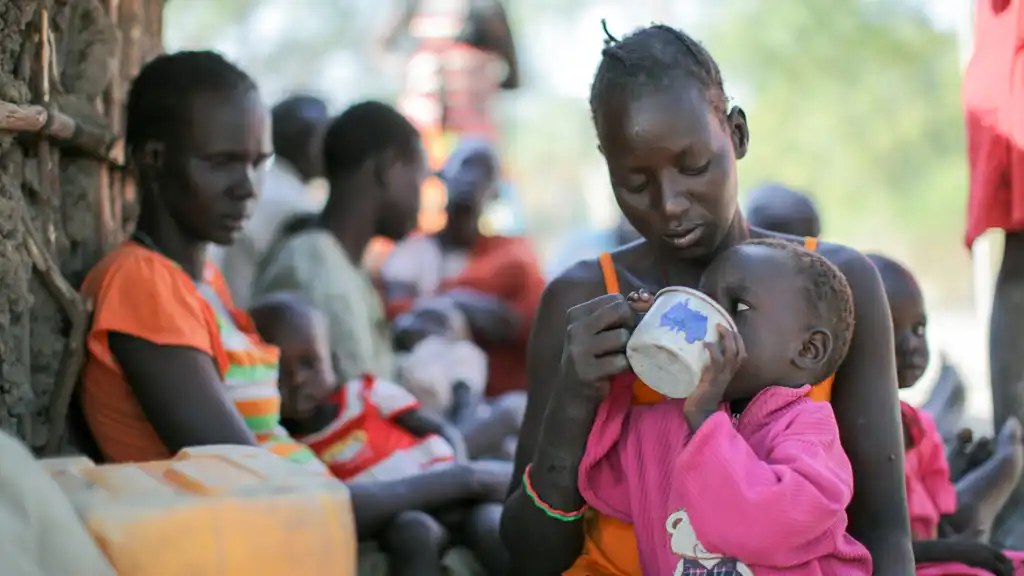
Photo Credit (United Nations Department of Economic and Social Affairs - DESA )
By *Amaju Ubur Yalamoi Ayani
(Pachodo.org) - It is a tradition in South Sudan that senior government officials deliver speeches at funerals and on other social gatherings. Unfortunately, many of these leaders end up making controversial statements. This observation is fully substantiated by recent assertions by Eng. Kuol Manyang Juuk, a Senior Presidential Advisor to the president of South Sudan and veteran commander of the liberation struggle, when he stated that poverty in South Sudan is primarily a consequence of laziness. Such arguments, in my opinion, represent a significant misdiagnosis of the country’s protracted economic crisis. By suggesting that citizens should use their minds to harvest unconventional food sources such as frogs, snakes and other reptiles as well as amphibians to survive hunger, Manyang adopts a narrative that individualizes systemic failure. While he is entitled to his opinion like any other citizen, nevertheless, Manyang’s perspective on this matter apparently ignores the structural paralysis that has defined the post-independence era. Poverty in South Sudan is not a character flaw; rather it is the inevitable outcome of institutional barriers that no amount of individual effort can currently overcome. The structural problems I have alluded to include persistent conflicts, infrastructure gap, market isolation, economic volatility and above all, policy failures. These factors are indisputably responsible for the chronic poverty in South Sudan, not an individual laziness.
The myth of choice in a conflict zone
The argument that “God has created food all around us” fails to account for the pervasive insecurity that dictates daily life for millions of South Sudanese. Decades of civil war followed by persistent subnational violence have created a landscape where the primary economic activity is not production, but survival. For example, when a community is repeatedly displaced, they lose more than just their homes; they lose the “sunk costs” of their labour—cleared fields, irrigation channels, and breeding livestock. In such an environment, the decision to invest labour into the land is not a matter of work ethic, but a high-stakes gamble against armed actors who can seize or destroy those assets in an instant.
Furthermore, the psychological toll of generational trauma and constant displacement cannot be discounted as a factor in economic participation. Resilience is a finite resource. When families are forced into Protection of Civilians (PoC) sites or refugee camps in neighbouring countries, they are stripped of their agency and decoupled from their traditional means of production. To label a displaced person lazy for not farming a land they cannot safely access is a profound distortion of reality. The choice to remain idle is often a calculated survival strategy in a theatre of war where movement equates to mortal risk.
The breakdown of the rule of law in the country means that even those who do produce have no guarantee of retaining the fruits of their labour. Predatory taxation by local militias and the lack of a functional judiciary to settle land disputes create a disincentive structure. If the state cannot protect property rights, for example, the rational economic actor will minimize their effort to avoid attracting the attention of looters. Therefore, the perceived lack of productivity is a direct symptom of a security vacuum, not a deficit of human ambition.
The infrastructure gap and market isolation
True economic productivity is inextricably tethered to infrastructure, a sector where the South Sudanese state has struggled to provide basic public goods. South Sudan remains one of the most physically isolated countries in the world, with only a fraction of its territory connected by all-weather roads. For a farmer in a fertile region like Western Equatoria, the laziness argument falls apart when one realizes that the cost of transporting a bag of grain to a market in Juba often exceeds the market value of the grain itself. Without a transport network, surplus production results in rot and waste rather than capital accumulation.
The energy deficit further compounds this structural trap. With one of the lowest electrification rates globally, South Sudan’s industrial sector is virtually non-existent outside of oil extraction. Small-scale entrepreneurs—welders, tailors, or food processors—are forced to rely on expensive, imported diesel generators, which eat into slim profit margins. When the basic inputs for business are prohibitively expensive due to state-level neglect of the power grid, the entrepreneurial spirit is stifled. This is a technological bottleneck, not a lack of individual ingenuity.
Moreover, the absence of digital infrastructure and a formal banking system in the periphery limits access to credit. Without credit, farmers cannot buy improved seeds or mechanized tools, and youth cannot start small businesses. In the 21st century, using one’s mind requires access to information and capital. When the state fails to provide the digital and financial roads necessary for modern commerce, it effectively benches a significant portion of its workforce. The resulting poverty is a byproduct of market exclusion, orchestrated by a lack of public investment.
The economic volatility and policy failures
The laziness narrative fundamentally disregards the macroeconomic collapse that has systematically eroded the purchasing power of the South Sudanese people. The nation has been trapped in a cycle of hyperinflation and dramatic currency depreciation, which has rendered traditional labour-based economic advancement impossible. When the cost of the caloric intake required to perform manual labour exceeds the daily wage offered for that labour, the fundamental social contract of work is broken. This is not a failure of individual exertion; it is a failure of the monetary authorities to maintain a stable environment for value exchange, effectively taxing the poor through the inflation of basic goods.
In addition, South Sudan’s extreme dependence on petroleum revenues has fostered a classic “Dutch Disease” effect, where the agricultural and manufacturing sectors have been hollowed out in favour of volatile oil rents. This structural imbalance centralizes wealth within a narrow political and bureaucratic elite, while the broader population is left to navigate a demonetized rural economy. When national budget priorities consistently favour defence and administrative overhead over developmental capital, the state essentially architect’s the very idleness it later critiques. The lack of a diversified job market is a direct policy outcome, not a demographic trait.
Finally, the government’s critique of international food aid dependency—while Manyang suggests a return to foraging—signals a dangerous move toward state abdication. Humanitarian aid is not a choice made by a complacent citizenry; it is a desperate stop-gap for a state that has failed to provide the basic security and market conditions necessary for food sovereignty. Real economic reform requires moving beyond moralizing rhetoric toward a framework of transparency and the elimination of the corruption tax that stymies local investment. Attributing poverty to a lack of individual will is a convenient political distraction from the urgent necessity of governance reform.
The path toward structural transformation
The narrative of individual laziness is a convenient political shield, but it is an inadequate explanation for South Sudan’s economic stagnation. To move beyond the current crisis, the state must transition from a model of resource extraction and moralizing to one of developmental governance. The industriousness of the South Sudanese people is already evident in their survival under extreme duress; what is lacking is a domestic environment that allows that energy to be channelled into sustainable growth.
To dismantle these structural barriers, the following institutional shifts are non-negotiable:
- Prioritizing rural connectivity
Shifting budget allocations toward all-weather road networks to link agricultural surplus regions with urban consumption centres, effectively ending market isolation.
- Monetary stabilization
Implementing transparent fiscal policies to curb inflation and restore the purchasing power of the South Sudanese Pound, ensuring that a day’s labour can once again feed a family.
- De-risking production
Strengthening the rule of law and local security to ensure that farmers and entrepreneurs can invest in their land and businesses without the constant threat of predatory seizure or conflict-driven displacement.
Ultimately, South Sudan’s poverty is a reflection of its infrastructure and institutions, not its people. By addressing these systemic failures, the government can move past the rhetoric of blame and begin the actual work of nation-building. Only when the structural ceiling is lifted will the nation’s true economic potential be realized.
About the author

*Amaju Ubur Yalamoi Ayani is a teacher and political observer. He can be reached via
Newer articles:
- South Sudan Needs Creative Leadership For Eradication Of Poverty - 06/04/2026 14:36
- God’s Redemptive Plan Unfolds In The Glory Of Easter - 06/04/2026 14:31
- South Sudan’s Most Dangerous Path: Ethnic Nationalism — and the Case for a Civic State (Part 3) - 06/04/2026 14:24
- When Information Is No Longer Enough: Intelligence and the Degradation of Strategic Truth - 06/04/2026 14:18
- South Sudan’s Most Dangerous Path: Ethnic Nationalism — and the Case for a Civic State (Part 2) - 03/04/2026 16:19
Older news items
- South Sudan’s Most Dangerous Path: Ethnic Nationalism — and the Case for a Civic State (Part 1) - 01/04/2026 18:50
- Either Oppositions Unite, Or Are All Defeated One By One by The Regime - 01/04/2026 18:34
- South Sudan's Monkey Politics Of Folly - 23/03/2026 18:22
- Is God Your Lord Or Your Witch-Doctor? The Myth Of Divine Manipulation - 20/03/2026 16:56
- The Power of Alliances: How the Delusion of America Alone is Manifested in the Strait of Hormuz - 18/03/2026 12:22
Latest news items (all categories):
- Canada helping to fund South Sudan vote despite growing repression - 05/10/2026 15:10
- UNMISS patrol reaches remote Ibba communities amidst heavy rains, insecurity, and growing health threats - 05/10/2026 15:07
- WFP Strongly Condemns Attack on Trucks in South Kordofan, Killing One Driver - 05/10/2026 15:03
- Advancing Women’s Land Rights through building capacity of customary institutions in Magwi County, South Sudan - 02/10/2026 13:18
- AU calls for release of political detainees ahead of South Sudan elections - 02/10/2026 13:15
See also (all categories):
Random articles (all categories):
- [video] South Sudanese orphans finally saved - 08/04/2014 23:43
- Banks explore opportunities in virgin market - 08/06/2009 10:24
- Searching for ghosts in South Sudan - 04/08/2013 08:38
- Thuraya, YahClick and G4T to support connectivity in South Sudan - 24/10/2023 09:26
- Polio cases confirmed in South Sudan, Madagascar: WHO - 14/11/2014 21:17
Popular articles:
- The Final Communique of SPLM-DC Third Session of the National Council - 29/03/2011 01:00 - Read 83242 times
- Roles and Definition of Political Parties - 29/04/2011 01:00 - Read 64993 times
- Agriculture in Southern Sudan: Challenges and Investment Opportunities - 06/10/2010 01:45 - Read 57686 times
- Fashoda Youth Forum Rehabilitation of Drainage Culverts in Malakal town Report - 07/08/2008 16:22 - Read 36007 times
- Creation and establishment of the Local Government Councils ( Counties ) (2) - 28/09/2011 01:00 - Read 33859 times
