
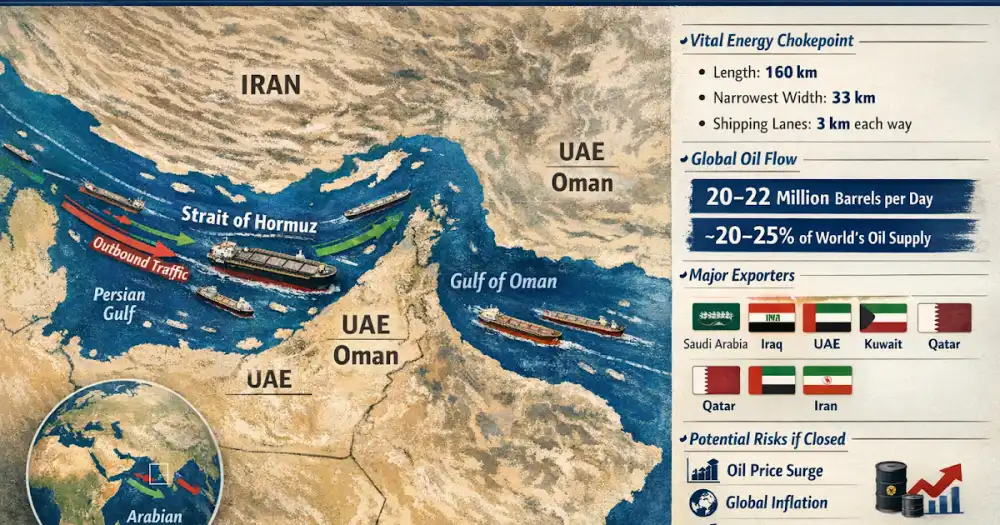
Strait of Hormuz (File / Pinterest)
By *Amaju Ubur Yalamoi Ayani
“Canada has not been consulted over the U.S.—Israeli strikes on Iran that spark the war in the Middle East and has no intention in participating in offensive military,” Canadian Foreign Minister Anita Anand.
(Pachodo.org) - For the better part of the last century, the Strait of Hormuz has functioned as the global economy’s primary jugular, shielded by a post-World War II multilateral order that treated freedom of navigation as an inviolable global responsibility. This framework, rooted in the Bretton Woods era and codified by the UN Convention on the Law of the Sea (UNCLOS), operated on a foundational premise: American naval supremacy was the guarantor of a stable, rules-based system that benefited all maritime nations. By underwritering the security of these global commons, Washington secured not only the flow of energy but also a unique position of moral and strategic leadership. This was an era where the “American security umbrella” was a collective asset, maintained through consensus and a shared understanding that an attack on the freedom of the seas was an attack on the global order itself.
Today, however, as a multifaceted conflict involving the United States, Israel, and Iran enters its third week, that storied umbrella is facing a terminal crisis of credibility. The current standoff has exposed a fundamental flaw in the contemporary American approach to foreign policy, revealing that the “America First” doctrine is a strategic fantasy that collapses the moment it meets the physical and economic friction of a global chokepoint. By retreating from the role of a reliable hegemony into that of a transactional actor, the United States has inadvertently signalled to both allies and adversaries that the rules of the sea are now negotiable. The crisis in the Strait of Hormuz is therefore more than a military bottleneck; it is the ultimate stress test for a unilateralist philosophy that prizes short-term leverage over the long-term stability of international alliances.
The Transactional Trap
The “America Alone” narrative—a cornerstone of the current administration’s foreign policy—posits that U.S. can unilaterally dictate global security through raw military preponderance while simultaneously retreating from the traditional burdens of international cooperation. This logic reached its breaking point this week. President Donald Trump’s sudden call for a seven-nation naval coalition to escort tankers is not an act of genuine diplomacy; it is a desperate pivot.
After a year and two months of transactional rhetoric that treated allies as subordinates in a protection racket, the Trump administration is now asking those same nations to provide a human shield for U.S. interests. The hard truth is surfacing: a superpower cannot spend years eroding the foundations of collective security and then expect the international community to mobilize the moment the bill for isolationism comes due. When leadership is framed as an optional burden, followership becomes equally discretionary.
Furthermore, this transactional approach fails to account for the “weaponization of geography” employed by Iran. Despite deploying two carrier strike groups, the U.S. has found that advanced weaponry cannot easily suppress the threat of naval mines, drones, and shore-to-ship missiles in a 21-mile-wide channel. The assumption that superior American technology could crush any adversary has been met with a protracted, costly stalemate.
In due course, the administration’s focus on “prosperity through leverage” has backfired in the maritime domain. While the U.S. is partially insulated from supply shocks due to its own energy production, its allies are not. By making security contingent on financial contributions or trade concessions, the U.S. has incentivized its partners to seek alternative security arrangements that do not rely on a volatile and demanding Washington.
A Silence that Speaks Volumes
First, the tepid international response to Trump’s call for a “Coalition of the Willing” in the Gulf is not merely a matter of logistical constraint. It is a direct, calculated rejection of a “Me First” world order. This reluctance stems from a profound credibility gap. Traditional allies are understandably wary of joining a collective mission led by an administration that has consistently questioned the value of NATO and other foundational pacts. When the prevailing U.S. message is “America First,” the logical strategic response from Tokyo, Paris, or Seoul is “Us First.”
Second, many global partners view the current escalation as a self-inflicted friction. The international community largely warned that the maximum pressure campaign and the abandonment of previous diplomatic frameworks would lead to exactly this kind of maritime volatility. There is zero appetite among middle powers to be dragged into a wider regional war to stabilize a situation they believe Washington destabilized on its own.
Third, we are witnessing the rise of strategic autonomy. European powers, under the EU’s Aspides mission, are increasingly looking for ways to protect their own interests without being tied to the U.S. military’s direct combat directives. This reflects a broader trend where even the closest U.S. allies are looking for ways to protect their own interests without being tethered to Washington’s escalatory tactics.
Finally, the lack of allied unity has created an opening for adversaries to exploit. Tehran has reportedly been approached by several nations seeking independent safe-passage agreements, effectively bypassing the U.S.-led blockade. This fragmentation of the global response undermines the efficacy of U.S. sanctions and military pressure, as regional giants like India and China prioritize their own energy security over a unified front with the United States.
The Invisible Blockade: The Crisis of Maritime Insurance
The most immediate threat to the “America Alone” security model is not a direct military engagement, but an invisible financial blockade driven by the collapse of the maritime insurance market. Following the escalation of U.S.-Israeli strikes, credible sources reveal that major global insurers—including Norway’s Gard and the UK’s North Standard—summarily cancelled war risk cover for vessels operating in the Persian Gulf. This withdrawal of private sector support effectively grounds commercial traffic more efficiently than any physical barrier.
For the few insurers still willing to provide coverage, premiums have skyrocketed by more than 1,000 percent, in some cases reaching 5 percent of a vessel’s total value for a single seven-day transit. This surge in costs creates a selective deterrence that disproportionately penalizes American and allied interests. While standard war-risk premiums for neutral vessels have jumped, ships with ownership or management linkages to the United States, Israel, or the United Kingdom are being quoted rates three times higher, if they are offered coverage at all.
In addition, the administration’s reliance on unilateral military force fails to address the underlying actuarial reality of modern conflict. Insurers are not merely reacting to the presence of Iranian warships, but to the persistent, asymmetric threat of naval mines and drone swarms that can overwhelm advanced Aegis-equipped destroyers. Even as President Trump promises naval escorts, maritime security experts warn that the U.S. cannot realistically protect over 3,000 ships that typically transit the Strait each month.
The long-term consequence of this insurance crisis is a deepening of global inflation that undermines U.S. domestic stability. Distinguished economists estimate that the current disruption could raise global inflation by up to 1.2 percent points, with energy-dependent regions like Europe seeing spikes as high as 4 percent. By prioritizing a maximum pressure military campaign over a de-escalatory diplomatic framework, the U.S. has inadvertently triggered a cost-push shock that hits the pump and the supermarket shelf.
The Sino-Iranian Axis: Bypassing the American Order
While Western-linked shipping remains paralyzed, the strategic vacuum is being filled by an increasingly formal Sino-Iranian partnership that directly challenges American maritime primacy. Under a 25-year strategic agreement, China has become the primary life support for Tehran, purchasing roughly 90 percent of Iran’s oil exports and providing the financial networks necessary to mitigate U.S. sanctions. In the current crisis, this relationship has evolved into a functional safe-passage corridor.
Tehran has explicitly signalled that it may grant exclusive safe passage to vessels that can prove their cargo was traded in Chinese yuan rather than U.S. dollars. This “Yuan-for-Security” arrangement represents a significant escalation in the global effort to de-dollarize energy markets. By tying maritime safety to the use of its currency, Beijing is transforming a regional military crisis into a long-term tool for financial hegemony.
The geopolitical price of this shift is the erosion of American influence among regional neutrals. Nations such as India and various Gulf states are watching as the U.S. struggle for maximum pressure yields a power vacuum that China is all too eager to fill. India has already seen its interests impringed upon by U.S. policy, forcing New Delhi to weigh the benefits of its partnership with Washington against the immediate need for energy security.
Ultimately, the Sino-Iranian axis provides Iran with the “strategic depth” to withstand American military intimidation indefinitely. Beijing’s support extends beyond finance to include critical components for Iran's ballistic missiles and drone programs, ensuring that Tehran's “weaponization of geography” remains a viable threat. By acting as a lone ranger, the United States has inadvertently forced its adversaries into a tighter embrace and its allies into a corner.
The Death of Effortless Domination
The “Hormuz Gambit” demonstrates that even the world’s most advanced navy cannot single-handedly secure a 21-mile-wide corridor against asymmetric threats—drones, naval mines, and shore-to-ship missiles—without a unified diplomatic front. Raw military power is a blunt instrument in a theatre where the primary weapon is the manipulation of global insurance premiums and energy market panic.
The fantasy that the United States can act as a “lone ranger” while demanding that the rest of the world foot the bill is being shattered. When alliances are treated as a liability rather than a bedrock of national power, the result is a strategic vacuum that adversaries are all too eager to fill. The U.S. may have the capacity to counter Iran's conventional forces, but clearing the strait of mines and persistent drone threats is a time-consuming process that could take weeks or months.
Moreover, the domestic political cost of a protracted conflict in the Gulf is likely to be high. While the Trump administration argues that the U.S. has plenty of its own oil, the “cascading effects” of a Hormuz blockage—on fertilizer, semiconductors, and global supply chains—will eventually reach American consumers. Without a broad coalition to share the military and economic burden, the “America Alone” path leads only to a more isolated and economically fragile United States.
The New Maritime Reality
The crisis in the Strait of Hormuz represents the final collapse of the unilateralist delusion. For seventy years, the global maritime order relied on a United States that led by consensus, underwriting a system that benefited all players. By trading that role for a transactional, “America First” posture, Washington has not shed a burden; it has surrendered its greatest strategic asset: the trust of its partners.
True maritime security requires a commitment built on mutual trust and shared risk, not a frantic call for emergency services once the fire has already spread. If the United States continues to pursue a doctrine that prizes isolation over integration, the Strait of Hormuz will not just be an energy chokepoint; it will become the graveyard of the unilateralist dream. The power of alliance is not a relic of the past; it is the only viable future for a nation that wishes to remain a global power.
To restore order in the Gulf, the United States must move beyond transactional demands and toward a viable collective plan that restores the confidence of its partners. This requires a return to a diplomacy that values the long-term stability of international norms over the short-term gains of maximum pressure tactics. Security cannot be coerced; it must be co-produced. For the sake of the global economy and its own national security, the United States must rediscover the power of alliance before the security umbrella it spent decades building completely collapses.
About the writer

Amaju Ubur Yalamoi Ayani is a teacher, researcher and regular opinion contributor for Pachodo.org. He can be reached via
Newer articles:
- Structural factors are responsible for persistent poverty in South Sudan, not laziness - 01/04/2026 18:56
- South Sudan’s Most Dangerous Path: Ethnic Nationalism — and the Case for a Civic State (Part 1) - 01/04/2026 18:50
- Either Oppositions Unite, Or Are All Defeated One By One by The Regime - 01/04/2026 18:34
- South Sudan's Monkey Politics Of Folly - 23/03/2026 18:22
- Is God Your Lord Or Your Witch-Doctor? The Myth Of Divine Manipulation - 20/03/2026 16:56
Older news items
- Empowering Educators: The Key to South Sudan's Future - 16/03/2026 15:20
- The Nuclear Apartheid: How Small States Suffer Great Power Nuclear Double Standards - 16/03/2026 15:18
- The Indivisible Security Principle: How China’s New Security Architecture Can Help Stabilize the Middle East - 09/03/2026 14:16
- Challenge Of Leadership In Enhancing Good Governance In South Sudan - 09/03/2026 14:12
- Whose Conflict is Ravaging the Middle East? Understanding the Disproportionate Influence of a Middle Power over a Superpower’s Grand Strategy - 06/03/2026 19:57
Latest news items (all categories):
- Juba commissioner denies chasing foreigners - 07/10/2026 14:36
- Australia: 19-year-old from South Sudan arrested over a wild joy ride - 07/10/2026 14:33
- South Sudan’s aid crisis deepens as food stocks run low - 07/10/2026 14:29
- South Sudan’s Juba warns foreigners against running small-scale businesses - 07/10/2026 14:25
- Peace Dialogues foster social cohesion in Nyirol County after persisting tensions - 07/10/2026 14:23
See also (all categories):
Random articles (all categories):
- Exciting Job Opportunities in UNICEF South Sudan - 29/07/2024 19:24
- South Sudan Update - 13/05/2018 15:20
- World’s most dangerous countries to visit in 2024 revealed - 14/12/2023 01:18
- Attacks and displacement spread in Sudan's Darfur - 18/07/2023 02:56
- South Sudan’s Kiir, USAID’s Green disagree over humanitarian access - 02/09/2017 17:00
Popular articles:
- The Final Communique of SPLM-DC Third Session of the National Council - 29/03/2011 01:00 - Read 83244 times
- Roles and Definition of Political Parties - 29/04/2011 01:00 - Read 64995 times
- Agriculture in Southern Sudan: Challenges and Investment Opportunities - 06/10/2010 01:45 - Read 57688 times
- Fashoda Youth Forum Rehabilitation of Drainage Culverts in Malakal town Report - 07/08/2008 16:22 - Read 36008 times
- Creation and establishment of the Local Government Councils ( Counties ) (2) - 28/09/2011 01:00 - Read 33862 times
