
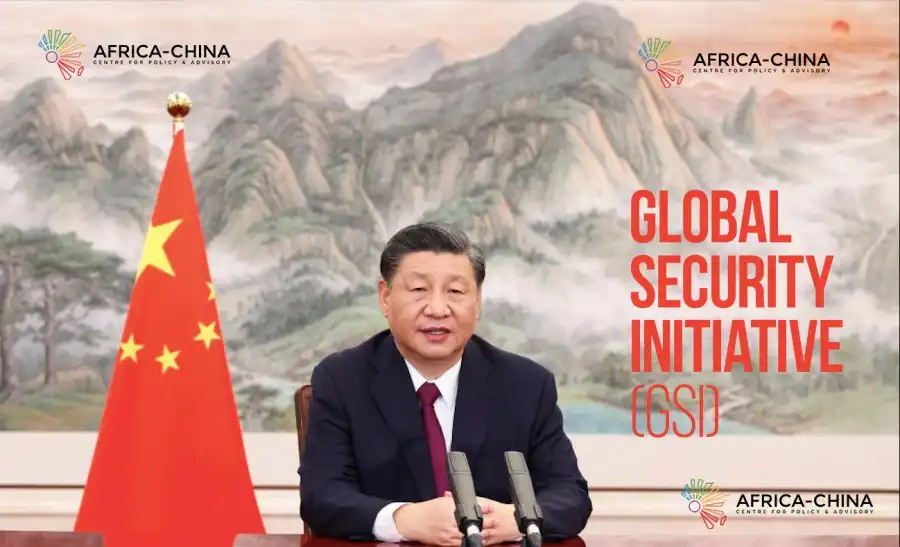
(Photo Credit: The Africa China Centre for Policy and Advisory)
By *Amaju Ubur Yalamoi Ayani
“Any country, while pursuing its own security, should take seriously into account the reasonable security concerns of others. We uphold the principle of indivisible security, advocating the indivisibility between individual security and common security, between traditional security and non-traditional security, between security rights and security obligations, and between security and development,” China’s GSI
(Pachodo.org) - The early months of 2026 have served as a brutal reality check for the architects of Middle Eastern stability, a blast that may potentially engulf other regions of the world if not contained as soon as possible. Between the precision-guided assassinations that have decapitated regional leadership and the subsequent rain of retaliatory ballistic missiles, the region has effectively closed the book on the era of “managed containment.” For decades, the United States has served as the ultimate security guarantor, operating under a logic of exclusion: stability through the fortification of allies and the systematic strangulation of adversaries. This was a peace built on the barrel of a gun, and as the smoke clears over the Persian Gulf and the Levant, it is evident that this zero-sum game has reached its logical, bloody conclusion.
Into this strategic vacuum, China has stepped forward not with a carrier strike group, but with a conceptual challenge: the Global Security Initiative (GSI) and its significant premise of “indivisible security.” At its core, the GSI argues that security is not a commodity to be hoarded, but a climate to be shared. It suggests that the safety of one state is inextricably tied to the safety of its neighbours—a notion that flies in the face of the deterrence model that has defined the Middle East for half a century. For this reason, “countries, whether big or small, weak or strong, rich or poor, should stay committed to taking the legitimate security concerns of all countries seriously. Humanity is an indivisible security community. Security of one country should not come at the expense of that of others. The legitimate security and reasonable security concerns of all countries should be taken seriously and addressed properly, not persistently ignored or systematically challenged.”
China is no longer a mere economic player; it is now the primary philosopher of a post-Western regional order, betting that the only way forward is a transition from competitive arming to cooperative coexistence.
The Bankruptcy of Exclusive Alignments
The traditional security architecture in the Middle East has long mirrored a hub-and-spoke system, with Washington at the centre and a select group of partners acting as regional anchors. This model was built on the assumption that stability could be enforced by maintaining a qualitative military edge for Israel and the Gulf states while imposing crippling isolation on Iran. It was a framework designed for a unipolar world, where the threat of American intervention was enough to freeze historic grievances in place.
However, the recent escalations prove that this “frozen conflict” approach merely backloads systemic risk. By treating security as a private club with a high barrier to entry, the West has inadvertently incentivized Iran toward asymmetric warfare and proxy insurgencies as its only viable path to relevance. When a state feels its security is structurally ignored by the prevailing order, it inevitably seeks to dismantle that order. The explosion of violence in 2026 is not a failure of the system; it is the system working exactly as designed, producing friction at every point where one actor is denied a legitimate security sphere.
China’s GSI serves as a direct rebuttal to this “Cold War hangover.” By championing "common, comprehensive, and cooperative" security, Beijing is attempting to dismantle the logic of the exclusive alliance. The Chinese leadership’s critique is cutting: they argue that the American hegemonic approach creates a self-perpetuating cycle of grievance that no amount of advanced weaponry can solve. In the eyes of PRC, a peace that ignores the legitimate security concerns of Tehran is just as unstable as a peace that ignores the concerns of Tel Aviv or Riyadh. The GSI is not about picking winners; it is about dissolving the structural imbalances that make conflict a rational choice for the isolated.
Strategic Agency and the Art of the Hedge
For the major powers of the Middle East, the GSI is far more than a diplomatic talking point; it is a vital mechanism for strategic autonomy. The days of regional capitals acting as passive clients of a distant superpower are fading, replaced by a sophisticated “multi-alignment” strategy. These states are no longer looking for a protector; they are looking for a portfolio of partners that allow them to navigate a multipolar world without surrendering their sovereignty to the whims of the U.S. electoral cycle.
For the Saudi and Emirati leadership, the GSI dovetails perfectly with their internal mandates for national transformation. They see in China a partner that offers technological and economic integration without the moralizing lectures on domestic governance. By flirting with the GSI, the Gulf states are engaging in a sophisticated strategic hedge. They are utilizing Beijing’s mediation to cool their borders—most notably through the 2023 Saudi-Iran deal—while keeping Washington’s security umbrella in reserve. This allows them to maximize their own sovereign leverage, playing both sides of the Great Power divide to ensure their own survival in a post-oil landscape.
For Tehran, the GSI represents a rare normative lifeline and a path out of systemic isolation. By adopting the language of “indivisible security,” Iran can frame its regional footprint not as malign influence, but as a legitimate defensive necessity within a shared architecture. The PRC provides a diplomatic shield that allows Tehran to engage with its neighbours without first having to submit to the specific ideological demands of the Western liberal order. This framework gives Iran the breathing room to stabilize its economy while maintaining its regional posture, a balance that the U.S. “maximum pressure” campaign sought to make impossible.
Furthermore, this regional pivot toward the GSI indicates a growing weariness with the volatility of American domestic politics. Middle Eastern leaders have watched Washington’s policy swing wildly between administrations, making the U.S. an increasingly uncertain guarantor. In contrast, China’s century-long strategic outlook and its consistent emphasis on stability over democracy-promotion offer a brand of predictability that is highly valued in a region currently defined by chaos.
The Washington Dilemma and the Crisis of Neutrality
The United States views the rise of the GSI with a mixture of public condescension and deep-seated private anxiety. Publicly, U.S. officials often dismiss Chinese diplomacy as empty rhetoric that lacks the military teeth or the carrier groups necessary to enforce anything in a region as volatile as the Middle East. They point to China’s reluctance to deploy troops as proof that Beijing is a free rider on the security provided by the U.S. Navy.
Privately, however, Washington is scrambling to keep pace with a challenge it did not see coming. The frantic efforts to expand the Abraham Accords and the proposal of new trade corridors like IMEC are essentially defensive manoeuvres designed to prove that the U.S.-led model can still deliver prosperity. Washington is realizing that its traditional “security-first” approach is losing its lustre when compared to China’s “development-first” alternative. The battle for influence in the Middle East is no longer just about who has the most planes; it is about who has the most compelling vision for the region’s future.
However, Washington faces an inherent mediator’s trap that it cannot easily escape. Because the United States is the primary arms supplier and security guarantor for Israel and the Gulf monarchies, it can never truly act as an honest broker. Every American diplomatic initiative is viewed through the lens of its rivalry with Iran. This lack of perceived neutrality is a profound strategic handicap in a region that is increasingly looking for a balanced arbiter who can speak to all sides without the baggage of past interventions.
China’s partnership without alliance model is increasingly seductive precisely because it doesn’t ask its partners to choose a side—it only asks them to trade. In the eyes of many Middle Eastern diplomats, the U.S. offers a “with us or against us” ultimatum, while China offers a business as usual invitation. In the current climate, where regional powers are eager to avoid being caught in the crossfire of a U.S.-Iran war, the Chinese model of de-securitization through trade is becoming the preferred path for Riyadh and Tehran alike.
The Development Security Nexus and the New Regional Contract
The path out of the current crisis requires more than just temporary ceasefires or de-confliction lines; it requires a structural overhaul of how the region conceives of peace. China’s developmental peace theory suggests that economic integration—not military deterrence—is the ultimate stabilizer. From this perspective, the hostility between Iran and Israel isn't just a religious or ideological struggle; it is a symptom of a regional order that has failed to provide a common economic incentive for peace.
By weaving the region into the Belt and Road Initiative (BRI), China is attempting to build a political foundation that can support long-term economic investment. They are betting that the high cost of conflict becomes the primary deterrent. In this model, the shared interests of a functional global energy market and maritime safety in the Strait of Hormuz act as the “tripwires” of a shared peace. For Beijing, the goal is to transform the Middle East from a battleground of ideologies into a corridor of commerce, where the preservation of trade routes takes precedence over the settling of historical scores.
China is not trying to be the new regional policeman; it has neither the naval capacity nor the political appetite to replace the U.S. Fifth Fleet. Instead, it is proposing a new regional social contract: one where sovereignty is sacred, security is shared, and peace is anchored in mutual prosperity. It is a vision of peace through trade, where the security of the Gulf is viewed as inseparable from the stability of the Levant.
Conclusion
If the Middle East is to break its fever of perpetual war, it may have to accept the GSI’s most uncomfortable and counter-intuitive lesson: that in a globalized world, you are only as safe as your neighbour—and your neighbour is only as safe as you allow them to be. The American era of “exclusive security” is over; the era of “indivisible security” has begun, and its success or failure will determine whether the Middle East becomes a stable pillar of the new global order or remains a volatile casualty of Great Power competition.
About the writer

*Amaju Ubur Yalamoi Ayani, aka Amaju Joseph Ubur Ayani, is a South Sudanese teacher and a regular opinion contributor on national and international affairs for Pachodo.org. He can be reached via
Newer articles:
- South Sudan's Monkey Politics Of Folly - 23/03/2026 18:22
- Is God Your Lord Or Your Witch-Doctor? The Myth Of Divine Manipulation - 20/03/2026 16:56
- The Power of Alliances: How the Delusion of America Alone is Manifested in the Strait of Hormuz - 18/03/2026 12:22
- Empowering Educators: The Key to South Sudan's Future - 16/03/2026 15:20
- The Nuclear Apartheid: How Small States Suffer Great Power Nuclear Double Standards - 16/03/2026 15:18
Older news items
- Challenge Of Leadership In Enhancing Good Governance In South Sudan - 09/03/2026 14:12
- Whose Conflict is Ravaging the Middle East? Understanding the Disproportionate Influence of a Middle Power over a Superpower’s Grand Strategy - 06/03/2026 19:57
- China Agenda / Two Sessions 2026 - 27/02/2026 23:54
- The Nile’s New Reality: Why Cairo Must Abandon the Past - 27/02/2026 20:56
- A Controversial Choice: Haavisto's Envoy Role in Sudan - 26/02/2026 13:24
Latest news items (all categories):
- Independent human rights investigators: Human cost of violence in South Sudan ‘continues to grow’ - 11/09/2026 10:43
- Displaced women build resilience through new livelihoods in Tambura - 11/09/2026 10:38
- Officially: Egypt lose their star for Angola and South Sudan clashes - 11/09/2026 10:36
- VP Nyandeng’s Critique And The Splintered Politics Of South Sudan - 09/09/2026 13:34
- UN rights Commission begins four-day South Sudan mission amid renewed conflict - 09/09/2026 13:25
See also (all categories):
Random articles (all categories):
- South Sudan: Gun battles threaten new country - 04/02/2012 19:35
- Tense oil talks resume between Sudan and South - 06/03/2012 00:41
- Press conference By Oyayi and Alfred Akowoc - 09/05/2010 17:17
- دعـــــــــــــــــوة - 19/05/2011 09:52
- South Sudan Rebel Leader Changes Course, Agrees to Sign Peace Deal - 29/08/2018 03:00
Popular articles:
- The Final Communique of SPLM-DC Third Session of the National Council - 29/03/2011 01:00 - Read 83164 times
- Roles and Definition of Political Parties - 29/04/2011 01:00 - Read 64900 times
- Agriculture in Southern Sudan: Challenges and Investment Opportunities - 06/10/2010 01:45 - Read 57548 times
- Fashoda Youth Forum Rehabilitation of Drainage Culverts in Malakal town Report - 07/08/2008 16:22 - Read 35938 times
- Creation and establishment of the Local Government Councils ( Counties ) (2) - 28/09/2011 01:00 - Read 33780 times
