
By Amaju Ubur Yalamoi Ayani
“Modernization is the inalienable right of all countries,” Xi Jinping
(Pachodo.org) - Fostering a more favourable and inclusive international environment for building a great country, and advancing national rejuvenation in all respects is one of the principles of China’s major-country diplomacy. This grand vision is no better than anchored in 70 years of China-Africa diplomatic relations. With future progress in mind, President Xi Jinping, also secretary general of the CPC Central Committee proposed that bilateral relations between China and all African countries having diplomatic relations with the People’s Republic of China “… be elevated to the level of strategic relations, and that the overall positioning of China-Africa relations be elevated to an all-weather China-Africa community with a shared future for the new era.”
As we navigate 2026—a year formally recognized as the China-Africa Year of People-to-People Exchanges—the architecture of international development is undergoing a profound shift. The “Partnership Action for People-to-People Exchanges,” introduced by Chinese President Xi Jinping at the 2024 FOCAC Beijing Summit, for example, has already transitioned from a diplomatic vision into a tangible reality. This framework is anchored in President Xi’s fundamental belief that “… the foundation and lifeline of China-Africa relations lie with the people.”
In South Sudan, the vision of “China-Africa Partnership in Pursuit of Modernization” is not merely theoretical; it is actively reshaping the nation’s social and economic landscape. As Chinese Ambassador to South Sudan H.E. Ma Qiang recently noted, “The blueprint has been drawn... the new journey of China and South Sudan joining hands to realize modernization dreams is now before us.”
The Ten Pillars of China-Africa Partnership
While addressing the summit on September 5, 2024, President Xi Jinping stressed that China and Africa’s joint pursuit of modernization would set off a wave of modernization in the Global South, and open a new chapter in building with a shared future for humanity. To facilitate a model of modernization that is both egalitarian and sustainable, the partnership is currently executing ten specific actions. These pillars represent a strategic pivot toward soft infrastructure—investing in the intellectual and vocational potential of 2.8 billion people of China and Africa combined. Specific courses of action include:
1. Civilizational Synergy and Mutual Learning
This action moves beyond traditional diplomacy to establish the China-Africa Knowledge Network for Development. It involves the creation of 25 dedicated research centres that prioritize "Southern-led" governance models. Rather than adopting external blueprints, this pillar allows South Sudan and China to exchange philosophies on state-building that respect local history and cultural sovereignty.
2. Trade Prosperity and Market Integration
China has eliminated trade barriers by granting 100 percent duty-free access for all tariff lines from African Least Developed Countries (LDCs). This is not merely a policy of aid, but one of empowerment, transforming the Chinese consumer market into what President Xi describes as “Africa’s big opportunity.” For South Sudanese exporters, this provides a direct window for speciality products like sesame and gum arabic.
3. Industrial Chain Cooperation
Focusing on the transition from extraction to production, this action encourages Chinese enterprises to build value-added manufacturing hubs within Africa. In South Sudan, this translates to developing local mineral processing and petroleum-byproduct industries, ensuring that the wealth generated by natural resources stays within the local economy.
4. Integrated Connectivity
This pillar merges physical hard infrastructure with digital soft connectivity. While it includes 30 major connectivity projects, it also focuses on the “Silk Road e-commerce” and digital logistics standards. It ensures that the roads built today are equipped with the fibre optics and digital frameworks needed for tomorrow’s digital economy.
5. Development Cooperation (The “Small yet Smart” Approach)
Moving away from massive, slow-moving projects, this action prioritizes 1,000 “small yet smart” livelihood projects. These are fast-tracked initiatives—such as village-level water wells, community clinics, and solar street lighting—that deliver immediate, visible improvements to the daily lives of rural populations.
6. Healthcare Resilience and Medical Diplomacy
This action strengthens health systems by deploying 2,000 medical experts across the continent. It moves beyond emergency response to foster long-term “hospital-to-hospital” institutional bonds, sharing advanced medical technology and training local South Sudanese doctors in specialized surgery and public health management.
7. Agrarian Transformation and Rural Revitalization
By utilizing mechanization, China is helping turn subsistence farming into a commercial engine. This involves not just donating tractors and other tools, but sharing “Smart Agriculture” techniques like drone-assisted crop monitoring. Ambassador Ma observed in January 2026 that these tools allow communities to “increase grain production and improve the lives of its people.”
8. The Future of Africa Vocational Plan
The cornerstone of youth empowerment, this initiative involves the establishment of ten specialized Luban Workshops. These centres provide high-end technical training in fields like AI, robotics, and rail engineering. It includes 60,000 training opportunities, ensuring that African youth are the architects of their own modernization.
9. Green Development and Ecological Leadership
China is establishing 30 joint green energy labs to ensure the Global South leads the renewable energy transition. In South Sudan, this focuses on harnessing the Nile’s hydro-potential and the region’s vast solar radiation, moving the nation toward a low-carbon energy grid.
10. Common Security and Stability
Recognizing that development requires peace, this action enhances regional stability through joint peacekeeping training and disaster response capacity. It focuses on “security through development,” addressing the root economic causes of conflict.
China-South Sudan Strategic Partnership in a New Era
In 2026, the fruits of the elevated Strategic Partnership between Beijing and Juba are evident. Ambassador Ma has frequently reminded stakeholders that “embracing China is embracing opportunities,” a statement that aligns with the common expectations and long-term interests of the two peoples.
A standout success is the China Scholastic Competency Assessment (CSCA), which now streamlines how South Sudanese students qualify for specialized degrees in China. Simultaneously, the arrival of agricultural machinery in Western Equatoria State will empower local farmers toward food sovereignty. Ambassador Ma states this demonstrates the “responsibility and commitment of Chinese enterprises” to catalyse an “economic takeoff.”
Looking Forward
To maximize these actions, I would suggest the creation of the China-South Sudan Youth Climate Corps (YCC). This initiative would merge Vocational Training (Action 8) with Green Development (Action 9). Ambassador Ma has acknowledged that “the issue of youth unemployment has become more prominent,” and the YCC would answer this by training youth to install solar water systems and use digital data to predict flood cycles, protecting the “Small yet Smart” projects from environmental threats.
In return, this initiative would transform the bilateral partnership into localized environmental action, empowering the next generation to lead the nation's green transition. The Corps would undertake specific courses of action, including but not limited to:
- Technological Vanguard
The Corps would deploy Chinese-pioneered “green development” tools, such as solar-powered e-classrooms, to provide reliable power for climate-resilient schools.
- Juncao Technology Integration
Members would receive training in Juncao (fungus grass) production—a Chinese innovation currently being promoted in South Sudan—to provide livestock feed and resources, addressing food security and ecological restoration simultaneously.
- Disaster Preparedness
Following the 2021 Declaration on Combating Climate Change, the Corps would focus on early warning systems, leveraging China's satellite expertise to protect rural communities from predictable flooding.
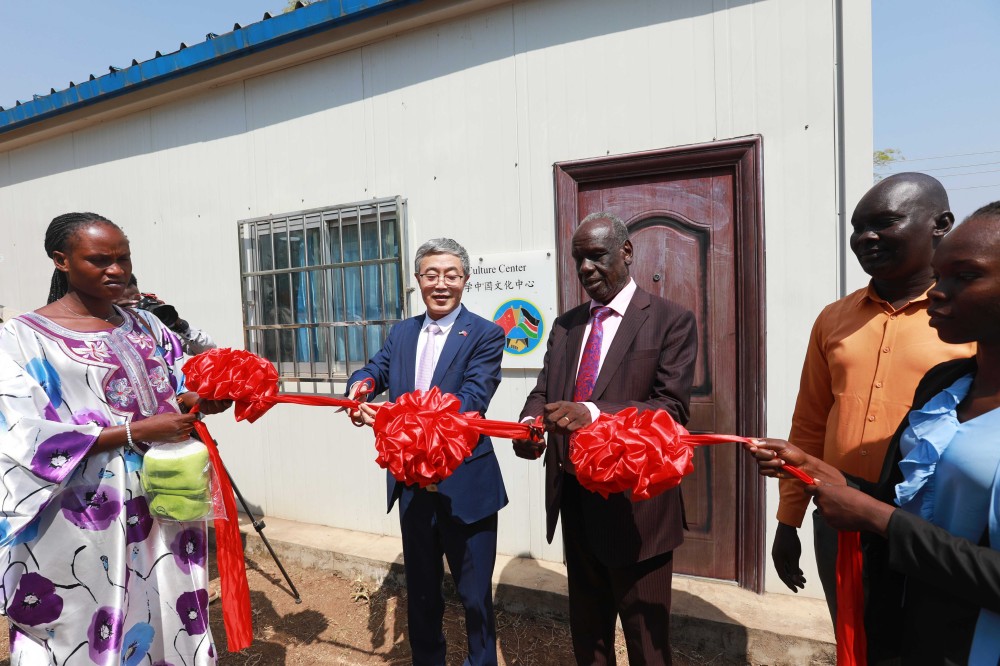
In addition, the partnership should establish the Centre for China and African Studies in South Sudan as highlighted in pillar one. Building on the foundation of the recently opened Chinese Language and Culture Centre, a dedicated research hub (think-tank) would formalize academic and policy synergy between the two nations.
The centre would function as a laboratory for the Belt and Road Initiative (BRI), the Global Development Initiative (GDI), the Global Civilization Initiative (GCI), and the Global Security Initiative (GSI), helping scholars adapt China’s rural revitalization models to South Sudanese agro-processing, seize opportunities available for the infrastructural development, understand the current international security reconfiguration, and expedite people-to-exchanges.
By establishing these institutions in Juba, South Sudan can transition from being a passive recipient of aid to a proactive leader in climate resilience and modernization.
The Test of Our Time
Apparently, 2026 marks a period of intense global trade volatility, and the attrition of the traditional rules-based international order as a result of the re-emergence of “America-First” transnationalism. Thus, there is consensus that the Global South, specifically Africa, has already weighed a fundamental recalibration of international relations. The long-standing dominance of American-led liberal internationalism is now facing its sternest test, not from a signal conflict with China, neither is it with Africa, but from a clash of diplomatic philosophies. On one side is the revived “America-First” doctrine of the Trump administration—characterized by punitive tariffs and transactional demands—and on the other is China’s enduring Five Principles of Peaceful Coexistence.
For smaller nations like South Sudan, the choice between these two paths is becoming the defining factor in their national development strategies. Whether a small country endures the kind of relationship in which a great power points a gun at its head, or it opts for the relationship that observes the principle of non-interference in internal affairs, win-win cooperation, and the respect for diversity of civilizations, is no longer a question of the time. The choice is very clear: China’s adherence to the United Nations Charter and rules-based international order offers a “golden rule” that protects smaller states from power politics.
Conclusion
Ultimately, President Xi Jinping’s assertion that “closer cooperation between China and Africa is needed more than ever” rings true. Our world, our times, and the course of history are experiencing unprecedented change. Nevertheless, when acted upon, the Ten Actions of China-Africa Partnership will prove that true modernization is found not in cold steel alone, but in the shared "engineering spirit" and the green innovations blooming in African fields. By investing in human capital, China and South Sudan are forging an all-weather community with a shared future that is both inclusive and enduring.
About the author
Amaju Ubur Yalamoi Ayani, also known as Amaju Joseph Ubur Ayani, is a teacher and political commentator. He can be reached via
Newer articles:
- Rebuilding Nationhood Through Schools: Why South Sudan Needs a Philosophy-Driven Curriculum - 16/02/2026 13:50
- South Sudan’s Vice-President on Trial: The Case’s Potential Consequences for the Restoration of Peace - 09/02/2026 11:12
- NDA's Crisis Is Orchestrated By The Regime - 06/02/2026 14:16
- Greenland: Trump's predatory mood - 03/02/2026 18:17
- A Call For Unity, For Victory Of The Opposition - 03/02/2026 12:23
Older news items
- The Silent Pulpit: How Singing Drowned Out the Word Of God - 23/01/2026 18:18
- From Washington To Beijing: Why Chinese Path To Modernization Is The Alternative Development Path For The Global South - 23/01/2026 14:48
- Another Empty Threats By Gen. Paul Nang - 23/01/2026 14:38
- Cultural Soft Power: The 2026 Mundari Festival as a Blueprint for South Sudanese Unity - 19/01/2026 12:50
- The Politics Of Joint Operations Of The Armed Forces By The Regime - 16/01/2026 15:20
Latest news items (all categories):
- China’s new Long March: Why its modernization is a demanding journey - 21/10/2026 12:31
- Drone attack in disputed Sudan-South Sudan border region kills at least 153 - 21/10/2026 12:17
- South Korea - 'Smart camp' system built at Hanbit Unit in South Sudan - 21/10/2026 12:09
- Sudanese refugees in Gorom camp, South Sudan, struggle for water, medicines, security - 21/10/2026 12:05
- South Sudan: A Testing Ground For Democracy While Citizens Struggle To Survive - 19/10/2026 14:31
See also (all categories):
Random articles (all categories):
- On This Day, July 9: South Sudan declares independence and other events - 09/07/2022 08:06
- Renew Commission on Human Rights in South Sudan - 05/03/2020 19:50
- South Sudan to draw electricity from Kenya in exchange for gas - 02/07/2019 15:09
- NOBODY IS BEING DEPRIVED: A RESPONSE TO DR. PETER ADWOK OTTO - 26/08/2010 10:27
- Just a Reminder - 29/07/2010 07:31
Popular articles:
- The Final Communique of SPLM-DC Third Session of the National Council - 29/03/2011 01:00 - Read 83320 times
- Roles and Definition of Political Parties - 29/04/2011 01:00 - Read 65085 times
- Agriculture in Southern Sudan: Challenges and Investment Opportunities - 06/10/2010 01:45 - Read 57800 times
- Fashoda Youth Forum Rehabilitation of Drainage Culverts in Malakal town Report - 07/08/2008 16:22 - Read 36081 times
- Creation and establishment of the Local Government Councils ( Counties ) (2) - 28/09/2011 01:00 - Read 33958 times
