
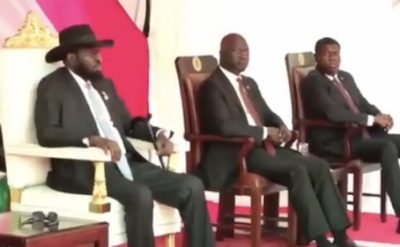
(Image Credit: Modern Tokyo Times)
A damning investigation by the United Nations has confirmed what many in South Sudan have long suspected: over the past decade, billions of dollars have vanished into the hands of corrupt political elites. While the country descends into chaos—torn apart by ethnic massacres, political strife, and crushing poverty—a small circle of power brokers enrich themselves with impunity.
As foreign nations, NGOs, and humanitarian organizations pour in aid meant to alleviate suffering, that lifeline is siphoned off to bankroll the luxury and excess of South Sudan’s ruling class. The result is a grotesque paradox: the more the international community gives, the less the nation’s leaders feel compelled to act. Shielded by endless streams of foreign assistance and emboldened by the total absence of accountability, South Sudan’s elites have no incentive to change.
Why should they? The money keeps flowing—and so does the silence.
AP News reports, “Billions of dollars in public funds in South Sudan have been stolen over the past decade in massive government corruption while the vast majority of the country suffers from lack of food, a U.N. commission said Tuesday.”
The UN commission pointedly says, “While a small group of powerful actors pillage and loot the country’s wealth and resources, enriching themselves, the state has effectively abdicated its sovereign responsibilities to its population, outsourcing critical services — such as the provision of food, health care, and education to international donors.”
The report shockingly said: “Corruption is killing the South Sudanese.”
Shockingly—and for the second time—South Sudan’s long-awaited national elections (last year) were cancelled, more than a decade after the country gained independence. It would have been the first democratic vote in the nation’s history. The excuse? A so-called “lack of funds.” Yet this claim rings hollow in a country where billions have already disappeared into the hands of corrupt politicians and their business cronies.
Lee Jay Walker (Modern Tokyo Times analyst) says, “As the political elite cry poverty, millions of ordinary South Sudanese survive on international humanitarian aid. Meanwhile, those in power continue to grow obscenely wealthy—profiting not only from unchecked.”
One of the most brazen examples of large-scale corruption was the so-called national roads program—a $2.2 billion initiative that was supposed to connect communities, boost trade, and lay the foundation for development. Instead, it became yet another cash cow for the political elite. According to the UN commission, a staggering $1.7 billion from the project is simply unaccounted for. No roads, no infrastructure—just vanished money and deepening despair. It’s not just theft; it’s the systematic looting of a nation’s future.
Unbelievably, more public money was funneled into the personal medical unit of South Sudan’s president (in 2023) than into the entire national healthcare system. In a country where millions lack access to basic medical care, this grotesque disparity is not just irresponsible—it’s immoral.
Equally alarming, less than 1% of the federal budget (2020 – 2024) was allocated to ministries responsible for food security, despite widespread hunger and famine risk. And even that meager amount is not safe—there is strong suspicion that a portion of it, too, was siphoned off through corrupt channels. While the nation teeters on the brink of humanitarian catastrophe, those entrusted with its care continue to plunder its resources, one scandal at a time.
The people of South Sudan fought long and hard for their independence, emerging from a brutal war where Arab Muslim forces massacred untold numbers of Black African ethnic groups and enslaved others. The birth of the nation in 2011 was meant to be a new beginning—an end to oppression, and the dawn of self-determination, dignity, and peace.
But that promise has been ruthlessly betrayed. In place of foreign oppression, South Sudanese now face the cruelty of their own leaders. Rampant political corruption, tribal cronyism, and unchecked greed have hollowed out the state from within. While the political elites grow richer—feeding off oil wealth, international aid, and stolen public funds—the vast majority of South Sudanese are trapped in a nightmare of poverty, hunger, and hopelessness. The war may have ended, but for millions, survival remains a daily battle—and the enemy now sits in the halls of power.
The people of South Sudan fought long and hard for their independence, emerging from a brutal war where Arab Muslim forces massacred untold numbers of Black African ethnic groups and enslaved others. The birth of the nation in 2011 was meant to be a new beginning—an end to oppression, and the dawn of self-determination, dignity, and peace.
But that promise has been ruthlessly betrayed. In place of foreign oppression, South Sudanese now face the cruelty of their own leaders. Rampant political corruption, tribal cronyism, and unchecked greed have hollowed out the state from within. While the political elites grow richer—feeding off oil wealth, international aid, and stolen public funds—the vast majority of South Sudanese are trapped in a nightmare of poverty, hunger, and hopelessness. The war may have ended, but for millions, survival remains a daily battle—and the enemy now sits in the halls of power.
Modern Tokyo News is part of the Modern Tokyo Times group
http://moderntokyotimes.com Modern Tokyo Times – International News and Japan News
http://sawakoart.com – Sawako Utsumi’s website and Modern Tokyo Times artist
https://moderntokyonews.com Modern Tokyo News – Tokyo News and International News
Source: https://moderntokyotimes.com/south-sudan-and-rampant-political-corruption-mass-poverty/
Newer articles:
- South Sudan’s leaders engage in ‘systematic looting’ in poor nation: UN - 16/09/2025 18:42
- Salva Kiir Promotes Rumoured Successor Bol Mel to Full General - 16/09/2025 18:40
- SPLM-IO Declares South Sudan Government Collapsed, Illegitimate - 16/09/2025 18:36
- South Sudan is printing new bank notes to cushion rising inflation - 16/09/2025 18:29
- Five things to know about South Sudan’s fragile peace deal - 16/09/2025 18:23
Older news items
- South Sudan's opposition says government trying to enforce "one-tribe rule" - 12/09/2025 12:50
- South Sudan VP Machar charged with treason and murder, suspended by president - 12/09/2025 12:45
- As fighting escalates, kidnappings of aid workers surge in South Sudan - 12/09/2025 12:36
- South Sudan: Humanitarian Snapshot (August 2025) - 12/09/2025 12:15
- South Sudan returns deportee from the US to Mexico - 09/09/2025 12:11
Latest news items (all categories):
- Ramaphosa presses Kiir to implement peace deal ahead of South Sudan’s first elections - 09/10/2026 12:19
- South Sudan steps up Ebola alert after Kenya case - 09/10/2026 12:17
- Laotian man deported by U.S. to South Sudan leaves for Laos after year in detention - 09/10/2026 12:14
- Bullet and blast injuries … and a constant need for blood: inside South Sudan’s overwhelmed trauma wards - 09/10/2026 12:10
- MTN South Sudan and Regulator Pledge Cooperation to Expand Connectivity - 09/10/2026 12:01
See also (all categories):
Random articles (all categories):
- COVID-19: South Sudan records 5 new cases - 06/07/2020 12:12
- How to rescue South Sudan - 27/07/2015 18:01
- Funding alone is not enough – we must give the brave girls of South Sudan every chance to succeed - 18/08/2018 07:35
- South Sudan president appeals for assistance for flood victims - 12/09/2013 23:21
- AU in 2023: closing the gap between intention and action? - 04/01/2023 01:24
Popular articles:
- Who is the darkest person in the world, according to Guinness World Record? - 25/10/2022 02:34 - Read 150854 times
- School exam results in South Sudan show decline - 01/04/2012 17:58 - Read 28209 times
- Top 10 weakest currency exchange rates in Africa in 2023 - 19/07/2023 00:24 - Read 25316 times
- No oil in troubled waters - 25/03/2014 15:02 - Read 24543 times
- NDSU student from South Sudan receives scholarship - In-Forum - 29/09/2012 01:44 - Read 22506 times
