
By Amaju Ubur Yalamoi Ayani
The global landscape has reached a definitive turning point. The rules-based international order (RBO)—a framework established by Western powers following the end of the Cold War to promote liberal democracy and free markets—is no longer the undisputed operating system of the world. We are witnessing a “Great Realignment” as the traditional hierarchy is dismantled by the very hegemony that created it.
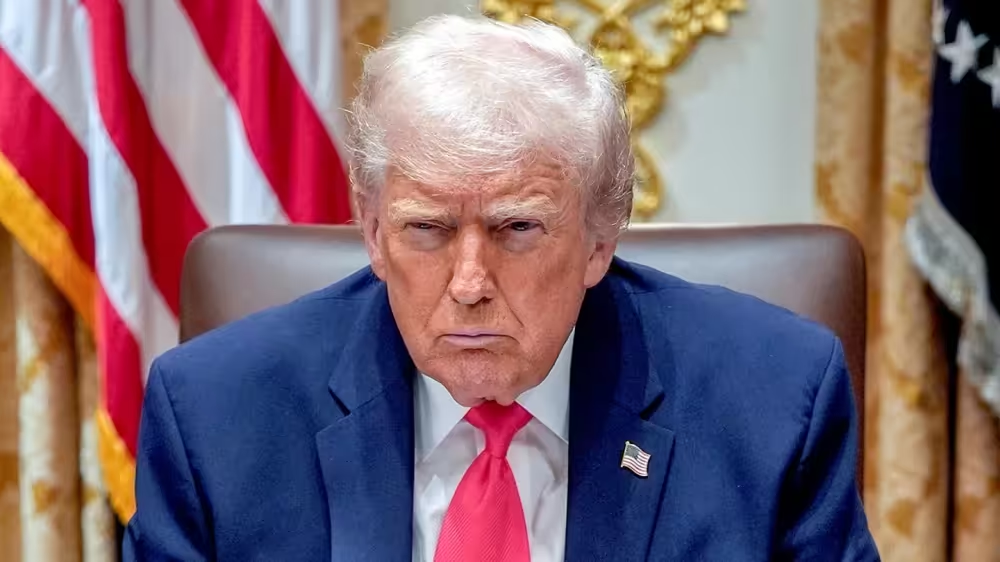
The final challenge to liberal internationalism has come from within the West itself. Under the second Trump administration, the United States has transitioned into a transactional superpower, signalling a global return to the logic of the Monroe Doctrine. By pursuing expansionist ambitions and prioritizing raw territorial interests—evident in strategic rhetoric regarding the annexation of Greenland and control of the Panama Canal—Washington has signalled a preference for Realpolitik over the multilateral norms it once championed. This shift was crystallized at the 2026 Munich Security Conference during a significant address by the U.S. Secretary of State Marco Rubio. Rubio delivered a civilizational ultimatum, framing the American commitment to its allies not through shared rules, but through a shared “Western Civilization” that must prioritize border security and reindustrialization. By treating long-standing allies as partners who must pay their way or face abandonment, the United States has retreated from its role as the global guarantor of liberal norms, and effectively ended the era of values-based alliances.
Fortunately, this shift comes at the time when the concept of Chinese modernization has already transitioned from a domestic strategy to a formidable global blueprint. Although the Chinese Government is not interested in competing with the United States for global power, this shift represents more than a change in the global leadership; it marks the dawn of a multipolar era where Western claims to preside over universal values are being challenged by diverse developmental paths that prioritize sovereign integrity over ideological convergence.
To understand this transition, especially to comprehend why the United States is acting the way it is, we must examine the competing visions of two distinguished scholars: Francis Fukuyama and Martin Jacques through the prisms of International Relations theory (Realism).
For nearly four decades, the West has been operating under the premise established in Fukuyama’s 1992 work, “The End of History and the Last Man”, which posited that liberal democracy represented the final form of human government. The rules-based international order (RBO) was designed to facilitate this assumed convergence, expecting all countries of the world to mirror the Western model as they developed politically, culturally and economically. However, the rise of a high-tech, prosperous, and sovereign China has fundamentally debunked the notion that modernization necessitates Westernization. Martin Jacques’ thesis in “When China Rules the World” has proven more prescient. Jacques argues that China is not a typical nation-state but a “civilization-state” governed by its own historical logic. This premise is triumphing because it correctly predicted that China would not integrate into the Western order but would instead reshape the world to respect cultural sovereignty, diverse political systems, and win-win international relations.
But, why is the United States taking the lead in dismantling the very system it pioneered and helped built for nearly four decades? From a theoretical standpoint, the decline of liberal internationalism validates the insights of Classical and Neorealism while challenging liberal institutionalism assumptions. The Athenian General Thucydides observed earlier in the Melian Dialogue, “… the strong do what they can and the weak suffer what they must.” This logic suggests that international norms are secondary to the survival instincts of great powers. Such institutions, if at all exist, are invariably controlled by powerful states. International institutions such as international law, international organizations and international trade could be set up only to lessen the harshness of realpolitik.
This objective reality prompted Niccolò Machiavelli to assert that a leader must prioritize state security over moral platitudes. Statesmen who are responsible for and to their separate publics, and who operate in an uncertain and threatening Milieu, have little choice but to put the interests of their own entity above those of others or those of the international system. National interests, thus, become synonym for national egoism. As a result, one could not rely on others, nor could one rely on international institutions and processes to protect one’s key values.
This practically explains why the United States under the leadership of Donald J. Trump is increasingly acting outside its own established rules. To Trump’s America First Doctrine, the United States has been taken advantage of for so long by the so-called “traditional allies” through international institutions such as the North Atlantic Treaty Organization (NTO). Consequently, its power (material power) is diminishing. Trump, like Han J. Morgenthau, views international politics through the lens of power politics. In his celebrated book “Politics Among the Nations”, Morgenthau contends that international politics, like all politics, is a struggle for power. Whatever the ultimate aims of international politics, power is always the immediate goal.
John J. Mearsheimer’s theory of “Offensive Realism” also clarifies this premise once he wrote, “… in an anarchic international system, rational states seek to maximize their share of world power to ensure security.” Thus, the rules-based international order (RBO) may be viewed not as a moral project, but as a strategic tool for American primacy. As it ceases to serve that function, it is being discarded in favour of raw power politics.
As the United States becomes increasingly unpredictable, China’s strategic rise appears inevitable, and for many, a necessary source of global stability. While Washington has withdrawn from dozens of international organizations, China has remained a central anchor of globalization. This has forced traditional U.S. allies, including the United Kingdom, Canada, Germany, to mention but a few, to hedge their strategic bets. Faced with aggressive American tariffs and nationalist policies, these middle powers are increasingly seeking strategic autonomy. They are engaging in high-level diplomacy with Beijing, recognizing that China’s massive market and its dominance in “New Quality Productive Forces”—such as advanced manufacturing and green energy—are essential for their own economic survival in a post-Western world.
For the Global South, Chinese modernization offers a release from the political conditionalities often attached to Western aid and trade. Unlike the West, which frequently ties trade to internal political reforms, China’s foreign policy is rooted in the “Five Principles of Peaceful Coexistence.” These principles emphasize mutual respect for sovereignty, non-aggression, and non-interference in internal affairs. Through the Belt and Road Initiative (BRI) and the Global Development Initiative (GDI), China provides the infrastructure and technology necessary for growth without requiring ideological alignment. This allows countries across Africa, Asia, and Latin America to modernize on their own terms, focusing on tangible industrialization and poverty alleviation rather than adhering to external political demands and presumed Western universalism.
In this shifting landscape, South Sudan should take specific, practical steps to strengthen its strategic partnership with China as a reliable alternative to traditional Western engagement. For example, Juba can prioritize resource-for-infrastructure agreements that focus on constructing refineries, road networks, and irrigation systems, which are often delayed by the political requirements of Western entities. Furthermore, South Sudan should not hesitate to partner with Chinese technological leaders to develop its digital infrastructure and telecommunications, and robustly fight against systemic corruption at all levels of government. By aligning with the BRI framework and the GDI, South Sudan can secure a position in the new multipolar order, ensuring its national sovereignty is protected by a partner that values stability and mutual cooperation over interventionism.
To achieve this, the government must move from a reactive diplomatic posture to a proactive strategic alignment. South Sudan should immediately apply for GDI Partner status to access the Global Development and South-South Cooperation Fund, providing a multilateral shield for projects away from the bilateral friction of Western sanctions. Establishing membership in the New Development Bank (NDB) would also pave a driveway for infrastructure financing in local currencies or the Yuan, mitigating risks associated with U.S. Dollar volatility and asset freezes. By adopting the Cross-Border Interbank Payment System (CIPS) for oil transactions and partnering with firms like Huawei for a national fiber-optic backbone, South Sudan can secure its digital and financial sovereignty.
In conclusion, the “End of History” has been replaced by the “Return of Civilization.” As the United States adopts a more transactional role, the old rules-based order is dissolving under its own contradictions. In its place, the emergence of Chinese modernization offers a more inclusive global framework that acknowledges the world’s inherent diversity of civilizations. For small nations like South Sudan and the wider Global South, the choice is becoming clear: continue to rely on a fading liberal order defined by instability, or embrace a partnership with a civilization-state that offers a path to the future through mutual respect and shared development.
About the writer
Amaju Ubur Yalamoi Ayani, aka Amaju Joseph Ubur Ayani, is a teacher and political commentator. He holds a Master of Arts in International Relations, a B.Sc. in Political Science and a Diploma in Civics. He can be reached via
Newer articles:
- The Nile’s New Reality: Why Cairo Must Abandon the Past - 27/02/2026 20:56
- A Controversial Choice: Haavisto's Envoy Role in Sudan - 26/02/2026 13:24
- Make the UN Great Again, Or Make It Collapse? - 26/02/2026 13:04
- From Referendum to Fragility: The Unfinished State-Building of South Sudan - 25/02/2026 19:53
- The Calculated Dissolution of the Global Norms and the Rise of Transactional Realism: A Critical Analysis of the 2026 Munich Security Conference - 23/02/2026 14:06
Older news items
- Research - From Helsinki to Vienna: Reflections on Cooperative Security and the Evolving European Order - 19/02/2026 13:34
- The Collo fight for their ancestral land and dignity - 16/02/2026 14:22
- Rebuilding Nationhood Through Schools: Why South Sudan Needs a Philosophy-Driven Curriculum - 16/02/2026 13:50
- South Sudan’s Vice-President on Trial: The Case’s Potential Consequences for the Restoration of Peace - 09/02/2026 11:12
- NDA's Crisis Is Orchestrated By The Regime - 06/02/2026 14:16
Latest news items (all categories):
- IGAD and South Sudan Strengthen National Coordination for the Implementation of the Building Women’s Economic Resilience for Sustainable Peace Project - 03/08/2026 18:53
- South Sudan plans interoperable birth registration, digital ID systems - 03/08/2026 18:50
- South Sudan Oil & Power Returns as South Sudan’s Premier Investment Platform - 03/08/2026 18:04
- Kenya: Mudavadi meets South Sudan foreign minister as Juba gears up for landmark elections - 03/08/2026 16:52
- A Long Road Home: Jal’s Journey Through Conflict and Separation - 03/08/2026 16:41
See also (all categories):
Random articles (all categories):
- South Sudan Conflict Interrupting Children's Education - 17/04/2014 03:23
- South Sudan celebrates National Day at Expo 2020 Dubai - 20/02/2022 02:09
- South Sudan: How is South Sudan's Economy Doing? - 29/08/2013 02:19
- A Letter to Gen Salva Kiir Mayardit, the President of the Republic of South Sudan : It is time to step aside and give way, Mr President. - 05/02/2018 16:35
- Sudan peace talks to resume in Juba Tuesday - 09/12/2019 06:46
Popular articles:
- The Final Communique of SPLM-DC Third Session of the National Council - 29/03/2011 01:00 - Read 83071 times
- Roles and Definition of Political Parties - 29/04/2011 01:00 - Read 64770 times
- Agriculture in Southern Sudan: Challenges and Investment Opportunities - 06/10/2010 01:45 - Read 57305 times
- Fashoda Youth Forum Rehabilitation of Drainage Culverts in Malakal town Report - 07/08/2008 16:22 - Read 35808 times
- Creation and establishment of the Local Government Councils ( Counties ) (2) - 28/09/2011 01:00 - Read 33598 times
