
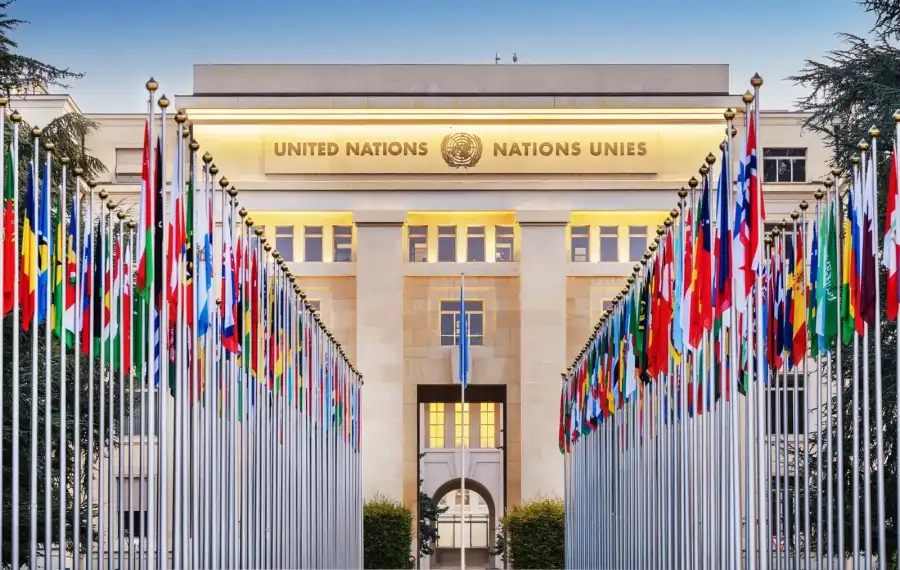
United Nations building in Geneva, Switzerland (Photo Credit: Alamy / Adobe)
By Amaju Ubur Yalamoi Ayani
How Trump’s Foreign Policy Rhetoric is Destroying the UN System
(Pachodo.org) - The establishment of the United Nations in 1945 served as the foundational pillar of the post-war international order. Emerging from the absolute devastation of a global conflict that brought humanity to the brink of self-annihilation, the institution has functioned for eight decades as the preeminent stage for diplomatic discourse, conflict mitigation, and the coordination of essential humanitarian efforts. Nevertheless, as the organization nears its 80th anniversary, it is being forced to confront an existential crisis. This threat does not originate from a foreign policy action of a small states neither from a middle power country, but rather from the transactional and isolationist rhetoric characterizing the second Trump administration. This movement represents far more than a simple plea for institutional reform; it is a calculated dismantling of the multilateral framework that has safeguarded American interests and global leadership since the conclusion of the Second World War.
During a recent address before the UN General Assembly in September 2025, U.S. President Donald J. Trump criticized what he imperfectly described as “destructive globalism,” asserting that the coming era belongs to the so-called “patriots rather than globalists.” This adversarial stance has found its most vocal proponent in former U.S. National Security Advisor Michael Waltz, who is currently serving as the U.S. permanent representative to the United Nations. Speaking at the 2026 Munich Security Conference, Waltz dismissed the UN as an “obsolete 80-year-old artifact” that required being “placed on a strict diet.” He contended that the United States is currently rescuing the world from disaster by pivoting toward a focused multilateralism instead of depending on an untransformed system. In a moment of high political theatre during a heated debate, Waltz donned a blue “Make the UN Great Again” (MUNGA) hat—a gesture signalling that Washington intends to compel a return to basic core mandates or otherwise permit the institution to disintegrate through systematic neglect.
The perils of this trajectory are deeply rooted in the sombre historical analogies of the 1930s. The League of Nations, which preceded the United Nations, disintegrated primarily because major global powers—most notably a retreating United States—treated it with domestic-focused derision. When the League proved incapable of responding to acts of aggression in Manchuria and Ethiopia, it devolved into a hollow shell. This state of paralysis did not foster a more secure world; rather, it birthed a lawless geopolitical vacuum that revisionist regimes quickly exploited, leading inevitably to the carnage of World War II. The current generation is in danger of committing a catastrophic error by failing to remember that the United Nations was not constructed out of soft-hearted idealism. It was built upon the grim realization that a world lacking a collective mediator is a world destined for total conflict. The League’s end was finalized when its participants began choosing short-term populist gains over the preservation of a rules-based international order. Today, the United States appears to be following that exact trajectory.
However, the cost of isolationism in the twenty-first century is even more prohibitive than it was in the twentieth. In an era defined by hyper-connectivity, a nation’s power is measured by its centrality to global networks—financial, digital, and diplomatic. Isolationism is no longer a strategic or sustainable retreat; it is an act of self-marginalization. By systematically withdrawing from an international stage, a superpower does not reclaim its sovereignty; it surrenders its ability to set the standards by which the rest of the world ought to operate. History suggests that when a dominant power like U.S. abdicates its role as a global rule-maker, it inevitably becomes a rule-taker. This is the fundamental paradox of the “America First” doctrine: by exiting the UN system, the United States is accelerating its own decline, transforming itself from the architect of global norms into an isolated observer of a world managed by rivals.
Current executive branch policies imply that these historical warnings are being disregarded in favour of isolationist political theatre. The Trump administration has already initiated withdrawals from dozens of international bodies and has drafted a 2026 fiscal budget that effectively guts UN funding by over 80 percent. By surrendering its prominent seat at the table through a budget reduction and withdrawals, the United States is effectively transferring the stewardship of the global order to its most significant rivals. In his recent article published by the Foreign Affairs titled “Asia After America: How U.S. Strategy Failed—and Ceded the Advantage to China”, Zack Cooper reinforced this premise by warning that with the United States facing divisions at home and distractions abroad, it had become clear that deep engagement across all Asia was no longer realistic. To Cooper, after fifteen years of American leaders pledging sustainable investment to prevent China from dominance in the region, the pivot to Asia in particular has failed, creating the gap between pledges and actions to persist, and this risks a catastrophic failure of deterrence. As the U.S. eliminates its financial backing for vital agencies such as UNICEF and the World Health Organization, countries such as China stand ready to emerge as the primary financiers of global development programs. This creates a massive geopolitical opening where another powerful nation like China can redefine the normative structures of international law to prioritize state-led stability over liberal universal principles. It is a fundamental truth of power: when U.S. exits the room, the room continues to exist; it simply adopts a different leadership.
Furthermore, this rhetoric of institutional destruction will impose a heavy economic burden on American commerce. The United Nations system acts as the underlying regulatory framework for the entire global economy. American enterprises depend upon international norms to ensure aviation safety, manage maritime trade routes, and protect intellectual property rights. Without an American presence within the International Telecommunication Union or the Universal Postal Union for example, competing nations can rewrite the rules to place American corporations at a significant disadvantage. Furthermore, when the agencies responsible for stabilizing developing regions are starved of resources, the resulting local unrest leads to severed supply chains and the evaporation of emerging markets. This scorched-earth diplomatic strategy compels other countries to migrate toward Chinese-led financial institutions, thereby accelerating the erosion of American financial primacy.
To counter these significant risks, other pillars of American governance must step forward. Congress, for example, must exercise its legislative authority over the budget as enshrined in the constitution to shield non-political, essential funding, ensuring that the gears of global commerce do not seize up. Simultaneously, leaders within the private sector must take part in informal diplomacy to guarantee that the American perspective is not completely extinguished in international regulatory bodies. If the executive branch is unwilling to lead, the U.S. legislature and the business community must serve as the final line of defence for international stability.
The UN framework certainly requires modernization. It is frequently burdened by bureaucracy, and its organizational structure still reflects the 1945 power balance that is largely out of sync with the twenty-first century. However, the current U.S. foreign policy ignores the possibility of measured reform in favour of wholesale destruction. By abdicating the role of top contributor, the United States is abandoning its duties as a permanent Security Council member, thereby inviting the very same chaos that followed the League of Nations’ fall. Now with President Trump as chief U.S. diplomat, Washington is essentially swapping the temporary inconveniences of multilateralism for the permanent catastrophe of a world without leadership.
History remains a stern and unforgiving instructor. The fundamental lesson of 1939 is that when the institutions designed to preserve peace are torn down, the resulting void is filled by conflict. The current push to “Make the UN System Collapse” embodies a perilous gamble with the safety of future generations. Failing to acknowledge these historical precedents will not make the world great; instead, it will lead to global instability. The choice we face is no longer a simple one between national sovereignty and globalism; it is a choice between a structured order and a rapid, uncontrolled decline that will leave no nation—regardless of its economic and military might—untouched.
About the writer
Amaju Ubur Yalamoi Ayani, aka Amaju Joseph Ubur Ayani, is a South Sudanese teacher and a regular opinion contributor on national and international affairs for Pachodo.Org. He can be reached via
Newer articles:
- Challenge Of Leadership In Enhancing Good Governance In South Sudan - 09/03/2026 14:12
- Whose Conflict is Ravaging the Middle East? Understanding the Disproportionate Influence of a Middle Power over a Superpower’s Grand Strategy - 06/03/2026 19:57
- China Agenda / Two Sessions 2026 - 27/02/2026 23:54
- The Nile’s New Reality: Why Cairo Must Abandon the Past - 27/02/2026 20:56
- A Controversial Choice: Haavisto's Envoy Role in Sudan - 26/02/2026 13:24
Older news items
- From Referendum to Fragility: The Unfinished State-Building of South Sudan - 25/02/2026 19:53
- The Calculated Dissolution of the Global Norms and the Rise of Transactional Realism: A Critical Analysis of the 2026 Munich Security Conference - 23/02/2026 14:06
- The Return of Civilization? How the Decline of Liberal Internationalism Presents Chinese Modernization as the Viable Option for Global Governance - 19/02/2026 13:44
- Research - From Helsinki to Vienna: Reflections on Cooperative Security and the Evolving European Order - 19/02/2026 13:34
- The Collo fight for their ancestral land and dignity - 16/02/2026 14:22
Latest news items (all categories):
- Canada helping to fund South Sudan vote despite growing repression - 05/10/2026 15:10
- UNMISS patrol reaches remote Ibba communities amidst heavy rains, insecurity, and growing health threats - 05/10/2026 15:07
- WFP Strongly Condemns Attack on Trucks in South Kordofan, Killing One Driver - 05/10/2026 15:03
- Advancing Women’s Land Rights through building capacity of customary institutions in Magwi County, South Sudan - 02/10/2026 13:18
- AU calls for release of political detainees ahead of South Sudan elections - 02/10/2026 13:15
See also (all categories):
Random articles (all categories):
- Suggestion Proposals for Chollo Community in the U.S.A. - 17/07/2007 17:23
- Diversity should be accepted in South Sudan – Machar - 28/05/2013 01:19
- We need new leaders: women of South Sudan's Bentiu camp speak - 21/07/2015 06:33
- Major airlift of South Sudanese enters week two: IOM - The Daily Star - 21/05/2012 10:00
- The Mobile Surgical Team Saving Lives in South Sudan - 08/04/2023 08:10
Popular articles:
- The Final Communique of SPLM-DC Third Session of the National Council - 29/03/2011 01:00 - Read 83236 times
- Roles and Definition of Political Parties - 29/04/2011 01:00 - Read 64985 times
- Agriculture in Southern Sudan: Challenges and Investment Opportunities - 06/10/2010 01:45 - Read 57674 times
- Fashoda Youth Forum Rehabilitation of Drainage Culverts in Malakal town Report - 07/08/2008 16:22 - Read 36004 times
- Creation and establishment of the Local Government Councils ( Counties ) (2) - 28/09/2011 01:00 - Read 33852 times
