
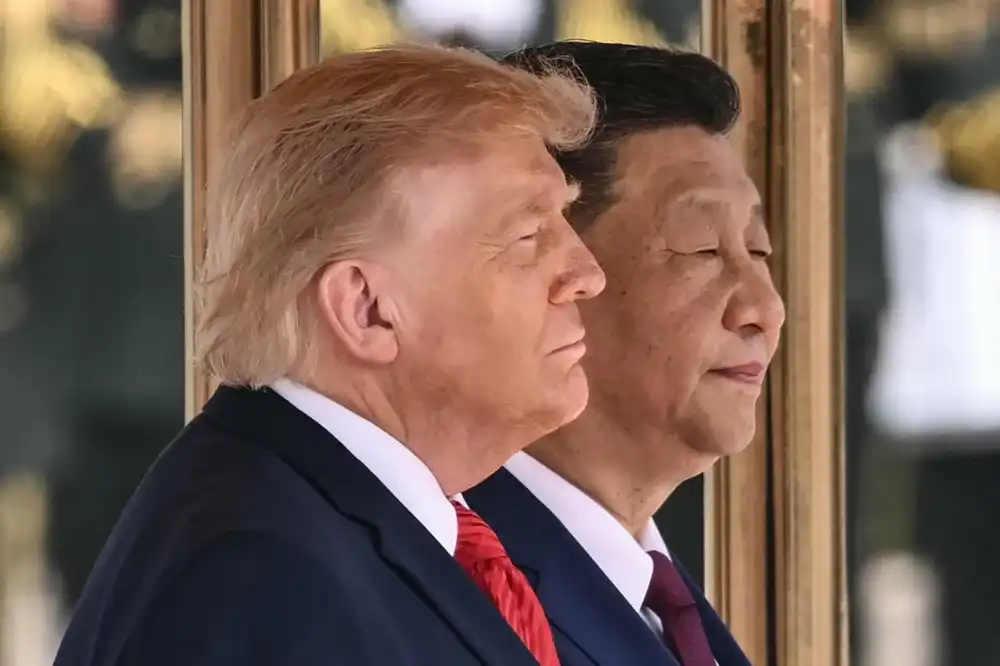
Trump and Xi stand for their countries' national anthems during Thursday's welcome ceremony at the Great Hall of the People (Photo Credit: Brendan Smialowski/AFP/Getty Images)
“Can China and the United States overcome the Thucydides Trap and create a new paradigm of major-country relations?” President Xi Jinping.
By *Amaju Joseph Ubur Ayani
(Pachodo.org) - As of Thursday, May 14, 2026, the high-stakes summit took place at the Great Hall of the People in Beijing between Chinese President Xi Jinping and U.S. President Donald J. Trump, marking a critical pivot in modern geopolitics. While conventional foreign policy consensus often views the relationship between the world’s two major countries through a lens of zero-sum competition, this meeting demonstrates that direct, top-level diplomacy can construct a durable framework for international security, economic resilience, and diplomatic predictability. By prioritizing pragmatism over ideological posturing, the summit proves that even intensely competitive nations can establish guardrails that actively protect global stability. In his opening remarks, President Xi noted, “…the fluid international situation prompts a vital, historic questions: Can China and the United States overcome the Thucydides Trap and create a new paradigm of major-country relations? Can we meet global challenges together and provide greater stability for the world? Can we build a bright future together for our bilateral relations in the interest of the well-being of the two peoples and the future of humanity?” To President Xi, answers to these questions would determine not only the future of American and Chinese peoples, but also the destiny of the world.
The bilateral engagement between China and the United States carries profound implications that ripple far beyond their borders. For example, when the United States and China align their core strategic focus on domestic renewal rather than external geopolitical dominance, they offer a blueprint for a more orderly world. Rather than fracturing the globe into adversarial blocs, their transactional diplomacy establishes clear rules of engagement that reduce friction across global supply chains and maritime corridors. This historic convergence reveals that Chinese National Rejuvenation and America First are not inherently contradictory paths, but complementary philosophies that can co-exist to deliver a substantial peace dividend to the entire international community.
For this reason, this article analyzes the macro-structural implications of this summit. Moving beyond standard state-visit journalism, the paper argues that executive negotiations between the world’s two largest economies function as a structural regulatory mechanism. These talks dictate global economic trajectories, stabilize regional security flashpoints, and establish regulatory frameworks for transnational governance. It asserts that structured, high-level diplomatic engagements provide essential guardrails that manage systemic friction, allowing the international community to navigate the structural pressures of the Thucydides Trap through managed coexistence rather than systemic collapse.
Security: Managing Flashpoints and Avoiding Conflict
The stabilization of military communication between Washington and Beijing acts as a primary buffer against unintended global conflict. When high-level leadership establishes direct, reliable communication channels, the risk of miscalculation in highly contested corridors decreases significantly. These lines of contact ensure that tactical encounters between naval or aerial assets do not escalate into strategic confrontations due to a lack of clear information. In their opening statements, President Xi explicitly underscored this responsibility, stating that the two nations must work together to meet challenges and bring greater stability to the world.
A primary focus of the closed-door talks centred on managing the critical security flashpoints of Taiwan and the ongoing war in Iran. Xi Jinping delivered a direct warning regarding the island, noting that if Taiwan is handled well, U.S.-China relations will enjoy overall stability, but failure to do so risks clashes and conflicts that could put the entire relationship in great jeopardy. Concurrently, the Trump administration used the summit to address Chinese economic ties to Tehran amidst the ongoing crisis in the Strait of Hormuz. By confronting these highly volatile security issues face-to-face, both leaders chose direct crisis management over proxy escalation.
In the whole set, regularized risk-reduction frameworks between two nuclear-armed states create a more stable international environment. By institutionalizing crisis-management protocols and operational hotlines, both capitals establish a template for managing systemic friction safely. This structural predictability reassures the global community that intense geopolitical competition can be managed through rigorous protocol rather than hazardous brinkmanship, fulfilling what President Xi called a historic responsibility to steer the relationship in the right direction.
Economy: Market Stability and Predictable Supply Chains
Clear and binding bilateral agreements between the world’s two largest economies provide essential stability to global financial markets. Sudden shifts in tariff policies and unpredictable trade restrictions historically trigger severe volatility across international stock exchanges, damaging investor confidence. When Washington and Beijing commit to structured, transparent trade parameters, global markets gain the predictability required for long-term capital allocation and sustained economic growth. President Trump highlighted this dynamic by bringing a massive delegation of top American business executives to Beijing, noting that they look forward to trade, expanded market access, and establishing totally reciprocal business relations.
The economic talks focused on updating the trade truce, addressing market access, and managing the intense global semiconductor and artificial intelligence rivalry. To ground these discussions in practical corporate realities, Trump's delegation included prominent tech leaders like Elon Musk of Tesla, Tim Cook of Apple, and Jensen Huang of Nvidia. Their presence underscored a mutual effort to prevent abrupt, catastrophic disruptions to transnational electronics and automotive manufacturing networks. By focusing talks on concrete deals—such as massive Chinese commitments to purchase American agricultural products, buy American oil, and secure passenger planes—the summit aimed to structurally reduce the bilateral trade imbalance.
Consequently, balanced trade frameworks between these economic engines help mitigate inflationary pressures worldwide. Predictable supply dynamics and stable tariffs allow manufacturers to optimize production costs, preventing sharp price spikes for essential consumer goods and industrial components. Developing nations, which are particularly vulnerable to fluctuating import costs, benefit heavily from the price stability generated by steady China-U.S. economic relations. Reflecting on this operational resilience, Trump noted in his opening remarks that whenever the two sides faced a problem, they worked it out very quickly.
Diplomacy: A Blueprint for Pragmatic Multilateralism
Direct, results-oriented negotiations between top leaders offer a highly effective alternative to gridlocked international bureaucratic bodies. Traditional multilateral forums frequently suffer from paralysis due to conflicting institutional agendas and lengthy procedural debates. Pragmatic, bilateral accords between major economies cut through this diplomatic inertia, producing actionable agreements that can be implemented swiftly to address pressing international challenges. President Trump matched this sentiment during the opening exchanges, stating plainly that the personal and diplomatic relationship between the two leaders remained very strong.
The spirit of this pragmatic diplomacy carried directly into the evening's state banquet held at the Great Hall of the People, where both leaders swapped geopolitical posturing for cultural appreciation and shared history. During his official toast, President Trump noted that citizens of the United States and China have long shared a deep sense of mutual respect. He illustrated his point with historical anecdotes, reminding the audience that Benjamin Franklin had published the sayings of the philosopher Confucius, and that Chinese admirers had gifted a stone tablet honouring George Washington that still adorns the Washington Monument. President Xi reciprocated by invoking historical milestones, reminding the room of Henry Kissinger’s foundational visit to China under Richard Nixon, which originally broke decades of diplomatic isolation.
This model of active diplomacy proves that competing political systems can coexist productively without fracturing global governance into adversarial blocs. Rather than demanding ideological conformity, this approach prioritizes practical cooperation on shared interests while respecting systemic differences. President Xi summarized this realist framework during the dinner by stating that the two nations must make the relationship work and never mess it up. He emphasized that both sides stand to gain from cooperation and lose from confrontation, charting a correct path for major-country relations in the modern era.
Convergence: National Rejuvenation Meets America First
The conceptual intersection of Chinese National Rejuvenation and America First lies in a shared preference for internal development over costly foreign entanglements. Both political philosophies prioritize domestic economic renewal, job creation, and industrial modernization above the expensive maintenance of expansive global empires. This inward focus naturally reduces the appetite for aggressive external expansion, lowering the frequency of major geopolitical interventions. President Xi captured this harmony perfectly during his banquet address, declaring to the attendees that achieving the great rejuvenation of the Chinese nation and making America great again can totally go hand in hand.
Industrial synergy emerges when China’s vast manufacturing capacity interacts with America’s renewed focus on rebuilding domestic infrastructure and reviving its industrial base. Instead of engaging in a destructive economic decoupling, both nations can leverage their respective structural strengths to fulfil domestic mandates. This balance allows the United States to secure cost-effective inputs for its national renewal projects while providing China with a stable, predictable export market. At the dinner, Trump echoed this optimism, confirming that their discussions had been extremely positive and productive, yielding outcomes that would favour both nations.
Finally, both ideologies share an explicit respect for national sovereignty, strong borders, and independent governance. By rejecting the expansive premises of borderless globalism, both leaderships validate a world order comprised of strong, self-governing nation-states. This shared respect for sovereignty creates a clear, predictable foundation for international relations, where state actions are guided by national interest rather than ideological crusades.
The Global Dividend of Inward Alignment
When the world’s primary powers focus their resources on domestic stability rather than geopolitical expansion, the entire international community receives a peace dividend. Historically, smaller nations are forced to choose sides in polarizing proxy conflicts that drain local resources and spark internal civil strife. The mutual decision to focus inward neutralizes the drive to fund and wage these proxy wars, allowing developing regions to maintain internal peace. In his banquet toast, President Xi contextualized this global impact, stating directly that stability in China-U.S. relations is a boon to the world.
Furthermore, this alignment grants middle powers and smaller nations unprecedented geopolitical breathing room to pursue independent foreign policies. Without the constant pressure of superpower policing or forced alignment, individual countries can tailor their economic and security partnerships to fit their specific national needs. This decentralization of power fosters a more resilient international system where regional stability is maintained by local stakeholders, rather than external arbiters.
Economically, the combined efficiency of a revitalized American industrial core and a stabilized Chinese logistics network drives down production costs worldwide. The technological innovations and logistical breakthroughs generated by their parallel domestic development projects quickly diffuse into the global marketplace. This technological spillover enhances transport, communication, and manufacturing capabilities across multiple continents, boosting global productivity and fulfilling Trump's forecast that the two nations are positioned to forge a fantastic future together.
Strategic Policy Actions for the International Community
To capitalize fully on this bilateral alignment, global policymakers and regional blocs must actively adjust their strategic frameworks to fit a post-globalist landscape. National governments should move away from sprawling, ideologically driven treaties that frequently stall during ratification. Instead, trade ministries ought to prioritize agile, value-neutral bilateral pacts focused entirely on concrete economic exchange and mutual commercial benefit.
Regional organizations, such as ASEAN, the African Union, and the European Union, must step forward to take primary responsibility for their own localized security arrangements. Rather than depending on permanent military intervention from Washington, these bodies need to institutionalize regional crisis-management hotlines and mediation panels. This localized approach ensures that minor border frictions are resolved before they escalate into broader geopolitical crises.
Conclusion
Lastly, international development agencies and finance ministers must design flexible infrastructure networks capable of interfacing with diverse technological standards. Nations should upgrade their physical ports, digital networks, and customs protocols to accommodate both Western systems, Central and Eastern logistical platforms simultaneously. By maintaining strict neutrality and technical adaptability, the international community can maximize the benefits of a stable, multipolar global economy.
About the writer

*Amaju Joseph Ubur Ayani is a teacher and researcher. He is a graduate of International Relations and Political Science from the University of Juba. His research interests fall within understanding China’s global initiatives and their roles in shaping global security architectures, economic development and cultural harmonization. He can be reached via
Newer articles:
- HRA Chairman Saad Kassis-Mohamed Raises Alarm as Renewed Violence Threatens Sudan Peace Process - 22/05/2026 14:58
- From tension to transformation: the new face of transatlantic relations - 22/05/2026 14:53
- Corruption, Party Capture, And State Failure In South Sudan: Reassessing The Role Of The SPLM - 21/05/2026 16:34
- Russian business leader on future China-Russia cooperation - 20/05/2026 14:22
- The Threat Of Mercy: Why The Carnal Mind Fights Against The Doctrine Of Grace - 20/05/2026 14:14
Older news items
- HRA Calls on Libya to Release Sudanese Nationals Held in Arbitrary Detention - 18/05/2026 12:09
- US–China Summit: A strategic moment for stabilizing bilateral relations - 15/05/2026 15:35
- From Dialectical Materialism to Peripheral Liberation: A Comparative Analysis of the New Sudan Vision and Marxism - 11/05/2026 20:27
- Iran Conflict: Geoeconomics, Fragmentation, and the possible trajectories - 11/05/2026 20:09
- Adopting Ethiopia’s 2021 electoral model can help end the transition in South Sudan - 06/05/2026 20:00
Latest news items (all categories):
- China’s new Long March: Why its modernization is a demanding journey - 21/10/2026 12:31
- Drone attack in disputed Sudan-South Sudan border region kills at least 153 - 21/10/2026 12:17
- South Korea - 'Smart camp' system built at Hanbit Unit in South Sudan - 21/10/2026 12:09
- Sudanese refugees in Gorom camp, South Sudan, struggle for water, medicines, security - 21/10/2026 12:05
- South Sudan: A Testing Ground For Democracy While Citizens Struggle To Survive - 19/10/2026 14:31
See also (all categories):
Random articles (all categories):
- South Sudan military arrests soldiers over gang-rape accusation - 03/03/2017 08:40
- South Sudan: New Refugees from Sudan in Need of Assistance - 11/10/2013 16:51
- اجتماع رابطة فشودة بمصر - 21/11/2008 09:26
- REFILE-Sudan sells disputed oil from S.Sudan after talks fail - Reuters UK - 04/02/2013 12:52
- Why is South Sudan being torn again by fighting? - 12/07/2016 13:42
Popular articles:
- The Final Communique of SPLM-DC Third Session of the National Council - 29/03/2011 01:00 - Read 83329 times
- Roles and Definition of Political Parties - 29/04/2011 01:00 - Read 65094 times
- Agriculture in Southern Sudan: Challenges and Investment Opportunities - 06/10/2010 01:45 - Read 57810 times
- Fashoda Youth Forum Rehabilitation of Drainage Culverts in Malakal town Report - 07/08/2008 16:22 - Read 36090 times
- Creation and establishment of the Local Government Councils ( Counties ) (2) - 28/09/2011 01:00 - Read 33970 times
