
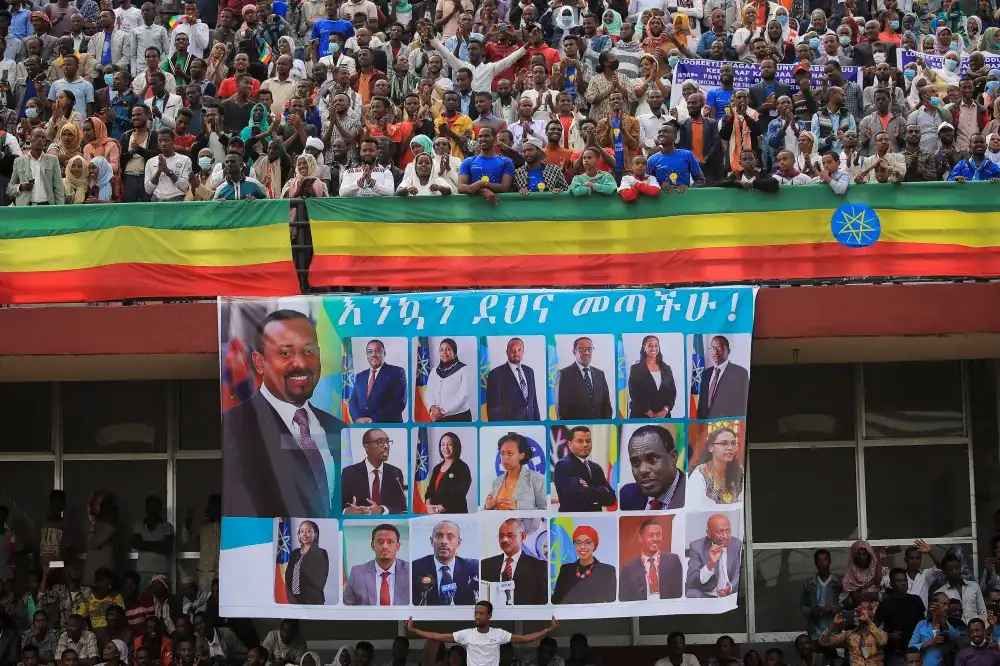
Supporters of Ethiopian Prime Minister Abiy Ahmed stand near a banner, as they attend his last campaign event ahead of Ethiopia’s parliamentary and regional elections scheduled for June 21, in Jimma, Ethiopia, June 16, 2021 (REUTERS/Tiksa Negeri)
By *Amaju Ubur Yalamoi Ayani
(Pachodo.org) - The quest for democratic legitimacy in South Sudan has long been defined by the “politics of delay”—a recursive cycle of missed deadlines, perpetual postponements, and a profound deficit of the political will required to break the transitional deadlock. As we look toward the December 2026 elections, the nation faces a definitive fork in the road: continue to wait for perfect conditions that may never materialize, or adopt a bracingly pragmatic, iterative approach to state-building. The Ethiopian 2021 election model, despite its inherent complexities and flaws, offers a vital blueprint for navigating the labyrinth of a fragile, post-conflict South Sudan.
A defining feature of Ethiopia’s 2021 general election was its embrace of phased voting. Confronted by active conflict in Tigray and formidable logistical hurdles across the hinterlands, the National Election Board of Ethiopia (NEBE) refused to let the national democratic project be held hostage by localized instability. Instead, it proceeded with polls in 436 constituencies during an initial round, strategically deferring others (47 constituencies) to a second phase months later. This staggered methodology acknowledged physical and political realities, rejecting the “all-or-nothing” fallacy that has paralyzed South Sudanese progress.
Central to this success was a comprehensive mapping strategy that designated over 49,000 polling stations. This was more than a technical feat; it was a masterclass in transparency. By explicitly mapping where voting was viable—and where it was not—the National Election Board of Ethiopia (NEBE) managed public expectations and provided a stable data set for political mobilization. This mapping allowed for the surgical allocation of resources, ensuring that ballot boxes and personnel reached the most remote corners of the Amhara and Oromia regions even amidst simmering tensions.
For South Sudan, where seasonal flooding and pervasive insecurity frequently isolate some states and counties, this model is far superior to a singular, fragile deadline. If conditions in states and counties of Equatoria or Bahr El Ghazal region are ready for the ballot, for example, there is no strategic reason they should wait for the resolution of every localized skirmish in other parts of the country. By holding elections in stages, the government can concentrate its scarce security and logistical assets, demonstrating the functionality of the democratic process in one region before scaling to the next.
Furthermore, a phased rollout mitigates the deadline fatigue currently afflicting the South Sudanese citizenry. When a single national date is set and subsequently missed, it erodes the foundational trust in the peace process. A mapped rollout allows for incremental successes that build cumulative momentum. It transforms the election from a high-stake, single-day gamble into a manageable administrative evolution that can eventually be extended into more volatile territories as conditions stabilize.
The security calculus: Transparency as a safeguard
Ethiopia’s 2021 model pioneered a structured approach to election security that South Sudan would be wise to emulate. The National Election Board of Ethiopia (NEBE) implemented a three-tier security classification system—categorized as Green (suitable), Yellow (proceed with caution), and Red (unfit)—to assess where voting could safely occur. This was not an opaque executive decree; it was a technical assessment shared with all stakeholders. By utilizing objective criteria, the board could justify the postponement of votes in over 110 constituencies without being reflexively dismissed as politically biased.
To operationalize this, a National Election Security Committee was established to integrate federal police and intelligence services. Their mandate was strictly custodial: providing security escorts for logistics and ensuring polling stations remained neutral sanctuaries. This committee operated under a stringent code of conduct that explicitly prohibited security personnel from influencing voters or projecting partisan affiliation. This visible security shield was instrumental in bolstering voter turnout in otherwise contested areas.
In South Sudan, where a large portion of the Necessary Unified Forces remains largely unintegrated and the line between political and military power is often indistinguishable, this model offers a path toward professionalization. By establishing a dedicated security committee with a transparent mandate, South Sudan can move away from a reality where security forces are viewed as an extension of the incumbent’s reach. Clear security labeling of states, administrative areas and counties would provide the National Elections Commission (NEC) with a defensive bulwark against accusations of disenfranchisement; if an area is deemed “Red,” the metrics are public and the pathway to “Yellow” is defined.
Moreover, the Ethiopian experience underscored that security should serve as a prerequisite for the ballot, not a pretext for its cancellation. Even in Yellow zones, the NEBE collaborated with local peace committees to establish safe corridors for voters. South Sudan could mirror this by involving traditional chiefs and local elders in the security mapping process. By making security criteria transparent and collaborative, the state, administrative area or county could transform security concerns from a tool of political obstruction into a technical challenge to be solved through community partnership and professional policing.
Decoupling the ballot from the bureaucracy
Ethiopia managed to register over 37 million voters to hold its first multi-party election in years despite the absence of a perfect demographic snapshot. The Ethiopian model proceeded on the conviction that the right to vote is an inherent civil liberty that cannot be suspended indefinitely while waiting for administrative perfection. They utilized existing data and vigorous registration drives to create a voter-based map rather than a census-based one.
South Sudan has frequently invoked the lack of a national census as a primary justification for delay. While a census is vital for long-term development, using its absence to block an election becomes a tactical stall. South Sudan’s recent decision to rely on 2010 constituency boundaries is a commendable, pragmatic step. It acknowledges that an imperfect boundary is infinitely better than a silent ballot, provided that the registration process is inclusive and transparent.
This decoupling also allows the political process to move forward while the gears of technical data gathering turn in the background. In Ethiopia, the election itself functioned as a surrogate census, identifying where populations were actually settled and what their immediate needs were. South Sudan should view the 2026 election as a massive data-acquisition exercise that will eventually inform the next formal census, rather than waiting for a census that may be impossible to conduct in the current security climate.
This shift from pre-conditions to process is what South Sudan requires most. By decoupling the vote from the census, the government removes the primary excuse for perpetual extensions. It shifts the burden of proof from the state bureaucracy (to count everyone) to the citizenry (to register themselves), empowering the individual and the political parties to demonstrate their own viability at the ballot box.
Independent oversight and community validation
The credibility of the 2021 Ethiopian model rested heavily upon the perceived independence of the National Election Board of Ethiopia (NEBE). Under the leadership of former opposition figure Birtukan Mideksa, the board demonstrated that a technical body could operate autonomously from the executive. This independence allowed the board to reject candidate lists and delay votes based on logistical failures rather than political whims. For South Sudan’s National Elections Commission (NEC), which is struggling with a significant trust deficit, institutional autonomy is not a luxury—it is a requirement for national survival.
Ethiopia also solved the problem of unregistered citizens through local community validation. Recognizing that millions of displaced persons lacked formal identity documents, the NEBE permitted voters to register via the sworn testimony of three local elders. This utilized existing indigenous social structures to solve a high-tech administrative problem. In South Sudan, where war has scattered millions of ordinary folks and destroyed civil registries, relying on traditional social capital is the only alternative to ensure the ballot remains inclusive and representative.
Furthermore, the model institutionalized oversight through local community observers. For instance, each polling station required a group of five local residents to observe and validate the tally. This decentralized the burden of integrity from international missions—who cannot be everywhere—to the local population, who have the greatest stake in the outcome. This bottom-up accountability creates a layer of legitimacy that high-level political agreements often lack.
By adopting these validation and oversight mechanisms, South Sudan can bypass the paralyzing costs of modern biometric systems. The NEC should empower local committees to verify identities using traditional methods. This approach not only makes the 2026 elections technically feasible but also rebuilds the social contract by giving local leaders a formal, recognized role in the birth of the nation’s democratic institutions.
Forging national interests over sectional rivalries
The 2021 Ethiopian model was characterized by a concerted push toward national political consolidation. The formation of the Prosperity Party—a merger of diverse ethnic-based parties—aimed to pivot the political discourse away from narrow ethnic grievances toward national policy. While this consolidation remains a flashpoint of debate, the underlying logic is essential for any multi-ethnic state: a stable democracy requires parties that can garner support across different regions and identities.
For South Sudan, where political parties are often viewed as proxies for ethnic militias, the Ethiopian model suggests a need for electoral laws that reward broad-based coalitions. The current system incentivizes leaders to activate ethnic loyalty to secure their base. By adopting rules that require parties to demonstrate support in a minimum number of states or from diverse ethnic cohorts—paralleling the NEC’s stringent registration requirements—South Sudan can begin to sanitize its political landscape of purely tribal zero-sum games.
This institutionalization also involves a shift from personalities to platforms. In Ethiopia, the 2021 cycle saw an increased emphasis on national economic and infrastructure agendas. South Sudan requires a similar transition. An election model that mandates the submission of national manifestos and encourages public debates can help migrate the country from a state of permanent armed peace toward a culture of competitive politics.
Finally, this national focus provides a vital exit ramp for the current transitional leadership. By building robust national institutions, the focus shifts from the individuals at the apex of power to the structure of the state itself. The Ethiopian experience demonstrates that while the path is fraught with difficulty, the act of attempting to build a national political identity through the ballot box is the only sustainable way to eventually transcend ethnic rivalries and move toward a unified, sovereign state.
The audacity of the ballot
While no electoral model is without its shortcomings, Ethiopia’s 2021 process obviously demonstrated that credible elections can be conducted even in the face of existential threats. The boycotts and security gaps encountered in Ethiopia serve as a reminder that democracy is an iterative process requiring constant refinement. For South Sudan, the Ethiopian experience provides a roadmap for exercising the fundamental right to choose leadership through a process that is technically sound, locally validated, and transparently secured.
The people of South Sudan are fatigued by years of transition and are ready to claim their stake in the future. Adopting these pragmatic measures—from phased voting to community-based validation—could finally allow the nation to move beyond transitional deadlocks. It is time to stop searching for the perfect moment and start building a legitimate government through the courage of the ballot.
About the writer

*Amaju Ubur Yalamoi Ayani, aka Amaju Joseph Ubur Ayani, is a teacher, researcher and political analyst. He holds a Master of Arts in International Relations, B.Sc in Political Science, and a Diploma in Civics. He is a regular opinion contributor to national and international media outlets, particularly for Pachodo.org, and can be reached via
Newer articles:
- Beyond Bilateralism - What the Recent China-U.S. Meeting Means to the World - 18/05/2026 12:15
- HRA Calls on Libya to Release Sudanese Nationals Held in Arbitrary Detention - 18/05/2026 12:09
- US–China Summit: A strategic moment for stabilizing bilateral relations - 15/05/2026 15:35
- From Dialectical Materialism to Peripheral Liberation: A Comparative Analysis of the New Sudan Vision and Marxism - 11/05/2026 20:27
- Iran Conflict: Geoeconomics, Fragmentation, and the possible trajectories - 11/05/2026 20:09
Older news items
- A Road to China: Can South Sudan Leverage Beijing’s 100 Percent Tariff Offer? - 06/05/2026 19:56
- The Iran–U.S./Israel Conflict One Month After Its Outbreak: The Logic of Controlled Escalation and Systemic Risk - 06/05/2026 19:53
- In Revolution; Don't Fear The State, But Betrayers - 04/05/2026 15:28
- Not All Revolutionary Leaders Want To Save And Serve South Sudan - 04/05/2026 15:25
- When Education Fails… the State Fractures: Why South Sudan’s Reform Must Begin with the Curriculum (2-2) - 01/05/2026 14:47
Latest news items (all categories):
- China’s new Long March: Why its modernization is a demanding journey - 21/10/2026 12:31
- Drone attack in disputed Sudan-South Sudan border region kills at least 153 - 21/10/2026 12:17
- South Korea - 'Smart camp' system built at Hanbit Unit in South Sudan - 21/10/2026 12:09
- Sudanese refugees in Gorom camp, South Sudan, struggle for water, medicines, security - 21/10/2026 12:05
- South Sudan: A Testing Ground For Democracy While Citizens Struggle To Survive - 19/10/2026 14:31
See also (all categories):
Random articles (all categories):
- South Sudan's reclusive Arab nomads - 29/01/2015 09:32
- South Sudan army says advancing on last rebel stronghold - 13/01/2014 10:15
- ‘Peace agreement fueling violence in South Sudan’- UN experts - 11/05/2022 00:20
- South Sudan Residents Protest Oil Facilities - 27/08/2020 20:30
- Sudan, South Sudan break off talks, no deal in sight - Reuters - 08/06/2012 03:52
Popular articles:
- The Final Communique of SPLM-DC Third Session of the National Council - 29/03/2011 01:00 - Read 83320 times
- Roles and Definition of Political Parties - 29/04/2011 01:00 - Read 65086 times
- Agriculture in Southern Sudan: Challenges and Investment Opportunities - 06/10/2010 01:45 - Read 57800 times
- Fashoda Youth Forum Rehabilitation of Drainage Culverts in Malakal town Report - 07/08/2008 16:22 - Read 36081 times
- Creation and establishment of the Local Government Councils ( Counties ) (2) - 28/09/2011 01:00 - Read 33960 times
