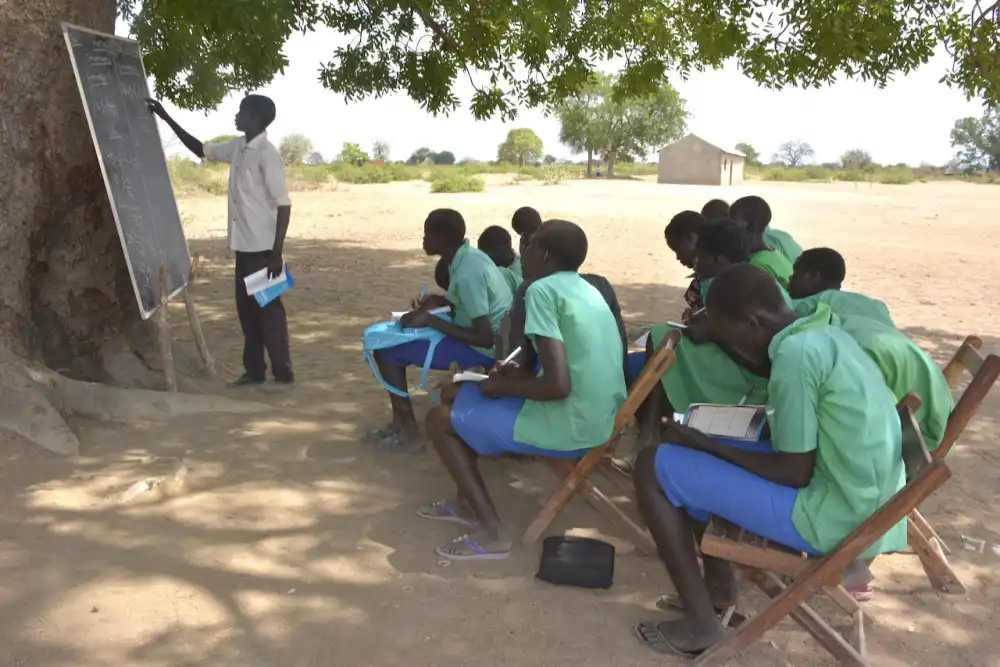
(Photo Credit: World Vision South Sudan)
Opinion by: James Lwany - April 2026
(Pachodo.org) - If the flaw in the curriculum is the initial spark, then neglecting the rest of the system turns that spark into a sustained trajectory of decay—one that no piecemeal remedy can contain. The issue is no longer confined to what is written in textbooks, but to whether the education system can translate reformist visions into daily practice inside classrooms. At this level, the debate moves beyond content to structural integrity: does the state possess an educational apparatus capable of carrying a national project, or has the gap between rhetoric and reality become the governing norm?
Reality, in its starkness, leaves little room for indulgent interpretation. Even the most coherent frameworks collapse upon contact with a system that lacks the conditions for execution. The crisis begins with the teacher—and does not end there. This is not merely a question of numbers, but of fragile training, absent stability, and eroding status. In many schools, education is entrusted to individuals who were never adequately prepared for the profession, or who entered it out of necessity rather than conviction. When the task of shaping minds rests on such a precarious foundation, the outcome is not temporary weakness but a cumulative defect that hardens into structural failure.
This is a profession stripped of its essential conditions. Meagre and irregular salaries fail to provide even the most basic stability, let alone the professional dignity the role demands. In such an environment, the exodus of talent is not an exception—it is an inevitability. Capable educators leave quietly, creating a vacuum that widens year after year until education itself is reduced to an activity without a backbone. With every departure, the system loses not just a teacher, but experience, continuity, and the possibility of building a durable professional ethos.
This haemorrhage coincides with a marked decline in enrolment in teacher training institutions, which should serve as engines of renewal. These colleges are no longer aspirational destinations but marginal options. Weak incentives, declining social standing, and the absence of a clear professional pathway produce a self-reinforcing cycle: diminished appeal leads to lower quality, lower quality deepens mistrust, and mistrust accelerates disengagement.
Nor does the crisis stop at the human element. The physical infrastructure of education reveals the limits of the state’s capacity to manage the sector. Schools lacking basic facilities, crumbling classrooms, acute shortages of textbooks and learning materials, and overcrowding that strips education of meaning—these are not peripheral deficiencies; they are defining conditions. In such settings, learning ceases to be a structured process and becomes a daily struggle to maintain the bare minimum. The message absorbed by students—whether stated or not—is unmistakable: education is not a priority.
In this context, talk of curriculum reform without addressing material conditions becomes an exercise in abstraction. Content, however refined, remains inert without a system capable of delivering it. The real challenge lies not in drafting better texts, but in building a system able to carry and activate them.
What further complicates the landscape is the nature of the economy within which this system operates. Heavy reliance on oil has not merely distorted resource distribution; it has reordered the state’s priorities. In a rent-based economy, resources gravitate toward sectors that yield immediate, visible returns, while education—by definition a long-term investment—is relegated to the margins. This is not incidental neglect, but the logic of an economic model that privileges the immediate over the strategic.
From this vantage point, a pressing question emerges: why is there no fixed and protected allocation of oil revenues for education? How can substantial resources be channelled into physical infrastructure while the human foundation is left to erode? Earmarking a defined share of oil income for education—enshrined institutionally and shielded from political volatility—is not merely a fiscal measure; it is a declaration of a different state philosophy. It marks a shift from consuming resources to investing in people. International experience in resource-dependent countries is unequivocal: the decisive difference between fragility and resilience lies in converting resource rents into human capital. Without such a shift, education will remain a residual expenditure rather than a central investment.
The imbalance is further deepened by stark regional disparities in resource allocation. While some areas receive minimal services, others exist in near-total educational voids. This disparity does more than produce unequal learning outcomes; it entrenches a sense of marginalization that extends far beyond the classroom. A student in a deprived setting does not simply feel academically disadvantaged, but structurally excluded from the state itself. Over time, this perception transforms educational inequality into a deeper fracture in identity and belonging.
Layered atop these challenges is a particularly acute issue: the language of instruction. The shift in teaching language, undertaken without adequate preparation of teachers, has created a profound disconnect between curriculum and delivery. A significant number of educators come from Arabic-language backgrounds, yet are required to teach in a language for which they have received little or no professional training. This is not a technical inconvenience; it strikes at the core of comprehension. A teacher without command of the instructional language cannot effectively transmit knowledge, and the student receives content that fails to take root. The result is a dual distortion—of method and outcome alike.
At the heart of these interlocking crises lies a political dimension that cannot be ignored. The education system does not operate in a vacuum; it is shaped by the broader logic of power. When appointments, scholarships, and promotions are governed by non-meritocratic criteria, the system forfeits its moral legitimacy. Education ceases to be a pathway to fairness and becomes an extension of patronage. In this environment, a dangerous consciousness takes hold: success is no longer tied to competence, but to position. Such a shift undermines the very foundation of a modern state.
These elements, though varied in form, converge along a single trajectory: a system marked by flawed vision, weak execution, and distorted priorities. At the end of this trajectory stands the student—not as a beneficiary, but as the product of a system that has never been fully constructed.
Yet acknowledging the scale of the crisis does not necessitate surrender. An exit remains possible, but it demands a shift in thinking before any policy intervention. The starting point is to redefine education as a sovereign, long-term investment rather than a secondary budget line. This requires a deliberate reallocation of resources, ensuring that education receives a stable, protected share of oil revenues. No education system can achieve stability on volatile funding.
In parallel, the teaching profession must be rebuilt from the ground up. Improving salaries is not a peripheral matter; it is a foundational condition for restoring the profession and reclaiming talent. This must be accompanied by the establishment of a clear professional pathway, grounded in continuous training, fair evaluation, and structured advancement.
Addressing the language crisis demands a comprehensive national program to retrain teachers, aligning linguistic proficiency with pedagogical competence. A curriculum cannot succeed if it remains trapped in a language its instructors do not master. At the same time, serious investment in infrastructure is essential—not merely to construct schools, but to create environments that reflect the value the state assigns to education.
Equally critical is the restoration of fairness within the system. Opportunities—from employment to scholarships—must be governed by merit, not affiliation. This single shift has the potential to rebuild trust not only in education, but in the state itself.
Finally, reform requires insulating education from short-term political fluctuations. Education is, by nature, cumulative; it cannot be managed through ad hoc decisions. It demands institutions capable of safeguarding policy continuity and ensuring long-term coherence.
Ultimately, the issue is not the reform of a sector, but the reconstruction of a pillar of the state. The school is not merely a site of learning; it is the first arena in which the citizen encounters the state. If that encounter is fractured, the damage extends beyond education to the very idea of belonging.
This leads to a question that admits no ambiguity: can a state rebuild itself without rebuilding its education system? The answer, borne out by experience, is unequivocal. When education fails, it is not only society that weakens—the state itself begins to fracture.
When Education Fails… The State Fractures: Why Reform in South Sudan Must Begin with the Curriculum (1-2)
Newer articles:
- Adopting Ethiopia’s 2021 electoral model can help end the transition in South Sudan - 06/05/2026 20:00
- A Road to China: Can South Sudan Leverage Beijing’s 100 Percent Tariff Offer? - 06/05/2026 19:56
- The Iran–U.S./Israel Conflict One Month After Its Outbreak: The Logic of Controlled Escalation and Systemic Risk - 06/05/2026 19:53
- In Revolution; Don't Fear The State, But Betrayers - 04/05/2026 15:28
- Not All Revolutionary Leaders Want To Save And Serve South Sudan - 04/05/2026 15:25
Older news items
- Revolution Starts With Your Voice - 27/04/2026 15:08
- When Education Fails… The State Fractures: Why Reform in South Sudan Must Begin with the Curriculum (1-2) - 27/04/2026 15:05
- Research: Dr. J. Scott Younger: Global Disorder and the Unravelling of Strategic Certainties: ‘Where Next, and What Next?’ - 27/04/2026 15:02
- Holding the Banner of True Friendship: The China-South Sudan Partnership for a Shared Prosperity - 24/04/2026 20:42
- Rescuing The Cry Of The Text: Why The African Church Needs Expository Preaching - 24/04/2026 19:29
Latest news items (all categories):
- Beyond the SPLM Primaries: What Young Lawmakers Must Deliver in 2027 - 23/11/2026 15:04
- Research ● Bogoljub J. Karić: Never again media darkness: Time for a new European Charter on the Economic and Professional Rights of Journalists - 23/11/2026 14:59
- 24 civilians, including children and women, killed in South Sudan - 23/11/2026 14:53
- MSF suspends all activities in Yei River county following abduction - 23/11/2026 14:48
- African leaders seek lasting peace - 23/11/2026 14:46
See also (all categories):
Random articles (all categories):
- Expected Results from SPLM’s 2nd Convention - 09/05/2008 17:45
- UN camp in South Sudan: 'There were far too many little bodies in that morgue' - 02/10/2015 05:17
- South Sudan bans 20 foreign journalists - 08/06/2017 08:19
- New bat genus earns its stripes in South Sudan - New Scientist (blog) - 11/04/2013 09:57
- South Sudan Elections: You’ll be rejected – Primate Ayodele tells President of South Sudan - 17/12/2022 06:54
Popular articles:
- The Final Communique of SPLM-DC Third Session of the National Council - 29/03/2011 01:00 - Read 83500 times
- Roles and Definition of Political Parties - 29/04/2011 01:00 - Read 65338 times
- Agriculture in Southern Sudan: Challenges and Investment Opportunities - 06/10/2010 01:45 - Read 58098 times
- Fashoda Youth Forum Rehabilitation of Drainage Culverts in Malakal town Report - 07/08/2008 16:22 - Read 36258 times
- Creation and establishment of the Local Government Councils ( Counties ) (2) - 28/09/2011 01:00 - Read 34271 times