
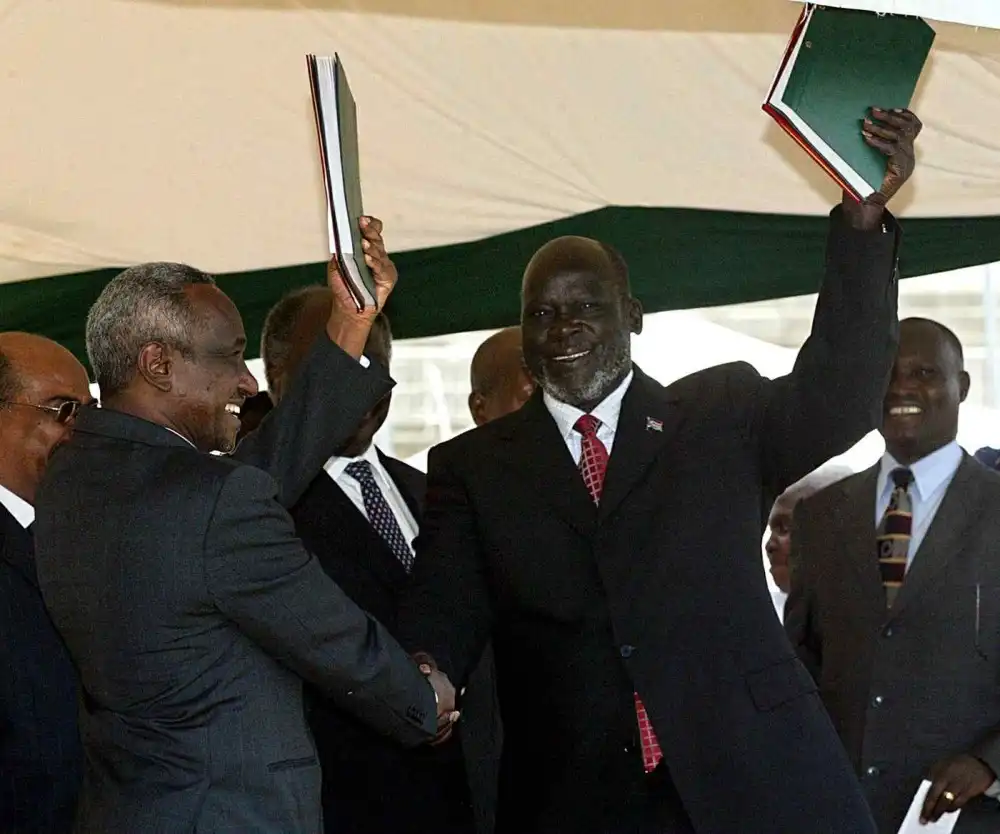
 Late Dr. John Garang (Right) and Ali Osman Taha during the signing of the Juba Peace Agreement (January 2005 | AFP)
By *Amaju Ubur Yalamoi Ayani
(Pachodo.org) - This article explores the profound ideological intersection between Dr. John Garang de Mabior’s New Sudan Vision (NSV) and the foundational tenets of Marxism. While the Sudan People’s Liberation Movement/Army (SPLM/A) emerged within a Cold War geopolitical context that necessitated certain socialist rhetorical flourishes, the intellectual relationship between these two theoretical frameworks is deeply rooted in a shared commitment to radical structural transformation. This masterpiece examines their commonalities in dialectical materialism, social diagnosis, and the vanguard model, while simultaneously highlighting their significant divergences regarding nationalism, private property, and the ultimate teleology of the post-revolutionary state. To these days, these ideologies continue to influence the struggle for civilian rule not only in Sudan but also in the Republic of South Sudan.
In the broader discourse of African political thought, Dr. John Garang’s New Sudan Vision (NVS) stands as one of the most intellectually ambitious theories of state-reconstruction in the post-colonial era. Evolved in 1983 amid the outbreak of the Second Sudanese Civil War, the New Sudan Vision was often dismissively categorized by the hegemonic establishment in Khartoum as a mere façade for Southern resentment. Similarly, many Western observers by then reduced it to a relic of Cold War socialist posturing, influenced by the Movement’s early relationship with the Derg government in Ethiopia.
However, an all-sided analysis reveals that the New Sudan Vision is far more than a tactical alignment. It is a sophisticated ideology designed to restructure the “Old Sudan” enterprise into a pluralistic, democratic and secular state, making its core precept of not just about statehood, but about the forging of nationhood. It is an ideology that fundamentally repudiates governance predicated on sectarianism, tribalism, or religious exclusivity. It champions inclusivity, diversity, restorative justice, and the equitable distribution of wealth and power. This ideology directly counters the issues of marginalization and political exclusion that have historically served as the tinder for conflict within the country. By postulating a civic state where all citizens are granted parity regardless of their ethnic origins, it offers a pragmatic blueprint for managing the multi-ethnic South Sudan—a nation comprising dozens of distinct cultural groups.
When juxtaposed with Marxism, the New Sudan Vision theory reveals a profound intellectual lineage rooted in the Hegelian-Marxist tradition. It represents a localized, praxis-oriented adaptation of structural analysis to the specific historical-material conditions of the Sudans.
As I appraise these ideologies comparatively, it is evident that both seek to resolve systemic exploitation through the dismantling of entrenched power structures at the centre, yet they provide vastly different answers to the questions of national identity, property ownership, and the ultimate teleology of the post-revolutionary state. As an architect of the New Sudan, Dr. Garang's foresight extended far beyond political liberation to a detailed economic strategy that fundamentally prioritized sustainable development over ephemeral gains. Central to his thinking was a strategic approach to South Sudan’s natural resources, often encapsulated in the poignant slogan: “Use the oil revenues to fuel agriculture.” He explicitly warned against the perils of becoming a rentier state, presciently predicting that a heavy reliance on oil windfalls without a diversified economic foundation would breed systemic corruption, economic inertia, and sovereign indebtedness.
Dialectical Materialism
Central to the relationship between Marxism and the New Sudan Vision is the Hegelian dialectics—a triadic process of development wherein a thesis (an initial state) generates its own antithesis (a contradictory force), ultimately resolving into a synthesis (a higher state of being that sublets both while preserving their essential truths). Definitionally, dialectical thought refers to the study of things in their relations and in process of development and change. For example, it is dialectical to identify distinct characteristics of a thing in a new form of relations, thereby adapting one’s form of thought to the new system which reality has taken. Dialectics, therefore, is not an abstract system of logic which human beings are asked to accept, it is necessary because the nature of the world necessitates it. To Hegel, there are no fixed properties in concrete world, therefore, there should be no fixed concepts in science. Since fixed concepts, for example, are nonexistent in science, there are no final scientific laws. For this reason, our thoughts must circumvent dogmatic finality.
Karl Marx famously inverted the Hegelian dialectic, stripping it of its idealistic “World Spirit” and grounding it in the physical world. This Dialectical Materialism posits that history is not driven by the evolution of abstract ideas, but by the clash of material forces and the objective contradictions within the mode of production.
As an economist by training, Dr. John Garang utilized this dialectical framework to diagnose Sudan’s terminal contradictory forces. In the concept of New Sudan Vision, the “Thesis” is termed as the “Old Sudan,” characterized by a monolithic Arab-Islamic identity imposed by the Khartoum center. This “Thesis” sought to define the Sudanese State in a singular-Arab identity as it was determined to exclude its inherent diversity. Hence, the Antithesis became the marginalized peripheries—encompassing Southern Sudan, the Nuba Mountains, Darfur, and the Blue Nile—arising in an inevitable resistance to their exclusion from the material and cultural life of the state. The Synthesis they hoped to established was the “New Sudan.” To John Garang, the synthesis was initially not the disintegration of the country or the secession of the South, but the rebirth of a state that could integrate both identities into a new, inclusive “Sudanism.” Unlike traditional Marxists who envision the dialectic terminating in a classless, stateless society, Garang’s synthesis was a secular, democratic state where material resource parity could serve as the primary equalizer.
Comparative Structural Analysis
- The Center-Periphery Dialectic
Marxism identifies the nexus of power as the bourgeoisie, who extract surplus value from the proletariat. Garang translated this economic binary into a spatial and cultural dialectic. In the New Sudan Vision, the center was the “Old Sudan” establishment—a narrow elite maintaining hegemony through the monopolization of state power and the central treasury. The periphery was the vast majority of the population kept in a state of underdevelopment. Both theories prioritize radical structuralism over mere reformism, emphasizing that the state is an instrument of asymmetric domination that must be fundamentally reconstituted rather than simply handed to new managers.
- The Agrarian Question and Materialism
Both frameworks are materialist, asserting that the physical realities of land and resources constitute the base of social organization. Marx’s Agrarian Question focuses on liberating the peasantry from feudal remnants. Garang addressed this through a policy of decentralized development, famously summarized as “taking the towns to the people.” This was a strategy to reverse the internal colonialism of the Khartoum centre. By advocating for the use of oil royalties to bolster rural agriculture and local infrastructure, Garang mirrored the Marxist objective of abolishing the rural-urban divide. In both systems, the goal is to end the alienation of the labourer from the land.
- Secularism as a Tool of De-alienation
Marxism views religion as an ideological state apparatus used by the ruling class to pacify the oppressed—the “opium of the people.” While the New Sudan Vision was not inherently atheistic, it maintained a commitment to radical secularism as a functional tool of de-alienation. In the Sudanese context, the imposition of Sharia law was the specific mechanism used by the “Old Sudan” to enforce cultural homogenization (Arabization) and exclude non-conforming citizens from the social contract.
A core principle of the New Sudan is the separation of state and religion to guarantee freedom of belief, worship, and practice for all citizens. This was a direct response to the imposition of religious law that triggered the longest civil war in Africa (1983-2005). Creating an environment where different communities can coexist peacefully is a vital part of this principle.
While South Sudan is a secular state, this principle remains important for managing internal religious diversity and preventing sectarian conflict. It ensures that all citizens feel included and that religious communities can coexist peacefully without state interference or preference. For both frameworks, the separation of state and religion is a pragmatic requirement for political parity, ensuring the individual is not marginalized by the state based on private belief systems.
The Vanguard Model and Revolutionary Mobilization
Both Marxism and the New Sudan Vision rely on the concept of the vanguard. In Marxist-Leninist thought, the vanguard party consists of the most class-conscious elements of the proletariat who lead the masses toward revolution. The SPLM/A operated under a remarkably similar model. Dr. Garang was known for his rigorous “Political Schools,” where recruits were taught that their struggle was not against “Arabs” as a race, but against the systemic structure of the Old Sudan. This attempt to build a "New Sudan consciousness" reflects the Marxist attempt to build a "class consciousness" that transcends parochial or tribal identities.
The Great Divergence
Despite these shared foundations, these ideologies diverge on their ultimate teleology (final purpose). While they have commonalities in dialectical materialism, social diagnosis, and the vanguard model, they significantly diverge regarding nationalism, private property, and the ultimate teleology of the post-revolutionary state.
First, on the question of nationalism. Marxism is inherently internationalist, viewing the nation-state as a temporary bourgeois construct that will eventually wither away. In contrast, Garang embraced Sudanism as a final destination. The New Sudan Vision was a project of nation-building, not nation-dissolution. Garang believed the state was the necessary instrument to protect the marginalized.
On the question of property, Marxism advocates for the total abolition of private property and the centralization of the means of production. The New Sudan Vision, however, sought a mixed economy. It aimed to protect customary land rights and ensure the equitable distribution of wealth (specifically oil and water) without necessarily dismantling the market mechanism or private enterprise.
While Marxist revolution often entails a forcible overthrow to end class antagonisms, the New Sudan Vision—as codified in the 2005 Comprehensive Peace Agreement (CPA)—evolved into a negotiated restructuring. Garang believed the Old Sudan could be transformed through constitutional reform, referendums, and power-sharing.
The Contemporary Perspective
As of today, the legacy of these theories remains at a critical juncture in both the Republic of Sudan and the Republic of South Sudan. In South Sudan, the New Sudan Vision is often viewed through the lens of betrayal. Critics contend that the current governing elite in Juba has replicated the extractive institutions and center-periphery dynamics of the old Khartoum system, effectively becoming a new “Old Sudan.” The revolutionary vanguard has, in many ways, transformed into a comprador class, prioritizing resource extraction over the taking the towns to the people philosophy.
Conversely, in the Republic of Sudan, the Rapid Support Force (RSF) and various pro-democracy movements continue to employ class-based analysis and dialectical thinking. Their demands for a “Civilian State” and a radical break with military-Islamist rule echo Garang’s insistence that sustainable peace requires a fundamental reconstitution of the state. The Marxist influence remains visible in the grassroots organization of these movements, which reject elite-led compromises in favor of structural overhaul.
Conclusion
The New Sudan Vision represents Marxism applied to the geography of marginalization. It utilized the intellectual tools of dialectical materialism to diagnose a state defined by racial, religious, and regional subordination. While Marxism provides the diagnostic tools for identifying the concentration of power and the mechanisms of exploitation, the New Sudan Vision remains the most enduring territorial blueprint for how a diverse, post-colonial society might achieve stability through pluralism and restorative justice.
Both ideologies agree on a fundamental truth: a state built on the exclusion of its own people cannot stand. To this end, the historical dialectic continues between the “Old Sudan” of centralized hegemony and the New Sudan of decentralized equality. Whether through the class struggle of Marxism or the peripheral liberation of the New Sudan Vision, the drive toward a more equitable social contract remains the defining engine of history in the Nile Valley.
About the author

* Amaju Ubur Yalamoi Ayani, aka Amaju Joseph Ubur Ayani, is a teacher, researcher and political analyst. He can be reached via
Newer articles:
- Russian business leader on future China-Russia cooperation - 20/05/2026 14:22
- The Threat Of Mercy: Why The Carnal Mind Fights Against The Doctrine Of Grace - 20/05/2026 14:14
- Beyond Bilateralism - What the Recent China-U.S. Meeting Means to the World - 18/05/2026 12:15
- HRA Calls on Libya to Release Sudanese Nationals Held in Arbitrary Detention - 18/05/2026 12:09
- US–China Summit: A strategic moment for stabilizing bilateral relations - 15/05/2026 15:35
Older news items
- Iran Conflict: Geoeconomics, Fragmentation, and the possible trajectories - 11/05/2026 20:09
- Adopting Ethiopia’s 2021 electoral model can help end the transition in South Sudan - 06/05/2026 20:00
- A Road to China: Can South Sudan Leverage Beijing’s 100 Percent Tariff Offer? - 06/05/2026 19:56
- The Iran–U.S./Israel Conflict One Month After Its Outbreak: The Logic of Controlled Escalation and Systemic Risk - 06/05/2026 19:53
- In Revolution; Don't Fear The State, But Betrayers - 04/05/2026 15:28
Latest news items (all categories):
- China’s new Long March: Why its modernization is a demanding journey - 21/10/2026 12:31
- Drone attack in disputed Sudan-South Sudan border region kills at least 153 - 21/10/2026 12:17
- South Korea - 'Smart camp' system built at Hanbit Unit in South Sudan - 21/10/2026 12:09
- Sudanese refugees in Gorom camp, South Sudan, struggle for water, medicines, security - 21/10/2026 12:05
- South Sudan: A Testing Ground For Democracy While Citizens Struggle To Survive - 19/10/2026 14:31
See also (all categories):
Random articles (all categories):
- Abyei residents vote on Sudan-Sudan choice - 27/10/2013 12:01
- ٢٦ قتيلا في أعمال عنف بمنطقة أبيي المتنازع بين السودان وجنوب السودان - 18/09/2026 13:26
- Timothy Tot's statement to SRS - 11/06/2011 01:00
- South Sudan: WFP Calls for Release of Abducted Staff Member - 17/10/2014 17:19
- China's peacekeeping mission in South Sudan - 01/12/2015 16:36
Popular articles:
- The Final Communique of SPLM-DC Third Session of the National Council - 29/03/2011 01:00 - Read 83329 times
- Roles and Definition of Political Parties - 29/04/2011 01:00 - Read 65094 times
- Agriculture in Southern Sudan: Challenges and Investment Opportunities - 06/10/2010 01:45 - Read 57810 times
- Fashoda Youth Forum Rehabilitation of Drainage Culverts in Malakal town Report - 07/08/2008 16:22 - Read 36090 times
- Creation and establishment of the Local Government Councils ( Counties ) (2) - 28/09/2011 01:00 - Read 33970 times
