
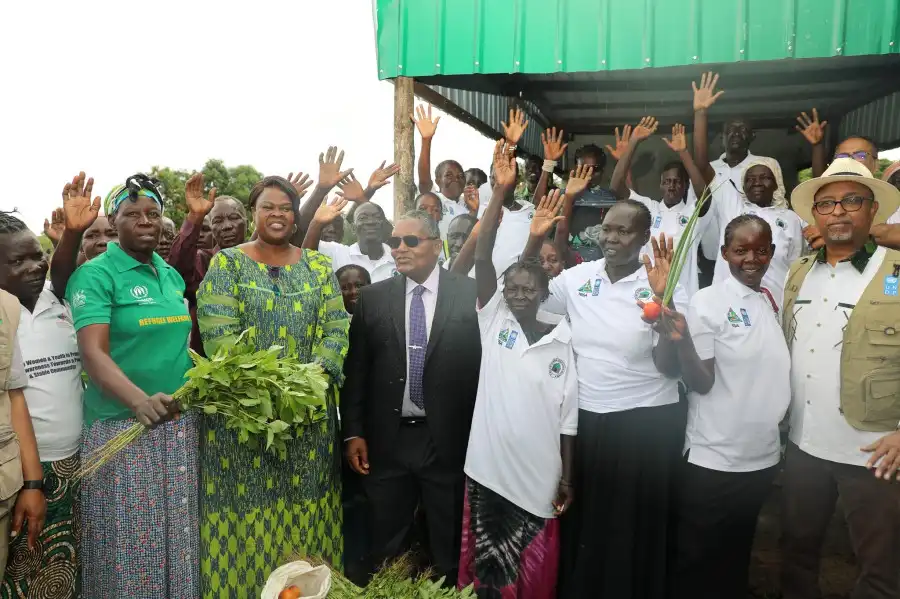
H.E. Ambassador Mahlodi Muofe of the Republic of South Africa, Dr. Mohamed Abchir, Resident Representative of UNDP, Hon. Elizabeth Pita Lugar, State Minister for Gender, Child and Social Welfare and the farmers at Ngongitajur vegetable group in Luri (Photo Credit: UNDP/Sarah Abraham)
A delegation from the Embassy of the Republic of South Africa in South Sudan, UNDP, Government of South Sudan, and Oxfam, through the IBSA Fund (India, Brazil, South Africa), concluded a high-level field mission to Kabo and Ngongitajur in Luri Payam to assess progress under the project “Empowering Women and Youth to Drive Sustainable Agriculture in South Sudan.”
Led by Ambassador Mahlodi Muofhe of the Embassy of the Republic of South Africa, Dr. Mohamed Abchir, Resident Representative UNDP, and the State Ministers of Agriculture and Fisheries, and Gender, Child, and Social Welfare. The visit showcased significant achievements in strengthening community resilience, enhancing food security, and expanding livelihood opportunities for women and young people, illustrating the power of South-South cooperation in supporting inclusive development and strengthening community-driven agriculture.
South Sudan has a total area of 2,400,368 square kilometers, yet only about 6% of its arable land is cultivated. Agricultural production and productivity account for only 15% of the GDP, and it employs 80% of the population. The sector remains poorly resourced. The microfinance sector is used to cushion the limited access to finance for producer groups and grassroots savings models such as the Village Savings and Loan Association (VSLA) or Village Savings Group (VSG). Other constraints include the use of rudimentary tools, poor crop planning, inadequate supply of clean, drought-tolerant, and quick-maturing crop varieties, poor pest and disease management, and poor harvest management practices, all of which threaten to keep the communities more vulnerable amid the worsening effects of climate change.
Implemented by UNDP in partnership with the State Ministry of Gender, Child, and Social Welfare, State Ministry of Agriculture, and Oxfam South Sudan, the project supports women and youth through tailored agricultural training, access to climate smart farming techniques and tools, livelihood inputs, and capacity-building for agribusiness development. During the mission, the delegation met beneficiaries whose stories reflected transformation and renewed self-reliance. At Ngongitajur vegetable group, women farmers demonstrated improved techniques in vegetable cultivation, irrigation management, and organic pest control. Youth groups also presented their progress in crop production, nursery management, and small-scale value addition.
 H.E. Ambassador Mahlodi Muofe of the Republic of South Africa with the farmers showcasing their bountiful produce ready for the market (UNDP/Sarah Abraham)
Madelina Joseph, one of the beneficiaries and a member of the group, said that although the learning process was initially difficult, this initiative has helped them support their families and save money through their village savings and loans association. She added that the skills they gained have strengthened their confidence in managing their businesses more effectively. She also noted that the group has fostered a strong sense of unity, enabling members to support one another and plan for a more stable future.
“Although the learning process was difficult at the beginning, this initiative has transformed our lives. Today, we can support our families and save money through our Village Savings and Loans Association.” She spoke.
While at the Kabo vegetable group, Joyce Angaika, the chairperson, highlighted how this project lifted the women out of poverty and improved their livelihoods, and emphasized the need for continued support to empower more people.
 Yaba excitedly showing his successful harvest of tomatoes ready for the market (UNDP/Sarah Abraham)
“We are encouraged by the commitment, innovation, and leadership shown by the women and youth involved in this project; the youth and women are eager to engage in productive work. If we utilize our land resources effectively, we can enter the global market and sell our fresh produce”. said H.E. Advocate Mahlodi Muofhe.
The project is already showing a positive impact on the farmers and their communities. Beneficiaries shared how access to seeds, tools, and practical training has led to improved yields and diversified crops, enabling households to enhance nutrition and generate income. Women-led producer groups showcased their organized farming systems, savings groups, and local market linkages—demonstrating increased confidence, financial independence, and decision making capacity. Youth cooperatives presented innovative approaches, including climate-smart farming techniques and small-scale agribusiness ventures, inspiring more young people to see agriculture as a viable livelihood.
Local leaders highlighted that the project had reduced dependence on humanitarian aid by equipping communities with the knowledge and tools to sustain year-round food production. Hon. Lily Kapukie the State Minister of Agriculture, Forestry, and Environment, said that the Ministry of Agriculture was pleased with the project targeting youth and women, who are the backbone of their communities. The mission concluded with a renewed commitment from both IBSA and implementing partners to continue strengthening agricultural systems, fostering rural entrepreneurship, and ensuring that women and youth remain at the forefront of local development.
“This partnership underscores the importance of investing in communities, and particularly in women and youth, to drive long term food security. The progress seen today reflects the power of collaboration and the resilience of the people we serve,” said Dr. Mohamed Abchir, UNDP Resident Representative
The project also reinforces cooperation among the governments of South Sudan, South Africa, India, and Brazil through South-South Cooperation. The purpose of the Fund is to identify replicable and scalable projects that can be disseminated to interested developing countries as examples of good practices in the fight against poverty and hunger. The “Empowering Women and Youth to Drive Sustainable Agriculture in South Sudan project is aligned with the Government's policy priorities, as stipulated in the National Development Strategy and the Comprehensive Agriculture Master Plan (CAMP), its five development themes, and the Revitalized Agreement on the Resolution of the Conflict in South Sudan (R-ARCSS).
Newer articles:
- Kiir to Deliver National Address as SPLM Marks 43rd Anniversary - 15/05/2026 15:06
- CES Cabinet Approves Measures to Improve Orphanage Welfare and Health Services - 15/05/2026 14:39
- United States Increases Pressure on South Sudan Over Peace Delays - 15/05/2026 14:22
- Mass Deportations from Sudan Add Pressure on South Sudan’s Humanitarian Crisis - 15/05/2026 14:12
- More than 61 killed in South Kordofan tribal clashes, Sudan Doctors Network says - 15/05/2026 14:05
Older news items
- US Slaps South Sudan Officials with Visa Bans Over Peace Deal - 13/05/2026 12:30
- Juba County Cracks Down on Illegal Land Grabbing and Unauthorized Demarcation - 13/05/2026 12:26
- Strengthening South Sudan’s agricultural statistics through census preparation - 13/05/2026 12:20
- The enduring commitment of religious congregations to South Sudan’s recovery - 13/05/2026 12:15
- Tanzania, South Sudan asked to remove roadblocks for EAC traders - 13/05/2026 12:11
Latest news items (all categories):
- Op-Ed - Breaking the Double-Standard Lens on China's Population Shifts - 23/10/2026 14:23
- South Sudan ceasefire monitors warn of rising violence ahead of December elections - 23/10/2026 13:39
- UNMISS SRSG visits Malakal, emphasizes that peace begins with collective action - 23/10/2026 13:36
- How Technology is Accelerating South Sudan’s Next Oil Discovery - 23/10/2026 13:34
- South Sudan’s Patriot make case in their opener against Urunani - 23/10/2026 13:12
See also (all categories):
Random articles (all categories):
- Garang Achiec Bol Agiu Is A Monger And Debased Man - 12/10/2019 20:34
- Trade thriving at border town between Sudan and its conflict-affected neighbour as security improves - 29/11/2018 04:14
- Wildcat Petroleum shares climb following confirmation of Sudan deal - 17/10/2022 00:58
- Uganda: PM Nabbanja Named Among 100 Most Influential African Women - 07/11/2022 00:56
- Former Sudanese FM Survives Assassination Attempt - 23/03/2008 21:47
Popular articles:
- Who is the darkest person in the world, according to Guinness World Record? - 25/10/2022 02:34 - Read 151206 times
- School exam results in South Sudan show decline - 01/04/2012 17:58 - Read 28345 times
- Top 10 weakest currency exchange rates in Africa in 2023 - 19/07/2023 00:24 - Read 25443 times
- No oil in troubled waters - 25/03/2014 15:02 - Read 24662 times
- NDSU student from South Sudan receives scholarship - In-Forum - 29/09/2012 01:44 - Read 22635 times
